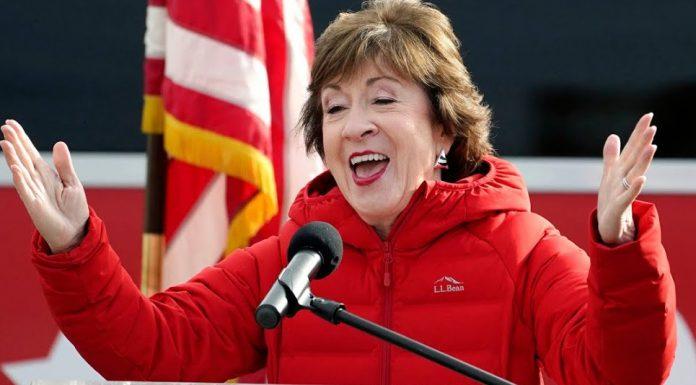
(Ben Sellers, Headline USA) President Donald Trump’s push to secure the nation’s elections through mandatory voter ID and other proof-of-citizenship safeguards drew a step closer last week with a key defection from his RINO opposition.
During a Thursday night voting spree, Sen. Susan Collins, R-Maine, said yes to passing the House version of the election-integrity bill known as the SAVE Act, giving the Republican-led measure the 50-vote majority it would need under budget-reconciliation procedures.
🚨 BREAKING OVERNIGHT: The SAVE America Act GOT 50 VOTES thanks to Sen. Susan Collins voting in favor of Mike Lee's amendment
THEY JUST PROVED IT CAN GET 51 VOTES, with JD Vance as a tie-breaker!
This version of the bill still contains voter ID and proof of citizenship 🔥
But… https://t.co/oqNHnuwk7z pic.twitter.com/vwzdlcIJyA
— Eric Daugherty (@EricLDaugh) June 5, 2026
However, because the Senate parliamentarian ruled it ineligible to be included in the reconciliation bill, it still failed to pass.
With Democrats universally opposed, the bill cannot clear the 60-vote threshold needed under normal Senate rules due to the longstanding filibuster tradition. Budget bills require only a simple majority, but the Budget Act’s “Byrd Rule” prevents items deemed non-budgetary from inclusion in them, unless the Senate votes to suspend the act altogether.
Collins opposed an earlier measure by Sen. Lindsey Graham, R-S.C., that would have added portions of the SAVE Act into an immigration funding bill, along with other items like federal restrictions on transgender athletes in women’s sports.
But after Sen. Mike Lee, R-Utah, took up the motion to use the cleaned-up House version of the SAVE Act, she symbolically shifted her position, signaling her provisional support for the election-integrity measures.
The SAVE Act continues to face opposition from three other RINO lawmakers: retiring Sens. Mitch McConnell of Kentucky and Thom Tillis of North Carolina, as well as Sen. Lisa Murkowski of Alaska. Meanwhile, Senate Majority Leader John Thune, R-S.D., has thrown up procedural hurdles to stymie its passage.
Opposition has proven politically costly for Republicans, with Texas Sen. John Cornyn’s recent primary loss having been, in large part, attributable to the Republican establishment’s refusal to take up the bill. Collins is currently trailing in polls to Democrat Graham Platner, an alleged Nazi apologist and rape enthusiast.
Meanwhile, California’s recent primary — which saw early leads by Republican gubernatorial candidate Steve Hilton and Los Angeles mayoral candidate Spencer Pratt eroded after the fact — has underscored the necessity of implementing federal voting reforms that would prevent blue states from simply continuing to count late mail-in ballots until they reach a favorable outcome.
Without Democrats’ support, Republicans have several other options to pass the SAVE Act, none of them ideal:
- Vote to end the filibuster. However, Collins has long opposed ending the filibuster and voted against doing so early in Trump’s first presidential term, meaning any attempt at a rules change likely could not get the simple Republican majority needed without added pressure.
- Force a talking filibuster. Thune has declared this a nonstarter due to the time required to allow Democrats (and other opponents) to voice their opposition on the floor, which would likely tie up the Senate through the summer. It nonetheless remains the most practical option under current Senate rules.
- Attach the SAVE Act to other must-pass legislation. An earlier proposal to add it to a bill renewing the Foreign Intelligence Surveillance Act’s controversial eavesdropping powers was disregarded. It is unclear what other pending legislation it might be added to before the November election that would compel Democrats to vote for it.
- Pressure the parliamentarian into including it in a budget bill. It is unlikely that Republicans will succeed in swaying Elizabeth MacDonough, a powerful but unelected official first appointed by Democrats in 2012. She has made controversial decisions in the past, often clearing the path for a Democrat agenda while blocking a GOP one. However, she did hold the line on Democrats’ 2021 “Inflation Reduction Act” monstrosity, during which they were unable to include measures like mass amnesty for illegal immigrants in a reconciliation bill. Thune has the power to fire MacDonough but is unlikely to do so.
Ben Sellers is a freelance writer and former editor of Headline USA. Follow him at x.com/realbensellers.