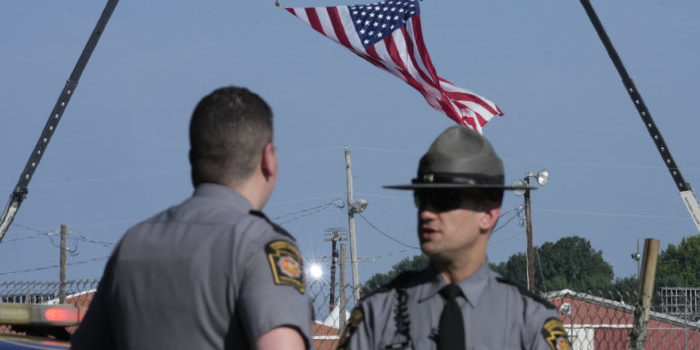
(Ken Silva, Headline USA) The Pennsylvania State Police refused to have its officers be interviewed for a federal investigation into the July 13, 2024, assassination attempt against Donald Trump, according to a new report from Homeland Security’s Office of the Inspector General.
In a report released last week, the DHS-OIG said it sought to interview PSP troopers about the assassination attempt, which took place at a Trump rally in Butler, Pennsylvania. But the PSP denied the interview requests, the report said.
“We did not interview state law enforcement officers; PSP denied our interview requests,” the report said. The PSP did provide written responses to the inspector general’s questions, the report added.
The PSP did not immediately respond to a media inquiry from Headline USA about why it refused to have its officers interviewed for the DHS-OIG investigation.
Much of the rest of the report details security failures that have already been widely publicized—including in this author’s book about the event, titled The Trump Assassination Plots: What the Investigations Missed, and Why it Matters.
Much of this new report seems to rehash what we already know, but here's an interesting footnote: The Pennsylvania State Police refused to be interviewed. The PSP has been perhaps the least transparent institution of them all when it comes to Butler—even more so than the FBI. https://t.co/O9SMeAwzI3 pic.twitter.com/ezWC8OBXRg
— Ken Silva (@JD_Cashless) July 2, 2026
The report detailed how the Secret Service missed some 102 radio communications from local police about the would-be assassin, Thomas Crooks. That’s because the Secret Service’s communications center was separate from the one operated by the locals.
The report also noted how officials inside the Secret Service comms center were Googling the location of the AGR complex—where Crooks shot from—at the time of the shooting. Additionally, the report noted that officials from Trump’s security team didn’t notify their local counterparts from Pittsburgh about intelligence that Iran was purportedly plotting to assassinate Trump.
Last week’s findings came on the heels of another DHS-OIG report, which revealed that some Secret Service text messages were “compromised” last year thanks to an unsecured third-party messaging app.
In that report, the DHS-OIG said that the Secret Service deployed a third-party messaging app on agency-owned devices in March 2025.
“A limited number of Secret Service messages were compromised when the messaging solution improperly stored them on unsecured third-party servers,” the DHS-OIG report says.
The Secret Service told the DHS-OIG that the compromised messages contained employees’ information—but not “operationally sensitive data.” However, the DHS inspector general said he did not review the accuracy of the Secret Service’s claim.
The DHS-OIG study was launched after President Donald Trump was nearly assassinated at his July 13, 2024, campaign rally in Butler, Pennsylvania. The inspector general has also reviewed other elements of the agency, including how its snipers are trained. In that review, the DHS-OIG found that they’re overworked and not properly qualified.
The inspector general was reportedly being blocked from conducting some of this review. DHS Inspector General Joseph Cuffari told Congress in March that he’s being blocked from investigating the agency’s intelligence-sharing ahead of the Butler rally.
Ken Silva is the editor of Headline USA. Follow him at x.com/jd_cashless.