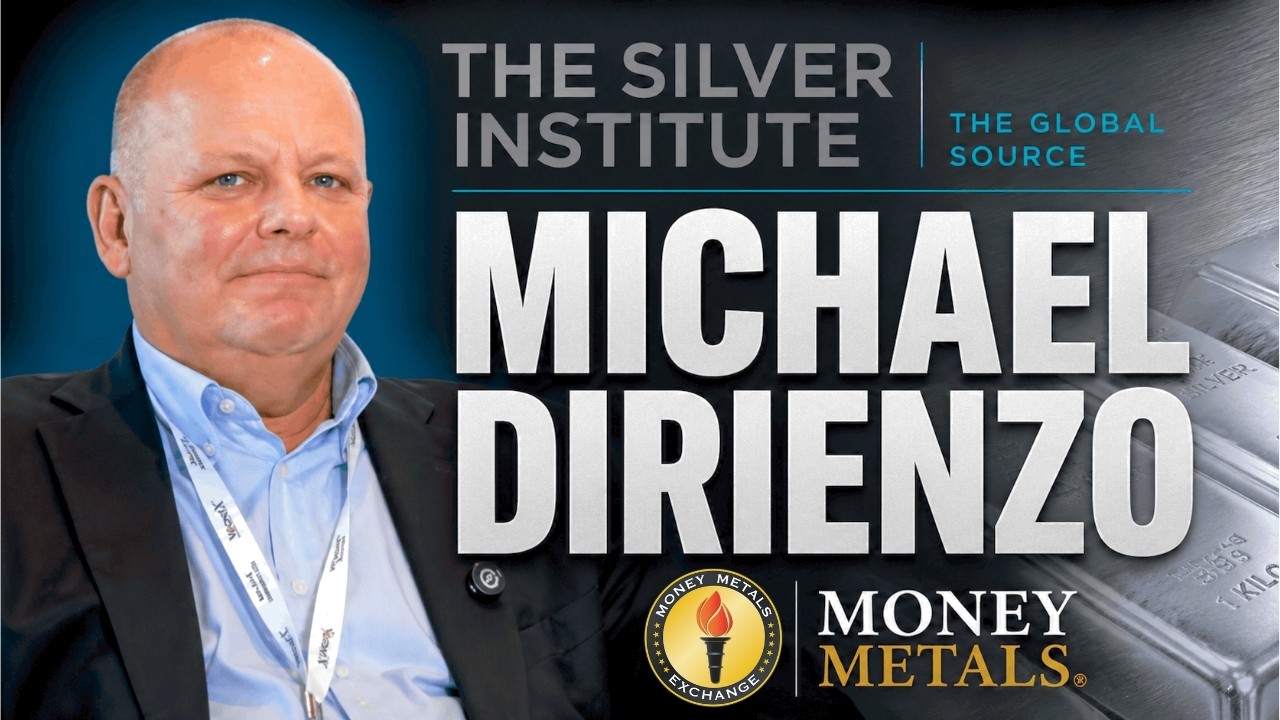
(Money Metals News Service) Silver has experienced a wild ride in 2026, but The Silver Institute President and CEO Michael DiRienzo says investors shouldn’t let the volatility obscure a much bigger story: the underlying silver market remains remarkably strong.
DiRienzo joined Money Metals podcast host Mike Maharrey to discuss silver’s dramatic price swings, persistent supply deficits, industrial demand, solar energy, artificial intelligence, investment flows, and the metal’s expanding role in medicine.
His central message was straightforward. Silver is no longer the $13 or $15 metal investors remember from less than a decade ago. In DiRienzo’s view, the market has established substantially higher floors because silver is increasingly being valued for both its industrial utility and its investment potential.
(Interview Starts Around 7:21 Mark)
From $121 Silver Back to $65
Silver surged to roughly $121 an ounce on January 29, 2026, before falling sharply alongside gold. By the morning of Maharrey’s interview with DiRienzo, silver was trading around $65 per ounce.
DiRienzo said the late-February outbreak of war in Iran put additional pressure on precious metals. Interestingly, he noted that gold and silver have tended to respond positively to announcements involving ceasefires or the reopening of the straits, suggesting the conflict has been weighing on the precious metals complex rather than providing the traditional geopolitical boost investors might expect.
But underneath the geopolitical turmoil, DiRienzo sees strong fundamentals.
He noted that just two years ago, predicting an average 2026 silver price above $72 to $75 per ounce would have sounded extraordinary. Yet the market has reached precisely that neighborhood this year.
Mining companies have also benefited substantially from higher prices. DiRienzo said second-quarter figures being reported by mining companies were broadly positive, including among Silver Institute members producing silver both as a primary product and as a byproduct.
Industrial Demand Remains a Powerful Force
Industrial demand remains one of the most important pillars supporting silver.
The Silver Institute expects a small decline in industrial demand this year, driven in part by reduced silver consumption in photovoltaics. With silver prices elevated, solar manufacturers have an obvious incentive to reduce the amount of silver they use or substitute another material.
Doing so, however, isn’t simple.
Silver has the highest electrical conductivity of any metal, and the process of screen-printing silver paste onto solar cells is already mature and highly efficient. Alternative materials and metallization technologies still face hurdles before they can compete with silver at scale.
Copper metallization exists, for example, but DiRienzo said it has yet to scale sufficiently to replace silver across the solar industry. For solar farms designed to operate for 25 years, manufacturers also have to consider silver’s reliability, durability, and stability rather than simply its upfront cost.
Solar’s Silver Appetite Has Exploded
The scale of silver consumption in solar has changed dramatically over the past decade.
DiRienzo said solar represented about 11% of total silver industrial demand in 2014. By 2024, its share had climbed to just under 30%, marking the peak year for silver consumption in solar to date.
The industry is now attempting to engineer some silver out of its cells as prices rise. But manufacturers were already trying to reduce silver consumption when the metal traded for only $13 per ounce.
As DiRienzo explained, manufacturers relentlessly pursue even tiny savings. Reducing costs by two, three, or four cents per solar cell can matter when production is measured in enormous volumes.
That means efforts to thrift silver will continue. But DiRienzo doesn’t foresee silver disappearing from photovoltaics the way photographic demand largely disappeared with the transition to digital photography.
AI Could Become Another Major Silver Demand Driver
Artificial intelligence represents another potentially significant source of future silver demand.
The AI boom requires an enormous physical infrastructure of data centers filled with electrical contacts, wiring, and other components that can use silver.
DiRienzo said data centers have grown by more than 6,000% in just three years. The Silver Institute has already examined silver’s role in AI data centers and other emerging technologies in a report on silver as a “next generation metal.”
The precise amount of silver being consumed by AI infrastructure remains difficult to quantify. DiRienzo acknowledged that the Institute is hearing about increased consumption but doesn’t yet have firm numbers.
The direction, however, appears clear to him. With AI infrastructure still in its infancy and data-center installations expanding around the world, DiRienzo expects silver demand from this sector to increase.
Higher Gold Prices Are Also Affecting Jewelry
Silver may also be benefiting indirectly from gold’s elevated price.
DiRienzo pointed to examples of jewelry made primarily from silver and then plated with gold, providing the appearance of gold while using silver as the underlying metal.
Jewelry demand remains highly price-sensitive because it is fundamentally a discretionary purchase. DiRienzo also highlighted an interesting demographic trend: more women between the ages of 24 and 30 are buying silver jewelry globally.
The Silver Institute expects overall silver jewelry demand this year to remain relatively consistent with last year’s level.
Higher Prices Can’t Quickly Produce More Silver
The supply side of the market presents a very different challenge.
A silver miner can’t simply flip a switch and dramatically increase production because prices have risen. DiRienzo noted that some of the mining taking place today traces back to plans made 10 years ago, in 2016.
Mining companies are spending more on exploration, but DiRienzo said they aren’t doing so recklessly. Much of the activity appears concentrated around existing projects as companies search for additional or previously unidentified veins.
That means substantially higher silver prices aren’t necessarily going to unleash a flood of new supply anytime soon.
Mine production increased about 3% in 2025, but the Silver Institute expects production to decline 0.3% in 2026.
A Sixth Consecutive Silver Market Deficit
The supply constraint becomes particularly important when considered alongside persistent demand.
The Silver Institute expects the silver market to record its sixth consecutive annual structural deficit in 2026. DiRienzo estimated the shortfall at roughly 46 million to 50 million ounces, although it could become larger if demand strengthens.
Recycling will help. The Institute expects recycled silver supply to increase by roughly 7% this year.
It still won’t be enough.
Even after incorporating recycling into total supply, DiRienzo expects demand to exceed supply again in 2026.
A market deficit doesn’t mean the world has literally run out of silver. It means annual demand is exceeding annual newly available supply, forcing the market to draw on above-ground inventories.
And those inventories aren’t necessarily as freely available as headline figures might suggest.
The Silver Sitting in Vaults Isn’t Necessarily Available
DiRienzo used London inventories to illustrate the problem.
Suppose London Bullion Market Association vaults contain approximately 750 million ounces of silver. That sounds like an enormous stockpile.
But DiRienzo estimated that roughly 75% of that silver is already allocated to exchange-traded products around the world.
That leaves a much smaller pool of readily available metal — and accessing that remaining “free float” can be extremely price sensitive.
The consequences became apparent when tariff concerns caused silver to move from London and elsewhere into New York ahead of the April 2, 2025, “Liberation Day” tariff announcement.
Precious metals ultimately weren’t included in the tariffs, but the episode demonstrated how quickly physical metal can move when market participants anticipate disruptions.
Maharrey pointed to another example closer to home: Money Metals was shipping 1,000-ounce silver bars to India during the tight market around Diwali.
DiRienzo recalled the episode and noted that silver lease rates subsequently surged as the market became extremely tight.
Could similar silver squeezes happen again?
“Absolutely,” DiRienzo said. “No question about it.”
Silver Investment Demand Could Strengthen
The Silver Institute also expects stronger retail investment demand for physical silver.
DiRienzo said demand for silver coins and bars could increase approximately 7% in 2026, despite challenges involving Indian import duties. India has been an especially strong market for silver bars and coins over the past several years.
Exchange-traded products tell another part of the investment story.
Silver ETPs recorded net inflows of approximately 270 million ounces in 2025. The outbreak of war subsequently contributed to liquidations in gold and silver ETPs, with DiRienzo saying silver had experienced outflows of roughly 6% this year.
He added that the Silver Institute was hearing that investment activity was beginning to pick up again.
Medicine Shows Another Side of Silver
When Maharrey asked DiRienzo to name one of silver’s lesser-known applications that he finds particularly interesting, DiRienzo pointed to health and medicine.
Silver’s antibacterial properties give it uses throughout healthcare environments. DiRienzo cited silver coatings in operating rooms and on operating tables and instruments, along with silver incorporated into hospital drapes and used alongside cleaning agents.
He also highlighted emerging nanotechnology. The Silver Institute’s August edition of Silver News was set to examine how nanosilver can help doctors administer the correct drug dosage.
Silver’s antibacterial properties extend beyond hospitals. DiRienzo also cited water purification, pools, and efforts to combat outbreaks of Legionnaires’ disease. In these applications, silver can help prevent infection and promote healing.
These applications may represent relatively small amounts of silver compared with solar panels, electronics, or investment products, but they demonstrate just how broad the metal’s usefulness has become.
From $15 to More Than $70
Perhaps the most striking way to understand today’s silver market is simply to look backward.
During the interview, DiRienzo opened the World Silver Survey and read off a series of historical average prices.
Silver averaged $17.05 per ounce in 2017. It subsequently averaged $15.71, followed by $16.21 in 2019. By 2023, the average had risen to $23.35, followed by $28.27 in 2024 and approximately $40 in 2025.
In 2026, DiRienzo said the market is talking about an average above $70 per ounce.
That longer-term perspective matters after silver’s retreat from its January peak.
At around $65 an ounce during the interview, silver was dramatically below its $121 high. But Maharrey emphasized that it wasn’t very long ago that investors were accustomed to silver trading for $13, $14, or $15.
DiRienzo believes the difference reflects a fundamental change in the market.
“We think new floors have been set in the market,” he said. Silver, in his assessment, is now trading on the strength of both its industrial applications and its investment appeal.
A Tight Market With Powerful Long-Term Drivers
Silver’s 2026 correction may dominate short-term investor psychology, but the fundamentals DiRienzo described point toward a much larger story.
The market is heading toward a sixth consecutive structural deficit. Mine production is expected to decline slightly. Recycling is increasing, but not enough to close the gap. Physical investment demand could rise 7%. Solar still consumes enormous amounts of silver despite ongoing thrift efforts. AI infrastructure presents another rapidly growing source of potential demand.
Meanwhile, much of the silver sitting above ground isn’t necessarily freely available to the market.
DiRienzo believes 2026 is shaping up to be a remarkable year for the metal. He expects the annual average silver price to set a record, and he sees evidence that the market has established price floors far above those of the previous decade.
Silver may still be volatile. But in DiRienzo’s view, today’s silver market is fundamentally different from the one investors knew when the metal traded in the teens.
And those fundamentals — industrial demand on one side and investment demand on the other — could continue defining the silver market long after the geopolitical turbulence of 2026 has passed.