New Mexico Governor Calls for Criminal Probe of DEA Allowing Fentanyl to Hit Streets

(Headline USA) New Mexico’s governor on Wednesday called for a criminal investigation into the Drug Enforcement Administration after an Associated Press investigation found federal agents allowed hundreds of thousands of fentanyl pills to reach the streets over a two-year period while pursuing larger drug-trafficking cases.

Gov. Michelle Lujan Grisham asked the state’s attorney general to examine whether the agency’s actions violated New Mexico law, an extraordinary challenge to a federal law enforcement agency at a time when fentanyl remains one of the country’s deadliest public health threats.

The request follows an AP investigation that found DEA agents repeatedly allowed major fentanyl shipments to continue moving through New Mexico between 2023 and 2025 rather than seize them immediately, as agents sought to build cases against higher-ranking traffickers. The governor’s call for a criminal review turns a debate over drug enforcement tactics into a question of whether federal agents themselves crossed legal lines while pursuing larger trafficking organizations.

Current and former DEA agents told AP the strategy amounted to a gamble with public safety in a state ravaged by the fentanyl epidemic and may have violated U.S. Justice Department rules intended to safeguard the public from a drug the White House last year designated as a “ weapon of mass destruction.”

“There are no words to describe how reckless and dangerous these decisions were,” Lujan Grisham said in a statement. “Make no mistake: the DEA knew people would die if these pills made it into New Mexico communities, and the agency let it happen anyway.”

The DEA did not immediately respond to a request for comment on the governor’s statement. The agency has contended it would not be plausible to seize every drug shipment and previously told AP in a statement “the investigative decisions at issue were lawful, reasonable under the circumstances and consistent with Department guidance.”

“Public descriptions suggesting that DEA knowingly permitted fentanyl to reach communities are false and fundamentally mischaracterize the facts,” DEA spokesperson Amanda Wozniak wrote in an email.

Alex Uballez, who served as U.S. attorney in New Mexico from May 2022 until February 2025, told AP that drugs went unseized at times due to his office’s limited resources and his belief that prosecuting larger organizations has a bigger impact than intercepting every suspected drug transaction.

It is not clear whether any fatal overdoses in the state can be directly attributed to the DEA strategy. While overdose deaths nationwide fell 14% last year, government data show New Mexico tallied a 21% spike.

“New Mexican lives are not the federal government’s cost of doing business,” the governor wrote in her statement. “I plan to hold the federal government accountable for this disaster and will explore every possible avenue of action against the federal government to right these wrongs.”

The AP investigation cited three current and former agents and government records, including an internal report of a 2023 delivery of 74,000 pills the DEA surveilled — but did not seize — at a mobile home park in Albuquerque.

DEA whistleblower David Howell, who filed a complaint drawing attention to the unseized fentanyl, spoke Wednesday with congressional staffers. Empower Oversight, a whistleblower advocacy group representing Howell, has asked the Senate Judiciary Committee and Justice Department’s Office of Inspector General to investigate the agent’s allegations.

Sen. Bernie Moreno, a Ohio Republican, called Howell’s revelations “a scandal of the highest order” and said in a post on X he plans to find out how many American lives were lost due to the DEA’s inaction.

Meanwhile, victims groups also spoke out about DEA’s inaction, saying its approach in New Mexico contradicts the agency’s prominent “One Pill Can Kill” campaign that warns as little as a few milligrams of fentanyl can cause a fatal overdose.

“Knowing the Justice Department had guidelines to seize the opioids whenever practical — and the fact these were ignored — is truly heartbreaking,” said Michael Glownia, who lost his daughter to fentanyl in 2023 and founded a nonprofit organization to support families suffering similar losses.

Adapted from reporting by the Associated Press

Reflecting Pool Liner was Cut with a Sharp Knife or Razor, National Park Service Says

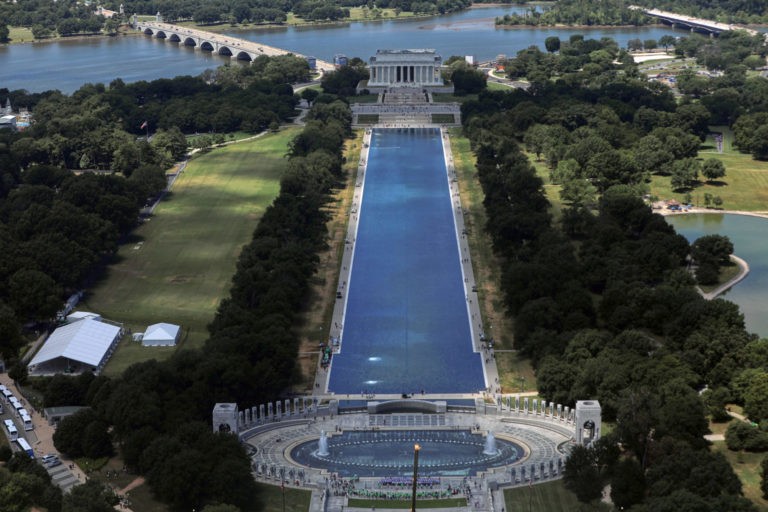
(Headline USA) A liner along the bottom of the Lincoln Memorial Reflecting Pool was cut with a sharp knife or razor this month, causing damage to the foam sealant installed as part of a $16 million rehabilitation project, a top official at the National Park Service says.

The U.S. Park Police responded June 9 to a complaint by the park service, said Frank Lands, deputy director of operations for the park service. Lands made the statement in a court document filed late Wednesday as part of a lawsuit filed by a nonprofit organization to halt the Trump administration’s work on the project.

His statement does not say when exactly the damage occurred or whether it was a suspected case of vandalism and does not identify anyone who might have been involved.

The police report indicates damage to the pool, “including a caulk over the foam sealant that was cut with a sharp knife or razor and destruction of delaminating surface material,” Lands said. About 70 fence post tops also were thrown into the pool, he said.

The statements were the first time the Republican administration has offered specifics for when and how the Reflecting Pool may have been damaged after work on the project was substantially completed.

A spokesperson for the Interior Department said Thursday that public notification about the damage was delayed because, “at the time of the June 9 incident, the vandalism was under investigation and believed to be isolated. So as not to encourage deranged individuals, we did not announce what we hoped to be an isolated incident.”

Around the same time, park service staff “discovered another incident where fencing around the pool had been forcibly removed and thrown into the pool,” the spokesperson said in an email.

The department soon noticed that “recurring cases and videos of people ripping at the coating began to circulate. We then knew this was not an isolated incident, but a new trend to attempt to damage the Reflecting Pool,” the email said.

President Donald Trump and other officials have repeatedly blamed, without evidence, unidentified vandals for peeling paint as well as a “350-foot gash” in the liner and other problems. Six people have been arrested, Trump said this week, without providing details.

The Interior Department said Thursday there have been seven arrests, seven federal citations and 18 police reports filed. The department did not specify what the charges were or identify anyone cited by police.

Trump pledged to beautify the century-old Reflecting Pool before the nation’s 250th birthday celebrations, draining its water and directing the bottom to be painted a color he called “American flag blue.” But since the site was restored, its water has been plagued by an algae bloom and pieces of the new coating have appeared to be peeling off the bottom.

His administration faces a self-imposed deadline to complete the renovation before July Fourth. Trump also has said the federal government would release images to substantiate his claim.

Trump said Wednesday that “sick people” had used razors and box cutters to slice portions of the lining.

The Associated Press reviewed videos showing that the Reflecting Pool was refilled between June 4 and June 9, meaning the alleged cut reported to law enforcement on June 9 could have occurred before the basin was fully refilled. Days later, pieces of the new blue liner were observed peeling up from the bottom.

The Park Police posted surveillance footage Wednesday evening and asked for help “identifying the individual depicted here in connection with a Destruction of Government Property investigation.” The grainy, 30-second video appears to show a person kneeling down, reaching into the reflecting pool and removing something from the water. Police said it was taken Friday afternoon.

In his statement to the court, Lands said the parks agency plans to begin draining the Reflecting Pool following Independence Day celebrations to conduct repairs, including assessing and repairing any damage to the lining.

The park service completed more than two months of renovations at the Reflecting Pool in early June. The 2,000-foot-long basin was drained and a tinted, plastic-like liner was installed to waterproof and protect the concrete pool surface, and the pool was refilled with water, Lands said.

The Cultural Landscape Foundation, an education and advocacy group that sued in May to halt work on the project, asked a federal judge to block further renovations.

“It is also not too late to correct course,” the group wrote in a filing Monday. It urged the administration to “engage with experts and the public, and make an informed decision about what is best based on the consultations mandated by the law, instead of once again rushing ahead with half-baked ideas.”

Congressional Democrats have called for formal investigations into the pool renovations, saying no-bid contracts for work on the project were awarded to vendors with previous relationships to Trump.

Ohio-based Green Water Solutions was given a $1.7 million contract to install a water-purification system in the Reflecting Pool, while Virginia-based Atlantic Industrial Coatings was awarded $14.7 million to repaint and waterproof the pool’s concrete floor.

Oregon Sen. Jeff Merkley, the top Democrat on the Senate Appropriations panel overseeing the Interior Department’s budget, said the pool renovation appears to be a waste of taxpayers’ dollars.

“After railing about waste, fraud and abuse, Donald Trump spent more than $16 million on a renovation of the Reflecting Pool that’s now peeling and chock full of algae,” Merkley said Thursday. He said this is a “massive waste” of tax dollars and the public deserves “swift answers — and a refund.”

Merkley is one of about 10 Democratic senators and House members investigating the pool project.

“Taxpayers deserve a full explanation of how these failures occurred and who will be held accountable for correcting them,” said another letter, signed by New Mexico Sen. Martin Heinrich and five other senators.

Heinrich is the top Democrat on the Senate Energy and Natural Resources Committee, which oversees the Interior Department.

Adapted from reporting by the Associated Press

Trump Asks Congress for Additional $87.6 Billion, Mainly for Iran War

(Dave DeCamp, Antiwar.com) The White House sent a letter to Congress on Wednesday requesting an additional $87.6 billion in supplemental funding, with the vast majority going toward “costs incurred” by the US-Israeli war against Iran.

The White House Office of Budget Management told House Speaker Mike Johnson (R-LA) that the nearly $70 billion earmarked for the Iran war would go toward “funding for military personnel and readiness expenses, operational costs to rebuild stocks expended by [the Department of War], classified programs, and other key expenses.”

Included in the $70 billion is $21 billion that will go to the Pentagon to “support critical capabilities, munitions procurement, and strengthen the US industrial base” as the US military used an enormous number of air defense interceptors and other munitions in the war and seeks to replenish its stockpiles.

The request is significantly higher than the Pentagon’s initial claim that, as of mid-May, the bill for the war was about $29 billion, and it lines up with independent analyses of the conflict’s costs. Journalist Stephen Semler of the Security Policy Reform Institute found that the war had cost about $72 billion in the first 60 days alone, an estimate that doesn’t account for indirect costs.

The $70 billion request for the Iran war is on top of the Pentagon’s record-breaking 2026 military budget, which topped $1 trillion for the first time, and the White House’s request for a nearly 50% increase in military spending for 2027 to bring the military budget to $1.5 trillion.

The White House is also asking Congress to provide $11.1 billion in economic assistance for American farmers, $1.4 billion for the Ebola virus outbreak in Central Africa, $1 billion to complete the renovation of Penn Station in New York City, and several other smaller costs.

This article originally appeared at Antiwar.com.  


Walz Files for Information on Trump ‘Retribution Campaign’

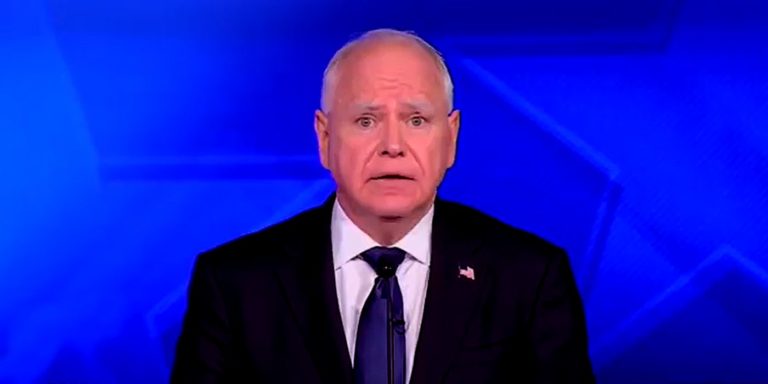
(Elyse Apel, The Center Square)  Gov. Tim Walz has filed 16 Freedom of Information Act requests with federal agencies seeking records he says could reveal what he has labeled as the Trump administration’s “campaign of retribution” against Minnesota.

The requests seek records, communications and other documents referencing terms including “Minnesota,” “Walz,” “reckoning,” “retribution,” “punish” and “Democrat” since Jan. 20, 2025.

Walz’s office said the records could reveal whether federal agencies “coordinated actions targeting Minnesota” and who was responsible for directing them.

“Minnesotans are living through a coordinated campaign of retribution from the Trump Administration,” Walz said in a social media post. “Funding cuts. Lawsuits. Terrorizing our citizens.”

The filings come just after U.S. District Chief Judge Patrick Schiltz, appointed by President George W. Bush, denied federal subpoenas directed at Walz and other Minnesota elected officials as “unconstitutional.”

“In sum, because the Court finds that the dominant purpose of the challenged subpoenas is to coerce Minnesota officials into assisting the federal government with enforcing civil immigration law and to harass and retaliate against them for failing to do so, the Court grants the motions to quash,” the ruling stated.

Following the ruling, Walz labeled the decision as a win for the “rule of law.”

“The U.S. Justice Department is pursuing criminal investigations into the President’s political opponents,” he said. “This case was just one example of that, but we are seeing daily reminders of this administration’s lawlessness—in Minnesota and around the country. We all must continue to seek justice and uphold the rule of law.”

On Tuesday, Walz said the FOIA requests are part of that effort and seek “to find out exactly how far this campaign reaches, who’s directing it, and what it has cost Minnesotans.”

The requests were filed with 16 federal agencies and departments, including the U.S. Department of Homeland Security, Department of Justice, Department of Health and Human Services, Department of Agriculture, Department of Transportation, Department of the Treasury and Department of Education.

DHS and DOJ did not immediately respond to requests for comment from The Center Square.

According to a news release from the governor’s office, Minnesota has been subject to more than 100 federal demands, investigations, lawsuits and threats to “illegally” withhold federal funding.

These are not the first requests Walz’s office has sent to the federal government. Earlier this year, he sent letters seeking information on the number of children currently held in federal detention centers.

“Those requests remain unanswered,” his office said on Tuesday.

Ex-Fire Chief Sues Los Angeles Mayor for Defamation

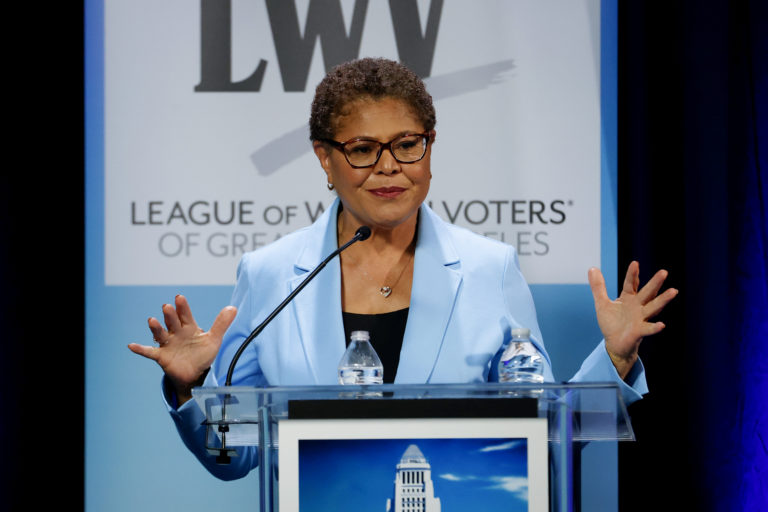
(Chris Woodward, The Center Square) The former Los Angeles fire chief is suing Mayor Karen Bass for defamation related to the devastating Palisades Fire.

Kristin Crowley was removed from her position on Feb. 21, 2025, weeks after the blaze began. The fire, which hit the Pacific Palisades neighborhood of Los Angeles and nearby communities such as Malibu, burned 23,448 acres, destroyed 6,833 structures and killed 12 people.

In the lawsuit, Crowley claims Bass made and continues to make false statements about her and has damaged her reputation. Bass demoted Crowley but did not fire her from the department, where Crowley continues to work as an assistant chief in the Valley Bureau.

“Former Fire Chief Kristin Crowley filed a new stand-alone lawsuit against Karen Bass individually based on Bass’s alleged defamatory statements made in her personal capacity to benefit herself in her mayoral campaign,” attorneys Genie Harrison and Mia Munro said, answering The Center Square’s questions by email. “Chief Crowley remains steadfast in her commitment to the truth and looks forward to a jury trial through which the citizens of Los Angeles will sit in judgment of Bass’s conduct.”

The Mayor’s Office has called the lawsuit meritless in statements sent to The Center Square Wednesday and others.

Maryam Zar, who lives in Los Angeles, called the lawsuit absurd and noted, “Mayor Bass dismissed the Chief because at least 1,000 firefighters had been excused on a high-wind day that was under a Red Flag Warning.”

After smelling smoke and seeing it on the horizon from her backyard, Zar tried calling the captain at her local fire station.

She told The Center Square she was told the captain was off for the day.

Zar called that inexcusable.

“This was a senior captain at a Pacific Palisades fire station, six days after a previous fire, on the morning of a high-wind warning day, with smoke already in the air,” said Zar. “I do not know how the Chief’s lawsuit will turn out, but I do know she deserved to be fired.”

Meanwhile, Zar said this “does not absolve the Mayor of responsibility for this fire, nor for her inability to establish a proper recovery for the community” more than a year and a half later.

“She has also failed in her responsibilities,” said Zar. “We do not have a recovery district, nor do we have any meaningful structure or working framework for what recovery should look like.”

To date, Zar said that her community is “still largely on its own” and is figuring things out as it goes.

“The people on the ground are doing the most important work, and many of us are engaged in efforts that may ultimately become the blueprint for disaster recovery,” said Zar. “This is happening with little help from local government, which has largely failed to deliver.”

This is the second lawsuit from Crowley.

In February, Crowley sued the city of Los Angeles, alleging retaliation in violation of the Labor Code and the state Constitution.

The lawsuits – both of which are filed in Los Angeles County Superior Court – are seeking unspecified damages.

Upon demoting Crowley,  Bass issued statements saying that Bass was acting in the best interest of public safety and the Los Angeles City Fire Department.

“We know that 1,000 firefighters that could have been on duty on the morning the fires broke out were instead sent home on Chief Crowley’s watch,” said Bass in February 2025. “Furthermore, a necessary step to an investigation was the President of the Fire Commission telling Chief Crowley to do an after-action report on the fires. The Chief refused. These require her removal. The heroism of our firefighters – during the Palisades fire and every single day – is without question. Bringing new leadership to the fire department is what our city needs.”

On the day the Palisades Fire broke out, Bass was in the African nation of Ghana for the inauguration of President John Dramani Mahama. The mayor faced heavy criticism for being out of the country, and Bass conceded the trip was a mistake.

In a separate lawsuit, one that is not connected to Crowley’s challenges, Bass’ brother – Kenneth Bass – and thousands of other people are suing the city of Los Angeles over the Palisades Fire. Bass’ brother lived in Malibu until the fire destroyed his home.

The Mayor’s Office told The Center Square Wednesday there is nothing new related to the suit.

Survey: Central Bankers Plan to Keep Stacking Gold

(Mike Maharrey, Money Metals News Service) Central bank gold reserves have increased by an average of 1,000 tonnes per year over the last four years. That’s double the 500-tonne average during the previous decade, and the trend doesn’t appear to be slowing down.

According to the World Gold Council’s 2026 Central Bank Gold Reserves Survey, a record 45 percent of the 76 respondents indicated they expected their gold holdings to increase over the next year. Only 1 percent of the central bankers surveyed anticipate a decline in gold reserves over the next year.

Last year, 43 percent of the respondents expected to expand their gold holdings.

The World Gold Council called gold sentiment within the central bank community “upbeat.”

“Expectations point to continued gold buying over the next 12 months, reflecting sustained confidence in gold’s strategic role amid evolving geopolitical and macroeconomic dynamics.”

The survey also reflects ongoing de-dollarization, with 74 percent forecasting a “moderate” or “significant” drop in dollar holdings.

When asked how they would pay for this gold-buying spree, half the respondents said they plan to increase gold reserves through domestic gold-purchasing programs in local currency. 38 percent said they would fund gold purchases by selling other existing reserve assets.

African countries have been particularly aggressive in establishing domestic gold-buying programs. For instance, earlier this year, the Ghanaian government announced a scheme to buy 127 tonnes of gold from “artisanal” and small-scale mining (ASM) operations to boost reserves and stem smuggling.

Fifty-three percent of the emerging market central banks included in the survey said that they had domestic gold-buying programs in place, and another 12 percent said they plan to establish such a program.

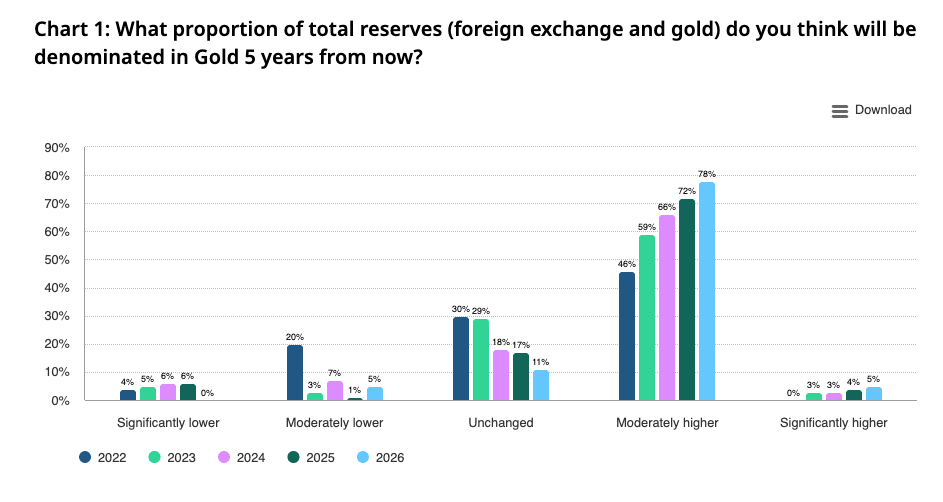
Central bankers generally agree that global gold reserves will continue to increase, with 84 percent saying they think gold will make up a higher share of reserves five years from now. That was up from 76 percent in last year’s survey.

Meanwhile, 74 percent expect the share of dollar reserves to be lower in five years.

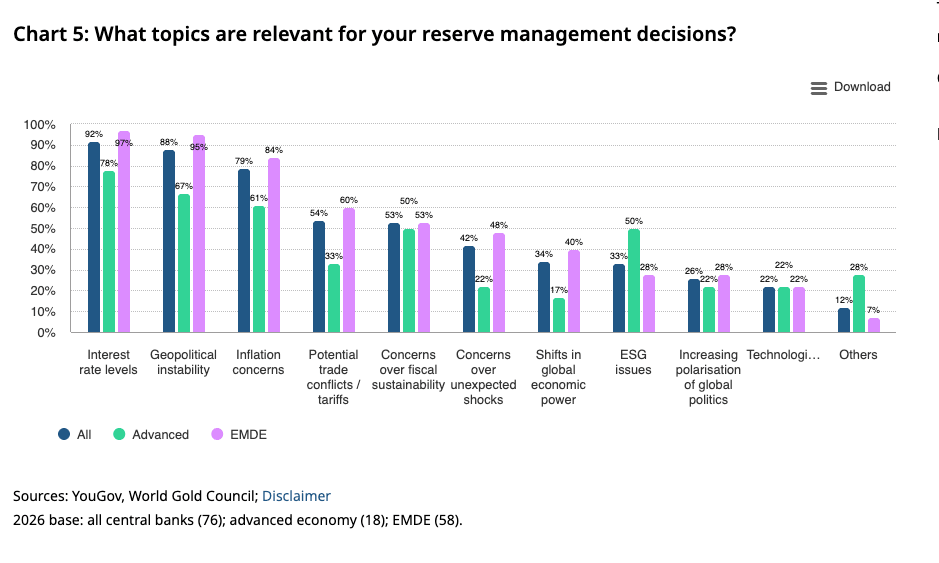
Central bankers responding to the survey ranked interest rate levels and geopolitical instability as key factors driving their reserve management decisions.

90 percent of the survey respondents said gold’s performance during a crisis was a highly relevant factor in their reserve management decisions.  84 percent listed gold’s role as a store of value, and 83 percent mentioned it as a portfolio diversifier.

This was the ninth annual central bank survey. The World Gold Council said positive sentiment toward gold has increased “notably” in that time.

“Optimism about gold’s future role as a reserve asset has grown alongside a desire by respondents to add more gold to their reserves. Central banks increasingly view gold as an active and important strategic asset within their reserve portfolios. Ongoing economic and geopolitical uncertainty continues to weigh on reserve managers, as this year’s findings highlight. Concerns over interest rates, the inflation outlook, and geopolitical uncertainty show that diversification and risk mitigation continue to be key drivers of strategic reserve management decisions.”


Mike Maharrey is a journalist and market analyst for Money Metals with over a decade of experience in precious metals. He holds a BS in accounting from the University of Kentucky and a BA in journalism from the University of South Florida.

U.S. Senators File National Security Amendment Targeting Dangerous Gold Market Concentration

(Sound Money Defense League, Money Metals News Service) A bipartisan group of U.S. Senators sponsoring the System Integrity through Licensed Vault Expansion and Resilience (SILVER) Act filed the legislation as an amendment to the National Defense Authorization Act for Fiscal Year 2027 (NDAA), further elevating the issue of geographic concentration within the United States’ precious metals settlement infrastructure as a matter of urgent national security.

Supported by a broad industry coalition that includes mints, refineries, depositories, dealers, miners, banks, logistics companies, risk managers, and industry trade groups, the bipartisan and bicameral SILVER Act (SB 4621 and H.R. 8007) would enhance financial and national security resilience by ending the extraordinary concentration of exchange-approved depositories for gold, silver, platinum, and palladium in and around New York City.

The geographic concentration of America’s publicly traded precious metals is viewed not only as anticompetitive but also highly dangerous since it creates a single point of failure for a market that plays a critical role in price discovery, physical settlement, and the functioning of U.S. and global markets.

Other Markets Evolved, But Gold Market Remains Mired in 1970s Thinking

The SILVER Act targets archaic policies that date back to the 1970s and that leave financial markets and defense supply chains severely vulnerable to disruptions such as natural disasters, infrastructure failures, cyberattacks, terrorist attacks, and other public emergency situations.

Even before Senators Jim Risch (R-ID) and Catherine Cortez Masto (D-NV) introduced their bipartisan legislation last month, concerns about the extreme concentration of exchange-approved precious metals depositories in only the New York area had already drawn scrutiny from federal regulators.

Earlier this year, Commodities Futures Trading Commission (CFTC) Chairman Michael Selig applauded the introduction of the SILVER Act by House sponsors and offered to work with Congress on the bill.

Government Privileges for SIFMUs Create Risk Mitigation Duties

Proponents note that the risks identified are particularly significant because the primary U.S. futures exchange is designated by the U.S. Treasury Department’s Financial Stability Oversight Council (FSOC) as a Systemically Important Financial Market Utility (SIFMU).

Institutions receiving SIFMU designations are given special government privileges due to their importance to the stability of the U.S. financial system, including access to Federal Reserve services and emergency liquidity facilities. But with those benefits come heightened responsibilities.

Specifically, Title VIII of the Dodd-Frank Act created the SIFMU framework to mitigate concentration, operational, settlement, and liquidity risks – all of which are exacerbated by the archaic exchange policy that excludes all precious metals depositories located outside the New York region from serving publicly traded markets in any capacity. This policy also stands in sharp contrast to other commodity contracts that are geographically disbursed.

Financial Stability, Supply Chain Resilience Critical to National Security

The SILVER Act would not lead to the approval of any specific precious metals depository. Instead, it would establish an application process, greater transparency, and objective evaluation standards for depository approvals while ensuring that geographic concentration risks and other public-interest considerations (such as broader market access, greater competition, and cost savings) are addressed via the inclusion of several qualified depositories across the U.S.

Gold, silver, platinum, and palladium play an increasingly important role not only as financial assets but also as critical inputs for defense, aerospace, electronics, medical technology, and energy production.

The decision to advance the SILVER Act through the NDAA reflects a growing consensus that critical mineral supply chains, financial stability, and national security are deeply interconnected.

Industry Coalition Seeks Regional Diversification, Market Access, Competition

The Precious Metals Industry Coalition for Market Security & Access wrote in a letter to Congress this month that, “This problem extends beyond risk exposure. The lack of geographic diversity also undermines market liquidity, competition, and access. It also undermines the ability to build precious metals supply chain infrastructure in other regions of the country.”

“Passage of this simple bipartisan bill would [also] modernize the nation’s precious metals infrastructure by promoting regional diversification, reducing costs, strengthening domestic supply chains, enabling new innovative digital products, and expanding market liquidity and access — while better aligning the system with the realities of a national marketplace,” the Coalition stated.

Deep Corrections Are Normal During Secular Bull Markets

(Mike Maharrey, Money Metals News Service) Gold broke below $4,000 an ounce on Wednesday. This 28 percent drop from the record highs of January is certainly painful, but deep corrections are not unusual in a bull market.

In a recent note, Solomon Global managing director Paul Williams said investors need to put the recent price movement into perspective, noting that there were several big corrections during the secular bull market of the 1960s and 1970s.

“During the 1970s, gold fell by around 45 percent between its mid-decade highs and 1976 lows before surging to record levels in 1980.”

He also pointed out the 30 percent decline in the early days of the Great recession.

“These episodes demonstrate that sharp corrections have often been part of the journey for long-term gold investors, and the question they need to ask is whether the fundamental reasons for owning gold have materially changed. In my view, they have not.”

Williams said the fundamentals that drove gold and silver to record highs “didn’t disappear overnight.” These include central bank gold buying, geopolitical risks, and elevated debt levels.

“Short-term price moves are often driven by factors such as profit-taking, shifts in interest rate expectations, and currency strength, rather than by a fundamental change in gold’s long-term investment case.”

In an interview with Kitco News, KraneShares Mount Lucas Managed Futures Index Strategy ETF COO and chief portfolio manager Jeffry Prior echoed Williams’ thoughts, arguing the factors driving the long-term bull market remain intact. He specifically mentioned ongoing de-dollarization, which he said is becoming “structural” and will remain “persistent.”

Prior pointed out that many countries want to shield themselves from the weaponization of the dollar, and the trend isn’t likely to slow down anytime soon.

“Countries are looking for a store of value outside of the U.S. dollar and the U.S. Treasury market. If countries are producing more oil and income starts flowing again, we don’t see that capital going into the Treasury market. We see it going back into the gold market.”

We see this de-dollarization in continued central bank gold buying. The pace of central bank purchases moderated in 2025 but remained far above the recent historical average. Official net full-year buying came in at 863.3 tonnes. That was down 21 percent year-on-year, charting the lowest level since 2021.

Even so, gold has overtaken Treasuries as the top global reserve asset. And while central bank gold purchases declined last year, they remained well above the 2010-2021 annual average of 473 tonnes.

To put that into context, central bank gold reserves increased by an average of just 473 tonnes annually between 2010 and 2021.

Prior said the recent correction creates a buying opportunity for investors.

“I think, given the repricing of gold here, it’s probably a pretty good entry point.”

While Prior remains long-term bullish on gold, he did warn that investors will likely see plenty of near-term volatility. That said, they should focus on the bigger structural themes and not the short-term interest rate fluctuations.

“Gold is a defensive asset within a portfolio. The retail flow that was going into gold has largely been cleaned up, so you probably won’t get stuck in a panic sell at this point.”


Mike Maharrey is a journalist and market analyst for Money Metals with over a decade of experience in precious metals. He holds a BS in accounting from the University of Kentucky and a BA in journalism from the University of South Florida.

Seattle City Council Committee Approves Closing Streets Following Gun Violence

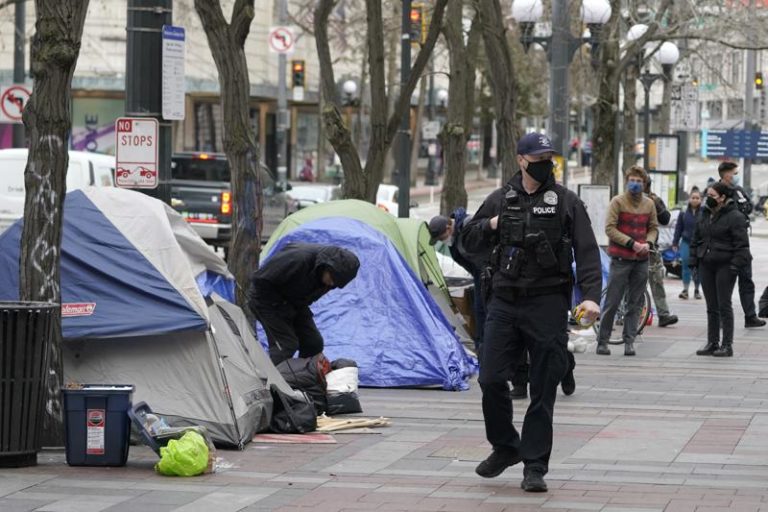
(The Center Square) The Seattle City Council’s Public Safety Committee approved an emergency plan Tuesday that will allow closure of residential streets off Aurora Avenue in North Seattle to through traffic after residents had complained for months about increasing crime and gunfire.

The plan is expected to be approved by the full City Council on June 30 and caps several weeks of activity by community residents, who packed City Council meetings and, on their own, closed neighborhood streets in a series of community protests.

The plan allows the police chief to close off streets in Seattle that see gunfire, drug activity prostitution and other crime.

The North Aurora Avenue corridor has been a center of underage prostitution for years, and police and community residents say the prostitution was helping fuel the increasing violence.

“This resolution is meant as a temporary tool when public safety issues arise in concentrated areas, providing the city the ability to act quickly in subduing crime, which allows time to assess long-term needs and implement solutions for these areas,” said Councilwoman Debora Juarez, whose district includes the Aurora Avenue corridor.

Juarez also said that she wanted to make clear that Seattle Mayor Katie Wilson always had the power to close Seattle streets for public safety issues and said it was “unfortunate” that it was not done sooner.

“I am just going to be straightforward about the fact that it had to get to this point to have legislation, to make an emergency, to do what the mayor’s office could have always done,” she said.

Juarez said as gun violence increased in May, residents closed off residential streets by Aurora Avenue between May 24-28 and saw reduced crime, only to see rates go up after the mayor’s office stepped in and removed barricades, replacing them with traffic calming devices.

Mayor Wilson’s office did not respond to requests for comment.

One Aurora Avenue area resident,  Jake Wallack, was among more than a dozen residents who appeared before the City Council on May 26 to plead with city officials to do something.

Wallack said he had been complaining to Wilson’s office and city council members for six months to no avail.

“In the past two weeks, my house was hit by gunfire,” he told a City Council Public Safety Committee on May 26. “I have a six-week-old baby, and it [bullet hole] hit two feet above my baby’s window. A week later, my neighbor had a bullet go through their window and into their bedroom.“

Wallack said he had been complaining to Wilson’s office and city council members for six months to no avail. Wilson was not at Tuesday’s city council committee meeting.

But on June 11, she appeared with City Council members at a joint press conference at City Hall supporting the street closures.

“We absolutely need to stop human trafficking, and we also need to take care not to push women further into the margins, create more danger for them, or blame them for causing this problem,” Wilson said at a night press conference in City Hall.

Another Public Safety Committee Member, Rob Saka, applauded the mayor on Tuesday for agreeing to the plan to close the streets off of Aurora Avenue.

Saka also said the mayor had the power to close the streets without City Council approval.

“We’re taking away all excuses,” he said of the council vote closing the streets.

Oppenheimer’s Grandson Supports Nuclear Energy Bill

(The Center Square) The grandson of the man who oversaw the invention of the atomic bomb spoke out Wednesday morning in support of nuclear energy development in California.

Charles Oppenheimer’s testimony before the state Senate Energy and Utilities Committee was part a push by state Democratic lawmakers to expand clean energy production.

Assembly Bill 2647, authored by Assemblymember Lisa Calderon, D-City of Industry, would require the California Energy Commission to study nuclear energy development in an effort to reach 100% zero-carbon and renewable energy goals by 2045, according to a legislative analysis.

The Senate committee Wednesday passed the bill with a 15-2 vote. The legislation, which was already passed by the full Assembly, is now heading to the Senate Appropriations Committee.

“One of the attributes is it makes the total cost of electricity lower, and it is the only path, I believe, that we have to get to the total decarbonization goal,”  Oppenheimer, grandson of J. Robert Oppenheimer and founder of The Oppenheimer Project, told The Center Square at the Capitol before the Senate committee’s hearing. “We need 100% decarbonization by 2045, and not using nuclear energy is kind of an older bias. We really need to re-examine that.”

J. Robert Oppenheimer is widely regarded as the father of the atomic bomb. As part of the Manhattan Project, the theoretical physicist led a highly-classified research facility in Los Alamos, New Mexico until 1945, designing the bomb and overseeing its first successful test in the remote desert research base that summer.

After the war, he actively opposed the development of the hydrogen bomb. He died in 1967 of throat cancer.

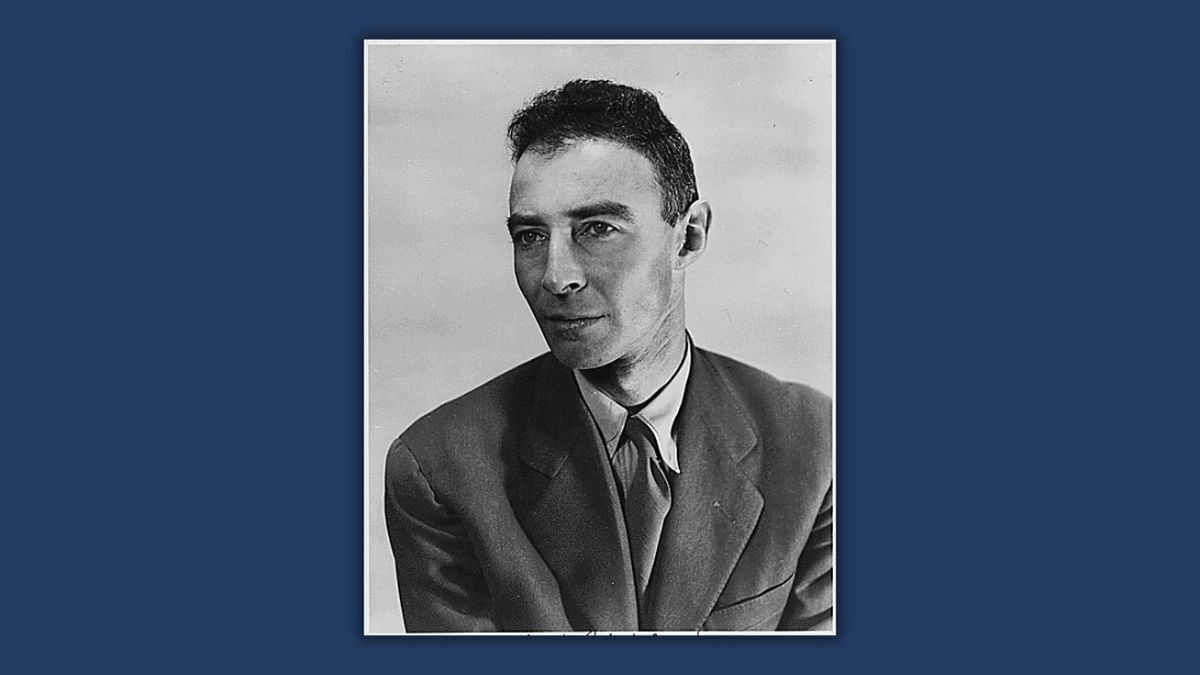
Portrait of Dr. J. Robert Oppenheimer in 1944.

Theoretical physicist J. Robert Oppenheimer, seen in this 1944 photo, was the director of the Las Alamos Laboratory for the Manhattan Project, which developed the atomic bomb. Photo: National Archives via pingnews.com / Wikimedia Commons / Public Domain

“The idea of being pro-nuclear science and against the use of making weapons for it is something he would approve of,” Charles Oppenheimer told The Center Square of his grandfather.

“He had hope that we wouldn’t go into an arms race, and people would have a friendly impression of nuclear energy,” said Oppenheimer, who lives in San Francisco. “I think he would be broadly supportive in 2026 that we need to take advantage of the good parts of nuclear.”

nuclear

“As you, on this committee, continue navigating the state’s clean energy transition, I understand wanting to survey all the available options,” Haakon Williams, executive director of the anti-nuclear nonprofit Committee to Bridge the Gap, testified in opposition to the bill. “My message to you is that if we want to do a study on nuclear energy, let’s do it right. This bill, as written, does not set the energy commission up to do the study right.”

Williams expressed concern that with the federal government’s deregulation of agencies that monitor the nuclear industry, decades of essential nuclear protections are being undone. He testified he is also worried that the study, as described in the bill, would not require a look at impacts on water use, emergency planning, the environment and the California economy.

“In that context, potential nuclear development needs more scrutiny, not less,” Williams testified. “This study would not consider the potential severe economic liability to our state in reactor accidents, which would cost hundreds of billions of dollars.”

California’s only operational nuclear power plant is Diablo Canyon, near Avila Beach in San Luis Obispo County. Gov. Gavin Newsom in April applauded the U.S. Nuclear Regulatory Commission’s approval of license renewals that will keep the carbon-free plant operating through 2030. According to the Governor’s Office, the plant provides about 10% of the state’s electricity.

Keeping the Diablo Canyon Power Plant open beyond 2030 would require approval by the Legislature.

Oppenheimer mentioned the plant briefly during his testimony before the committee.