Zimbabwe Reintroduces Gold Coins Sale to Strengthen Currency Reserves

(Mike Maharrey, Money Metals News Service) As gold prices skyrocket, the Reserve Bank of Zimbabwe (RBZ) has resumed issuing gold coins.

The central bank introduced the coins in June 2022. The program was touted as a way for investors to store value in the face of rampant inflation. At the time, a Zimbabwean brokerage firm analyst told Al Jazeera that the coin was a “welcome development.”

“For a long time, the market did not have many investment options, and this is a new asset class. The thinking was inspired by the need to come up with an instrument that addresses the inflation problems in the economy, where purchasing power has been eroded. From what we are gathering, this is going to be a store value.”

He went on to say that the fundamentals of gold help it hedge against inflation and geopolitical risk, and that the gold coins would open the gold market to “ordinary investors.”

The RBZ suspended the sale of the coins 10 months ago, but they are now being reintroduced through local banks.

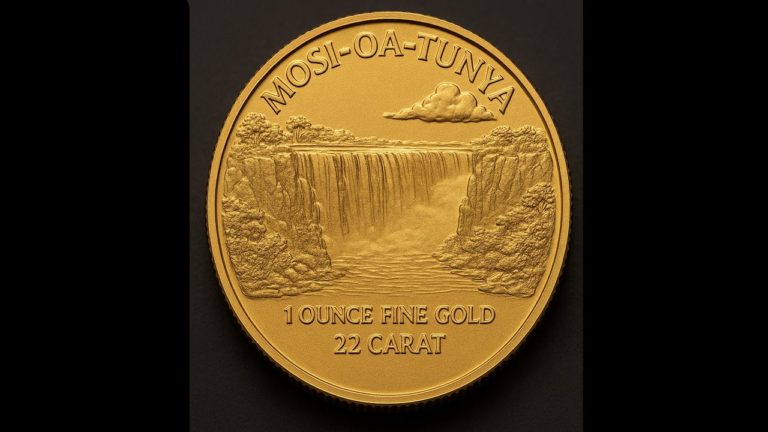
Fidelity Gold Refineries (Private) Limited mints the 22-carat “Mosi-Oa-Tunya” coin. It is available in various sizes, ranging from 1/10 ounce to 1 ounce.

The Zimbabwe central bank owns Fidelity Gold Refineries (Private) Limited, and it operates as the only gold-buying and refining entity in the country.

RBZ monetary policy committee member Persistence Gwanyanya told Bloomberg that the reintroduction of the gold coins comes at a time when “gold is more attractive to the market,” and that the move “supports our value preservation efforts.”

“We are taking advantage of firm gold prices and re-injecting the gold coins into the market.”

According to the Bloomberg article, the hope is that resuming gold coin sales will “ramp up the bullion stockpile used to back up the local currency, the ZiG.” 

You might be wondering how selling gold increases a bullion stockpile.

The answer is it doesn’t. Bloomberg seems to be oversimplifying a monetary policy scheme that will increase the reserves backing the ZiG, but won’t increase the country’s gold reserves specifically.

Propping Up the ZiG

Zimbabwe introduced the ZiG in an effort to stabilize the country’s financial system. It is a structured currency backed primarily by 2.5 tons of gold, along with other forex reserves, including $100 million in U.S. currency.

As the Zimbabwe African National Union-Patriotic Front (Zanu PF) explained when the currency was introduced, “Given that Zig is a structured currency deriving its value from gold (a valuable asset), it is likely to maintain a stable value, ceteris paribus. The value of zig against USD, therefore, appreciates or depreciates as the gold price increases or decreases in the international market. Given the stability of the gold price, the zig is more likely going to be stable in value currency.”

Less than six months later, the central bank had already devalued the new money.

From a practical standpoint, selling gold coins won’t increase the country’s gold reserves. However, the sale of the coins could be used as a monetary policy tool by pulling local currency out of circulation, thereby reducing the money supply.

Even though the physical gold moves into private hands, the RBZ could treat the original gold acquisition to mint the coins, and the sale process as building financial reserves behind the ZiG. From a balance sheet perspective, the gold and the currency collected from selling the gold would become part of the “reserves” backing the ZiG.

Zimbabwe’s Sketchy Monetary History

To say Zimbabwe has a bad track record for monetary management would be a gross understatement.

The ZiG was the sixth government attempt to shore up the Zimbabwean currency since 2009.

The country has a long history of rampant inflation. The Zimbabwean dollar (RTGS) lost about 800 percent of its value against the dollar in 2023 alone.

Hyperinflation wiped out the value of the Zimbabwe dollar in the early 00s. In 2009, the government simply abandoned its own currency and adopted foreign currencies – primarily the U.S. dollar (or, more accurately, the Federal Reserve Note).

The African nation reintroduced the Zimbabwe dollar in 2019. But the government apparently didn’t learn its lessons, and the currency quickly devalued again. By mid-July 2019, price inflation had increased to 175 percent.

As economist Milton Friedman once said, “Inflation is always and everywhere a monetary phenomenon, in the sense that it is and can be produced only by a more rapid increase in the quantity of money than in output.”

In other words, if a country is experiencing price inflation and currency devaluation, it is ultimately the government’s fault. Price inflation is a symptom of monetary inflation – government creating more and more currency to prop up spending.

During Zimbabwe’s first round of hyperinflation, the government was printing money to finance Mugabe’s military involvement in Congo. It was also allegedly creating currency to pay for government corruption and to fill the pockets of politicians and their buddies.

More recently, Al Jazeera reported, “The printing of new money by the central bank has also worsened the situation, reversing gains made in the past two years that saw inflation decrease from a peak of 800 percent in 2020 to 60 percent in January [2023].”

The ZiG was supposed to slam the door on the country’s monetary malfeasance. Backing currency with a hard asset theoretically limits money creation. The government shouldn’t create more notes unless it gets more gold. A gold standard puts a natural brake on monetary expansion.

But merely pegging a currency won’t do the trick if the government can’t resist the temptation to arbitrarily change the peg. A gold standard only works when government officials leave it alone. And as Americans learned in the 1930s, governments can and will quickly unravel a gold standard when it suits their purposes.

With the dollar tied to gold, the Federal Reserve couldn’t significantly increase the money supply during the Great Depression. It wasn’t able to simply fire up the printing press as it can today. The Federal Reserve Act required the central bank to hold enough gold to back at least 40 percent of the notes in circulation.

But a lot of Americans were redeeming paper dollars for physical gold because they were losing faith in the paper currency. As a result, the central bank was low on gold and up against the limit.

This put President Franklin D. Roosevelt between a rock and a hard place. He wanted the Fed to increase the money supply and support government spending, but this was limited by the partial gold standard.

To solve the problem, FDR took several steps to untether the dollar from gold, including attempting to remove most gold from private ownership. He also raised the dollar peg, just like Zimbabwe recently did.

It appears the Zimbabwe government is going down the same path – again – using monetary smoke and mirrors instead of dealing with the root of the problem – government spending.


Mike Maharrey is a journalist and market analyst for Money Metals with over a decade of experience in precious metals. He holds a BS in accounting from the University of Kentucky and a BA in journalism from the University of South Florida.

Can Gold Reach $16,000?

(Jan Nieuwenhuijs, Money Metals News Service) As we are in the final stages of a debt cycle that is causing gold to skyrocket, the question arises: how high can gold go?

Comparing the current bull run to the previous two points to a gold run as high as $16,000 per ounce.

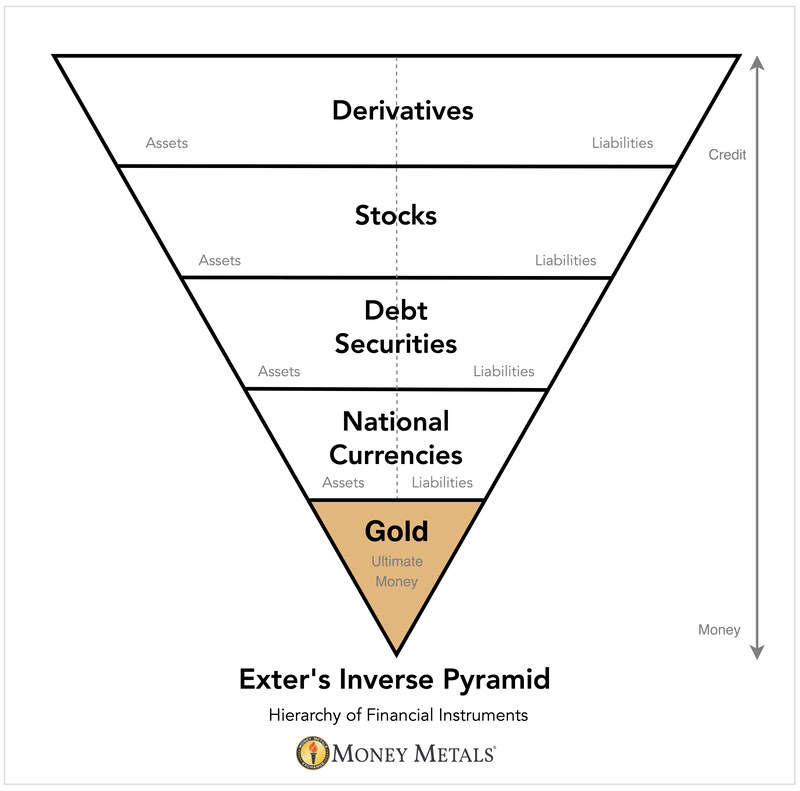
I typically analyze the gold price through a framework of how gold relates to “credit assets” (national currencies, debt securities, equity, etc.). Simplified, trends in the ratio between gold and credit assets tell us where we are in a debt cycle, and where we are in a debt cycle reveals in what direction the gold price is heading.

In an economic boom, capital flows into credit assets (debt), and the gold price stalls. When markets exhibit excessive confidence in credit, financial bubbles tend to form.

When the bubbles pop, investors flock to gold until a new equilibrium is established in the financial system between money without counterparty risk (gold) and assets with counterparty risk (credit).

Money Metals Inverse Pyramid

Our version of the financial system based on Exter’s inverse pyramid.

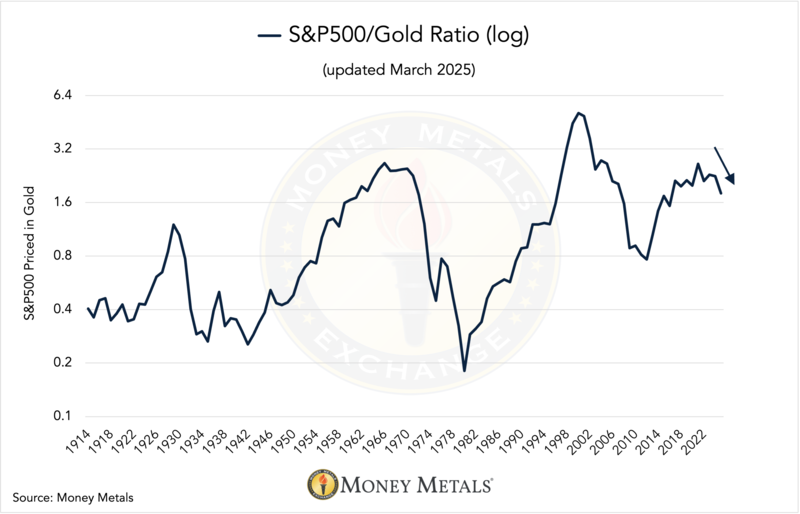
We will use a gold-to-credit ratio to examine debt cycles wherein the S&P 500 stock index is divided by the gold price. As can be seen in the chart below, this ratio shows there have been four debt cycles over the past 100 years.

SP / 500 Gold Ratio Chart

The S&P 500 index priced in gold can be used as an indicator for peaks and bottoms of debt cycles. For more examples, go here.

The first cycle ended in the late 1920s, the second in the 1970s, the third after the dot-com bubble, and the fourth is ending as we speak.

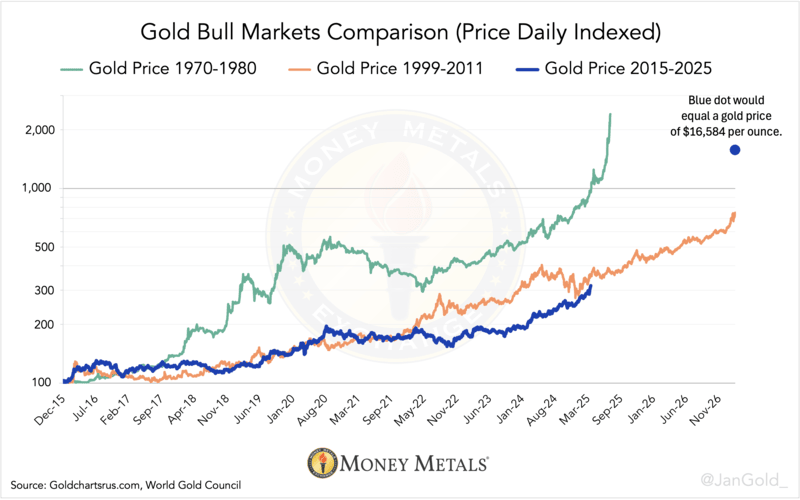
To get a sense of how high the gold price can go during this bull market, let’s compare its price action to the two previous bull markets. (The gold price jumped up in 1933 due to a one-off devaluation of the dollar against gold, so we can’t use gold price data from that period.)

From 1970 until 1980, the price of gold rose 23-fold. From 1999 until 2011, gold went up 6.5X. On average, that’s a 16-fold increase. Measured from the most recent bottom in 2015, gold going up by 1700% would produce a price peak of over $16,000 per ounce.

Gold bull market comparison between today’s bull market and the two previous ones.

When gold was trading at $2,700 an ounce in January, I calculated that gold could reach $8,000 this decade. While I feel more comfortable sticking to my conservative estimate, I wouldn’t be surprised if gold overshoots big time. If history is any guide, it will.


Originally a sound engineer in the Dutch movie industry, Jan Nieuwenhuijs has devoted the last decade to in-depth gold market research. His commentary and analysis has earned him international recognition as a top expert on the Chinese gold market, the COMEX futures market, the London Bullion Market, and the Turkish gold market. At Money Metals, he writes about the international monetary system, central bank gold policies, the mechanics of the global gold market, the gold price, and economics in general.

Gold Outperforms… Will that Continue?

(Clint Siegner, Money Metals News Service) There are plenty of frustrated silver bugs. Gold is outperforming once again, and they wonder when silver will finally catch up.

History suggests silver will outshine gold in a bull market for metals. So far, that has not been the case for much of gold’s current bull run which began in 2015.

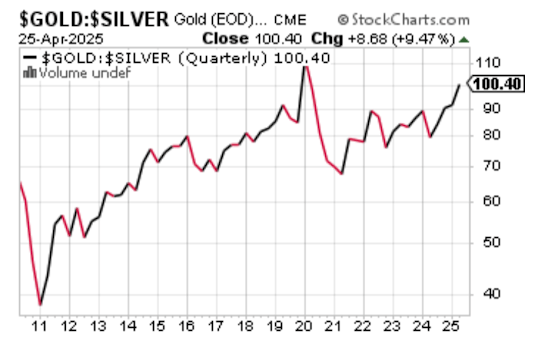
It isn’t certain whether this time will ultimately be different. Nine years into the run higher, silver remains way below the 2011 highs. Gold broke through its prior high five years ago. Recently, the gold/silver ratio floated back above 100, an extraordinarily high figure. (See Chart Below.)

Gold/Silver Chart (April 25, 2025)

Why has gold fared so much better than silver?

The answer is complicated and some of it is guesswork. For example, it is not possible to gauge how much influence artificial forces such as bullion bank price rigging and algorithmic trading have had on current metal prices. The answer, in our view, is at least some.

But given the dwindling above-ground inventories of silver, the difficulties miners have in raising production, and the steadily growing demand for silver, the days of lower silver prices are numbered.

There are other forces which might help explain why gold has fared so well. Gold’s demand is more concentrated. The vast majority of buying comes from investors and from central banks. While silver has seen growing demand from investors, the metal isn’t something central banks are stockpiling.

Industrial demand is a far larger component in the silver market than for gold.

During periods when investors worry about the economy, such as early months of COVID and the more recent fears over tariffs, silver is likely to underperform. Investors anticipate less demand for the metal from manufacturers.

While slowing demand from manufacturers will weigh more heavily on silver prices, there is another key difference which accrues in silver’s favor.

Silver used in manufacturing is mostly “used up.” It goes into products which eventually wind up in a landfill. It is different for gold. Most of what is used in major applications like jewelry and dentistry is ultimately recovered and recycled.

There is no large-scale recycling effort for silver. That could change as recycling processes improve, but silver prices will likely have to be much higher before it makes sense to try to recover silver from things like trashed electronic devices and solar panels.

Gold gets a lot more demand from institutional and very large investors. The fact is it would be hard to park $100 million on silver without impacting the price. Taking a billion-dollar position without having to pay a huge premium would be impossible.

Gold benefited during recent weeks as huge sums of money shifted out of the equity markets, the bond markets, and even the U.S. dollar.

For a lot of money managers making these big moves, silver isn’t even really among their options.

The safe-haven buying for silver comes largely from retail investors, not titans on Wall Street. This buying was frenetic from 2020 to 2023, it slowed down dramatically during 2024, and has only recently begun picking up.

An environment where there is strong demand from retail investors as well as solid industrial demand would be ideal for silver to catch up to gold. Whether or not silver bugs will be fortunate to get a market which fires on all cylinders is pure speculation.

The truth is the silver market doesn’t need that much help for the metal to be repriced dramatically higher relative to gold.

The setup in the futures market is explosive. The recent surge in imports from vaults in London and elsewhere provided some reprieve in the U.S., but annual deficits in new mine supply versus demand is problematic.

Deficits will almost certainly persist until higher prices start moving the needle on production, and this situation keeps a floor under silver prices.


Clint Siegner is a Director at Money Metals Exchange, a precious metals dealer recently named “Best in the USA” by an independent global ratings group. A graduate of Linfield College in Oregon, Siegner puts his experience in business management along with his passion for personal liberty, limited government, and honest money into the development of Money Metals’ brand and reach. This includes writing extensively on the bullion markets and their intersection with policy and world affairs.

Buy Gold to Hedge Against Everything!

(Mike Maharrey, Money Metals News Service) You often hear gold referred to as an “inflation hedge.” Jim Rickards argues that we should really consider gold the “everything hedge.”

Rickards is an investment banker and a well-known commentator and market analyst.

Gold has been on a tear for well over a year. To put the recent bull run into perspective, in October 2023, gold was at $1,830 an ounce. Today, the yellow metal is trading around $3,300 an ounce. That’s a 75 percent gain in just 18 months.

As Rickards put it in an article published by the Daily Reckoning, “the upward trend in gold prices is relentless and undeniable.”

Consider the other gold bull markets. During the inflationary decade of the 1970s, gold rose 2,185 percent. Between 1999 and 2011, the yellow metal added another 670 percent. Even with significant bear markets between 1981 to 1999 and from 2012 to 2015, gold has still gained 9,000 percent since 1971.

Gold: Not Just an Inflation Hedge

Conventional wisdom is that investors should hold gold as an inflation hedge. Over the long term, this is a wise strategy. Consider that at the peak of the latest inflation surge, CPI climbed by around 12.3 percent. During that inflationary period, gold rose by 29 percent.

But as Rickards observes, gold is “an imperfect inflation hedge in terms of strict correlation.” He argues that it’s better to think of gold as an “everything hedge.”

Fundamentally, gold is a hedge against uncertainty. And as Rickards notes, one certainty in this day and age is uncertainty.

“The vectors of uncertainty are everywhere. These include tariffs, tax policy, the Department of Government Efficiency (DOGE), the War in Ukraine, the rise of China, a likely recession, left-wing violence, and even the status of Greenland and the Panama Canal among others.

“It’s difficult to forecast how any one of these situations will turn out, let alone all of them and their complex interactions. Stocks and bonds can be volatile as a result. Gold is the one safe haven asset that powers through them all and offers investors some peace of mind. It is truly the everything hedge.”

We’ve seen this play out during the extreme volatility caused by the trade war. When tariffs went into effect, sending markets into chaos, gold was the last safe haven standing.

Gold has been propelled higher primarily by central bank buying and investing in the Asian markets. Western investors have still largely remained on the sidelines. Rickards argues that this sets things up for even more explosive moves higher.

He also notes that each $1,000 gain is easier than the next, thanks to a psychological phenomenon known as “anchoring.”

“The investor anchors on the number of $1,000 as a fixed gain and treats each such gain as the same. In pure dollars, they are the same. You make $1,000 per ounce as each benchmark is passed.”

However, each $1,000 gain is a smaller percentage. For instance, from $1,000 to $2,000 is a 100 percent gain. But from $3,000 to $4,000 is only a 33 percent increase.

“This math is what gives rise to a gold buying frenzy. We’re not there yet. Gold buying has been limited mostly to central banks and large institutions such as sovereign wealth funds (SWFs). Retail interest in the U.S. has been slight although retail buyers have been more active in India and China. Once the frenzy kicks in those $1,000 benchmarks will be passed quickly. That’s why it’s not too late to become a gold investor. Don’t kick yourself about the gains you’ve missed. Instead, look forward to the gains that are coming.”


Mike Maharrey is a journalist and market analyst for Money Metals with over a decade of experience in precious metals. He holds a BS in accounting from the University of Kentucky and a BA in journalism from the University of South Florida.
Amazon Launches Its First Internet Satellites to Compete Against SpaceX’s Starlinks

Amazon’s first batch of internet satellites rocketed into orbit Monday, the latest entry in the mega constellation market currently dominated by SpaceX’s thousands of Starlinks.

The United Launch Alliance’s Atlas V rocket carried up 27 of Amazon’s Project Kuiper satellites, named after the frigid fringes of our solar system beyond Neptune. Once released in orbit, the satellites will eventually reach an altitude of nearly 400 miles (630 kilometers).

Two test satellites were launched in 2023, also by an Atlas V. Project officials said major upgrades were made to the newest version. The latest satellites also are coated with a mirror film designed to scatter reflected sunlight in an attempt to accommodate astronomers.

Stargazers oppose the fast-growing constellations of low-orbiting satellites, arguing they spoil observations. Others fear more satellite collisions.

Founded by Jeff Bezos, who now runs his own rocket company, Blue Origin, Amazon aims to put more than 3,200 of these satellites into orbit to provide fast, affordable broadband service around the globe.

Elon Musk’s SpaceX already has launched more than 8,000 Starlinks since 2019. The company marked its 250th Starlink launch Sunday night. More than 7,000 Starlinks are still in orbit some 300-plus miles (550 kilometers) above Earth.

The European-based OneWeb satellite constellation numbers in the hundreds in an even higher orbit.

Amazon already has purchased dozens of rocket launches from United Launch Alliance and Blue Origin for Project Kuiper, as well as others.

“There are some things you can only learn in flight” despite extensive testing on the ground, said Rajeev Badyal, the project’s vice president.

“No matter how the mission unfolds, this is just the start of our journey,” he said in a statement ahead of the evening liftoff.

The first liftoff attempt earlier this month was nixed by bad weather. It took until now to secure another spot in the launch lineup at Cape Canaveral Space Force Station.

Adapted from reporting by the Associated Press.

Kenya Considering Gold to Diversify Away from Dollar

(Mike Maharrey, Money Metals News Service) The Central Bank of Kenya (CBK) is considering adding gold to its reserves to “diversify away from other currencies.”

Given that the Kenyan central bank holds most of its foreign reserves in dollars, this appears to be yet another step toward global de-dollarization.

During an interview on Bloomberg TV, CBK Governor Kamau Thugge said “a dedicated team” is assessing the feasibility of gold purchases, but he has not set any timeline.

Thugge specifically said Kenya needs “to diversify foreign reserves away from other currencies.”

Kenya currently only owns 0.02 tonnes of gold. By expanding its gold holdings, the Kenyan central bank aims to “hedge against currency volatility and strengthen financial stability.”

Eroding Dollar Dominance

Kenya is part of a growing trend of de-dollarization.

As of the end of last year, dollars made up 57.8 percent of global reserves. That is the lowest level since 1994, representing a 7.3 percent decline in the last decade. In 2002, dollars accounted for about 72 percent of total reserves.

Meanwhile, central banks are loading up on gold.

Official central bank gold demand topped 1,000 tonnes for the third straight year in 2024. To put that into perspective, central bank gold reserves increased by an average of just 473 tonnes annually between 2010 and 2021.

The pace of central bank gold buying picked up after the aggressive Western sanctioning of Russia. Other countries have noted the weaponization of the dollar and have taken steps to decrease their dependence on the greenback. Sticky price inflation and out-of-control federal spending, driving massive budget deficits, have also made other countries wary of the greeback.

According to a report by the Atlantic Council, “In recent years, and especially since Russia’s invasion of Ukraine and the Group of Seven (G7)’s subsequent escalation in the use of financial sanctions, some countries have been signaling their intention to diversify away from dollars.”

According to IMF data, between 2006 and 2023, central banks globally increased their official holdings by about 200 million troy ounces (6221 tonnes). This doesn’t account for the large amount of gold being purchased by the People’s Bank of China (and likely other countries) off the books.

This de-dollarization trend should raise Americans’ eyebrows.

The U.S. depends on this global demand for dollars supported by its reserve status to underpin its massive government. The only reason the federal government can borrow, spend, and run massive budget deficits to the extent that it does is the dollar’s role as the world’s reserve currency. It creates a built-in global demand for dollars and dollar-denominated assets. This absorbs the Federal Reserve’s money creation and helps maintain dollar strength despite the Federal Reserve’s inflationary policies.

The world doesn’t have to completely abandon the dollar to create negative impacts. Even a modest de-dollarization of the world economy would cause a dollar glut. The value of the U.S. currency would further depreciate. That translates to more price inflation at home. In the worst-case scenario, the dollar could collapse completely, leading to hyperinflation.


Mike Maharrey is a journalist and market analyst for Money Metals with over a decade of experience in precious metals. He holds a BS in accounting from the University of Kentucky and a BA in journalism from the University of South Florida.
Gold Isn’t Going Up

(Jesse Colombo, Money Metals News Service) Inflation is caused by the growth of the money supply, and gold is a strong hedge because it rises alongside it.

Whenever gold rises and I get excited as a gold investor, I’m often met with the familiar refrain: “Gold isn’t really going up—the dollar is just losing value.”

I used to brush that off as a cliché or a semantics game, and honestly, it annoyed me. But eventually, I decided to dig deeper. I started analyzing the data visually—my favorite way to learn—and that’s when it really clicked: they were right.

Gold wasn’t so much soaring as fiat or paper currencies were quietly eroding. Since then, I’ve made it a mission to help others see this clearly too—through compelling charts that drive the point home. And that’s exactly what I’m going to show you today.

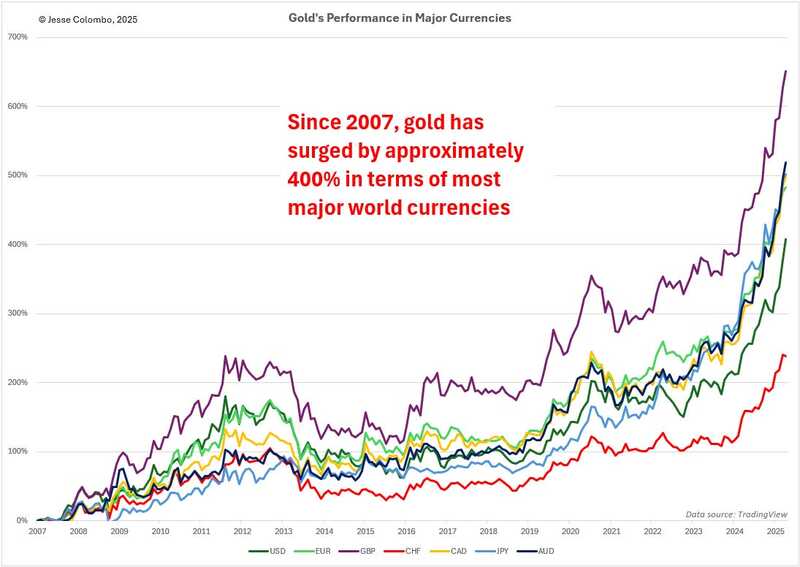
Let’s start with a clear visual: the chart below shows gold’s performance since 2007 in several major world currencies: the U.S. dollar, euro, British pound, Swiss franc, Canadian dollar, Japanese yen, and Australian dollar. While not an exhaustive list of global currencies, this group provides a solid and representative sample for the points I’ll be making throughout this piece.

As the chart reveals, gold has surged by roughly 400% in most of these currencies—with gains ranging from a low of 238% in Swiss francs to a staggering 651% in British pounds.

Gold's Performance in Major Currencies

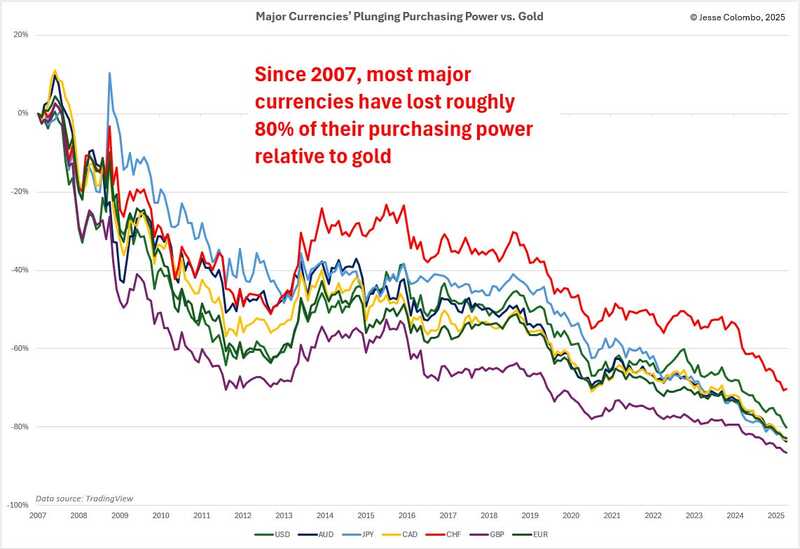
Next, I’ll present the same data from a different perspective—this time highlighting the purchasing power of each currency relative to gold, or in other words, how much physical gold each currency could buy over time.

Since 2007, the major world currencies featured in this article have lost approximately 80% of their purchasing power when measured against gold. On the low end, the Swiss franc has declined by about 70%, while the British pound has suffered the most, with an 87% loss.

This chart offers compelling visual evidence of a critical truth: gold isn’t actually rising in value—fiat/paper currencies are losing purchasing power at an alarming rate:

Major Currencies' Plunging Purchasing Power vs Gold

So why are we using gold as the yardstick? Because it’s the most reliable monetary yardstick in history.

For over 6,000 years, gold has served humanity as the premier form of money and store of value. While it temporarily fell out of favor starting in the 1970s, it’s now making a powerful comeback as the world begins to recognize the deep flaws in our fiat money and monetary system—flaws that have led to rampant inflation and terrifying financial instability.

That’s why people around the globe are turning back to gold in increasing numbers, helping drive its price to nearly double over the past five years. And in my view, this move is still in its early stages.

If you’re skeptical about using gold as a yardstick for measuring currency purchasing power, rest assured—its decline is confirmed by other metrics as well. The most widely used is the Consumer Price Index (CPI), which tracks the average change in prices over time for a fixed basket of goods and services.

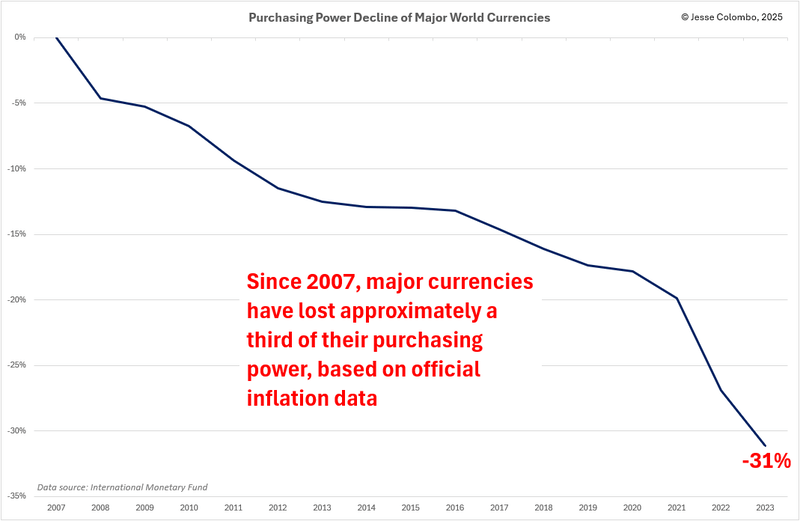
I calculated the average CPI for the major world currencies referenced throughout this article and found that, on average, they’ve lost 31% of their purchasing power since 2007.

The resulting chart closely mirrors the gold-based purchasing power chart shown earlier, with the steepest declines occurring during two key periods: 2007 to 2012 and 2020 to 2023—both of which were periods of heavy monetary expansion during recessions.

Purchasing Power Decline of Major World Currencies

Now, I realize there’s a noticeable discrepancy between the roughly 80% loss of purchasing power in terms of gold and the 31% loss according to official CPI data.

My working theory is that this gap exists because CPI figures are based on government-reported economic data—and governments are notorious for understating inflation to make their currencies and economies appear healthier than they really are.

Most people have noticed that the price increases they experience in the real world don’t line up with the tame inflation numbers coming from economists in ivory towers.

Personally, I trust what gold is telling us—and it’s saying that official inflation metrics are understating reality. When it comes down to it, I’ll err on the side of gold.

Now let’s examine why currencies steadily lose purchasing power over time: inflation, or the persistent rise in the cost of living.

It’s important to understand that inflation isn’t fundamentally caused by wars, tariffs, supply shocks, strikes, droughts, or energy crises—those may contribute to short-term price spikes, but they’re not the underlying driver.

At its core, inflation results from the debasement of currency—in other words, the dilution of a currency’s value through excessive creation of new money.

As Nobel Prize–winning economist Milton Friedman famously said, “Inflation is always and everywhere a monetary phenomenon.”

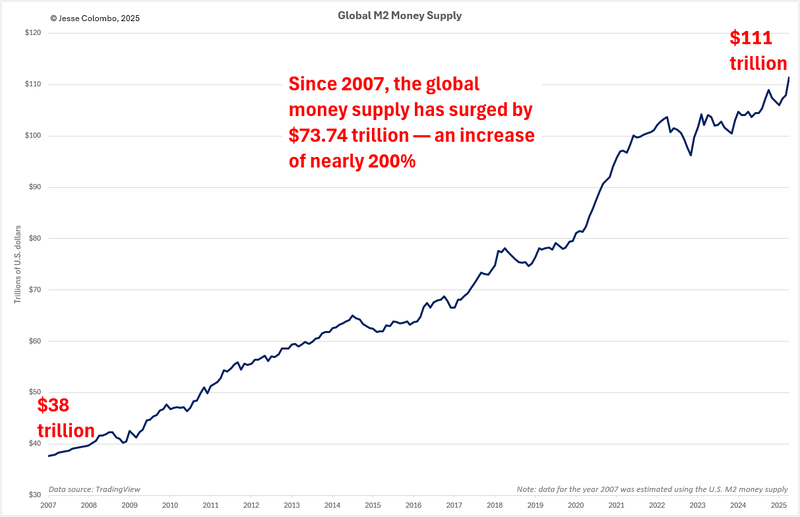
As the chart below illustrates, the global M2 money supply—one of the most widely used measures of total currency in circulation—has surged by 200% since 2007, skyrocketing from $38 trillion to a staggering $111 trillion.

This massive expansion of the money supply is the driving force behind the soaring cost of living worldwide—and a key reason why the price of gold has surged in every major currency across the globe.

Global M2 Money Supply

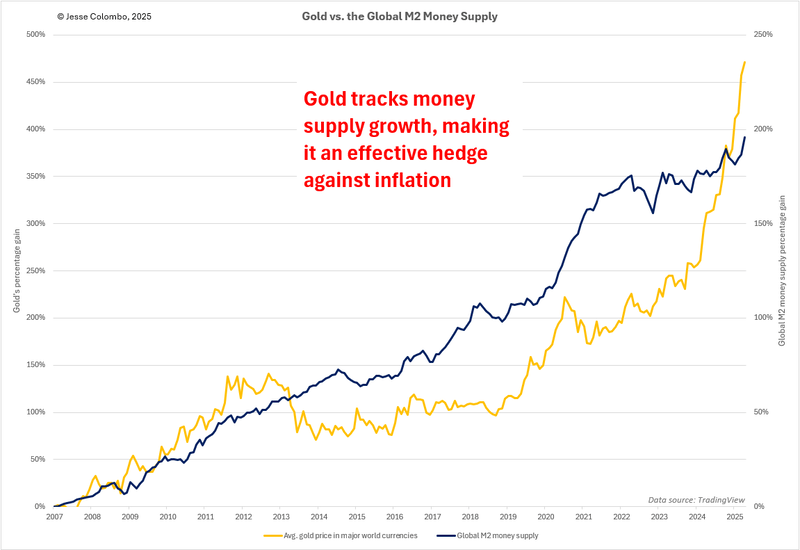
The next chart demonstrates how gold’s price closely tracks the growth of the global M2 money supply over time—the primary reason why gold remains the most effective store of value and hedge against inflation:

Gold vs the Global M2 Money Supply

Although nearly everyone alive today has lived their entire lives in a world of persistent inflation, it’s important to understand that this condition is not an inevitable feature of life or capitalism.

Instead, it’s a direct consequence of fiat money—paper currencies that are not backed by gold or silver, as they were prior to 1971.

Once the world abandoned the gold standard—that is, the practice of backing currency with gold—governments and central banks gained the power to expand the money supply without restraint. And that’s exactly what they did. The result? A relentless rise in the cost of living.

Another key point to highlight is this: as long as the world remains on a fiat money regime, inflation isn’t going away—and gold will continue to rise.

That’s because fiat currencies all suffer from the same terminal flaw: over time, they devalue, deteriorate, and eventually die. History shows that no fiat currency has ever escaped this fate—and neither will the dollar, the euro, nor the yen. It’s not a question of if they fail, but when.

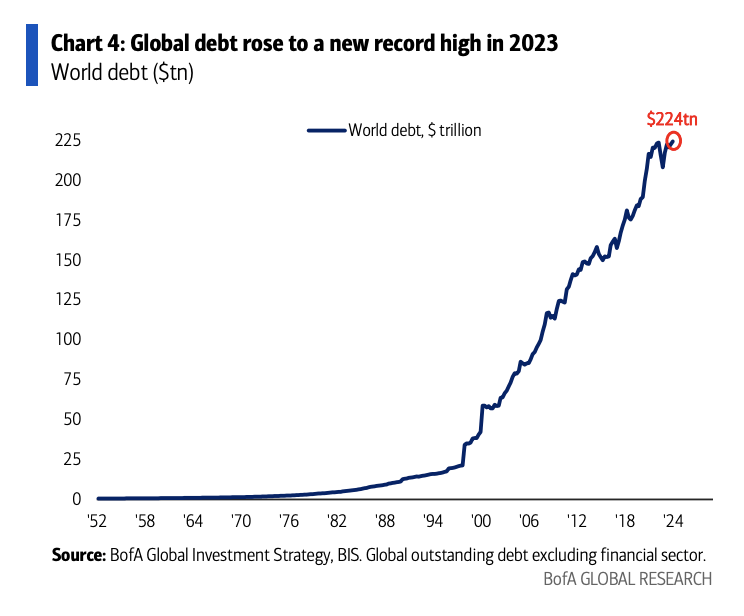
One of the most alarming forces sealing the fate of the world’s fiat currencies is the explosive growth of global debt, which has surged tenfold since the late 1990s, reaching an estimated $224 trillion. This towering debt burden is the ticking time bomb that will ultimately bring fiat currencies to their knees.

As debt levels spiral out of control, they begin to choke economic growth and destabilize entire financial systems.

Eventually, governments and central banks are left with little choice but to fire up the printing presses to service that debt and pay their bills. The result? A tsunami of rapidly devaluing paper money and a skyrocketing cost of living—a classic setup for hyperinflation.

Chart 4: Global Debt Rose to a New Record High in 2023

The chart below illustrates how, during Weimar Germany’s infamous hyperinflation of the early 1920s, physical gold—such as a single gold Mark coin—not only preserved its value but skyrocketed when priced in the rapidly devaluing paper Marks of the time.

This happened because the Reichsbank, Germany’s central bank, was running the printing presses at full throttle to prop up a collapsing economy and cover massive government deficits.

That chart is a historical preview of what will unfold in the years ahead, when gold hits $4,000… $5,000… $7,000… $15,000… even $20,000 per ounce—and, ultimately, some mind-boggling figure like $20 quadrillion, when the dollar and other major fiat currencies are on the brink of worthlessness.

To conclude, I hope I’ve made it clear that when gold soars in price across global currencies, it’s not gold that’s truly gaining value—it’s paper currencies that are rapidly losing theirs.

As a passionate advocate for gold and a heavy investor who avoids mainstream assets like stocks, bonds, and real estate in these times, I can’t deny feeling a surge of excitement when I see gold’s price—and the nominal value of my portfolio—rising sharply, as it has over the past year.

But that excitement is tempered by a sobering reality: gold is soaring because fiat currencies—including the U.S. dollar—are taking yet another hit to their purchasing power. Still, I’d much rather be watching that unfold from the safety of owning gold than from the sidelines without it.

If you found this report valuable, click here to subscribe to The Bubble Bubble Report for more content like it.


Jesse Colombo is a financial analyst and investor writing on macro-economics and precious metals markets. Recognized by The Times of London, he has built a reputation for warning about economic bubbles and future financial crises. An advocate for free markets and sound money, Colombo was also named one of LinkedIn’s Top Voices in Economy & Finance. His Substack can be accessed here.

Woman-Beating Ex-Congressman Dies

(Headline USA) Bob Filner, a 10-term U.S. congressman whose long political career ended abruptly after he was elected mayor of San Diego and driven from office amid sexual misconduct allegations, has died. He was 82.

Filner passed away April 20 with his children by his side, according to an obituary published Tuesday in the San Diego Union-Tribune. No cause was given. The newspaper reported that he was residing at an assisted living facility in Costa Mesa in Orange County.

Filner largely disappeared from public life after his 2013 resignation speech as mayor that reflected the same fiery, defiant tone that launched the political career of the former congressman and 1960s civil rights activist. But, ultimately, Filner agreed to step down as leader of the nation’s eighth-largest city amid the flurry of sexual harassment allegations from at least 17 women.

He pleaded guilty months later to charges of false imprisonment and battery involving three women. He was sentenced to three months of home confinement and three years of probation. The city of San Diego spent more than $1 million to settle multiple lawsuits filed by women.

He had held the office for less than nine months of a four-year term after becoming San Diego’s first Democratic mayor in 20 years.

Born Sept. 4, 1942, in Pittsburgh, Pennsylvania, Robert Earl Filner waded into politics as a sophomore at Cornell University, when he joined the Freedom Riders in the 1961 in their campaign against a segregated South. He spent two months in a Mississippi jail for inciting a riot after he and others confronted an angry mob at a bus station.

In 1970, he accepted a position at San Diego State University, where he taught history for more than 20 years before running for a seat on the San Diego Unified School District Board of Education.

He went on to be elected to the City Council and then U.S. House of Representatives in 1992 as a progressive Democrat who fought for veterans, underserved communities and labor unions. As chair of the House Veterans Affairs Committee, he also helped secure $200 million to provide pension benefits for Filipino veterans who served in World War II as part of the 2009 stimulus bill.

He resigned from Congress in 2012 to run for San Diego mayor, winning easily.

Filner is survived by two children, his daughter Erin Filner and son Adam Filner, as well as by his brother Bernard Filner and two grandchildren. He is also survived by two former wives, Barbara Christy and Jane Merrill.

Adapted from reporting by the Associated Press

Supreme Court Seems Likely to Rule Narrowly In Case Over FBI Raid on Wrong Georgia Home

(Headline USA) The Supreme Court seemed inclined to a narrow ruling on Tuesday in a law-enforcement accountability case over an FBI raid that targeted the wrong house.

While some justices appeared open to the argument that the family should be able to sue over the mistake that left them traumatized, the court seemed wary of handing down a more sweeping ruling on when the federal government can be held liable for law-enforcement decisions.

The case was filed after FBI agents broke down Trina Martin’s door before dawn in 2017. They pointed guns at Martin and her then-boyfriend and terrified her 7-year-old son before realizing they were in the wrong place.

The FBI team quickly apologized and left, with the leader later saying that his personal GPS had led him to the wrong place.

The government says judges shouldn’t be second-guessing decisions made in the absence of a specific policy and Martin can’t sue over an honest mistake. The 11th U.S. Circuit Court of Appeals agreed, tossing out the lawsuit in 2022.

Both liberal and conservative justices appeared skeptical of the government’s position in Martin’s case, with Justice Neil Gorsuch asking incredulously, “No policy says, ‘Don’t break down the door of the wrong house? Don’t traumatize its occupants?’”

Still, Justice Ketanji Brown Jackson was among those who suggested there could be some situations where law enforcement decisions should be shielded from liability, though “perhaps not here.”

The justices seemed to be leaning toward tossing out part of the 11th Circuit’s decision and sending it back for more litigation. A decision is expected around the end of June.

Public interest groups from across the political spectrum have urged the court to overturn the ruling, saying it differs from other courts around the country and its reasoning would severely narrow the legal path for people to try and hold federal law enforcement accountable in court.

Adapted from reporting by the Associated Press.

Scammer Steals $500,000 in Gold Coins from Oregon Woman

(Mike Maharrey, Money Metals News Service) Here’s a way to avoid 90 percent of scams.

Don’t answer the phone, and don’t click links in emails.

It’s pretty simple, really. If you don’t interact with scammers, they can’t scam you. It’s highly unlikely that a crook will show up at your door and let you see his face — at least initially. (It’s not out of the question, but not likely.) So, if you just refuse to respond to their initial outreach, you’re going to be pretty safe.

I get it — a lot of people just can’t resist picking up that phone to see who’s on the other end. But trust me, if it’s important, they’ll leave a message.

As for those emails, if they seem legit, you can always go directly to the company website and log in to your account. There is no need to click that strange link.

If a lady in Oregon had followed this simple advice, she probably wouldn’t be $500,000 poorer today.

It all started when the 70-year-old woman picked up the phone. The caller told her he was from the Federal Office of the Inspector General, and there was fraudulent activity associated with her Social Security number.

In an era of identity theft, this seems plausible.

It wasn’t.

I get it. A good scammer can sound very convincing. (On a side note, most of them aren’t good. It’s pretty obvious “Bob” with the thick accent calling from a Filipino area code isn’t an OIG investigator! Also, that email from AT&T with the Hotmail extension is fake!)

If you ever happen to connect with a plausible-sounding scammer, you can always hang up and call the agency they claim to represent to verify.

Unfortunately, this Oregon woman didn’t. She took the bait, hook, line, and sinker.

According to the Clark County Sheriff’s Office, the scammer conned her into withdrawing most of her savings, buying gold coins, and giving them to “an undercover agent” who promised he would give them back later. The scammer convinced her that this was part of a “federal process” to transfer assets to a new Social Security number.

You’ll not be shocked to learn that this isn’t a thing.

As the Clark County Sheriff said, “Legitimate law enforcement agencies will never ask for payment in gold, gift cards, or cryptocurrency.”

So, be careful out there. There are a lot of unsavory characters.

Don’t trust and always verify.

The Clark County Sheriff offered another bit of good advice.

“Young people should check on their elderly friends and family to make sure they are aware of these scams.”


Mike Maharrey is a journalist and market analyst for Money Metals with over a decade of experience in precious metals. He holds a BS in accounting from the University of Kentucky and a BA in journalism from the University of South Florida.