(Dave DeCamp, Antiwar.com) President Trump on Monday contradicted a report from Axios that said the US had delivered a proposal to Iran that would allow Tehran to enrich uranium at a low level for its civilian nuclear program.
“The AUTOPEN should have stopped Iran a long time ago from ‘enriching,’” Trump wrote on Truth Social. “Under our potential Agreement — WE WILL NOT ALLOW ANY ENRICHMENT OF URANIUM!”
Other US officials have been publicly demanding that Iran eliminate its enrichment program altogether, a condition Tehran has made clear is a non-starter. But the Axios report said the US is showing flexibility on the issue.
Sources told Axios that the offer put forward by US envoy Steve Witkoff describes “preliminary ideas” to be discussed in the next round of negotiations.
Under the outline, Iran would not be allowed to build any new enrichment facilities and must “dismantle critical infrastructure for conversion and processing of uranium.” Iran would also have to halt new research and development on centrifuges and would not be able to develop enrichment capabilities beyond those necessary for civilian purposes.
Once the agreement is signed, Iran would have to limit its uranium enrichment to 3% for an undetermined period of time. The 2015 nuclear deal, known as the JCPOA, capped Iranian nuclear enrichment at 3.67%.
According to the Witkoff proposal, the idea of a deal would be to establish a regional enrichment consortium. In exchange, Iran would receive sanctions relief once the US and the International Atomic Energy Agency (IAEA) were satisfied with its progress.
Other media reports conflicted with what Axios reported, including one from The New York Times, which said the US proposal demanded Iran immediately cease uranium enrichment. Sources told the Times that the US called for the establishment of a regional consortium to produce nuclear power, which would include Saudi Arabia and other Arab states.
Reutersalso reported that the US proposal included the demand for Iran to stop enriching uranium and cited Iranian sources who said Tehran was poised to reject the offer. “In this proposal, the US stance on enrichment on Iranian soil remains unchanged, and there is no clear explanation regarding the lifting of sanctions,” a source told the outlet.
Exploring a deal that allows Iranian uranium enrichment puts the Trump administration at odds with virtually every Republican in Congress and the government of Israeli Prime Minister Benjamin Netanyahu. Both the hawks in the US and Israel are demanding that any deal must eliminate Iran’s enrichment program altogether, a condition they’re likely pushing knowing it would sabotage diplomacy and bring the US and Iran closer to war.
While President Trump has been pursuing diplomacy with Iran, he has also been threatening to bomb the country if a deal isn’t reached. The threats have continued even though US intelligence agencies recently reaffirmed that there’s no evidence Tehran is building a bomb or that Khamenei has reversed his ban on the development of nuclear weapons.
(Bethany Blankely, The Center Square) Federal authorities continue to take action in Massachusetts after state and local authorities implemented policies directing police to not work with U.S. Immigration and Customs Enforcement.
In May, ICE agents, working with multiple federal partners, arrested nearly 1,500 criminal illegal foreign nationals, the largest total to date in the state of any month under any administration.
The month-long enforcement operation focused on transnational organized crime, gangs and “egregious illegal alien offenders” living in Massachusetts. ICE-Enforcement Removal Operations-Boston agents partnered with the FBI, U.S. Customs and Border Protection, ATF, the State Department’s Diplomatic Security Service, U.S. Marshals Service and U.S. Coast Guard.
“Make no mistake: Every person that we arrested was breaking our immigration laws, but most of these individuals had significant criminality,” ICE ERO Boston acting Field Office Director Patricia Hyde said. “They are criminal offenders who victimized innocent people and traumatized entire communities – murderers, rapists, drug traffickers, child sex predators and members of violent transnational criminal gangs. Some were convicted of violent crimes in the United States, and others were wanted for criminality in their native countries. All made the mistake of attempting to subvert justice by hiding out in Massachusetts.”
Overall, 1,461 illegal foreign nationals were arrested; more than half have criminal convictions or charges; 790 were charged with or convicted of crimes in the U.S. or abroad, including “numerous targets who had foreign arrest warrants and Interpol Red Notices” and “criminal alien offenders wanted by authorities in several foreign countries.”
Of those arrested, 277 had removal orders from a federal immigration judge but didn’t comply and remained in the country illegally. Everyone arrested remains in ICE custody pending removal proceedings.
Throughout the operation, ICE and federal law enforcement officers targeted transnational criminal organizations operating in and around Boston, including MS-13, Tren de Aragua, Trinitarios and 18th Street gangs.
They also targeted communities in Nantucket and Martha’s Vineyard, leading to the arrest of “40 illegal aliens, including at least one child sex predator and a member of a violent transnational gang.” The U.S. Coast Guard assisted ICE with transporting them off the islands.
Federal authorities were able to locate and arrest violent offenders “after local jurisdictions refused to honor immigration detainer requests to turn over the offenders and instead chose to release them from custody, forcing officers and agents to make at-large arrests in Massachusetts communities,” ICE said.
Examples of violent men arrested include those from:
Brazil: One with criminal charges including aggravated rape of a child by force, possession of child pornography and dissemination of obscene material, assault and battery and kidnapping; an active Interpol Red Notice for a drug trafficker who when fleeing his country on a motorcycle threw a brick of cocaine at Brazilian military police; an active Interpol Red Notice wanted for murder.
Colombia: One with felony charges including breaking and entering, kidnapping, aggravated rape, and indecent assault and battery; a convicted narcotics trafficker/manufacturer who fled Colombia to the U.S. to avoid serving 14 years in prison.
Ecuador: A convicted murderer sentenced to a year in prison and released into the community instead of complying with an ICE detainer request.
El Salvador: One with an active Interpol Red Notice wanted for aggravated homicide, robbery, aggravated kidnap and theft; one with criminal charges for aggravated rape of child by force, indecent assault and battery (under age 14), and open and gross lewdness.
Guatemala: A registered sex offender with pending criminal charges in Boston for five counts of indecent assault and battery and trafficking a person for sexual servitude. His previous arrests include aggravated rape of child and indecent assault and battery. ICE lodged two detainers that local jurisdictions refused to honor. Another is a convicted murderer in Boston who received a life sentence; another has charges of assault and battery, dangerous weapon charges, assault and battery on a family member, strangulation/suffocation and intimidation of witness.
Honduras: One with a criminal history of arrests for rape, indecent assault and battery, witness intimidation, kidnapping of a minor by relative, lewd and lascivious conduct and sexual conduct for fee; his convictions include operating a vehicle under the influence of alcohol in Massachusetts and Iowa, where he served a year in prison; another had convictions for obscene material to a minor, enticing a child under 16 and larceny.
Uruguay: A 69-year-old Uruguayan registered sex offender convicted of indecent assault and battery on a 7-year-old girl.
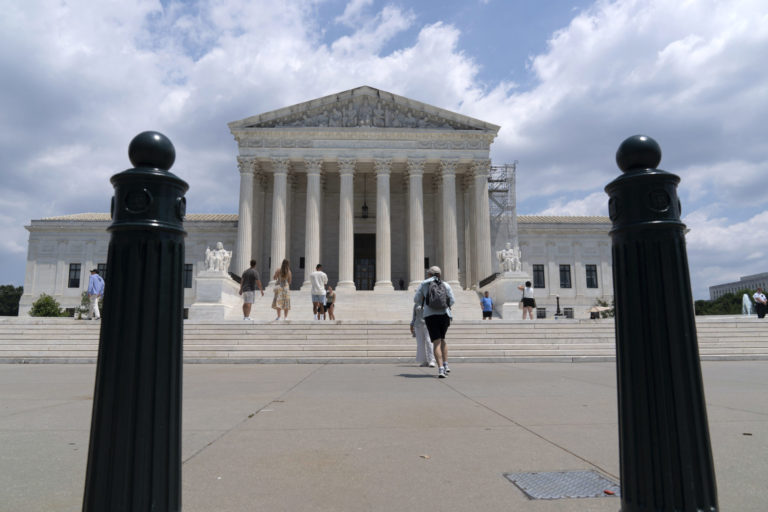
(Andrew Rice, The Center Square) June marks the final month of the Supreme Court’s 2024-2025 term and all nine justices are racing against the clock to issue final opinions on controversial cases.
From the legality of a federal injunction against birthright citizenship, to gun manufacturer liabilities and even age verification for online pornography the court is busy with many decisions. Here are some of the cases that the nation’s highest court will decide before the end of the month.
On Jan. 20, the Trump administration issued an executive order revoking citizenship from children born in the United States to either mothers or fathers that are in the country illegally or temporarily.
Lawsuits were quickly filed in district courts across the country. Courts in Maryland, Massachusetts and Washington blocked the enforcement of the executive order, which prevented the measure from going into effect nationwide.
The Trump administration appealed the case citing concerns over a district court’s ability to instate a nationwide block on an executive order but the appeals court left the injunction intact.
Now, the Trump administration is asking the Supreme Court to decide whether a district judge can block an order from going into effect throughout the nation or simply in their own district.
The Mexican government sued several United States gun manufacturers, arguing they facilitated gun trafficking to Mexican drug cartels.
Gun manufacturers, like Smith and Wesson, argued Mexico’s lawsuit is not allowed under the Protection of Lawful Commerce in Arms Act which blocks certain lawsuits against gun manufacturers.
The Supreme Court will decide whether United States gun manufacturers can be held liable for violence from Mexican drug cartels using illegally trafficked weapons.
This case is challenging a Texas law that requires online platforms that publish more than one-third sexually explicit content to implement age verification methods. The bill specifically sought to protect minors from access to sexually explicit content online.
The Free Speech Coalition challenged the law, arguing age verification violated the first amendment and conflicts with the communications decency act. Throughout the legal process, courts have gone back and forth whether to apply strict scrutiny or rational basis review to the case.
The Supreme Court will decide whether the case should be decided by strict scrutiny – a narrowly tailored law to achieve a compelling government interest – or rational basis – a law that is reasonably related to a government interest.
Tennessee and Kentucky passed laws restricting medical treatments for minors including administering puberty blockers, sex-transition surgeries and hormone therapy in 2023.
Groups of minors, their parents and healthcare providers challenged these laws, arguing they violated due process and equal protection rights.
The laws remain in effect for both Kentucky and Tennessee while the Supreme Court prepares to decide whether the equal protections clause of the 14th amendment applies to this case.
Parents sued Maryland’s Montgomery County School Board after it eliminated policies requiring parents receive notice and options for their children to opt into curriculum circulating around gender identity and sexuality.
The parents, from various religious backgrounds, cite a denial of religious freedom and parental rights in the case as the books conflicted with their faith on topics of gender, marriage and sexuality.
The Supreme Court is set to decide whether it is a violation of religious freedom and parents rights to be denied the opportunity to receive notice and opt-in to curriculum on gender and sexuality topics.
(Mike Maharrey, Money Metals News Service) Central bank gold buying moderated in April, as the gold price hit record levels.
Globally, central banks officially added a net 12 tonnes of gold to their reserves in April, according to the latest data compiled by the World Gold Council. This was 12 percent lower than March and below the 12-month average of 28 tonnes.
Gold touched a record high of $3,500 an ounce in April. The World Gold Council said the slowdown in central bank purchases could be in part “a response to the rapid appreciation in the gold price since the start of the year.”
“While the rally to multiple new record highs is unlikely to deter central banks from buying gold – as they tend to be more strategic in nature – it could explain some of the deceleration in the pace of monthly net buying.”
A large decrease in Uzbekistan’s reserves also pushed net purchases lower.
The World Gold Council cautioned against reading too much into the recent slowdown in central bank buying.
“The data series is very volatile, meaning that activity in one month is not necessarily an indication of activity in subsequent months. What’s more, data can be released with, at times, a significant lag. And while higher prices may have pushed up gold allocations in some central bank portfolios, possibly closer to targets, we still expect overall buying to continue, given that the economic and geopolitical outlook remains highly uncertain.”
The NBP has increased its gold reserves by 61 tonnes since the beginning of the year. Poland was the biggest buyer in 2024 as well, adding 90 tonnes to its holdings.
Last year, National Bank of Poland Governor Adam Glapiński indicated the central bank plans to increase its gold holdings to 20 percent of its reserves.
“This makes Poland a more credible country, we have a better standing in all ratings, we are a very serious partner, and we will continue to buy gold.”
The Polish central bank has exceeded that level and continues to add to its reserves.
The Czech National Bank has been adding gold at a steady pace over the last several years. It bought another 3 tonnes in April.
The People’s Bank of China reported an increase in its official reserves for the sixth straight month, adding 2 tonnes to its reported holdings. That pushed its official gold holdings to 2,294 tonnes, about 6.5 percent of its total reserves.
Notice the emphasis on “official.”
China is one of the central banks that likely holds significantly more gold than it publicly discloses. As Jan Nieuwenhuijs has reported, the People’s Bank of China is secretly buying large amounts of gold off the books. According to data parsed by the renowned Money Metals researcher, the Chinese central bank is currently sitting on more than 5,000 tonnes of monetary gold located in Beijing – more than TWICE what has been publicly admitted.
Several other banks reported increases in their gold reserves.
Turkey – 2 tonnes
Kyrgyz Republic – 2 tonnes
Kazakhstan – 1 tonnes
Jordan – 1 tonnes
As noted, Uzbekistan reported an 11-tonne decrease in its reserves. The Uzbek central bank was also the biggest seller in the first quarter. It is not uncommon for banks that buy from domestic production – such as Uzbekistan and Kazakhstan – to switch between buying and selling.
On net, central banks officially increased their gold holdings by 1,044.6 tonnes in 2024. It was the 15th consecutive year of expanding gold reserves.
Last year was the third-largest expansion of central bank gold reserves on record, coming in just 6.2 tonnes lower than in 2023 and 91 tonnes lower than the all-time high set in 2022. (1,136 tonnes). 2022 was the highest level of net purchases on record, dating back to 1950, including since the suspension of dollar convertibility into gold in 1971.
Looking at the broader perspective, the central bank gold buying trend is now entering its 16th year.
World Gold Council analysts expect the trend to continue, with buying “close to the range seen over the past three years on continued elevated trade-related risks and uncertainty premia in U.S. assets.”
The WGC also noted that “diversification” with “a reduction of U.S. assets” is one of the factors driving central bank gold buying. In other words, de-dollarization.
“We don’t see an end to this narrative unless there is a material shift in geopolitical tensions. The IMF has downgraded growth prospects in the US more than in other major economies, citing policy uncertainty. This suggests that other countries may have leverage in negotiations, although these typically last months and years, not weeks. Hence, we don’t expect any near-term resolutions.”
Mike Maharrey is a journalist and market analyst for Money Metals with over a decade of experience in precious metals. He holds a BS in accounting from the University of Kentucky and a BA in journalism from the University of South Florida.
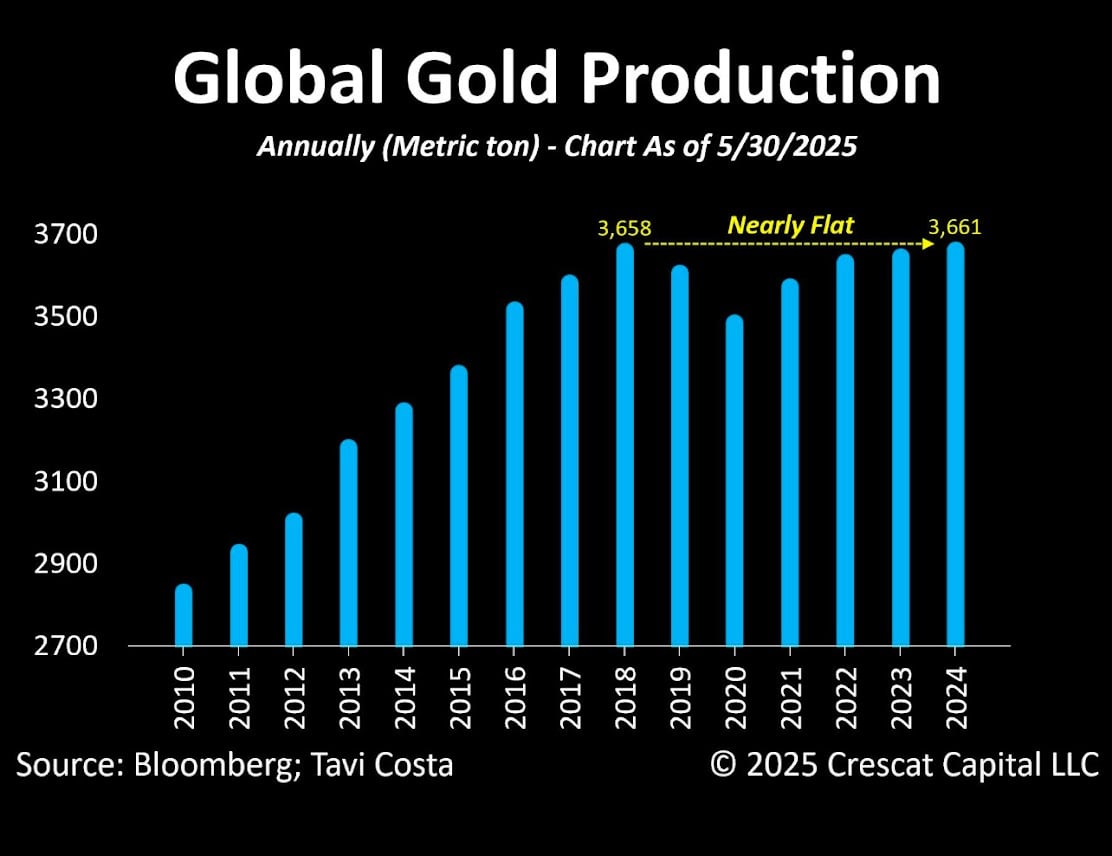
(Mike Maharrey, Money Metals News Service) Gold mine output has been basically flat since 2018. Could this signal that we are at or near “peak gold?”
Gold mines globally produced an estimated 3,661 tonnes of gold in 2024. It was a new record, but only 3 tonnes higher than the previous record set in 2018.
After slowing for several years, gold mine output fell by 1 percent in 2019. Although that year marked the first absolute decline in gold production since 2008, it continued a general trend of diminishing mine output.
Up until 2019, mine production had generally increased every year since the 1970s. There was a drop in production in 2008, but it was something of an anomaly, as it occurred at the onset of the 2008 financial crisis.
The return to 2018 mine output levels is encouraging. However, it’s too early to say that we have returned to an era of increasing mine output, and some industry insiders believe the plateau in recent years signals that we’re close to peak gold.
Peak Gold?
Peak gold is the point at which the amount of gold dug from the earth begins to shrink every year.
When the World Gold Council released its Gold Demand Trend report for 2022, it cautioned, “This lack of production growth gives further credence to claims that gold production is close to plateauing.”
Other players in the mining sector have raised concerns about the prospect of peak gold over the last several years.
That same year, MarketWatch asserted that we’re heading for “an impending gold production cliff” based on analysis by Sprott Asset Management. At the time, analysts said gold discoveries peaked in 2007, and a production peak would soon follow.
In 2017, World Gold Council Chairman Randall Oliphant cautioned that there are signs we’re reaching peak gold. He said in the near term, production is likely to plateau at best, before slowly declining as demand rises.
“We’re not going to fall off a cliff in the near term, but at the same time, it’s really hard to see how we’re going to produce enough gold to meet all this demand.”
At the same conference, Franco-Nevada Corp. CEO David Harquail said the gold mining industry was in an “ex-growth phase” where new mining projects are simply replacing older assets that are running out of ore.
In 2018, Goldcorp Chairman Ian Telfer said, “We’re right at peak gold here. … I don’t think there are any more mines out there, or nothing significant. And the exploration records indicate that.”
The following year, Deutsche Welle published an article headlined, “Is the World Running Out of Gold,” making the case for peak gold. The report highlighted the shrinking number of new deposit discoveries and declining ore grades.
“The largest and most prolific reserves have already been found,” Matthew Miller, an analyst at CFRA Research, told DW. “Gold miners are struggling to grow reserves in line with their production.”
According to a report According to a report by S&P Global analyst Paul Manalo released last fall, there have only been five major gold discoveries since 2020, totaling 17 million ounces of gold.
“The lack of quality discoveries in the recent decade does not bode well for the gold supply.”
South Africa provides something of a case study in peak gold. The country was once the world’s leading gold producer. In 2020, it dropped out of the top 10.
In December 2017, a study came out saying South Africa could run out of gold within four decades. Analysts said that at current production levels, the country only had 39 years of accessible gold reserves remaining.
There is cause for optimism. Technology advances could help mining companies identify new deposits and reach the more difficult-to-mine gold. The rising gold price could also boost exploration activity, leading to new discoveries.
However, Manalo projected that the gold supply would peak in 2026. He called the future trajectory of gold supply “a mixed bag.”
“The focus on old and existing assets has taken a toll on the number and size of discoveries in recent years, as proven by the lack of substantial discoveries in the last decade. However, the increasing gold budgets since 2017 bring a tad of optimism for the future of gold supply, as the number of initial resource announcements continue to grow in size and number.”
Whether we have reached peak gold or not remains debatable, but it’s clear that production has plateaued at least in the short term. Reversing the trend will require a significant industry focus on finding new deposits or developing methods to extract difficult-to-reach ore from the ground in a cost-effective manner.
Mike Maharrey is a journalist and market analyst for Money Metals with over a decade of experience in precious metals. He holds a BS in accounting from the University of Kentucky and a BA in journalism from the University of South Florida.
(Jesse Colombo, Money Metals News Service) Gold, silver, and mining stocks just had a stellar day, significantly improving their technical setups. Gold jumped 2.8% while silver surged 5.38%, driven by a weaker U.S. dollar and escalating trade tensions with China.
Over the weekend, President Trump accused China of violating a recent trade agreement and announced that U.S. tariffs on steel and aluminum would increase this week. Let’s take a look at the charts.
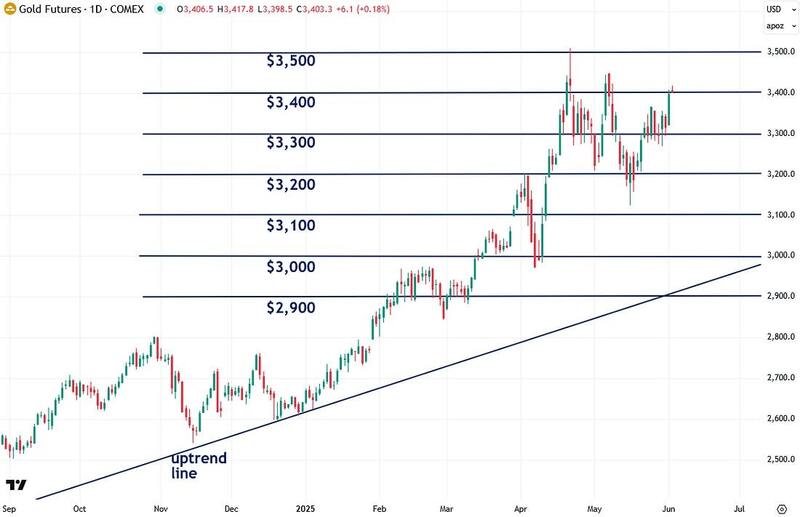
First, let’s take a look at gold via COMEX futures, which I follow closely due to its tendency to trade in clean $100 increments—creating strong support and resistance around round numbers like $3,000, $3,100, $3,200, and so on.
Yesterday’s surge pushed gold to a close just below the $3,400 level, which is an encouraging sign. However, I’d prefer to see a decisive close above $3,400 to confirm that further gains are likely on the horizon.
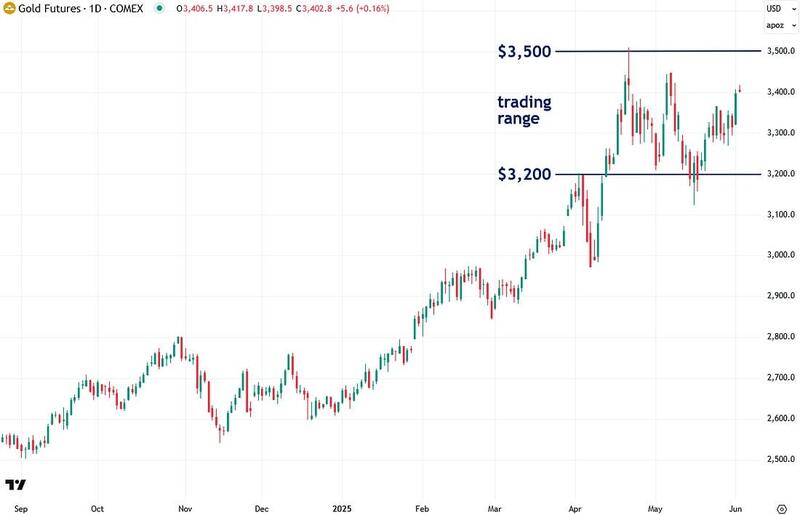
Gold remains in a healthy consolidation range between $3,200 and $3,500, pausing to catch its breath after strong gains earlier this spring. This sideways action may continue a bit longer, but a decisive breakout above $3,500 is the key signal I’m watching.
That would likely mark the start of gold’s next major leg higher—potentially targeting $4,000 next, given its significance as a major psychological milestone that tends to act like a magnet for price.
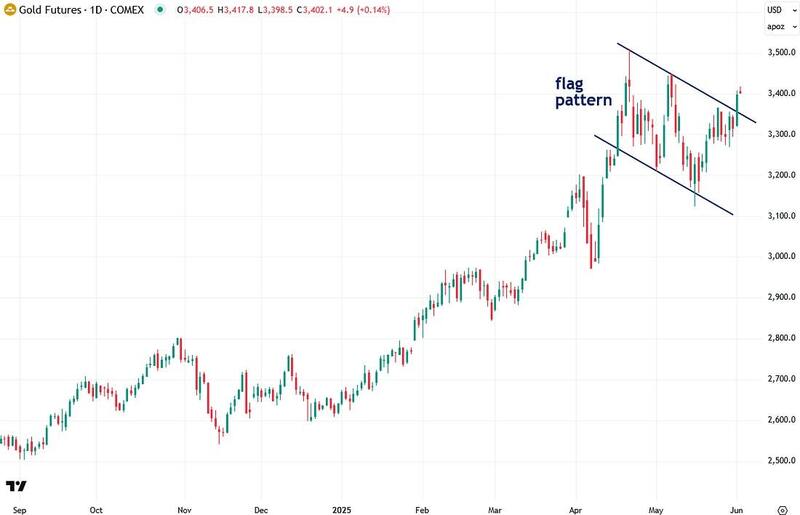
I also want to point out that gold had been forming a bull flag pattern over the past couple of months, and yesterday’s surge triggered a breakout—an encouraging development that deserves attention:
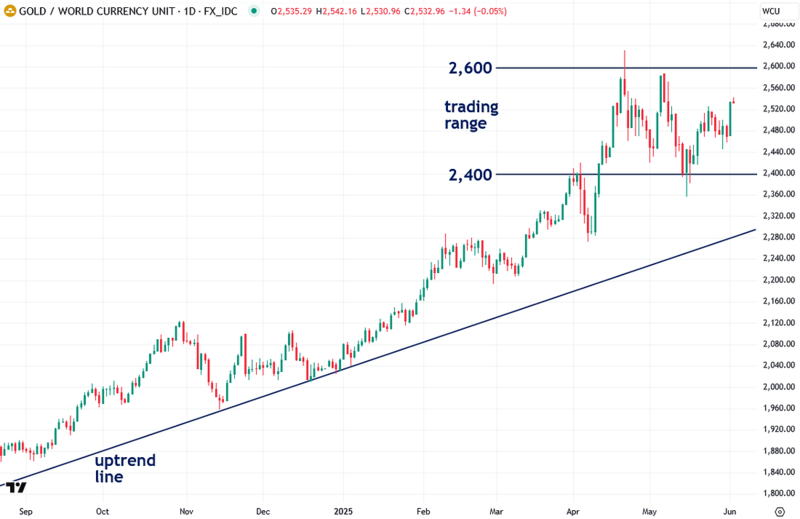
I’ve recently begun tracking gold priced in the World Currency Unit (WCU)—a composite currency based on the GDP-weighted average of the world’s 20 largest economies.
In many ways, it offers one of the most balanced and accurate reflections of gold’s true global performance, which is why I’ve been paying close attention to it.
Gold priced in World Currency Units (WCUs) clearly demonstrates that its uptrend remains strong, with a well-defined trading range between 2,400 and 2,600 that’s important to watch closely:
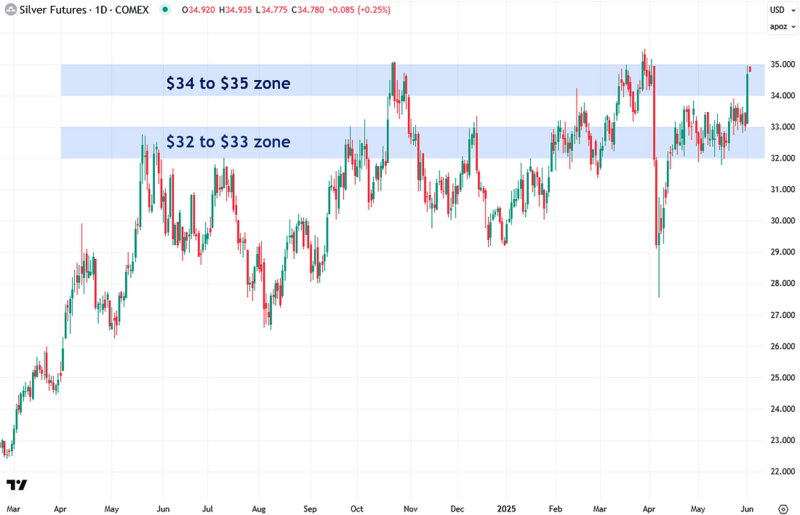
Now let’s turn to silver, which had an exceptional day. COMEX silver futures pushed cleanly through the critical $32–$33 resistance zone and continued into the $34–$35 zone, stopping just below the key $35 level.
A decisive breakout above $35 would likely mark the start of a powerful new silver bull market, as I outlined in a recent in-depth report. I’ll be watching this setup closely and keeping you updated—it’s shaping up very well.
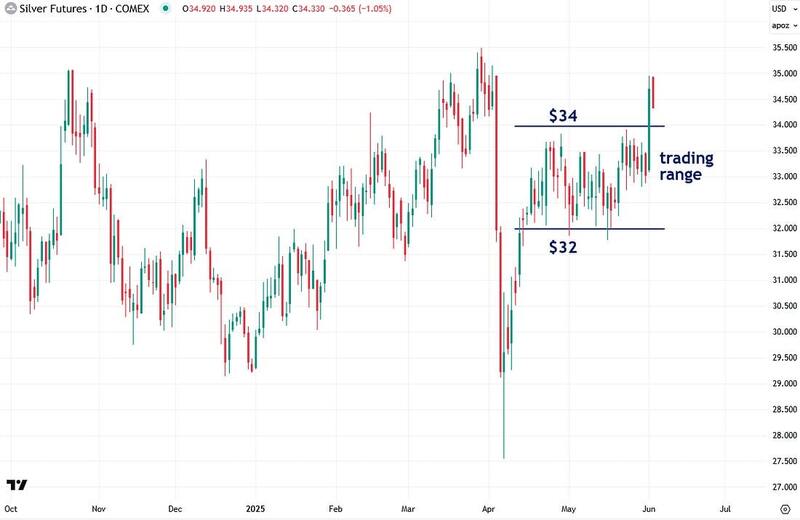
In recent updates, I’ve pointed out that silver had been trading in a range between $32 and $34. Yesterday’s surge broke it out of that range—a very encouraging sign for the bulls.
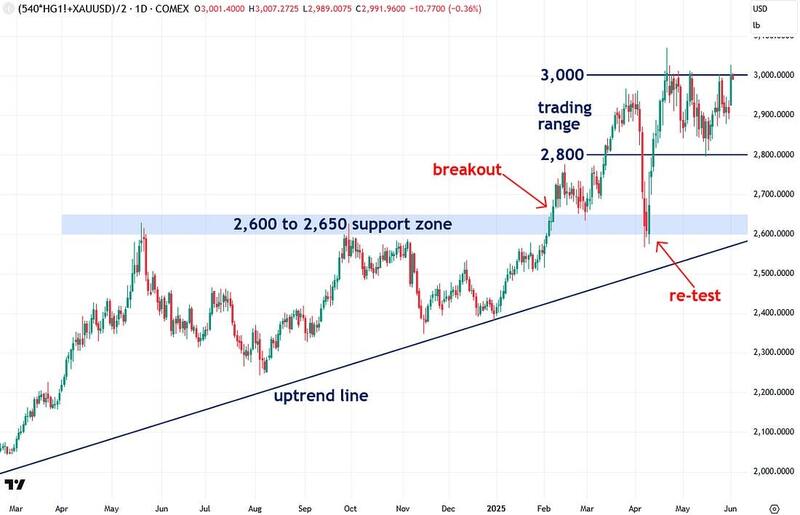
Next, let’s take a look at the Synthetic Silver Price Index (SSPI)—a proprietary indicator I developed to help validate silver’s price action and filter out potential false moves.
The SSPI is calculated as the average of gold and copper prices, with copper scaled by a factor of 540 to prevent gold from dominating the index. Interestingly, even though silver isn’t part of the calculation, the SSPI closely tracks its movements.
The SSPI remains in a consolidation range between 2,800 and 3,000. A breakout above the 3,000 level would be a strong bullish confirmation for silver.
Yesterday’s rally in both gold and copper pushed the SSPI right up to that 3,000 mark—an encouraging sign—but I’m waiting for a decisive close above it to confirm the breakout. I’ll be watching this development closely and will keep you all updated as it unfolds.
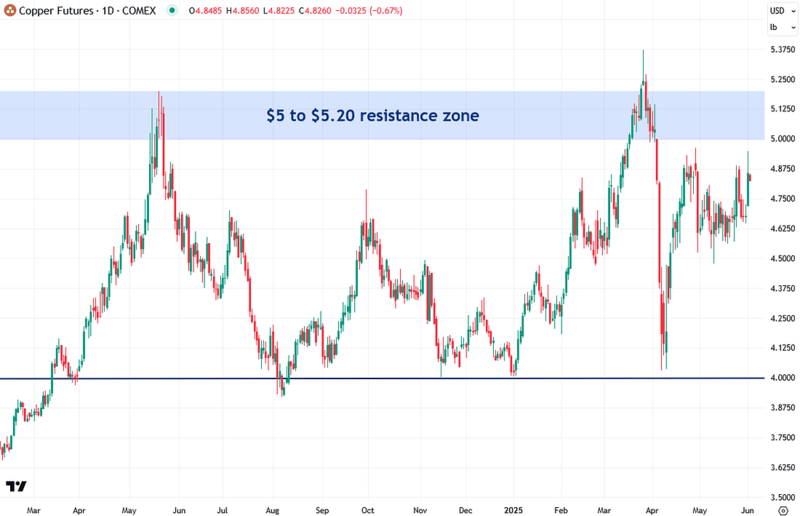
I also like to examine the underlying components of the SSPI to get a clearer sense of what’s happening beneath the surface. Since we’ve already covered gold, let’s now take a quick look at copper.
Copper is just under a major resistance zone between $5.00 and $5.20. A breakout above that zone would likely mark the start of a new copper bull market—one that would lift the SSPI and, by extension, silver as well. That’s because algorithmic trading systems arbitrage price relationships across metals, often causing their movements to align.
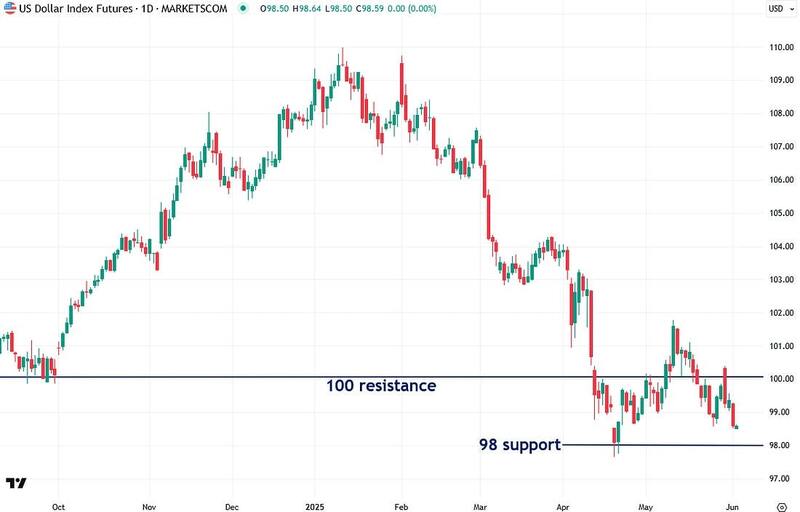
The latest round of tariff-related tensions with China triggered a drop in the U.S. dollar yesterday—a key driver behind the sharp moves in gold and silver, which, like most commodities, tend to trade inversely with the dollar. This weakness pushed the U.S. Dollar Index further below the critical 100 level.
I’ve recently shown it as a major threshold with important implications for precious metals. The next level I’m watching is the key support at 98. A decisive close below that would likely unleash a deeper wave of dollar weakness and should provide a powerful tailwind for gold and silver.
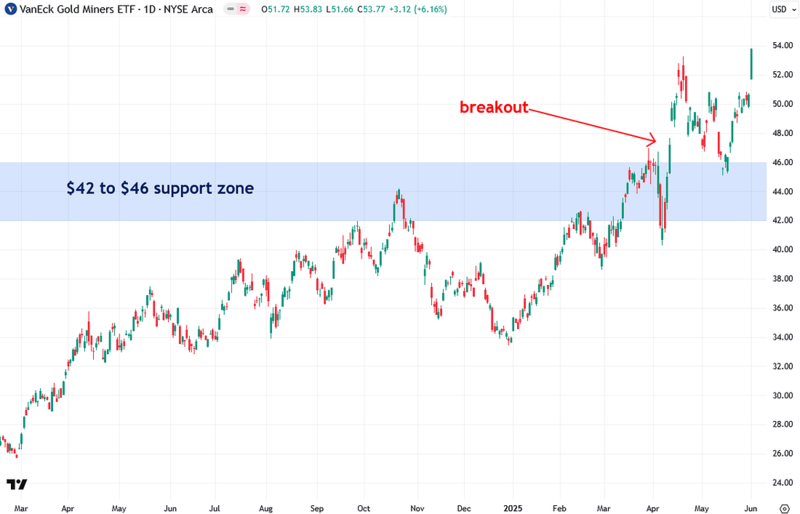
Next, let’s look at gold mining stocks, as tracked by the popular large-cap VanEck Gold Miners ETF (GDX). Notably, GDX recently broke above the $42–$46 resistance zone I’ve been highlighting—a strong signal that gold miners are finally coming to life.
Gold miners had a strong showing yesterday, with GDX surging 6.16%—another sign that we are likely on the verge of a major bull market in mining stocks.
After years of being deeply undervalued, they’re finally starting to attract attention and get bought up. I’m increasingly optimistic about the sector and will be writing more soon now that I have a much clearer read on their trajectory.
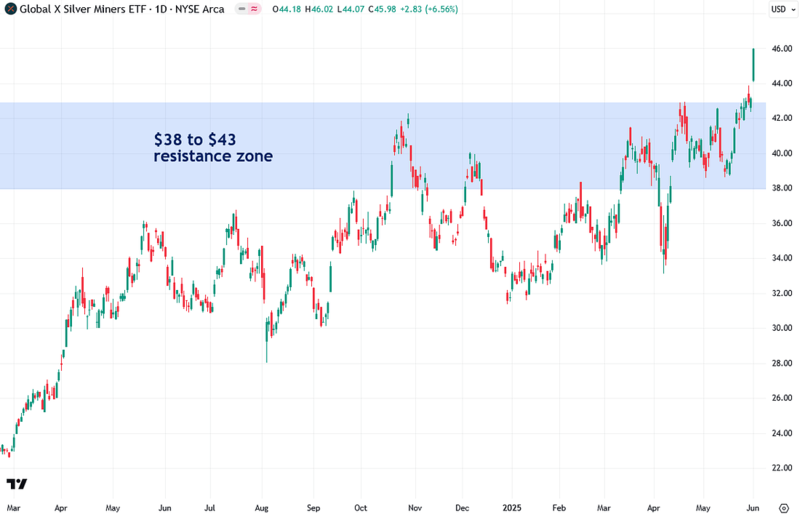
Silver miners, as tracked by the SIL ETF, had a strong day alongside silver itself—rallying 6.56% and finally breaking above the key $38–$43 resistance zone. This breakout indicates much more upside ahead, especially if silver can decisively clear the $35 level it has struggled with over the past year.
To summarize, the technical picture for gold, silver, and their miners has improved markedly following yesterday’s surge.
Silver, in particular, is finally showing real strength after a year of underperformance. I continue to watch for a decisive breakout above the key $35 resistance level, which I believe will trigger a powerful and sustained bull market.
Meanwhile, the U.S. dollar is showing additional signs of breaking down—driven in part by ongoing tariff-related tensions—which remains a major tailwind for precious metals. I’ll continue to keep you updated as this unfolds.
If you found this report valuable, click here to subscribe to The Bubble Bubble Report for more content like it.
Jesse Colombo is a financial analyst and investor writing on macro-economics and precious metals markets. Recognized by The Times of London, he has built a reputation for warning about economic bubbles and future financial crises. An advocate for free markets and sound money, Colombo was also named one of LinkedIn’s Top Voices in Economy & Finance. His Substack can be accessed here.
(Headline USA) Jonathan Joss, a voice actor best known for his work on the animated television series “King of the Hill,” was fatally shot near his Texas home, authorities said Monday.
Police were dispatched to a home in south San Antonio about 7 p.m. Sunday on a shooting in progress call. When officers arrived at the scene, they found the wounded 59-year-old near the street.
“The officers attempted life saving measures until EMS arrived. EMS pronounced the victim deceased,” San Antonio police said in a statement.
Joss’ husband, Tristan Kern de Gonzales, confirmed the actor’s death to The Associated Press in a text. The two were married earlier this year on Valentine’s Day.
In an email, San Antonio police did not immediately provide any information on what prompted the shooting.
In a statement, de Gonzales said he and Joss had previously faced harassment, much of it “openly homophobic.” Joss’ husband said the person who killed the actor yelled “violent homophobic slurs” before opening fire.
“He was murdered by someone who could not stand the sight of two men loving each other,” de Gonzales said.
Before the shooting, de Gonzales and Joss were checking mail at Joss’ home, which had been heavily damaged during a January fire that claimed the lives of their three dogs. A man approached the two and threatened them with a gun, de Gonzales said.
“Jonathan and I had no weapons. We were not threatening anyone. We were grieving. We were standing side by side. When the man fired Jonathan pushed me out of the way. He saved my life,” de Gonzales said in a statement.
After the shooting, authorities arrested 56-year-old Sigfredo Alvarez Ceja and charged him with murder in Joss’ death.
Court records did not list an attorney who could speak on behalf of Ceja, who was being held in the Bexar County Adult Detention Center.
In a statement, San Antonio police said its investigation “has found no evidence whatsoever to indicate that Mr. Joss’s murder was related to his sexual orientation.”
“We take such allegations very seriously and have thoroughly reviewed all available information. Should any new evidence come to light, we will charge the suspect accordingly,” police said.
Joss, who grew up in San Antonio, was best known as the voice of John Redcorn, a Native American character on the popular “King of the Hill” animated series that ran for 13 seasons from 1997 to 2008. A reboot of the show is set to start in August.
Joss also had a recurring role on the television show “Parks and Recreation,” playing Chief Ken Hotate. He appeared in two episodes of the series “Tulsa King” in 2022.
A GoFundMe page had been set up in January for Joss after the house fire. According to the page, Joss had lost all of his belongings in the fire, including his vehicle.
Before he was fatally shot, Joss had been in Austin, located about 80 miles northeast of San Antonio, for events related to a sneak peak of the “King of the Hill” revival.
On Saturday, Joss had posted a video on Instagram in which he said he was signing autographs at a comic book store in Austin.
“The fans get to revisit ‘King of the Hill’ again, which I think is an amazing thing because it’s a great show,” Joss said in the video, adding he had already done voice work on four episodes of the revival.
Joss’ husband said Joss was grateful for his fans.
“To everyone who supported him, his fans, his friends, know that he valued you deeply. He saw you as family,” de Gonzales said.
(José Niño, Headline USA) The Trump White House is reportedly awarding lucrative contracts to Palantir, a tech firm at the center of a growing debate over government surveillance and civil liberties.
The New York Times recently published a report detailing the administration’s contracts with Palantir, a controversial tech firm that is allegedly assisting Trump in developing a database of Americans’ private information. This data, collected from various government agencies, could theoretically be used to track or target individuals.
Creating detailed portraits of Americans based on government data is not just a pipe dream. The Trump administration has already sought access to hundreds of data points on citizens and others through government databases, including their bank account numbers, the amount of their student debt, their medical claims and any disability status. Mr. Trump could potentially use such information to advance his political agenda by policing immigrants and punishing critics, Democratic lawmakers and critics have said.
Per a report by opinion blogger Ja’han Jones, the White House did not respond to the Times’ request for comment, and Palantir declined to comment on its work with the Trump administration. Instead, the company referenced a blog post stating that organizations using its products “define what can and cannot be done with their data; they control the Palantir accounts.”
Palantir is among several private companies that have been vying for influence within the Trump administration. The company has been identified as a central figure in Trump’s mass deportation efforts, which have largely lagged thus far, as Headline USA reported.
Earlier this year, Palantir CEO Alex Karp gave investors a candid overview of the company’s extensive work for the Trump administration.
I’m very happy to have you along for the journey,’ Karp said. ‘We are crushing it. We are dedicating our company to the service of the West and the United States of America, and we’re super-proud of the role we play, especially in places we can’t talk about.’ ‘Palantir is here to disrupt,’ he continued. ‘And, when it’s necessary, to scare our enemies and, on occasion, kill them.’
Karp brings an unconventional background to the company’s leadership. Trained as a philosopher and lawyer, Karp holds a PhD from Goethe University Frankfurt and a law degree from Stanford. He co-founded Palantir in 2004 alongside Peter Thiel and has since positioned the company as a major player in data analytics for government agencies.
Known for his outspoken views and willingness to challenge Silicon Valley norms, Karp has been at the helm of Palantir during a period it has experienced significant growth, while also generating a fair share of controversy.
The evolving partnership between the government and technology firms like Palantir continues to raise important questions about data use and privacy, which could likely provoke a backlash among elements among the pro-privacy sectors of the Left and the Right.
José Niño is the deputy editor of Headline USA. Follow him at x.com/JoseAlNino
(Headline USA) A Wisconsin man is facing charges accusing him of forging a letter threatening President Donald Trump’s life in an effort to get another man who was a potential witness against him in a criminal case deported.
Prosecutors said in a criminal complaint filed Monday that Demetric D. Scott was behind a letter sent to state and federal officials with the return address and name of Ramón Morales Reyes.
Scott was charged Monday with felony witness intimidation, identity theft and two counts of bail jumping. His attorney, Robert Hampton III, didn’t immediately return an email from The Associated Press seeking comment.
The DHS touted the arrest this week of an illegal immigration who allegedly threatened to kill Trump, but it turns out that was likely a hoax. The illegal immigrant is set to testify in a trial against someone who assaulted him, and it's believed that the letter was sent to get… pic.twitter.com/TJpJxwkhJE
Immigration agents arrested Morales Reyes, 54, on May 21 after he dropped his child off at school in Milwaukee. Homeland Security Secretary Kristi Noem announced the arrest, saying he had written a letter threatening to kill Trump and would “self-deport” to Mexico. The announcement, which also was posted by the White House on its social media accounts, contained an image of the letter as well as a photo of Morales Reyes.
But the claim started to unravel as investigators talked to Morales Reyes, who doesn’t speak English fluently, and obtained a handwriting sample from him that was different from the handwriting in the letters, according to court documents.
Morales Reyes is listed as a victim in the case involving Scott, who is awaiting trial in Milwaukee County Jail on armed robbery and aggravated battery charges. The trial is scheduled for July.
Law enforcement officers listened to several calls Scott made from the jail in which he talked about letters that needed to be mailed and a plan to get someone picked up by Immigration and Customs Enforcement so Scott’s trial could get dismissed, according to the criminal complaint. He also admitted to police that he wrote the letters, documents said.
Morales Reyes works as a dishwasher in Milwaukee, where he lives with his wife and three children. He had recently applied for a U visa, which is for people in the country illegally who become victims of serious crimes, said attorney Kime Abduli, who filed that application.
Abduli told the Milwaukee Journal Sentinel on Monday that she was glad Morales Reyes was being cleared of any involvement in the letter writing.
His deportation defense lawyer, Cain Oulahan, wrote in an email Monday night that the main focus now is to secure Morales Reyes’ release from custody and the next step will be to pursue any relief he may qualify for in immigration court.
“While he has a U visa pending, those are unfortunately backlogged for years, so we will be looking at other options to keep him here with his family, which includes his three US citizen children,” Oulahan wrote.
(Headline USA) After a man threw two Molotov cocktails at pro-Israel demonstrators in Boulder, Colorado on Sunday, local law enforcement found at least 14 other unlit bombs, gasoline, and a backpack weed sprayer containing a potentially flammable substance nearby.
They also found paperwork with the words “Israel,” “Palestine,” and “USAID” inside of the suspect Mohammed Sabry Soliman’s Toyota Prius, according to an affidavit filed by the FBI. The paperwork did not provide more information about the USAID paperwork. USAID is the recently shuttered organization that had been funding a vast global network of liberal non-governmental organizations.
USAID Documents Found Among Boulder Illegal Muslim Terrorist’s Possessions
USAID is the largest funder of terror on the face of the earth.
Mohamed Soliman planned this attack for over a year. He told law enforcement authorities, he wanted "them all to die." He "had no regrets… pic.twitter.com/zWNVqc6aRO
— 🇺🇸 Pamela Geller 🇮🇱 (@PamelaGeller) June 3, 2025
Soliman said he dressed up like gardener with an orange vest in order to get as close to the group as possible, police wrote.
Witness Alex Osante said that after the suspect threw the two incendiary devices, apparently catching himself on fire as he threw the second, he took off his shirt and what appeared to be a bulletproof vest before the police arrived. The man dropped to the ground and was arrested without any apparent resistance in the video Osante filmed.
Six of the injured were taken to hospitals, and four have since been released, said Miri Kornfeld, a Denver-based organizer connected to the group.
Soliman told investigators he constructed the devices after doing research on YouTube and buying the ingredients.
“He stated that he had been planning the attack for a year and was waiting until after his daughter graduated to conduct the attack,” the affidavit says.
Soliman also told investigators he took a concealed carry class and tried to buy a gun but was denied because he is not a legal U.S. citizen.
No security at a Jewish event in a liberal city, in a heightened terror environment, at a time when the FBI is looking for any justification to redirect its counterterrorism resources towards antisemitism.
Authorities said they believe Soliman acted alone. He was also injured and taken to a hospital. Authorities did not elaborate on the nature of his injuries, but a booking photo showed him with a large bandage over one ear.
In video and photos shot right after the attack by a woman at the gathering, Soliman can be seen pacing without his shirt on with what appears to be burns down one of his arms. He and a small group of people around him are screaming at each other, with some witnesses filming him.
Soliman, who was born in Egypt, moved to Colorado Springs three years ago, where he lived with his wife and five kids, according to state court documents. He previously spent 17 years living in Kuwait.
McLaughlin said Soliman filed for asylum in September 2022 and was granted a work authorization in March 2023 that had expired. DHS did not immediately respond to requests for additional information.