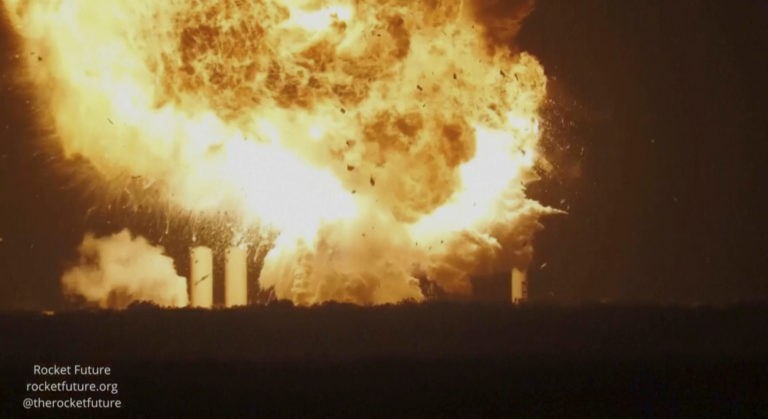
(Headline USA) A SpaceX rocket being tested in Texas exploded Wednesday night, sending a dramatic fireball high into the sky.
The company said the Starship “experienced a major anomaly” at about 11 p.m. while on the test stand preparing for the tenth flight test at Starbase, SpaceX’s launch site at the southern tip of Texas.
“A safety clear area around the site was maintained throughout the operation and all personnel are safe and accounted for,” SpaceX said in a statement on the social platform X.
It marked the latest in a series of incidents involving Starship rockets. On Jan. 16, one of the massive rockets broke apart in what the company called a “rapid unscheduled disassembly,” sending trails of flaming debris near the Caribbean. Two months later, Space X lost contact with another Starship during a March 6 test flight as the spacecraft broke apart, with wreckage seen streaming over Florida.
Following the back-to-back explosions, one of the 403-foot (123-meter) Starship rockets, launched from the southern tip of Texas, tumbled out of control and broke apart on March 27. SpaceX had hoped to release a series of mock satellites following liftoff, but that got nixed because the door failed to open all the way. Then the spacecraft began spinning and made an uncontrolled landing in the Indian Ocean.
At the time, SpaceX CEO Elon Musk called the launch “a big improvement” from the two previous demos and promised a much faster launch pace moving forward, with a Starship soaring every three to four weeks for the next three flights.
SpaceX said Wednesday night’s explosion posed no hazards to nearby communities. It asked people not to try to approach the site.
The company said it is working with local officials to respond to the explosion.
(Headline USA) A drug informant who helped the U.S. Drug Enforcement Administration build some of its biggest cases has been arrested and charged with scheming to extort major cocaine traffickers facing extradition from Colombia and the Dominican Republic.
Jorge Hernández, 57, was charged in a criminal complaint unsealed Wednesday with one count of conspiring to commit wire fraud. He remains in custody after being arrested and making his initial court appearance Wednesday in federal court in Fort Lauderdale.
Court papers allege that Hernández operated a scheme starting in 2020 in which he pretended to be a paralegal who, for the right price, could obtain lighter sentences for drug kingpins, according to 17-page FBI affidavit.
This photo provided by the Broward County Sheriff’s Office shows Jorge Hernández, 57, who was charged in a criminal complaint unsealed, Wednesday, June 18, 2025. (Broward County Sheriff’s Office via AP)
The FBI alleged that Hernández demanded payments of $1 million from six suspected drug traffickers who ended up surrendering or being extradited to the U.S.
In exchange for the payments — which came in the form of cash, jewelry, properties and vehicles in Colombia — Hernández guaranteed short prison sentences that would be served “in an apartment similar to being on house arrest,” the court papers said.
But Hernández never delivered on his promises, nor did he have authority to offer such leniency. As the traffickers who thought they were buying influence grew upset, he would deny responsibility and shift blame to the traffickers’ attorneys, the FBI said.
Nestor Menendez, an attorney who represented Hernández at his initial appearance, declined to comment.
In two decades as a confidential informant, Hernández had been one of federal law enforcement’s most prolific case-makers, providing the types of tips and information that led to prosecutions of high seas drug smugglers, a former University of Miami money laundering expert and a close ally of Venezuelan President Nicolás Maduro.
Better known in law enforcement circles by his Spanish nickname Boliche — bowling ball — the beefy, bald-headed Colombian was also the star witness in the 2023 bribery trial of two former DEA supervisors convicted for leaking information on ongoing drug investigations.
He got his start as an informant in 2000 shortly after he was arrested in Venezuela, where he had fled to escape drug dealers seeking to kill him, according to a 2023 investigation by The Associated Press.
After bribing officials to secure his release, he approached the DEA, admitting to killing three people during his days as a drug runner near his home along Colombia’s Caribbean coast. He then began helping the DEA build some of its biggest cases.
Agents grew so reliant on Hernández’s network of criminal associates across the Western hemisphere that they set him up with a phone and desk at a federal anti-narcotics task force, the AP found.
The DEA terminated his cooperation agreement in 2008, court records show, after authorities discovered he had threatened to expose informants as snitches unless they paid him to keep quiet.
But he kept close to some of his former DEA handlers and eventually returned to Miami. In 2016, he met DEA agent John Costanzo, who was supervising agents investigating Colombian businessman Alex Saab, a suspected bag man for Venezuela’s Maduro. In 2023, Hernández testified against Costanzo and another former DEA agent convicted of taking bribes from narco defense attorneys.
Hernández turned the tables on the DEA around the same time he was charged alongside University of Miami professor Bruce Bagley for helping move $3 million on behalf of Saab, who prosecutors said was secretly negotiating a deal to betray Maduro.
Those charges remain under seal. In the complaint unsealed Wednesday, the FBI that Hernández is serving a term of probation on a federal conviction for conspiracy to commit money laundering that is set to end in May 2027.
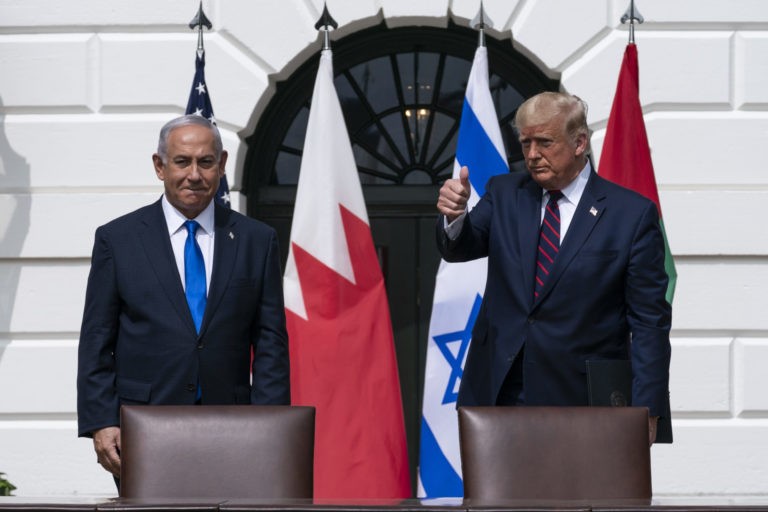
(Dave DeCamp, Antiwar.com) President Trump said on Wednesday that he told Israeli Prime Minister Benjamin Netanyahu in a phone call a day earlier to “keep going” with his attacks on Iran.
The president told reporters that Netanyahu, who is wanted by the International Criminal Court for his role in war crimes in Gaza, is a “good man” who has been treated “very unfairly” by his own country. “He’s a wartime president. Going through this nonsense — ridiculous,” Trump said.
Trump has told Netanyahu to “keep going” and to keep striking Iran.
Trump’s comments about Netanyahu come amid anticipation over whether or not the US will enter Israel’s war with Iran directly by launching airstrikes. The US has supported the assault by providing weapons and intelligence and intercepting Iranian missiles and drones, but so far hasn’t launched direct strikes of its own.
The president also said on Wednesday that “nobody knows” whether he’ll enter the war or not. When asked if he was moving closer on a decision to bomb Iranian nuclear facilities, Trump said, “You don’t know that I’m going to even do it. You don’t know. I may do it. I may not do it. I mean, nobody knows what I’m going to do. I can tell you this, that Iran’s got a lot of trouble.”
In other comments to the press, Trump said he wasn’t interested in an Israel-Iran ceasefire. “We’re not looking for a ceasefire. We’re looking for a total and complete victory. Again, you know what the victory is: no nuclear weapon,” he said.
Netanyahu launched his war of aggression against Iran under the pretext of preventing Iran from obtaining a nuclear weapon, but US intelligence assessed before the attacks that Tehran was not pursuing a nuclear bomb.
(Dave DeCamp, Antiwar.com) The Wall Street Journalreported on Wednesday that President Trump has told his top officials that he approved plans to attack Iran but is holding off on giving the final order for now.
Sources told the Journal that Trump was waiting to see if Iran would agree to give up its nuclear program, which is almost certainly not going to happen. Iranian Supreme Leader Ayatollah Ali Khamenei has rejected the US president’s calls for surrender, and Tehran’s position is that it won’t negotiate while under Israeli attack.
Iran also has no reason to trust the US at the moment since Trump backed Israel’s attack amid negotiations between Washington and Tehran. Trump has refused to say if he will launch airstrikes on Iran, telling reporters on Wednesday, “I have ideas on what to do, but I haven’t made a final—I like to make the final decision one second before it’s due.”
The Journal report didn’t specify what attack plans Trump approved, but it would likely involve US airstrikes on the Fordow nuclear plant, which is buried deep underground, making it impossible to do significant damage without US bunker buster bombs and the US heavy bombers needed to drop them.
Iran has made clear it would hit back if the US launches airstrikes, and many US bases in the region are in range of Iranian missiles. Trump could be planning to launch limited airstrikes to damage Fordow, but American casualties could lead the US into deeper involvement in the war.
Israeli officials are expecting the US to intervene with direct attacks on Iran soon. “The whole operation is premised on the fact that the US will join at some point,” an Israeli official told CNN on Tuesday.
Israeli Prime Minister Benjamin Netanyahu launched the war based on the pretext of preventing Iran from obtaining nuclear weapons, but US intelligence had assessed that Tehran wasn’t seeking a nuclear bomb.
(Mike Maharrey, Money Metals News Service) Powell & Company at the Federal Reserve sees an elevated stagflation threat. In response, they decided to do nothing.
The Fed held interest rates steady between 4.25 and 4.5 percent. Rates have remained at that level since last December.
The official FOMC statement was little changed from the May meeting. The committee emphasized that it is “attentive to the risks to both sides of its dual mandate.”
Powell remains convinced tariffs will boost price inflation. During his post-meeting press conference, he said everybody he knows is forecasting a meaningful increase in inflation due to tariffs.
“It will be someone in that chain that I mentioned, between the manufacturer, the exporter, the importer, the retailer, ultimately somebody putting it into a good of some kind or just the consumer buying it.”
Despite no sign of increasing inflation pressure in the CPI, Powell said it is in the pipeline and we shouldn’t expect it to manifest immediately.
“It takes some time for tariffs to work their way through the chain of distribution to the end consumer. … Ultimately, the cost of the tariff has to be paid. And some of it will fall on the end consumer.”
On the other side of the coin, the FOMC is clearly worried about a slowing economy. It lowered its growth forecast down by 0.3 percent, projecting a tepid 1.4 percent this year with price inflation rising to 3 percent.
And what do we call high inflation coupled with low growth?
Stagflation.
Meaningless Dot Plots
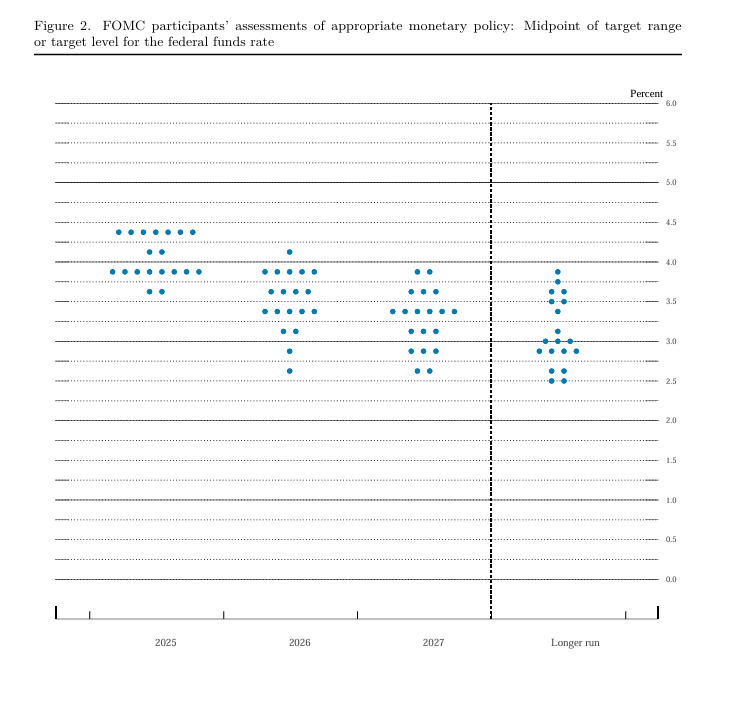
The FOMC also released its revised dot plot showing the projected trajectory of interest rates. It still calls for two rate cuts in 2025, but it eliminated one cut each in 2026 and 2027. If the Fed follows the forecast, there would be four cuts totaling 1 percentage point over the next three years.
Notably, the number of committee members projecting no rate cuts this year rose from four to seven.
While analysts tend to get all excited about these dot-plot forecasts, they are virtually meaningless.
Fed members are notoriously bad a projecting the trajectory of interest rates, even though they’re the ones literally setting the rates.
How bad is their track record?
Fund manager David Hay analyzed past dot plots and found the FOMC only got interest rate projections right 37 percent of the time. And as Hay pointed out, “They control interest rates!”
For instance, in March 2021, the FOMC projected the interest rate would still be zero in 2022. The actual 2022 rate was 1.75 percent. And in 2023, the vast majority of FOMC members thought the rate would still be at zero. The actual rate was over 5 percent.
The FOMC would probably get much better results by flipping coins or throwing darts at the wall.
Powell even indicated we should take their dot plots with a grain of salt.
“I think what you see people doing is looking ahead at a time of very high uncertainty and writing down what they think the most likely case is. No one holds these rate paths with a great deal of conviction, and everyone would agree that they’re all going to be data dependent.”
Is Holding Steady the Right Move?
The ugly reality is that there isn’t a “right move” for the Fed given the dynamics. It’s stuck between a rock and a hard place.
When central bankers are worried about economic growth, they typically ease rates for the stimulative effect. But this move elevates inflation. (Keep in mind that inflation isn’t rising prices. It’s an increase in the money supply. One of the results of this monetary inflation is price inflation.)
When central bankers are worried about inflation pressures, they tend to raise rates (or hold them steady).
What is a central banker to do when worried about both inflation and growth?
Nothing.
That’s exactly the path the Fed has laid out. Powell said the Fed is “well positioned to wait to learn more about the likely course of the economy before considering any adjustments to our policies.”
It appears the plan is to stand pat and then address whichever side of the mandate gets ugly first. If the CPI surges, rates will remain elevated, but if the economy begins to wobble, you can expect fast and aggressive cuts.
President Trump is not pleased with this approach. He wants rate cuts now. He blasted Powell before the meeting, calling him “a stupid person.”
“He probably won’t cut today. Europe had 10 cuts, and we had none. I guess he’s a political guy, I don’t know. He’s a political guy who’s not a smart person. But he’s costing the country a fortune.”
Trump is referring to the rising interest expense for the federal government. He also likely knows that this debt-dependent economy needs to stimulus to keep limping along.
Trump isn’t wrong. But he isn’t right either.
The Fed’s inaction is exactly what you would expect given the Catch-22 it finds itself in. It simultaneously needs to cut rates to prop up the easy money-addicted economy and hold rates steady (or even raise them) to keep inflation at bay.
Keep in mind that despite the cooler CPI readings over the last several months, inflation (as defined by a rise in the money supply) has been increasing for more than a year.
Powell and his fellow central bankers have been walking this tightrope for quite a while. He acknowledged it in April during a speech at the Economic Club of Chicago. As the AP described it, “The Fed would essentially have to choose whether to keep interest rates high to fight inflation or cut them to spur growth and hiring.”
“Our tool only does one of those two things at the same time,” Powell said during a Q&A session.
What is a central banker to do?
Wait and see.
Mike Maharrey is a journalist and market analyst for Money Metals with over a decade of experience in precious metals. He holds a BS in accounting from the University of Kentucky and a BA in journalism from the University of South Florida.
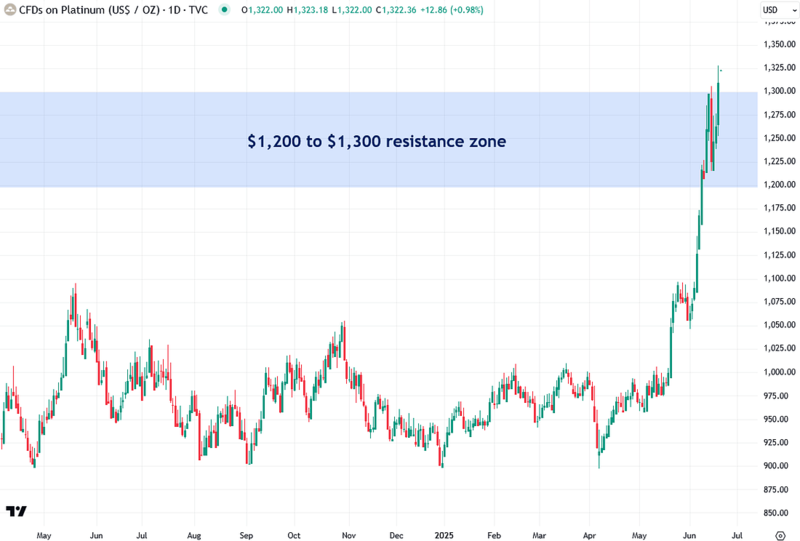
(Jesse Colombo, Money Metals News Service) After yesterday’s 4.49% surge, platinum has broken through the key $1,200 to $1,300 resistance zone that had been a major hurdle—an encouraging bullish signal.
Last week, I published a detailed report on the bullish case for platinum—even though my usual focus is on gold and silver. In it, I highlighted several bullish tailwinds: a nearly 1 million-ounce supply deficit over the past three years, historically low valuations, a strong technical setup, and rising demand from Chinese jewelry buyers who are increasingly turning to platinum as gold prices soar.
I also pointed out the key $1,200 to $1,300 resistance zone just overhead, noting that it could pose a short-term challenge—but that a breakout above it would signal further upside.
Well, after yesterday’s 4.49% surge—which brings platinum’s gains over the past three months to nearly 50%—it has decisively broken through that resistance, confirming its technical strength. Let’s take a closer look at where platinum stands now and what may lie ahead.
A look at the daily chart confirms that platinum initially struggled at the $1,200 to $1,300 resistance zone, just as I anticipated—but that struggle was short-lived. After yesterday’s rally, platinum now stands firmly above this critical zone:
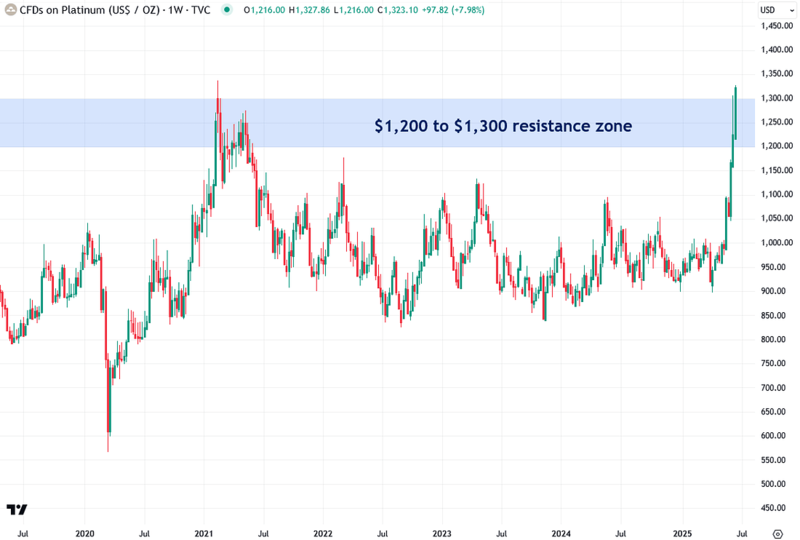
The weekly chart highlights the $1,200 to $1,300 resistance zone even more clearly than the daily chart—and shows that platinum is now trading above it. That said, I’d ideally like to see a strong weekly close above this zone, which we’ll find out at Friday’s close.
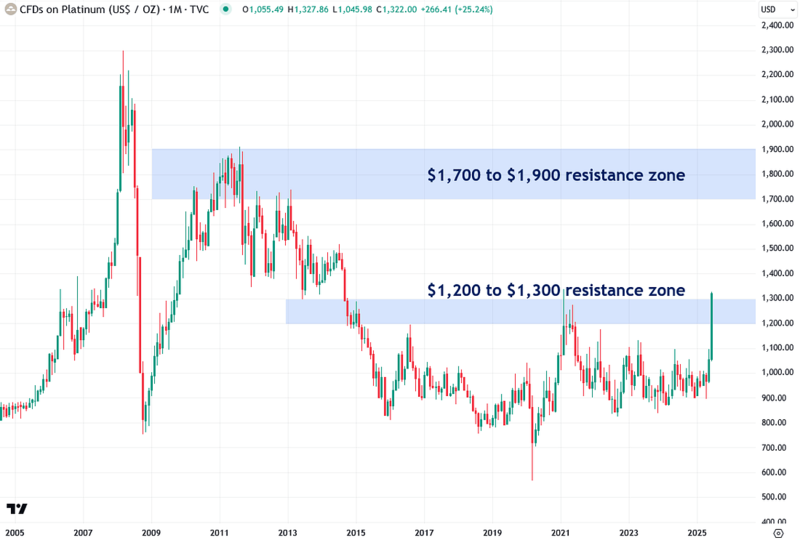
The long-term monthly chart, which spans the past two decades, also highlights the significance of the $1,200 to $1,300 resistance zone—initially established by price peaks in 2016 and 2021. While I’d ideally like to see a monthly close above this zone for added confirmation, platinum is already looking very strong following yesterday’s daily close.
The next major price target I’m watching is the $1,700 to $1,900 resistance zone, defined by peaks from the early 2010s. Considering how undervalued platinum remains—even after its recent rally—reaching that level shouldn’t be too difficult in the near future.
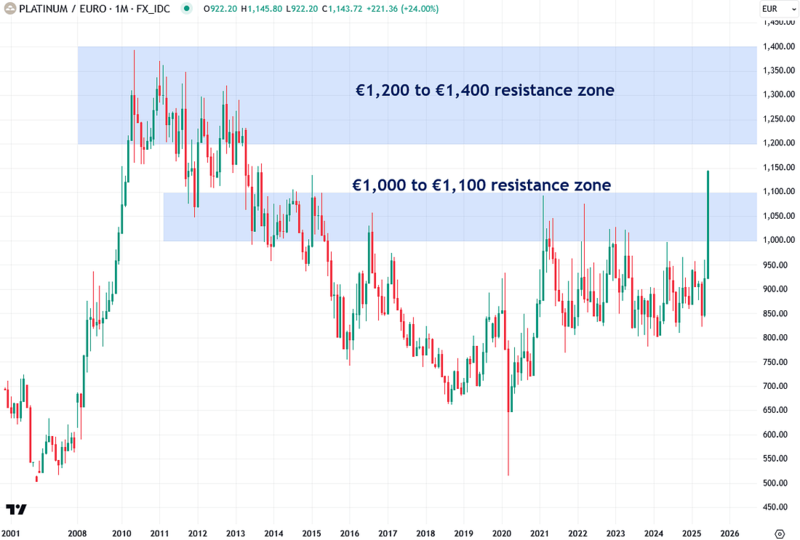
I also monitor precious metals prices in euros, as it removes the influence of U.S. dollar fluctuations and often reveals the underlying trend more clearly. In euro terms, platinum has just broken above the €1,000 to €1,100 resistance zone—a very encouraging sign.
The next target is the €1,200 to €1,400 resistance zone, which was formed by the highs of the early 2010s. A decisive breakout above that zone into blue-sky territory would be a powerful bullish signal, indicating even further gains likely ahead.
As a staunch precious metals and commodities bull, it’s both fascinating and encouraging to see platinum finally waking up in a big way after 15 years of stagnation—especially as it coincides with silver breaking out and gold holding strong, even as it consolidates after its earlier rally this year.
While platinum remains a niche investment and a much smaller market compared to gold and silver, I still welcome this development. It’s likely to draw increased investor interest and media attention to the broader precious metals space, which I believe still holds significant upside despite the strong gains over the past year.
If you found this report valuable, click here to subscribe to The Bubble Bubble Report for more content like it.
Jesse Colombo is a financial analyst and investor writing on macro-economics and precious metals markets. Recognized by The Times of London, he has built a reputation for warning about economic bubbles and future financial crises. An advocate for free markets and sound money, Colombo was also named one of LinkedIn’s Top Voices in Economy & Finance. His Substack can be accessed here.
(Money Metals News Service) This week’s Money Metals Midweek Memo podcast, hosted by Mike Maharrey, delivers a sharp and timely analysis of the accelerating global pivot away from the U.S. dollar and the growing strategic importance of gold.
Maharrey ties together current events, economic indicators, and monetary trends to highlight how central banks are stacking gold while American fiscal policy grows increasingly reckless.
From silver’s breakout to de-dollarization, the data points to a world quietly moving toward sound money—and away from the greenback.
Stanley Cup, Silver, and Real Value
The episode opens with a celebration of the Florida Panthers’ Stanley Cup victory, but Maharrey uses this to launch into a deeper point about value—particularly silver’s role in the real world.
The Stanley Cup may be priceless to players, but it’s also made from 459.74 troy ounces of silver, giving it a melt value of approximately $17,144 at current prices. The total estimated trophy value is around $650,000. In comparison, the NFL’s Lombardi Trophy—despite the NFL’s bigger commercial presence—has a melt value of just $3,800.
It’s a light-hearted way to re-emphasize a serious point: silver holds real value. When physical silver can account for tens of thousands in value in a single item, it speaks volumes about its utility as money—something fiat can’t match.
Silver Climbs, Gold-Silver Ratio Shrinks
Silver is on the move. It’s holding strong above $37 an ounce, and the next major resistance level sits around $37.50. If silver breaks through that, Maharrey expects a run to $50, its all-time high.
The gold-to-silver ratio is narrowing fast. Just weeks ago, the ratio stood at 103:1. Now it’s around 91:1, meaning it takes 91 ounces of silver to buy one ounce of gold. Historically, that ratio hovers closer to 60:1, and in past bull markets, it has dropped to 50:1 or lower.
Silver is finally playing catch-up. For over a year, investors have wondered why gold was running while silver lagged. Maharrey emphasizes this pattern is typical: silver often lags until later in a bull cycle, then surges ahead. Even now, it remains historically underpriced relative to gold. The discount is real—and the window is still open.
Oil Jumps, Treasuries Wobble
Tensions in the Middle East have again put upward pressure on commodities. After Israel’s strike on Iran, oil prices shot higher. Gas prices in central Florida jumped from $2.89 to $3.09 per gallon practically overnight.
Gold reacted predictably, rising modestly as a safe-haven asset. But one traditional safe haven didn’t—U.S. Treasuries. Instead of gaining in value, Treasury yields inched up, signaling weak demand.
This is not normal. During past geopolitical crises, investors fled to U.S. government bonds. Now, they’re hesitating. That suggests serious underlying concerns about U.S. debt levels, inflation, and political risk.
It also signals a paradigm shift—the bond market may no longer be the refuge it once was.
Germany Eyes Its Gold
One of the most telling developments in global finance is the renewed focus on gold repatriation. Germany, once content to store part of its national gold reserves at the New York Fed, is now facing mounting internal pressure to bring it home.
The German Taxpayer Federation recently sent a letter to the Bundesbank urging it to repatriate gold, citing U.S. political instability.
Their warning?
“Trump wants to control the Fed, which would also mean controlling the German gold reserve.”
The Bundesbank has downplayed the concerns publicly, but the pressure is mounting. Gold stored abroad—especially in a country whose fiscal policies are growing erratic—poses strategic risk.
More and more nations are beginning to realize: if you don’t hold it, you don’t own it.
Federal Deficits Blow Past Trillion Mark
The May 2025 deficit came in at a staggering $316 billion, the second-largest monthly shortfall this fiscal year. That brings the fiscal 2025 deficit to $1.36 trillion—and the year isn’t even over.
For perspective, the first trillion-dollar deficit in U.S. history occurred during the Great Recession under President Obama. Today, trillion-dollar deficits are business as usual—even without a crisis.
Government revenue actually increased in May—$371 billion, up 14.7 percent year-over-year. But spending still outpaced it massively, hitting $687 billion. Total federal outlays for fiscal 2025 have already reached $4.85 trillion, up 8 percent from last year.
Maharrey is blunt: the government doesn’t have a revenue problem—it has a spending problem.
Central Banks Are Buying Gold—Fast
Three consecutive years of central banks buying over 1,000 tons of gold signals something far bigger than a passing trend. In 2022, they purchased a record 1,136 tons, and 2024 was close behind—just 91 tons shy of that all-time high.
In the latest World Gold Council survey, 95 percent of central banks said they expect global gold reserves to rise in the next 12 months. Even more significantly, 43 percent of them plan to increase their own gold holdings—up from 29 percent a year ago.
This is not speculation. It’s a coordinated, global strategy.
Countries like China, Turkey, India, and Poland are leading the charge. And much of their buying, particularly from China, likely goes unreported. What we see officially is just the surface.
The Dollar’s Share Keeps Slipping
The U.S. dollar’s share of global reserves has dropped steadily over the past two decades. In 2002, it made up 72 percent of total central bank reserves. By the end of 2024, that number had fallen to 57.8 percent—a 30-year low.
Gold has now surpassed the euro to become the second-largest reserve asset globally. That shift is especially notable because the euro’s share has remained steady. It’s not the euro that’s shrinking—it’s the dollar being replaced.
Seventy-three percent of central banks now expect their dollar holdings to decline further over the next five years.
Why They’re Buying: Inflation and Sanctions
Emerging-market central banks say the top two reasons for buying gold are inflation concerns and geopolitical risk—particularly sanctions and weaponization of the dollar.
Gold is viewed as crisis-proof. It’s an asset that doesn’t rely on another party’s solvency. It doesn’t carry counterparty risk. And it can’t be frozen, seized, or debased.
As central banks fuel inflation through excessive money printing, they’re buying gold to shield themselves from the consequences of their own policies.
The Implications for You
The U.S. government relies on global demand for dollars. That demand props up borrowing and hides the inflation created by the Federal Reserve’s endless money creation. But as other countries start rejecting the dollar, those excess dollars will flood back home.
That means higher prices, rising interest rates, and mounting debt service costs.
Maharrey warns that this doesn’t require a dollar collapse. Even a modest drop in dollar demand is enough to trigger significant inflation at home. As investors demand higher yields, interest payments on the national debt will soar, forcing even more borrowing.
This is the largest, most sustained accumulation of gold by central banks since records began in 1950. These aren’t temporary hedges. They’re long-term, strategic shifts in monetary policy.
Even CNBC recently acknowledged that gold is being accumulated by countries concerned about sanctions and the potential erosion of major currencies.
We’re heading into a multi-currency world. The dollar will still matter—but less so. Maharrey predicts we’ll see more settlements in yuan, euros, and gold, along with the rise of alternative payment systems and decentralized trade frameworks.
That doesn’t mean collapse. It means gradual loss of dominance—and that’s more than enough to shake the foundations of U.S. economic stability.
What Central Banks Know—And You Should Too
Central banks are hoarding gold for the same reasons you should be: to hedge against inflation, reduce exposure to fiat risk, and take direct control of your wealth.
If they don’t trust fiat currency and are shifting out of dollars, you shouldn’t either. Gold and silver are the insurance policies against monetary malpractice. They’re the real money in a world drowning in debt.
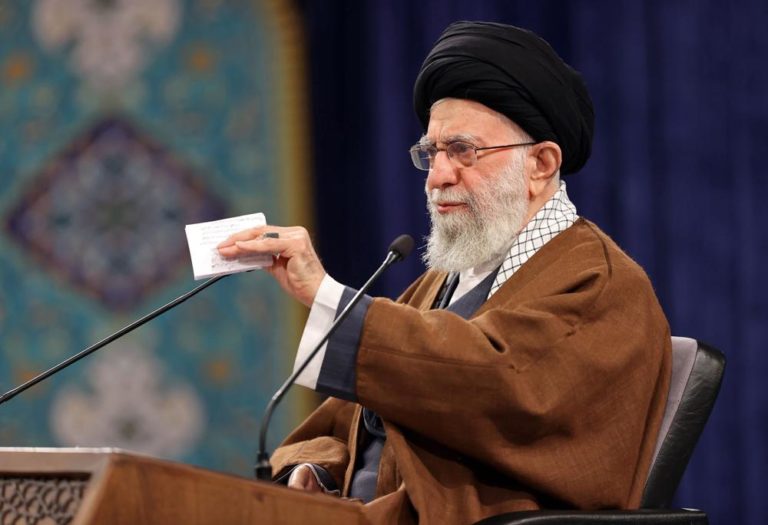
Trump has also threatened Khamenei, claiming the US was aware of his location but wasn’t going to kill him for the time being. “[Trump] has threatened us. Not only does he make threats, but he also uses absurd, unacceptable rhetoric to openly demand that the Iranian people surrender to him. When a person hears such things, it’s truly surprising,” Khamenei said in a televised address.
“It isn’t wise to tell the Iranian nation to surrender. Wise people who know Iran, the Iranian people, and Iran’s history would never utter such words. What should the Iranian nation surrender to? The Iranian nation isn’t a nation that surrenders. We haven’t attacked anyone, and we definitely won’t tolerate anyone attacking us, and we will never surrender in response to the attacks of anyone,” Khamenei said.
The US has supported Israel’s war on Iran by providing weapons and intelligence and by intercepting Iranian missiles and drones. So far, the US hasn’t launched direct airstrikes on Iran, but Trump is considering doing so, especially against the Fordow nuclear plant, which is buried deep underground.
“Of course, the Americans who are familiar with the policies of this region know that the US entering in this matter [war] is 100% to its own detriment,” Khamenei said. “The damage it will suffer will be far greater than any harm that Iran may encounter. The harm the US will suffer will definitely be irreparable if they enter this conflict militarily.”
Iranian ballistic missiles are believed to be able to do significant damage to US bases in the region. Trump was asked on Wednesday if he would launch strikes on Iran’s nuclear program, but wouldn’t say. “I may do it. I may not do it. Nobody knows what I’m going to do,” he said.
Israeli Prime Minister Benjamin Netanyahu launched the war under the pretext of stopping Iran from advancing toward a nuclear bomb, but US intelligence agencies had assessed there was no evidence Tehran was working to make a nuclear weapon, and the US was unconvinced by new Israeli intelligence.
Israel’s attack also disrupted negotiations between the US and Iran. Trump said on Wednesday that Iran had asked for a meeting at the White House, but the claim was rejected by Tehran, as Iranian officials have said they won’t negotiate while Israel continues its attacks.
“No Iranian official has ever asked to grovel at the gates of the White House. The only thing more despicable than his lies is his cowardly threat to ‘take out’ Iran’s Supreme Leader,” Iran’s mission to the UN said. “Iran does NOT negotiate under duress, shall NOT accept peace under duress, and certainly NOT with a has-been warmonger clinging to relevance.”
(Kim Jarrett, The Center Square) The FBI has settled litigation with a Tennessee newspaper over its previous refusal to release the manifesto written by the perpetrator of the March 2023 shooting at Covenant School.
The Tennessee Star and others sued the FBI for the release of Audrey Elizabeth Hale’s manifesto after the agency denied it during the Biden administration. Hale, a female who identified as a male, killed three children and three staff members in the shooting at the Nashville school before being shot and killed by responding officers.
Settlement negotiations over the release began after FBI Director Kash Patel took over the agency, according to the Wisconsin Institute of Law and Liberty.
The FBI released 120 pages of Hale’s writing in April. As part of the lawsuit settlement, the agency will pay $86,000 in legal fees to the law firm.
“Journalists everywhere should be willing to go to the mat to hold their government accountable, regardless of the story or who is in charge at the nation’s capital,” said Michael Patrick Leahy, CEO, editor-in-chief, and majority owner of Star News Digital Media. “We appreciate WILL for taking our case and fighting back against the Biden administration’s reckless and dangerous record retention policies.”
Matt Kittle, an investigative reporter with The Federalist, was also a plaintiff in the law firm’s suit.
“This settlement is a win for government transparency and efforts by real journalists to keep their government open and accountable,” said Dan Lennington, deputy counsel for the law firm.
(Luis Cornelio, Headline USA) The Democratic National Committee may soon find itself in the red and forced to take out loans just to keep operations running after its disastrous 2024 performance and internal fights over how to counter President Donald Trump’s second-term agenda.
The DNC’s financial woes were reported Wednesday by the liberal New York Times, which found that major donors have deserted the party since November.
The party’s cash reserve has decreased by $4 million from January through April, leaving just $18 million on hand.
In stark contrast, the Republican National Committee’s reserves grew by $29 million over the same period, totaling roughly $67.4 million, according to the Times.
DNC chair Ken Martin—who received a hefty pay increase when he took over the party in early 2025—confirmed the shortfall to the newspaper.
🚨 BREAKING: Ken Martin and the DNC are going underwater.
They may soon have to borrow money just to keep the lights on at the Democratic National Committee.
Turns out it’s not just Tim Walz who’s in over his head going to the national stage. pic.twitter.com/hVsSOyNTmQ
Acknowledging ongoing talks about taking out a line of credit to keep the party afloat, Martin said, “That’s certainly not our plan right now. I don’t know if we’ll have to at this point.”
The DNC’s humiliating cash crisis comes less than five months after Trump was sworn in for a second term on Jan. 20, following Republican holds of the House majority and Senate control.
As previously reported by Headline USA, the DNC has been roiled by a private and public feud between Martin and former DNC vice chair David Hogg, the Parkland shooting survivor turned influencer.
Hogg, who was expelled after his vice chair election was deemed out of line with the party’s DEI mandates, threatened to use outside funds to challenge incumbent Democrats in direct clash with the DNC’s mission to reelect its own.
Martin was left humiliated after a leaked conversation showed him questioning his ability to lead the party.