(Thérèse Boudreaux, The Center Square) As lawmakers begin crafting the 12 annual appropriations bills to fund the federal government in fiscal year 2026, Senate Minority Leader Chuck Schumer, D-N.Y., has implied that his party will refuse to cooperate in the process if Republicans revoke billions in funding from previous years.
The Senate is set to vote on a rescissions package that narrowly passed the House in June and would cancel already appropriated federal funds for public broadcasting and some foreign aid programs.
Republicans only need a majority vote for the legislation to pass the upper chamber. But Schumer warned GOP lawmakers in a Tuesday letter that passing the rescissions package will have “grave implications,” such as Democrats blocking any government funding deal and risking a government shutdown.
“[I]t is absurd for [Republicans] to expect Democrats to act as business as usual and engage in a bipartisan appropriations process to fund the government, while they concurrently plot to pass a purely partisan rescissions bill to defund those same programs negotiated on a bipartisan basis behind the scenes,” Schumer wrote.
Lawmakers never passed a fiscal year 2025 budget, instead passing three consecutive Continuing Resolutions (CRs) to keep government funding on cruise control until the end of the current fiscal year, Sept. 30.
The Rescissions Act of 2025, compiled by the Office of Management and Budget, requests the cancellation of $9.4 billion in federal spending deemed wasteful by the Trump administration. This includes $8.3 billion for non-lifesaving, “woke” foreign assistance and $1.1 billion for “politically biased” public broadcasting systems, including PBS and NPR.
Among other foreign aid projects, the GOP rescissions package would claw back $900 million from various USAID global health programs. OMB said the loss will not reduce treatment for HIV, AIDS, infectious diseases, or child and maternal health. Instead, it will zero out funding for programs related to population control and abortion, LGBTQ activities and equity programs.
Some of those clawbacks include $3 million for circumcision, vasectomies and condoms in Zambia; $6 million for “Net Zero Cities” in Mexico; and $5.1 million to strengthen the “resilience of lesbian, gay, bisexual, transgender, intersex, and queer global movements.” The bill also slashes funding for climate-based energy projects in developing countries, such as electric buses for Rwanda.
House Speaker Mike Johnson, R-La., has told reporters that the rescissions package is “the first of many” in Republicans’ “multifront war against the deficit.”
President Donald Trump has also asked Republicans to cut more than $163 billion from programs across federal agencies, especially programs related to DEI or climate initiatives.
(José Niño, Headline USA) Last Friday, a group of ten individuals launched a coordinated, armed assault on the Prairieland ICE Detention Center in Alvarado, Texas.
As Headline USA recently reported, authorities say the attack—which included vandalism, fireworks, and gunfire—led to the arrest of eight individuals, some wearing body armor, and is being investigated as a coordinated assault on federal property.
The attackers, described as “heavily armed with military gear, guns, AR-15 style rifles, 12 sets of Kevlar bullet proof vests, masks, goggles, tactical gloves, two-way radios, and helmets,” also carried Faraday bags—devices that block wireless signals and can thwart law enforcement tracking efforts.
In the chaos, a police officer was shot in the neck but is expected to survive. Inside the suspects’ vehicles, authorities recovered a flag reading “Resist Fascism. Fight Oligarchy” and flyers stating “fight ICE terror with class war”— language that tends to be associated with the radical Left.
Check out the sophistication of the Antifa-linked terror cell members in Dallas-Fort Worth charged with attempted murder after opening fire on an ICE facility in Alvarado on July 4th. They were heavily armed with military gear, guns, AR-15 style rifles, 12 sets of Kevlar bullet… pic.twitter.com/fOpvMw4ZFn
— Elizabeth MacDonald (@LizMacDonaldFOX) July 8, 2025
The sophistication of the operation and the anti-ICE messaging quickly fueled online speculation about the group’s ideological ties. Elizabeth MacDonald, a Fox Business journalist, amplified these claims on social media, writing:
“Check out the sophistication of the Antifa-linked terror cell members in Dallas-Fort Worth charged with attempted murder after opening fire on an ICE facility in Alvarado on July 4th. They were heavily armed with military gear, guns, AR-15 style rifles, 12 sets of Kevlar bullet proof vests, masks, goggles, tactical gloves, two-way radios, and helmets. Also had Faraday bags that block all wireless signals from law enforcement trying to track them. Blocks all GPS signals, calls, texts or pings. Agent shot in neck expected to survive. ‘Resist Fascism. Fight Oligarchy’ flag and ‘fight ICE terror with class war’ flyers were in their cars.”
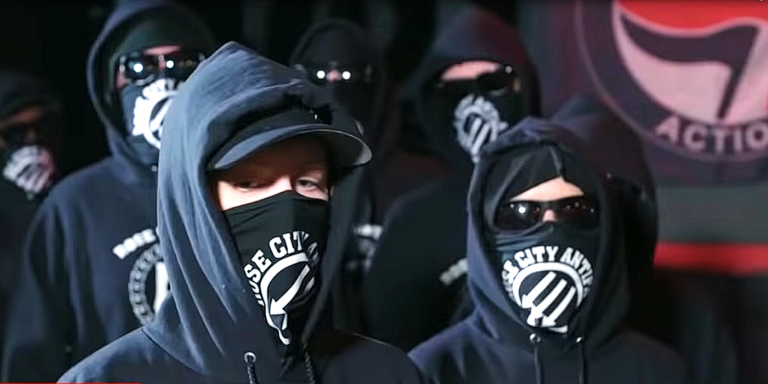
Despite the viral spread of the “Antifa-linked” label, a thorough review of federal charging documents, sworn affidavits, and official statements reveals no direct evidence connecting the suspects to Antifa at the moment. No court filings, Department of Justice press releases, or police statements mention Antifa or any formal antifascist group in relation to the defendants.
Instead, the charges focus on the violent conduct itself: three counts of attempted murder of a federal officer and three counts of discharging a firearm during a violent crime.
Authorities did recover anti-authoritarian slogans and left-wing revolutionary rhetoric among the group’s belongings.
However, none of Antifa’s distinctive symbols—such as the double-flag logo—were reported. Investigators have not cited any evidence of membership in, or communication with, known antifascist networks. The suspects’ coordination reportedly occurred online, but not through channels tied to established Antifa formations.
José Niño is the deputy editor of Headline USA. Follow him at x.com/JoseAlNino
(Ken Silva, Headline USA) A U.S. citizen arrested in central Mexico over the weekend with a number of guns, tactical equipment and a CIA identification is not a U.S. government employee and carried a fake ID, Mexico’s security chief said Tuesday.
The man was arrested Saturday in Atlacomulco, Mexico state, an industrial city 80 miles northwest of Mexico City. An anonymous caller alerted authorities that an armed man was acting aggressively on an apartment balcony.
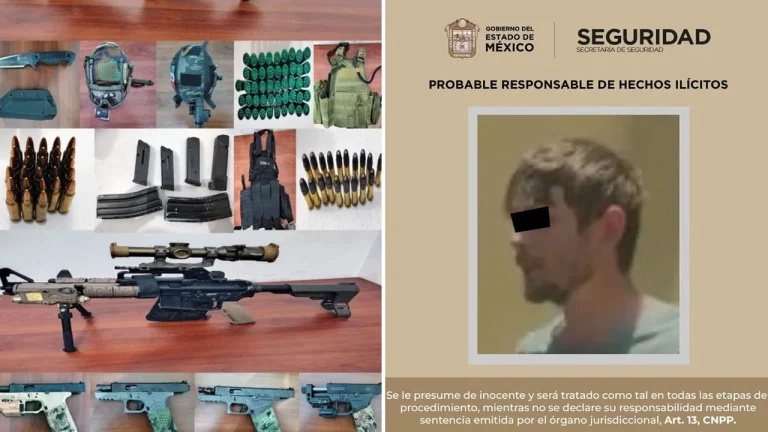
State authorities said at the time that he was wearing a helmet and a tactical vest, from which hung a rifle. He had a knife in his hand and a wound on his hand.
Mexico Security Secretary Omar García Harfuch said Tuesday that after checking with the U.S. Embassy, it was confirmed that he was “not an official nor public servant.” He is under investigation for weapons possession and authorities are investigating whether he is tied to an organized crime group.
The name of the man still hasn’t been released to the public.
Despite the denials that the man really worked for the CIA, the incident raises questions about whether the U.S. government is still flooding Mexico with illegal firearms. It comes more than 10 years after the revelations from Operation Fast and Furious—an Obama-era scandal where the purposely allowed illegal gun purchases under the guise of tracking organized crime.
In late 2023, Sen. Chuck Grassley released information suggesting that a Fast and Furious-type operation is still ongoing. An ATF whistleblower made a shocking disclosure to Grassley’s office in October 2023, alleging that an ATF investigator trafficked guns to Mexico for years, and that top bureau officials covered up his illegal activity.
According to the whistleblower, former ATF Investigator Jose Luis Meneses, a foreign national, admitted to engaging in trafficking numerous firearms for multiple years.
What's the most underrated government scandal of the 21st century, and why is it Operation Fast & Furious?
The whistleblower said that in May 2017, the ATF Deputy Attaché in Tijuana interviewed Meneses after ATF Mexico received a tip that he had trafficked numerous firearms into the country.
In the interview, Meneses admitted that for multiple years he ordered various firearms parts from the internet and retail stores in the U.S. to traffic into Mexico. Meneses claimed that he purchased enough firearm parts to complete eight AR-15-style rifles.
Meneses further admitted that he purchased and trafficked firearms for at least three people in Mexico: his brother who was a police officer, a state judicial official, and a man identified as “Romero,” a former member of the Mexican military.
According to allegations, the ATF terminated Meneses “without cause” and ultimately paid him a severance package after the termination.
“According to the ATF memo and whistleblower disclosures, ATF did not investigate whether Meneses had ties to Mexican cartels, whether ‘Romero’ was connected to the cartel, the full extent of Meneses’s trafficking network, whether he had co-conspirators both in the U.S. and Mexico, or if other ATF employees were complicit or involved in his criminal activity,” Grassley said in an open letter to the ATF.
“Whistleblower disclosures indicate that Meneses used his ATF issued devices and diplomatic vehicle to conduct some or all of his firearm trafficking into the U.S. because his diplomatic plates would not subject him to searches at the U.S. and Mexico borders.”
Neither Grassley nor anyone else in Congress have followed up on the matter.
The Associated Press contributed to this report.
Ken Silva is the editor of Headline USA. Follow him at x.com/jd_cashless.
(Headline USA) President Donald Trump leapt to the defense of Attorney General Pam Bondi on Tuesday in the face of mounting criticism from far-right influencers and conservative internet personalities over the Justice Department’s abrupt refusal to release additional documents from the Jeffrey Epstein sex-trafficking investigation.
When a reporter attempted to ask Bondi about Epstein at a White House Cabinet meeting, Trump headed off the questions and scolded the journalist: “Are you still talking about Jeffrey Epstein? This guy’s been talked about for years.”
“At a time like this,” he added, “where we’re having some of the greatest success and also tragedy with what happened in Texas, it just seems like a desecration.”
The comments appeared to signal continued job security for Bondi and amounted to a striking rebuke of members of Trump’s base who have called for her resignation and mocked her for what they believe to be her failed commitment to release incriminating files from the Epstein investigation. A supposed Epstein “client list” that Bondi once intimated was sitting on her desk for review does not exist, the Justice Department acknowledged in a two-page memo Monday that further riled conservative critics who’d been hoping for proof of a government cover-up.
The pressure is on Bondi
Bondi has faced pressure after a first document dump she hyped failed to deliver revelations. Far-right influencers were invited to the White House in February and provided with binders marked “The Epstein Files: Phase 1” and “Declassified” that contained documents that had largely already been in the public domain.
After the first release fell flat, Bondi said officials were poring over a “truckload” of previously withheld evidence she said had been handed over by the FBI and raised expectations of forthcoming releases.
But after a months-long review of evidence in the government’s possession, the Justice Department said in Monday’s memo that no “further disclosure would be appropriate or warranted.” The department noted that much of the material was placed under seal by a court to protect victims and “only a fraction” of it “would have been aired publicly had Epstein gone to trial.”
The only evidence disclosed as part of the memo was a video meant to definitively prove that the wealthy financier had taken his own life in jail in 2019, but even that disclosure did little to quiet conspiracy theorists who believe he was killed.
It’s not a happy development for online detectives
The department’s client list revelation was especially dismaying for conservative influencers and online sleuths given that Bondi in a Fox News interview in February had intimated that such a document was “sitting on my desk” for review. Bondi insisted Tuesday that she had been referring to the Epstein case file as being on her desk, as opposed to a specific client list.
“That’s what I meant by that,” she said.
She also defended her earlier public statements suggesting that the FBI was reviewing “tens of thousands” of videos of Epstein with “children or child porn.” The Associated Press published a story last week about the unanswered questions surrounding those videos and the Justice Department’s refusal to provide clarity.
The memo Monday did not suggest that the videos in the government’s possession depicted Epstein with children, instead referring to images of Epstein as well as more than 10,000 “downloaded videos and images of illegal child sex abuse material and other pornography.”
“They turned out to be child porn downloaded by that disgusting Jeffrey Epstein,” she said.
But she did not explain why the department could not release other files from the “truckload” of evidence she said was delivered to the agency months ago.
(José Niño, Headline USA) When President Donald Trump promised the “largest deportation operation in American history,” border cities across Mexico mobilized for a crisis. Local governments declared emergencies, federal authorities constructed shelters for thousands of anticipated deportees, and officials described the mood as a “zombie apocalypse scenario.”
Yet, five months into Trump’s second term, the reality on the ground tells a different story: the shelters are nearly empty, with some facilities mothballed due to low arrivals, according to a report by the Washington Post.
“We really thought we would be inundated,” said Rev. Patrick Murphy, who runs the Casa del Migrante shelter in Piedras Negras. In Tijuana, a party venue was converted into a reception center for up to 2,600 deportees, but the average daily arrivals have hovered around just 38 people. “The reality is, up until now, there haven’t been mass deportations,” confirmed Mónica Vega, the Baja California official overseeing the Tijuana shelter.
The pattern is similar across other border cities. Despite Trump’s aggressive immigration enforcement, which has sparked protests in U.S. cities, Mexican officials have been surprised by the low number of deportees.
The empty shelters highlight a striking irony: Trump’s policies have dramatically reduced the northbound flow of migrants by ending U.S. asylum programs and deploying more troops to the border, but this has also dried up the pool of recently arrived, easy-to-deport migrants. As a result, the administration has shifted focus to targeting long-term residents in the U.S. interior.
Precise deportation numbers are hard to verify. The Department of Homeland Security has stopped publishing monthly enforcement data, and independent analysts report that the actual number of removals is well below Trump’s stated goals.
While the administration claims over 239,000 deportations since January, analysts note this is fewer than the same period under President Biden. For perspective, during the five-month period from February through June last year, the Biden administration repatriated 341,060 people
Unless there is a significant increase in internal removal operations, Trump’s will likely far short of the 1 million annual target based on current projections.
As Headline USA has previously reported, the Trump administration has been critiqued by members of the populist Right like former State Rep. Anthony Sabatini, R-FL, who believe the administration is not fulfilling its mass deportations promise.
“Trump has already achieved his objective of closing the border,” said Tonatiuh Guillén, former head of Mexico’s immigration agency. However, the “resistance of communities, the opposition to government policies and the resistance of all kinds of associations—churches, lawyers’ offices—will act as a brake” on large-scale removals, Guillén argued.
Despite the slow start, deportations are beginning to accelerate as new resources come online.
The passage of President Trump’s budget reconciliation bill, officially known as the “One Big Beautiful Bill” (BBB) or “One Big Beautiful Bill Act,” has resulted in an unprecedented increase in ICE funding. The agency’s annual budget has increased from approximately $10 billion to more than $100 billion through 2029.
José Niño is the deputy editor of Headline USA. Follow him at x.com/JoseAlNino
(Mike Maharrey, Money Metals News Service) Through the first half of 2025, gold-backed funds globally reported the highest semi-annual inflows of metal since H1 2020 in the early months of the pandemic.
After modest outflows of gold in May, flows flipped positive in June with ETFs globally adding 74.6 tonnes of gold to their holdings.
Every region reported positive flows last month.
Through the first half of 2025, gold-backed funds globally increased their holdings by 397.1 tonnes.
Gold inflows totaled $38 billion through the first half of the year. That drove total assets under management (AUM) higher by 41 percent to $383 billion. That broke a month-end record and hit the highest level in 34 months.
North American funds led the way, increasing their gold holdings by 206.8 tonnes. Total H1 inflows totaled $21 billion. It was the strongest H1 for North American gold ETFs in five years.
A World Gold Council analyst said the current dynamics should continue to support North American gold ETFs.
“Persistent policy uncertainty and ongoing fiscal concerns are likely to remain an overhang on the market, which in turn could help support gold ETF demand in the near to medium term.”
European funds increased their gold holdings by 78.9 tonnes, totaling $6 billion through the first half of 2025. According to the World Gold Council, “The eighth cut from the European Central Bank, uncertainties surrounding growth, and rising geopolitical risks generally, contributed to gold ETF demand in several major markets.”
Asian ETFs increased their gold reserves by a record 104.3 tonnes in H1, totaling $ 11 billion. Asian investors bought a record amount of gold ETFs during H1, making up 28 percent of net global flows with only 9 percent of the total AUM.
China’s inflows of 85 tonnes totaling $8.8 were unprecedented, driven by spiking trade risks with the U.S., growth concerns, and the surging gold price.
Funds listed in other regions, including Australia and Africa, added 7.2 tonnes of gold to their holdings. ETFs based in Australia and South Africa were the main contributors.
ETFs are relatively liquid. You can buy or sell an ETF with a couple of mouse clicks. You don’t have to worry about transporting or storing metal. In a nutshell, it allows investors to play the gold market without buying full ounces of metal at the spot price.
Since you are just buying a number in a computer, you can easily trade your ETF shares for another stock or cash whenever you want, even multiple times on the same day. Many speculative investors take advantage of this liquidity.
But while a gold ETF is a convenient way to play the price of gold on the market, you don’t actually possess any gold. You have paper. And you don’t know for sure that the fund has all the gold either, especially when the fund sees inflows. In such a scenario, there have been difficulties or delays in obtaining physical metal.
Gold Trading Volumes
Gold market trading volumes averaged $329 billion per day through the first half of the year. That was the highest semi-annual average on record.
Over-the-counter trading increased to an average of $165 billion per day in H1, well above the 2024 average of $128 billion/day.
Exchange-traded volumes also saw a significant increase through H1, averaging $159 billion per day. Increased activity on COMEX and the Shanghai Futures Exchange helped drive this momentum.
Money managers reduced their long gold positions by 28 percent over the first six months. However, there was a notable shift in June, with longs increasing by 11 percent. According to the World Gold Council, “This was likely supported by consolidation in the gold price, providing investors with a window of opportunity to begin rebuilding positions.”
Mike Maharrey is a journalist and market analyst for Money Metals with over a decade of experience in precious metals. He holds a BS in accounting from the University of Kentucky and a BA in journalism from the University of South Florida.
(Brien Lundin, Money Metals News Service) I occasionally give presentations on gold and silver to audiences that aren’t familiar with the sector.
So I try to include as much of the basic rationale for owning the precious metals, stressing that there are two distinct reasons to do so — as insurance and as an investment.
To illustrate the importance of the former, I present this chart showing the depreciation of the Roman denarius silver coin through the history of the empire:
Almost without exception, their reaction is something along the lines of “That’s interesting…but it could never happen here.”
To which I respond, it already has:
Purchasing Power of the U.S. Dollar
The realization that the U.S. dollar has experienced a loss of purchasing power that was almost identical to that of the Roman denarius — which was directly associated with the collapse of that empire — really wakes up an audience of investors who have never been aware of what has been happening around them.
The chart of the denarius is a bit misleading, as there are a few 60-year periods that mirror the experience of the last 60 years with the U.S. dollar.
In fact, my choice of 1965 as the starting point for the dollar chart above was not arbitrary: It is the date that silver was removed from U.S. coinage.
In other words, what took centuries for the denarius was done with one fell swoop with the dollar!
I was reminded of this recently when my long-time friend and economic historian, Gary Alexander, published a column for Louis Navellier on the 60th anniversary of silver’s removal from coinage.
I hadn’t realized that the anniversary was coming up — it was announced in June of ’65 and went into effect in July of that year.
But no anniversary of any significance escapes the steel-trap mind of Gary…and he duly reported on the event with his usual flair:
Modern Monetary Theory (MMT) is a new term (since 1993) for printing paper money out of thin air, but coin-clipping is as old as time. In fact, a major milestone in fiat money took place 60 years ago, on June 3, 1965, when President Lyndon B. Johnson wanted to push all his federal chips in on “Guns and Butter” to fund the Vietnam War to the full, while sending men on rockets to the moon and expanding welfare spending to the max (ending poverty!) and inventing new entitlements (Medicare and Medicaid), which have made cutting federal spending practically impossible, as we have seen in the resistance to DOGE.
Inflation Has Soared 10-fold (and Gold is up Nearly 100-Fold) Since 1965
There’s a great deal of jawing about whether current politicians are “following the Constitution” these days, but I can read. I’m an editor by training, and when I read the Constitution, it does not authorize our unbacked fiat money, nor our unlimited “Guns and Butter” spending since 1965, which have thrown us into a $37 trillion debt hole and unprecedented 10-fold inflation. In fact, the Constitution prohibits it.
The Constitution did not vest our federal or state governments with any authority to issue unbacked paper money, which the Constitution termed “bills of credit.” The nation’s then-recent (1778) experience with worthless cardboard money during the American Revolution led to the highest inflation in our history, so Article I, Section 10 said: “No State shall…emit Bills of Credit; make any Thing but gold and silver Coin a Tender in Payment of Debts.” That’s about all the Constitution has to say about what real money is.
There was virtually no inflation in America’s first 150 years, except for the Civil War and a few other brief outbreaks, but the truly rapid attack of inflation came after President Johnson took silver out of America’s coins as a result of the Coinage Act of June 3, 1965, which LBJ signed into law on July 23.
Like President Nixon’s later abandonment of the gold standard (in 1971), this move came due to pressure on the fixed price of silver (capped at $1.29), causing hoarding of silver coins. This hoarding (saving?) caused LBJ to ask Congress to authorize him to take silver out of our dimes and quarters and create a 40% silver-clad Kennedy half-dollar. On signing the bill, LBJ warned against hoarding any silver coins:
“If anybody has any idea of hoarding our silver coins, let me say this. Treasury has a lot of silver on hand, and it can be, and it will be used to keep the price of silver in line with its value in our present silver coin. There will be no profit in holding them out of circulation for the value of their silver content.”–LBJ, 1965.
He was dreaming (or more likely, knowingly fibbing, since silver was fast disappearing). Gresham’s Law, named after Thomas Gresham, financier to Queens Mary I and Elizabeth I, was a 400-year-old axiom that said, “Bad money drives out good,” meaning people will naturally hoard silver or gold and spend the debased coins. Within three years, silver was trading at $2.56, twice its 1965 price, then it hit $50 in 1980.
Inflation began to soar after gold (1933) and silver (1965) were taken out of our coins. When the Federal Reserve was born in 1913, the Consumer Price Index (CPI) was set at “10.” Through two world wars and a postwar boom, the CPI only tripled after 50 years, reaching “30” in 1963. In my first job as a freshman college janitor in 1963, I earned 90-cents an hour, under minimum wage, and tuition was $480 per year.
In the 60 years after the removal of silver from our coinage, the CPI grew 10-fold, from 31.6 during the summer of 1965 to 317.8 at its last reading, in March 2025. The dollar is down 98.9% to gold.
The Cheapest Insurance You Will Ever Buy
We complain all the time, but the skyrocketing costs of home insurance (and for me and my friends down here in New Orleans, flood insurance!).
But there’s one type of insurance you can buy that is always cheap — gold.
Consider the advantages of this insurance:
You only have to pay the premium once…
It always pays off full value (if not more) and…
It protects you not against a possible calamity, but one you know is going to occur: the loss of purchasing power in your currency.
History shows clearly that, over broad swaths of time, gold has always protected people from the depreciation of their currency. This is as true today as it was in ancient Rome and every other civilized society.
Consider what gold has done against the dollar, as it lost 90% of its purchasing power during that period after silver was removed from our coinage:
Of course, if you’re buying gold as an investment, you need to consider the current price level and how far it’s already run. Fortunately, silver and mining stocks have lagged and still remain long-term values…which is why new investors coming into the sector are focusing on those areas.
But if you’re buying gold as insurance for your wealth (and you should!), you needn’t concern yourself with the current price.
That’s because you can lock in the current purchasing power of your dollars by buying gold with those dollars (hat tip to my friend Robert Helms for this clarity).
The lesson is that human nature never changes. That means governments have always and will always debase their currencies. It also means that we’re prone to procrastination in protecting ourselves against this certainty.
To get Brien Lundin’s ongoing commentary on the markets at no charge, click here to subscribe to his free Golden Opportunities newsletter.
Brien Lundin is the publisher and editor of Gold Newsletter, the publication that has been the cornerstone of precious metals advisories since 1971. Mr. Lundin covers not only resource stocks but also the entire world of investing. He also hosts the annual New Orleans Investment Conference. To get Brien Lundin’s ongoing commentary on the markets at no charge, click here to subscribe to his free Golden Opportunities newsletter.
(Mike Maharrey, Money Metals News Service) The Federal Reserve’s Washington, D.C. headquarters is getting an expensive facelift, and it appears Fed Chairman Jerome Powell lied about it to Congress.
According to reporting by the New York Post, the cost of the taxpayer-subsidized renovation approved in 2019 has ballooned by nearly 32 percent. The original estimate called for spending $1.9 billion. The price tag has reportedly soared to over $2.5 billion due to significant cost overruns.
Meanwhile, the Fed is hemorrhaging money. It reported a $77.6 billion operating loss in 2024, including unrealized losses on its Treasury and mortgage-backed security holdings totaling $1.06 trillion.
Former Fed board member and current Dartmouth College economics professor Andrew Levin has criticized the Fed for the opulent nature of some of the renovations, likening the central bank to the French monarchy.
“The Federal Reserve is building the Palace of Versailles on the National Mall.”
According to the Post, the plan calls for “rooftop garden terraces, skylights, ornate water features, and a new elevator system that allows board members to be dropped off directly in their VIP dining suite.”
Former White House Office of Budget Management staffer Joe Grogan called the cost of the renovations “crazy.”
“It’s a long-held axiom that any time a corporation builds an extravagant new headquarters, it’s time to sell the stock,” said Grogan, who oversaw domestic healthcare spending of $1.3 trillion during his two-year stint at the spending watchdog.
“Let’s hope the Feds’ new HQ doesn’t mean that we’re headed for a crash.”
In April, Levin called on Congress to “put its foot down and take a closer look at this to determine what authority the Fed has to spend this on its buildings.”
Did Powell Lie?
Levin got his wish last month when the Senate Banking Committee grilled Powell about the renovations.
Under questioning during a June 25 hearing, the Fed chairman called the New York Post report “misleading and inaccurate.”
“There’s no VIP dining room. There’s no new marble. There are no special elevators. There are no new water features, there’s no beehives, and there’s no roof terrace gardens.”
Powell also brushed off concerns about the cost overruns, saying they “are what they are.”
According to the Post, Powell’s statement contradicts publicly available planning documents on file at the National Capital Planning Commission. The plans were signed off on in 2021, and there is no indication that they were ever revised.
One excerpt in the filing reads, “The private dining rooms on Level 4 (of the Fed’s Eccles building) will be restored.” Another excerpt states, “The Governors’ private elevator will be extended to discharge at the dining suite level.” According to the Post, the documents also expressly mention “vegetated roof terraces” that will welcome “urban wildlife and pollinators” as well as new marble and water features.
Echoing Levin’s sentiments, Senate Banking Committee Chair Sen. Tim Scott (R-S.C.) said the “luxury upgrades” to the Fed building “feel more like they belong in the Palace of Versailles.”
Levin called on Congress to punish the Fed chair for lying.
“A top Fed official cannot be permitted to make false statements under oath at a congressional hearing. Such statements must be promptly corrected, and in egregious cases, subject to censure by the Senate.”
Sen. Cynthia Lummis (R-Wyo.) told the Post that Powell “was clearly not prepared for his testimony and should be embarrassed.”
“He made a number of factually inaccurate statements to the Committee regarding the Fed’s plush private dining room and elevator, skylights, water features, and roof terrace. This is typical of the mismanagement and ‘don’t bother me’ attitude that Chair Powell has always shown.”
If Powell can play fast and loose with the truth about renovation costs before a Senate committee, what else is he lying about?
One can’t help but think back to all those times the Fed chair insisted inflation was “transitory.”
Mike Maharrey is a journalist and market analyst for Money Metals with over a decade of experience in precious metals. He holds a BS in accounting from the University of Kentucky and a BA in journalism from the University of South Florida.
(Resource Stock Digest, Money Metals News Service) Gerardo Del Real of Resource Stock Digest sat down with Stefan Gleason, president of Money Metals Exchange and a longtime advocate for sound money stewardship and smart precious metals ownership.
The interview dug into why Money Metals is one of the most trusted firms in the sector and how they’re helping investors protect and grow their wealth. Not only does he help clients buy and sell gold, silver, copper, palladium, platinum, and rhodium, he also helps them invest through IRAs, borrow against their metals, or store them in North America’s largest private vault.
They discuss Empress Royalty (TSX-V: EMPR)(OTC: EMPYF) and why Stefan sees the small-cap as a standout in the royalty and streaming space thanks to its profitability, disciplined strategy, and world-class backing.
Gerardo Del Real: This is Gerardo Del Real with Resource Stock Digest. Joining me today is a gentleman that, frankly, does not need an introduction — but I will provide a brief one anyway. He’s the president of the Money Metals Exchange and a director of the Sound Money Defense League — Mr. Stefan Gleason. Stefan, it’s so great to have you on. How are you, sir?
Stefan Gleason: Great, thanks, Gerardo. I’ve been watching you for years, so it’s great to finally meet you.
Gerardo Del Real: I appreciate the kind words. I mentioned off-air that I feel like I know you because I see so much of your work and your interviews — and so the sentiment is equal. Thank you for taking the time.
I have been incredibly fortunate in my career to have people be really kind with their time and their knowledge. And the past month has been a really great example of that. I had the pleasure of interviewing David Rhodes, who I know you’re familiar with. And just last week I had the pleasure of meeting and interviewing — I should say — Mr. Rick Rule. And now I get to interview you.
I was sitting here thinking earlier, ‘These three have a lot in common as far as philosophy goes.’ You’re all three Sound Money advocates. You all three like the royalty streaming model.
And it kind of hit me the other day — I was talking to a friend and mentor of mine — that all three of you are substantial shareholders of this small company, royalty and streaming company, of course, called Empress Royalty Corp.(TSX-V: EMPR)(OTC: EMPYF).
I want to talk Money Metals Exchange, and I want to get your thoughts on the best way to own precious metals in this turbulent — but what I think is going to be a very profitable — time for those that position correctly.
But I have to get your thoughts. It’s a heck of a coincidence that all three of you are involved with the company. I’m familiar with the team — it’s a phenomenal team — but I want to get your take as to how you got involved and why you got involved in such a pronounced way.
Stefan Gleason: Sure. In the case of Empress — I’ve always been a huge fan of royalty companies because of the benefits of getting exposure to the best part of the mining industry without the downsides.
You’re not taking on that other risk that comes with most mining companies — you know, the government risk, the operational risk, the exploration capital costs and everything. And it’s basically just taking a percentage right off the top, and you don’t have to put in any extra money other than the initial investment.
I’ve always favored royalty companies because of that superior model. It’s really geared to harness the best aspects of mining and eliminate the worst.
In fact, inflation is your friend. Even if a project is delayed, that can be not necessarily bad — because the prices are higher in the future, and you’re getting a percentage of that right off the top.
I’ve always liked royalty companies for a variety of reasons. I think it’s the best way to invest in that sector because it’s such a difficult area — the mining industry in general. So that’s, for me, the best way.
And I like the smaller royalty companies in particular, because I don’t think the market really recognizes the smaller ones — because they haven’t reached critical mass. They haven’t been discovered by most investors, and so they’re trading usually at a discount.
As they mature and add projects — and have cash flow expand more rapidly — you get the margin expansion, and that causes some torque as they mature.
I think on the smaller side is really where I like to focus — and the royalties. Empress Royalty met those conditions. There’s a couple others I’m involved in on the smaller side as well, but in terms of precious metals, Empress is really the number one for me.
Gerardo Del Real: How often… because, I mean, they’ve been on fire. They just reached profitability, and they’re expected to double revenue here over the next several years.
How rare is it for a company with such a tiny market cap — and by the way, I don’t think that’s going to hold up for very much longer — how rare is it for a company to be at profitability with the kind of team that they have?
Stefan Gleason: That’s a really good point, and I think it’s a direct result of their strategy and the wisdom that they brought to the model.
They focused on bringing in — and starting with — assets that were either in production or very close to production, instead of long-dated call options on the exploration side.
I think they recognized that, especially in a more difficult market — which the mining sector has had the last few years — if they could make sure they front-load the cash flow and keep their overhead low at the same time, which they’ve done, and then they’d get to profitability very quickly. And the market has rewarded them already.
We’re just starting to really see the fruits of that, particularly as one of their assets recently really got sorted out.
They had a mine that they came in on really late in the process. It had problems for years and years, and it’s gotten everything straightened out in the last two years or so — the Tahuehueto project. And that’s silver. Silver has that torque, and they got in when silver was at $20 an ounce — and now it’s $37 per ounce.
Some of these things have sort of blossomed at the same time as the company has become better positioned and diversified with more assets.
Again, that was a deliberate strategy on their part. And now, I think they’re looking at layering in more longer-term assets, now that they’ve taken care of the front-loaded cash flow — and the market is starting to really reward them for that.
Gerardo Del Real: When I was digging through their shareholder registry, it’s one of the more impressive ones in the business — especially for such a young company.
Stefan Gleason: Yes
Gerardo Del Real: I noticed — and correct me if I’m mistaken — but I noticed that most, if not all, of the shares that you’ve owned — and it’s quite a bit; it’s a substantial stake — you bought in the open market.
Stefan Gleason: Yes, well, it’s probably about two-thirds of them, and most of that was two years ago and last year. But yes, I definitely have a nice position in the company, and I’ve gotten to know the team really well. I really like their thoughtful approach — they really spend a lot of time analyzing.
They have that Endeavour Financial relationship, where they have access to a very high-end team without much of the cost. It’s available to them, and they’re seeing great deal flow.
The other thing I like about Empress is that they focus on originating royalties, as opposed to chasing pieces of paper that are already out there. They’re going in and directly underwriting projects. They’re bringing in that team of expertise to do so, and they’re able to get direct access to the mines themselves and the producers, understand the management team, and decide whether to invest.
They see a lot of different opportunities, so they can be selective. And they’ve focused — at least in the past — a bit more on tougher jurisdictions where they have expertise and therefore not much competition.
On the other hand, they’re also not going after the really big ticket sizes, so again, not much competition. Most royalty companies are just going out and buying portfolios. Very few — especially on the smaller side — are originating royalties themselves. And so that’s one of their competitive advantages. I just like it.
Gerardo Del Real: Yes. No, I love that. How important do you think — and obviously it’s a question I know the answer to, but I want to get your take — how important do you think that Endeavour Financial background that Alex and David Rhodes and the team have is? They’ve raised tens of billions of dollars in capital. And again, you typically don’t get that kind of expertise in a company this small.
Stefan Gleason: Yes, I think it’s important in the sense that we’re already seeing that the investments they’ve made have been good ones. And I think that’s because of the skill of the team and the deal flow they have access to.
They can be selective. And again, because they’re originating royalties as opposed to buying ones that already exist, they’re really able to go deep — do a deep dive on the company itself — and underwrite it like a bank would.
They really have an understanding, and they also have ongoing communication and commitments for reports and so forth directly from the operator. Especially for a company that’s small, they’re outclassing a lot of the other small royalty companies in terms of expertise.
Gerardo Del Real: Yes. I think their timing is excellent. I think your positioning, obviously, was excellent.
I pride myself on being a simple guy with simple ideas at my core. And when people ask me about the Money Metals Exchange, I tell them, ‘Well, Stefan’s got his own Fort Knox!’
But it’s much more complicated than that. Can you speak to Money Metals and what you do and how you do it?
I think the timing for gold and silver — and just where we’re at geopolitically, with the bond market screaming caution — it’s an important time to know how to own gold and silver in the right way, how to look out for the scams, what the wrong way to do that is, and how you can help with that.
Stefan Gleason: Yes, we’re one of the largest online dealers in the US. We do some business in Canada as well. We buy and sell — we’re a retailer, we’re a wholesaler. We’re also a depository. And we built the largest depository in the western United States.
It’s twice the size of Fort Knox in terms of vault size. Fort Knox has higher ceilings, but we have more square footage.
Gerardo Del Real: I undersold you — I apologize!
Stefan Gleason: We don’t have as much gold and silver in our vault as Fort Knox claims to have.
Gerardo Del Real: You know how much you have though, correct?
Stefan Gleason: We’re audited. There are dual controls, tons of audits — internal, external — everything is carefully scrutinized. Everything that goes in is fully accounted for. It’s insured — all that.
That’s not the core part of our business, though. The core is the dealer aspect — the buying and selling. We also lend against gold and silver, which is very unusual unless you’re talking about a pawn shop… and of course, that comes with very ripoff-level interest rates.
But in the case of Money Metals, we’re able to offer people a line of credit that’s very competitive — similar to a home equity line — secured by their gold and silver, as long as it’s stored in our depository. So that’s another accommodation we offer our customers.
It’s a pretty big industry — though nowhere near the size I think it will be once the public becomes more aware of the role gold and silver can and should play. We’re seeing that recognition grow worldwide. But here in the US, demand still isn’t anywhere near what it is in other parts of the world — especially Asia.
And US demand is not what’s driving the price action we’re seeing in gold and silver — particularly gold.
So you see gold and silver advertised — especially on television. People probably can’t escape it. It’s all over the cable news channels.
And I’m sad to say there’s a part of our industry — mostly those advertising on TV with celebrity spokespeople, offering ‘free investor kits’ — that are doing a real disservice to investors. In many cases, it’s a classic bait and switch.
The right way to own gold and silver is as actual bullion ounces — bars, coins, or rounds that are valued purely for their metal content. Not for collectible value, not for some story.
That’s not to say there aren’t real rarities and valuable coins out there. If you’re an expert — a true expert — there’s value. But most of what’s marketed as ‘rare’ or ‘collectible’ is just ordinary bullion dressed up in a fancy plastic slab, with a story attached.
Unfortunately, most of the people advertising on TV… with high-pressure sales teams behind them and celebrity endorsers… and not to point at any particular company, but there is definitely a business model that leads to people being, I should say, upsold into collectible coins that have very high premiums or proof coins or things that are not… you’re not going to recover more than the metal value when you go to sell.
And so unfortunately, there’s a lot of that. People are paying way too much. And some of these companies have gotten into big trouble and they’ve brought discredit, unfortunately, to our industry and made customers suspicious.
The bottom line is, when you’re buying gold and silver, the first thing you want to understand is: what is the melt value of the metal that you’re buying? And also, what would you be paid that day if you were to sell that very thing back to the dealer?
You need to understand what the bid-ask spread is, and it should be very narrow — particularly in gold, 3%, 4%, or 5% at most for the physical gold bar or a coin. Silver has a bit of a higher spread, but it’s not going to be extreme. You’re not talking 30%, 50%, 100% type of thing — hopefully 5%, 6%, 7% on the bid and the ask if you were to sell it back.
You need to understand: what is the melt value of what I’m buying, and what can I get if I were to sell it back? And so as long as you’re focusing on things that are priced based on the bullion value that’s transparent 24 hours a day, five days a week, around the clock, around the world — and you’re not paying much more than that — then you’re probably going to be fine.
Obviously, you still need to vet the dealer. You need to understand how they operate. Check their BBB complaints or reviews. Some of these other review sites, frankly, don’t trust them. Even those are not reliable. And I won’t get into too much more on that, but the bottom line is BBB is the only credible source for reviews, in my opinion.
And of course, you’re always going to have the complainers, and people understand that. When you do… in our business, we do tens of thousands of transactions a month, so we do extremely well. But there’s going to be a complainer out there — there always will be. And people, I think, understand that when they look at reviews. But you should look in particular for evidence of delivery delays.
All of the big blow-ups in our industry — virtually all of them — you could see coming if you were paying attention, either to what happened in your transaction and took a lesson from that and don’t come back… or go to BBB and find out, oh my gosh, it’s taking them four weeks, six weeks, eight weeks to deliver packages, and you can just see it.
You see these complaints pile up, and it’s like they said it was going to be next week, and it turned out to be two months later.
When you see that, you have a big problem. And there are instances where there can be delivery delays — where it actually does happen. Right now is definitely not the case, and it hasn’t been for several years. There were some incidents back during COVID where there were periods of time where even well-capitalized dealers may have had delays in shipping.
But right now, in any time recently, absolutely no excuse. All the inventory should be live. It should be available to ship as soon as you deliver a good payment to them. People will have a payment delay on a check or an ACH because there’s a fraud risk. So you might have a little bit of a delay before that kind of order is shipped, if it’s paid that way.
But the bottom line is: do your due diligence, watch for commitments that are made and not kept. And I’m not saying that you can avoid all problems, but that’s probably a good start.
Don’t buy from the people who are advertising on TV. I can almost say that without exception. That’s the key thing. Just like any industry where there’s money, there’s bad actors. But in the case of Money Metals, you can ask for a copy of our depository audit, for example.
You can do a personal inspection of it at our site. You can also do it via video. If you are storing in our depository, we can bring it out and show it to you on a camera, remotely, that kind of thing.
Gerardo Del Real: That’s incredible.
Stefan Gleason: Yes, there’s different things, but the bottom line is just know who you’re dealing with and do your due diligence.
Gerardo Del Real: I have to say, if you did half the due diligence that you do for your business for Empress, Empress shareholders are probably going to have a good couple of years. This has been absolutely fascinating.
Where can people find you? If I decide that I want to buy or store some gold and I want it from a reputable source, where do I go?
Stefan Gleason: Yes, go to MoneyMetals.com. That’s our main website. You can learn about the depository there. You can buy, you can sell, you can sign up for a loan if that’s what you want to do — that’s not a big part of our program. But yes, we deal in Canada and the US. We’re one of the largest online dealers. We’ve been in business since 2010. So MoneyMetals.com is the best way to start.
Gerardo Del Real: I think you’re about to be a lot busier. Stefan, it’s been an absolute pleasure. Thank you so much for your time.
Stefan Gleason: Thank you.
Gerardo Del Real: Let’s do this again. Let’s follow up. I think we’re at the early stage of a historic precious metals market. I think it’s going to be turbulent, but exciting at the same time.
I would love to have you back on, Stefan, and get some more of your thoughts — just where we are in the cycle, what history tells you, what it tells you and informs about the future. I think it would be a fascinating discussion to hear your take on that.
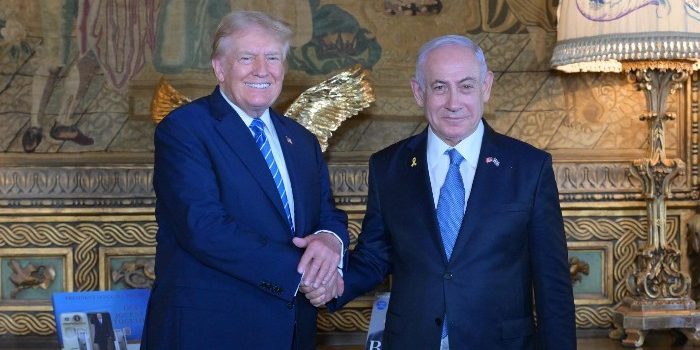
(Dave DeCamp, Antiwar.com) President Trump hosted Israeli Prime Minister Benjamin Netanyahu at the White House on Monday, marking the Israeli leader’s third visit to Washington within six months. The private talks between the two leaders were expected to focus on the 12-day US-Israeli war against Iran and the potential Gaza ceasefire deal.
Ahead of the meeting, Axios reported that Israeli officials believed Trump would greenlight more Israeli attacks on Iran under certain circumstances, including if Iran attempts to restart its civilian nuclear program or tries to remove enriched uranium from the nuclear sites that the US bombed.
Speaking to reporters ahead of dinner with Netanyahu, Trump said that he wants a deal with Iran. Trump’s Middle East envoy, Steve Witkoff, said that he expects talks with Iran to resume within a week, although Iranian officials are saying they need a guarantee that Israel won’t attack again during the next round of negotiations.
Witkoff also said that there was an opportunity for a Gaza ceasefire deal, but it remains unclear if Trump is willing to put pressure on Netanyahu to achieve that goal. Drop Site News reported on Monday that there was “zero” progress at indirect negotiations between Israel and Hamas in Doha as the two sides are awaiting the result of the Trump-Netanyahu meeting. In the meantime, Israel’s genocidal war continues with massive Palestinian casualties being inflicted each day.
Trump and Netanyahu were also asked about their previous calls for the “relocation” of Palestinians from Gaza. Netanyahu claimed he wanted only for the Palestinians in Gaza to have the “free choice” to leave if they desire.
Netanyahu and other Israeli officials have framed their desire for ethnic cleansing as “voluntary,” but the Israeli military campaign has been making Gaza uninhabitable. Both Netanyahu and Trump suggested that Arab countries in the region may be willing to take in Palestinians. “We’ve had great cooperation from surrounding … countries, great cooperation from every single one of them. So, something good will happen,” Trump said.
During the meeting, Netanyahu, who is wanted by the International Criminal Court (ICC) for his role in war crimes in Gaza, also presented Trump with a letter nominating the American president for a Nobel Peace Prize. In the wake of the US-Israeli war with Iran, Trump has strongly backed Netanyahu and has called for an end to the corruption trial against him.