(Christina Urso) WASHINGTON DC — In March, Secret Service agents shot and wounded a man who had driven from Indiana to the White House, supposedly with the intent to commit “suicide by cop.” At the time, few details were provided about the suspect, 27-year-old Andrew Dawson, other than that he was taken to a nearby hospital and remained alive.
On Tuesday, Headline USA attended Dawson’s sentencing hearing at the Washington DC Superior Court, where prosecutors revealed bombshell details about what happened. Dawson was given a six-month suspended sentence, plus a year of probation after pleading guilty in May to carrying a pistol without a license.
According to prosecutors, Secret Service agents shot Dawson a whopping 18 times. At least one of those shots may have hit on or near Dawson’s throat. He appeared to have a vocal-cord injury when he appeared remotely with his father. Prosecutors said he was “permanently impaired” from the incident. No Secret Service agents were injured.
It’s still unclear what exactly led to the shooting.
In March, officials said a “be on the lookout order” (BOLO) was issued for Dawson by the Metropolitan Police Department’s Homeland Security Division. According to charging papers, Secret Service followed Dawson to the 1700 Block of G St. NW, where additional Secret Service units arrived on the scene.
Dawson, who had left his vehicle and was walking, was stopped and given orders. According to the Secret Service, he responded by “brandishing” a firearm—likely a BB gun, given that’s what officers say they found on his person. He also had a “cell phone handgun” in his pocket, according to charging papers.
However, CCTV cameras purportedly didn’t capture the shooting. Moreover, a judge has slapped a protective order on the Secret Service bodycam footage from the incident.
@NotRadix has some bombshell updates on the bizarre case of a "suicidal" man shot by Secret Service agents outside of the White House in March. pic.twitter.com/fCh1vcqKcV
On Tuesday, prosecutors didn’t provide any more details about how law enforcement agencies knew Dawson was coming to the White House, or how they knew he was suicidal.
While at the courthouse, Headline USA also grabbed a copy of Dawson’s eight-count indictment from the courthouse. The indictment also raises further questions, because it said that Dawson did “possess, sell and transfer” a large-capacity ammunition feeding device.
Courthouse officials said an application to the DC Attorney’s Office would be necessary to obtain the bodycam footage.
Headline USA is working to obtain more records about the case.
(Mike Maharrey, Money Metals News Service) The July CPI data indicated moderate price inflation and boosted optimism for a September interest rate cut, even though monetary inflation is on the upswing.
There were no big surprises in the July CPI data, with the numbers generally coming in as forecast. Markets tend to interpret “meeting expectations” as good news, even if the expectations weren’t particularly good to begin with.
In this case, the numbers were akin to cold oatmeal. They weren’t great, but you can stomach them and gain some sustenance, especially if you are hoping for interest rate cuts.
July CPI By the Numbers
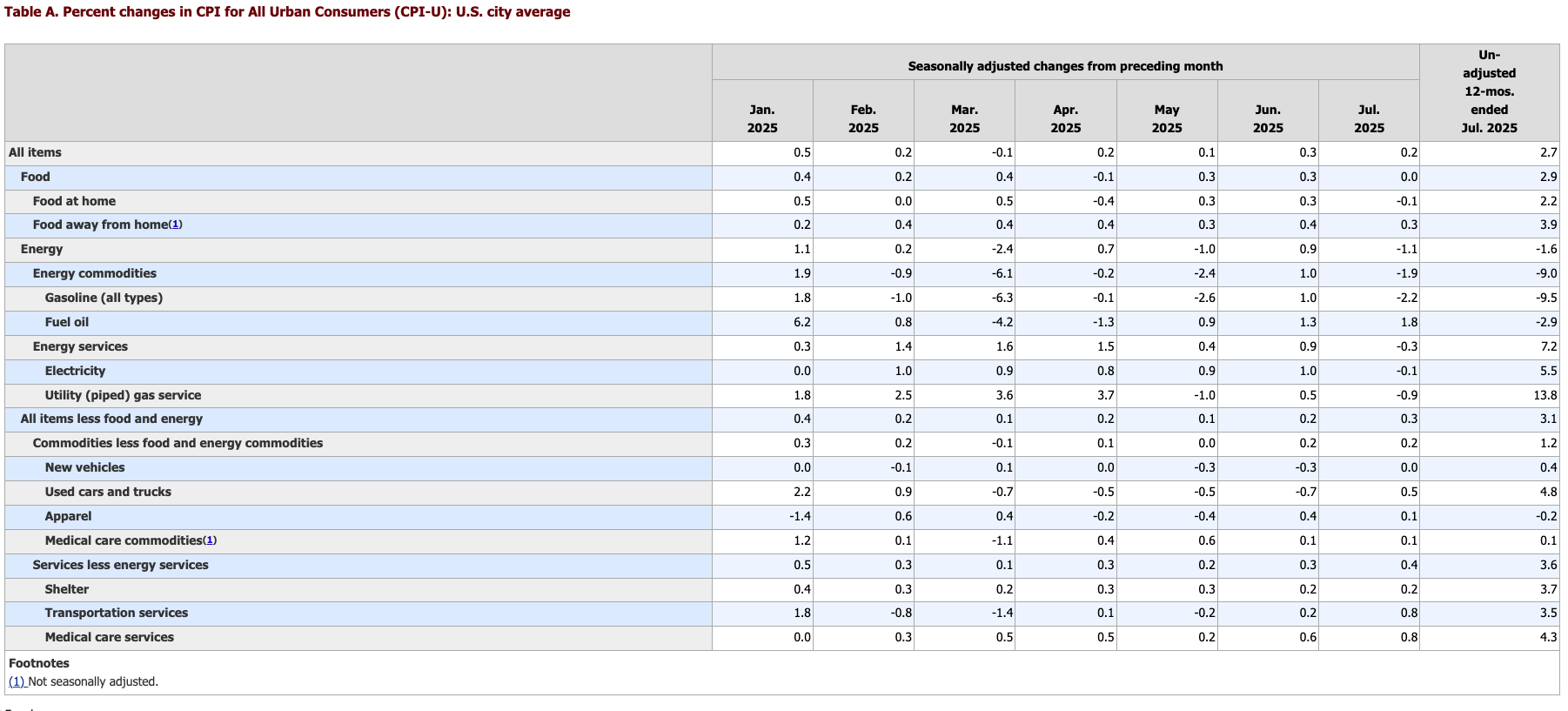
Price inflation rose 2.7 percent in July, the same rate reported in June, according to the BLS data. The expectation was for the headline annual number to tick up to 2.8 percent.
On a monthly basis, prices rose 0.2 percent. That was a tad cooler than June’s 0.3 percent reading and right on the forecast.
Excluding more volatile food and energy prices, core CPI rose 0.3 percent month-on-month, heating a tad compared to June’s 0.2 percent increase and hitting the forecast.
On an annual basis, core CPI rose 3.1 percent. That was up sharply from 2.9 percent in June. The expectation was for a 3.0 percent gain.
CNBC noted that, “Federal Reserve officials generally consider core inflation to be a better reading for longer-term trends.”
Well, that core number has remained stubbornly high for months. It dropped as low as 2.8 percent in March but began creeping up again in June.
Note that none of these numbers is close to the Fed’s mythical 2 percent target.
As you parse the data, keep in mind that the CPI doesn’t tell the entire story of inflation. The government revised the CPI formula in the 1990s so that it understated the actual rise in prices. Based on the formula used in the 1970s, CPI is closer to double the official numbers. So, if the BLS used the old formula, we’d be looking at CPI closer to 6 percent. And using an honest formula, it would probably be worse than that.
However, this is the formula the government uses, and it drives decision-making.
It is also important to note that a federal government hiring freeze has reportedly stretched the BLS thin, and the agency recently reduced data collection and expanded a process known as “imputation,” which uses modeling to fill in incomplete data. In April, the BLS announced it was “reducing sample in areas across the country” and suspended data collection in Lincoln, Nebraska; Provo, Utah; and Buffalo, New York.
Digging more deeply into the CPI data, we find that the falling energy prices once again helped pull the overall index lower. The energy index fell by -1.1 percent month-on-month, with gasoline prices dipping by -2.2 percent.
However, prices in most categories rose modestly. Shelter was once again a big driver of price inflation, rising by 0.2 percent since June. Other indexes that increased over the month include medical care, airline fares, recreation, household furnishings and operations, and used cars and trucks. Lodging away from home and communication were among the few major indices that decreased in July.
Market Reaction
The markets read this as a positive CPI report. The CNBC headline trumpeted that prices rose “less than expected,” which generally wasn’t true. USA Today tells us that “inflation held steady.” CBS News said, “Inflation was cooler than expected.
Stock futures rose on the news, as did gold, as the perception of cooler-than-expected inflation ramped up hope for an interest rate cut.
Media outlets reported that tariffs don’t seem to have bled into consumer prices, at least not yet. CNBC summed it up this way.
“Tariffs did appear to show up in several categories. For instance, household furnishings and supplies showed a 0.7 percent increase after rising 1 percent in June. However, apparel prices were up just 0.1 percent and core commodity prices increased just 0.2 percent. Canned fruits and vegetables, which generally are imported and also sensitive to tariffs, were flat.”
Future market pricing seems to be leaning strongly toward a September interest rate cut. CME Group’s FedWatch increased the odds of a cut to 93.9 percent in September. The chance of an October cut also moved up from 55 percent to 67 percent.
The Real Inflation Story
Everybody focuses on prices, but that only tells part of the inflation story. More precisely defined, inflation isn’t just rising prices. It is the increase in money and credit. One of the results of monetary inflation is price inflation.
Henry Hazlitt is best known for his brilliant book Economics in One Lesson. In another essay titled “Inflation in One Page,” he explained why using a more precise definition of inflation is crucial.
“Inflation is an increase in the quantity of money and credit. Its chief consequence is soaring prices.
“Therefore inflation—if we misuse the term to mean the rising prices themselves—is caused solely by printing more money. For this, the government’s monetary policies are entirely responsible.” (Emphasis added)
No matter how you choose to parse the CPI data, inflation is already increasing, and a rate cut will accelerate that trend.
After the last Fed meeting, Chairman Jerome Powell called the current monetary policy “modestly restrictive.”
This characterization is debatable.
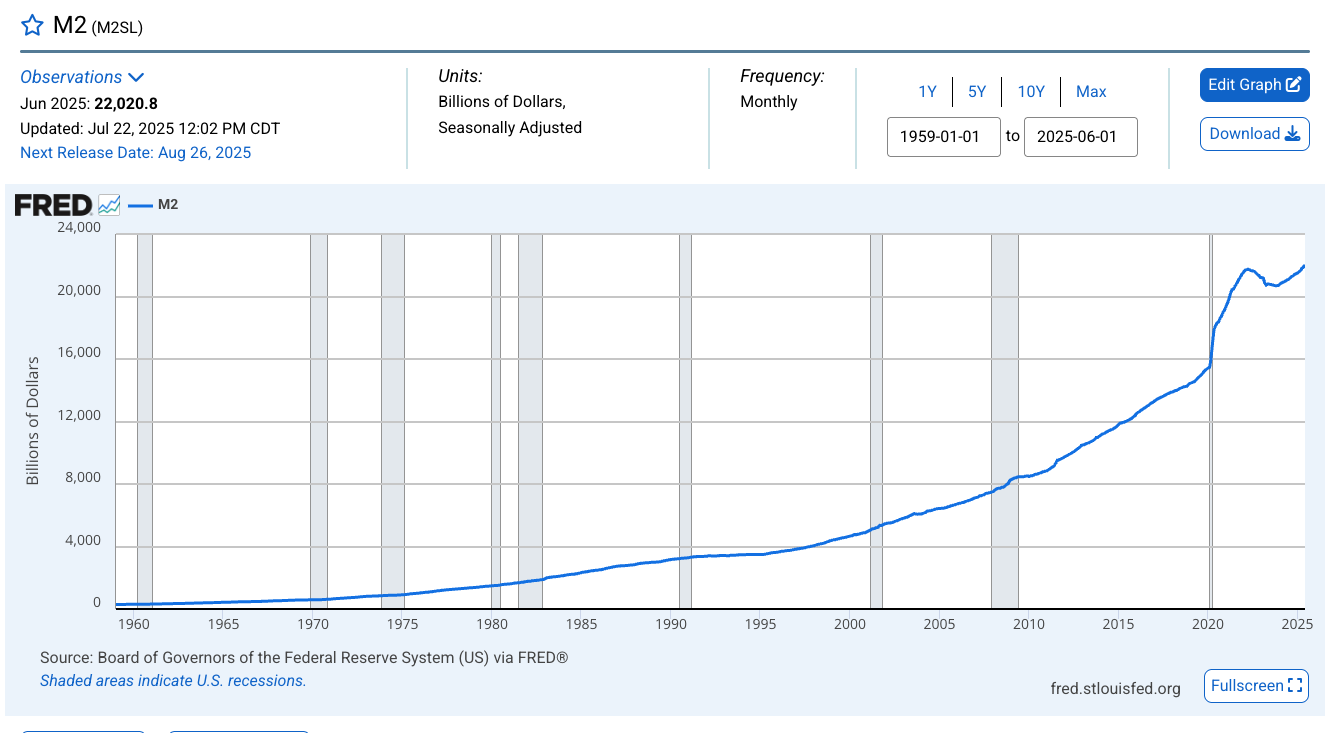
As of the end of June, the money supply had expanded by more than $600 billion since its low point in mid-2023.
As of June, the M2 money supply stood at $22 trillion and is above the peak reached during the pandemic.
During the Fed’s inflation fight, the M2 money supply contracted. This is exactly what needs to happen to wring out inflation from the economy. The money supply bottomed a little over a year ago at $20.60 trillion.
That sounds like an impressive inflation fight, until you realize that the money supply would need to fall by at least another $3 trillion to get back to the trend of 2019. Clearly, that’s not the trajectory.
While the Federal Reserve tightened monetary policy enough to rein in rising prices, it never did enough to slay the inflation dragon. In fact, inflation (properly defined as an increase in the money supply) has been going up for over a year.
That means there is a plausible case for holding rates steady. You could even argue that rates should be higher.
On the other side of the coin, President Trump and those pushing for rate cuts can point to this CPI data and plausibly argue that price inflation remains muted. The tariffs have not impacted consumer prices significantly. And while you could parse the data and argue that price inflation is heating up, it remains cool compared to the numbers a year ago.
Meanwhile, the U.S. economy is buried in debt (incentivized by more than a decade of artificially low interest rates), and it really can’t function long-term in a higher-rate environment.
That means there is a plausible argument for rate cuts.
But even insists the Fed should cut rates based on the CPI, it’s important to remember that this is actually a push to increase inflation.
Given the fact that the money supply is expanding, and financial conditions are loose from a historical standpoint, caution in cutting is warranted. Just taking the CPI at face value should signal caution. After all, none of the metrics are at the mythical 2 percent target.
However, President Trump and others pushing for rate cuts aren’t wrong either.
A higher interest rate environment will eventually crack the debt-riddled economy and pop the bubbles. The economy needs its easy money drug.
So, when you boil it all down, it appears the central bank needs to simultaneously keep rates higher for longer and cut rates. That’s quite a Catch-22.
(Headline USA) The Georgia Bureau of Investigation says the man who fired more than 180 shots at the headquarters of the U.S. Centers for Disease Control and Prevention died of a self-inflicted gunshot wound after killing a police officer.
Documents found in a search of the suspect’s home “expressed the shooter’s discontent with the Covid 19 vaccinations,” Georgia Bureau of Investigations Director Chris Hosey said.
Patrick Joseph White also had recently verbalized thoughts of suicide, which led to law enforcement being contacted several weeks before the shooting, Hosey said.
Police say White opened fire outside the CDC headquarters in Atlanta on Friday, leaving bullet marks in windows across the sprawling campus. At least four CDC buildings were hit, Director Susan Monarez said.
The 30-year-old suspect had further tried to get into the CDC’s headquarters in Atlanta but was stopped by guards before driving to a pharmacy across the street and opening fire.
DeKalb County Police Officer David Rose was mortally wounded while responding. Rose, 33, a former Marine who served in Afghanistan, had graduated from the police academy in March.
Shooter had fixation on COVID-19 vaccine
White’s father, who contacted police and identified his son as the possible shooter, said White had been upset over the death of his dog and also had become fixated on the COVID-19 vaccine, according to the law enforcement official.
A neighbor of White told The Atlanta Journal-Constitution that White “seemed like a good guy” but spoke with her multiple times about his distrust of COVID-19 vaccines in unrelated conversations.
“He was very unsettled, and he very deeply believed that vaccines hurt him and were hurting other people,” Nancy Hoalst, told the Atlanta newspaper. “He emphatically believed that.”
But Hoalst said she never believed White would be violent: “I had no idea he thought he would take it out on the CDC.”
(Kenneth Schrupp, The Center Square) California’s annual state spending is up 50% per capita, or $106.3 billion, since 2019, the first year Gov. Gavin Newsom took office, highlighting the state’s growing budget woes.
According to taxpayer advocates, the state government has increased spending, despite the state’s constitutionally-mandated balanced budget requirement, by over-estimating future revenues.
“The Newsom administration and the Legislature have been recklessly over-projecting revenue to meet the requirement for a balanced budget while increasing spending. They have not been honest with the public about the cost of meeting the state’s renewable energy targets, the cost of new entitlement programs, or the cost of increasingly lucrative contracts for public employees,” wrote Howard Jarvis Taxpayers Association Vice President of Communications Susan Shelley in an email to The Center Square.
“Instead they’ve used accounting trickery that would make Enron blush.”
In the 2019-2020 fiscal year, the state estimated it would receive $143 billion in personal, sales and use, and corporate (Big Three) tax revenue, and spend $215 billion overall; it received $139 billion in the aforementioned tax revenue and spent $209 billion.
The state posted higher than expected revenues while COVID-era funds lasted through the 2022-2023 fiscal years, but have since returned to lower than expected revenue.
In the 2023-2024 fiscal year, the state estimated it would receive $194 billion in Big Three revenue, and spend $311 billion overall; it received $193 billion and spent $332 billion overall.
While data for the 2024-2025 fiscal year that ended on July 31, 2025 is not yet available, the state faced a $73 billion revenue shortfall, requiring fund shifts and cuts to meet the state’s balanced budget requirement.
The state-funded Legislative Analyst’s Office projects ongoing deficits of tens of billions of dollars due to the state’s spending growth, and lack of spending cuts for ongoing commitments.
California Gov. Gavin Newsom’s office did not respond to The Center Square by the time of publication.
(Andrew Rice, The Center Square) The deadline to enact further reciprocal tariffs against China will be extended by 90 days, President Donald Trump announced Monday night.
“[China] continues to take significant steps toward remedying non-reciprocal trade arrangements and addressing the concerns of the United States relating to economic and national security matters,” Trump explained in an executive order.
The deadline was set to expire on Aug. 12. The new deadline is set for after midnight on Nov. 10.
While negotiations with China are worked out, a 10% reciprocal tariff rate will remain in effect until Nov. 10, according to a fact sheet provided by the White House.
“President Trump is ensuring economic cooperation between two of the largest economies in order to protect American interests, stop unfair trade practices, and strengthen America’s domestic manufacturing base,” the fact sheet read.
In April, the U.S. imposed 145% tariffs against Chinese imports and China retaliated with 125% tariffs on U.S. goods.
The countries backed off these tariffs after meeting in May. The U.S. went down to 30% tariffs while China went down to 10%.
The fact sheet said the U.S. goods trade deficit with China was $295.4 billion in 2024. The White House said this number is “already decreasing substantially.”
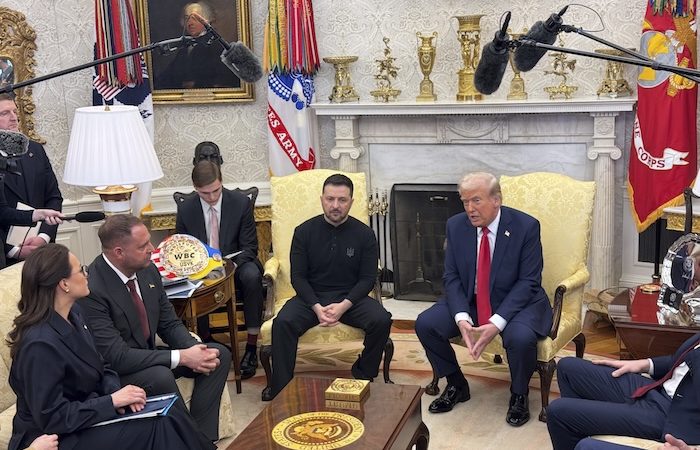
(Dave DeCamp, Antiwar.com) President Trump said on Monday that there will be “land swapping” between Russia and Ukraine as part of a potential peace deal and pushed back on Ukrainian President Volodymyr Zelensky’s public rejection of ceding any territory to Moscow.
“I was a little bothered by the fact that Zelensky was saying, ‘Well, I have to get constitutional approval.’ I mean, he’s got approval to go into war and kill everybody, but he needs approval to do a land swap — because there’ll be some land swapping going on,” Trump told reporters.
The president is gearing up for a meeting with Russian President Vladimir Putin in Alaska this Friday and said that after the talks, he will relay Moscow’s “parameters” to end the war to Ukraine and the US’s European allies. “If it’s a fair deal, I will reveal it to the European Union leaders and to the NATO leaders and also to President Zelensky,” he said. “I may say, ‘lots of luck, keep fighting,’ or I may say we can make a deal.”
According to reports from The Wall Street Journal, Putin has conveyed to the US that he would end the war if Ukraine withdrew its forces from the territory it still controls in Donetsk in the eastern Donbas region. The reports suggest Moscow would be willing to accept freezing the lines in Kherson and Zaporizhzhia, a potential climbdown from Moscow’s earlier demand for a full Ukrainian withdrawal from both oblasts.
While Zelenksy has publicly rejected the idea of ceding any territory, The Telegraph reported on Monday that he’s willing to give up the land that is already controlled by Russia, but that he wouldn’t give up any territory Ukrainian forces still hold as part of a European-backed plan.
“The plan can only be related to the current positions held by the militaries,” a Western official familiar with the plan told The Telegraph.
European leaders have also been pushing for Zelensky to be part of the Trump-Putin summit, but Trump has made clear that won’t happen. Trump said on Monday that he hopes Zelensky and Putin will meet following the Alaska summit and said he could potentially join the meeting.
(Mike Maharrey, Money Metals News Service) Indian jewelry dealers remain upbeat despite headwinds created by higher prices. They expect demand to rebound in the latter half of the year and are aggressively stocking inventory as the fall festival and wedding season approaches.
India ranks as the second-largest gold market in the world, trailing only China.
The India International Jewelry Show (IIJS) ran from July 30 through August 4. The event serves as an important barometer for sentiment in the industry, and Metals Focus sent its Mumbai team to the conference to assess the mood along the jewelry supply chain.
Metals Focus concluded that most market players are optimistic.
“The positive response at the IIJS suggests that manufacturers and retailers expect consumers to soon adjust to higher gold prices and in turn help demand to recover from the weakness seen so far this year.”
The analysts said that retailers have “started to stock up aggressively” for the upcoming season.
“Given that retailers in H1.25 mainly focused on paring down existing inventory, this creates an appetite for fresh purchases. As a result, manufacturers saw increased orders from larger chain stores and independents.”
Gold jewelry is deeply interwoven into India’s marriage ceremonies, along with its religious and cultural rituals. Festival seasons typically boost gold demand.
Indians have long valued the yellow metal as a store of wealth, especially in poorer rural regions. Around two-thirds of India’s gold demand comes from beyond the urban centers, where large numbers of people operate outside the tax system. Many Indians use gold jewelry not only as an adornment but as a way to preserve wealth.
Gold jewelry in India tends to be of a higher purity (22 karat) than that sold in the U.S.
Higher Gold Prices Create Headwinds
The rapidly rising price of gold has put a drag on Indian gold jewelry demand, with many people opting to buy investment bullion in the form of gold bars and coins.
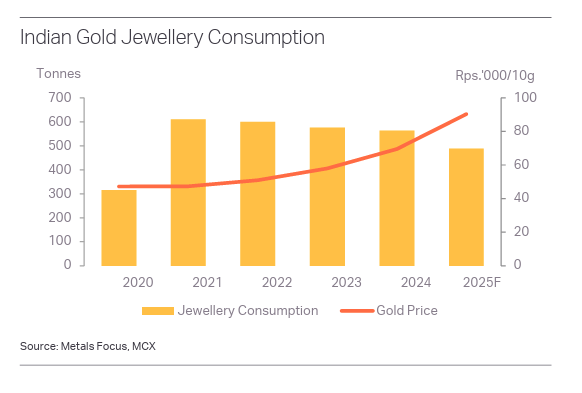
Gold extended its gains in July in rupee terms, remaining the top Indian investment class with a 30 percent gain on the year. Gold has been trading at or around ₹100,000/10g.
Seasonal weakness in June and early July, following the end of the wedding season, put a further drag on jewelry sales.
Metals Focus estimates that gold jewelry demand was down about 21 percent year-on-year through the first half of 2025. Gold consumption for jewelry manufacturing came in at around 160 tonnes in H1. It was the weakest start to a year since Metals Focus began collecting data in 2010, except for 2020 in the midst of the pandemic.
Indian consumers seem to be opting for smaller or lower-karat pieces.
According to the World Gold Council, anecdotal evidence suggests that Indians are monetizing their gold jewelry by exchanging old pieces for new, liquidating it altogether, or using it as collateral for loans. Some companies reported that a gold exchange was involved in as many as 40 percent of their sales.
The Market Adjusts
Even with the slowdown in sales, Indian jewelry dealers are reaping the benefits of higher prices. Listed jewelers posted double-digit revenue growth in the second quarter, despite flat or lower volumes.
Retailers and manufacturers in India have adjusted to the higher price by offering lighter-weight pieces. The goal has been to keep jewelry within specific price brackets such as below Rs0.1lakh (US$1,140), below 2lakh ($2,280), and below 5lakh ($5,700).
While there is plenty of optimism that domestic demand will return, jewelry exporters worry about the impact of a 25 percent tariff on Indian exports to the U.S.
“These pieces are available in designs that closely resemble traditional gold products, including certain bridal styles and temple jewelry. With positive price expectations, manufacturers have begun stockpiling in preparation for the upcoming wedding and festive season.”
According to the Silver Institute, retail demand for silver in India rose 7 percent through H1 2025.
Meanwhile, silver imports exploded by 431 percent year-over-year through the first five months of 2025, totaling 544.1 tonnes.
Indian interest in silver isn’t new. It’s just being revived by record prices. Over the last decade, investors have accumulated over 17,500 tons of silver in the form of coins and bars. The country ranks as the world’s largest consumer of silver jewelry and silverware.
Demand for platinum jewelry has also remained “resilient” with fabricators reporting an increase in orders at the IIJS.
“Despite a rally in platinum prices, the metal remains far more affordable than gold. Higher margins associated with platinum jewelry have also encouraged more retailers to stock the metal.”
Metals Focus analysts said they are “optimistic” about the outlook for Indian gold, silver, and platinum jewelry demand in the second half of 2025.
“If the gold price remains broadly stable at around current levels of around ₹100,000/10g, consumers may finally adjust to the elevated price and so return to jewelry outlets.”
Mike Maharrey is a journalist and market analyst for Money Metals with over a decade of experience in precious metals. He holds a BS in accounting from the University of Kentucky and a BA in journalism from the University of South Florida.
(Jesse Colombo, Money Metals News Service) I wanted to post a quick follow-up to the recent tariff saga that has whipsawed the gold market in recent days—and, by extension, silver, due to their close correlation. I first covered this on Saturday, and yesterday brought the latest development.
After some back-and-forth over whether gold bullion imports into the United States would be hit with tariffs, the Trump administration confirmed yesterday that they will not be. In response, spot gold fell 1.62% and spot silver dropped 1.86%.
While some investors are understandably frustrated and confused by these abrupt shifts, this short-lived drama does nothing to change my bullish outlook on either metal. In this update, I’m going to explain why, and I believe you’ll find it both reassuring and confidence-boosting.
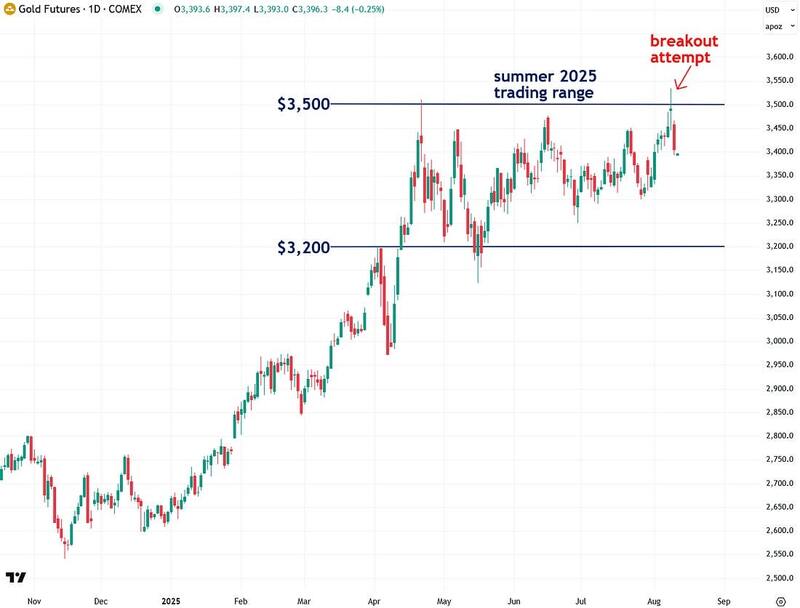
For the past few months, I’ve shown that gold has been trading in a range between $3,200 and $3,500. This kind of consolidation is both normal and healthy after the strong gains we saw in the fall and spring.
Strong-performing assets need time to digest their gains before resuming a bull market, and gold is no exception.
It’s even more understandable given that we’re deep in the dog days of summer, when volume and news flow are light as much of Wall Street is still in vacation mode.
Markets need volume to move, and right now there simply isn’t enough “juice” to propel prices higher. But with only a few more weeks of summer left, there’s no reason to rush or worry about gold and silver.
My advice? Enjoy the season—spend time with family and friends, relax at the beach or pool, fire up the barbecue, and make the most of the warm weather.
That’s exactly what I’m doing. When fall inevitably arrives, trading volume will return, and there’s a very good chance that precious metals will get back to rallying. Make no mistake—the bull market is still intact and still in its early stages.
The chart below of COMEX gold futures shows this summer’s trading range and Thursday night’s attempt to break above the $3,500 resistance level following speculation that gold bullion might be tariffed. However, there was no close above that level, so the breakout was not confirmed.
My suspicions were confirmed when prices quickly retreated. Still, this is just market noise, and I believe another breakout attempt is coming soon that is far more likely to stick.
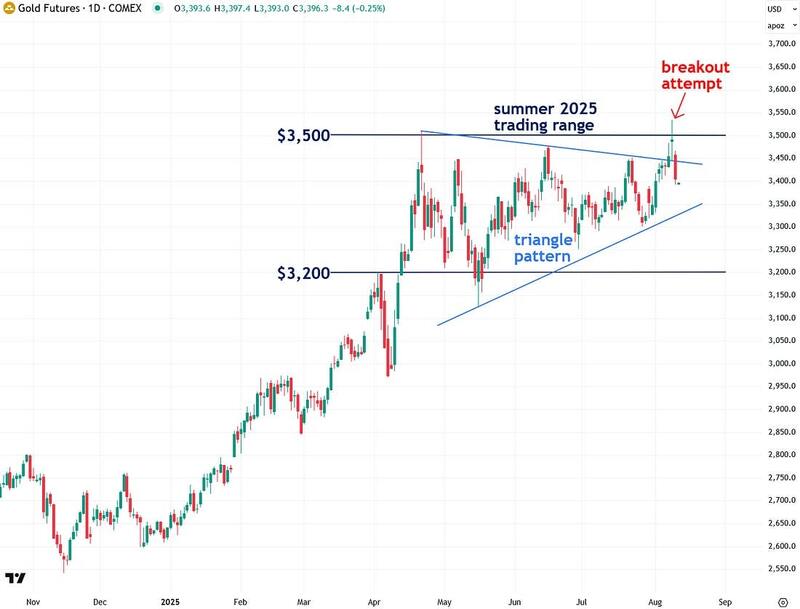
In recent weeks, I’ve been highlighting a triangle pattern forming within the summer 2025 trading range, as shown in the COMEX gold futures chart below.
A breakout above this compound formation should set the stage for gold to surge past $4,000. That outlook remains fully intact—we are simply waiting for confirmation.
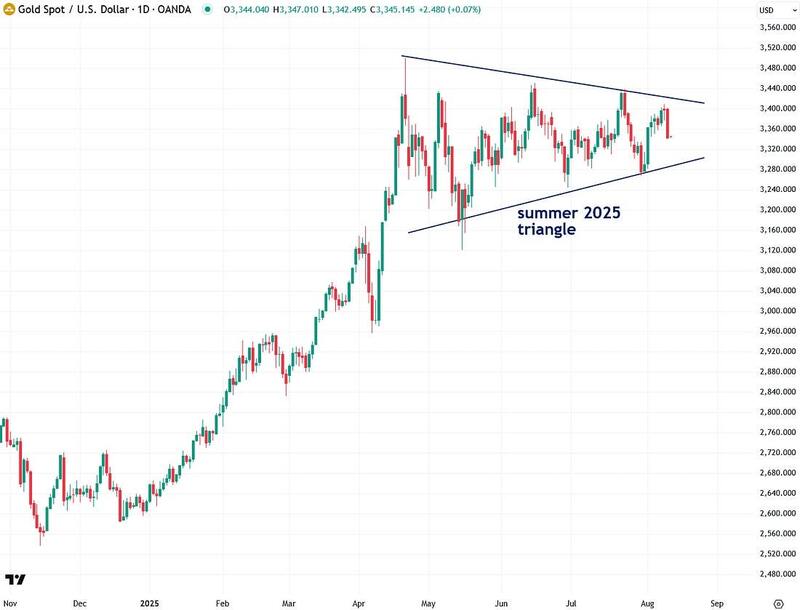
The last two charts showed COMEX gold futures, which have been whipsawed by shifting U.S. tariff speculation. In contrast, the spot gold price, which is the international benchmark, has remained relatively stable and continues to trade within its triangle pattern, as shown below.
As I noted on Saturday, the lack of bullish follow-through and confirmation from spot gold made me question the late-week moves in COMEX futures, and those doubts proved correct. Even so, the chart below still looks strong, and there is no reason for concern.
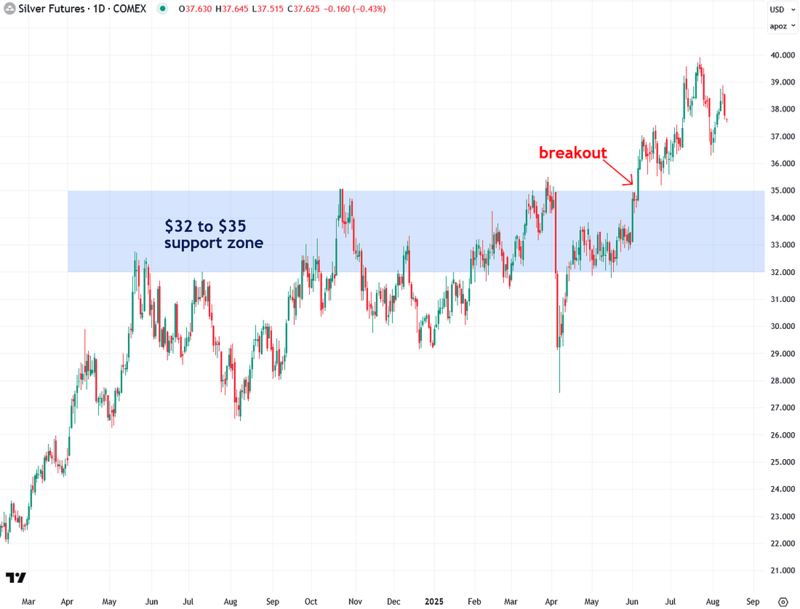
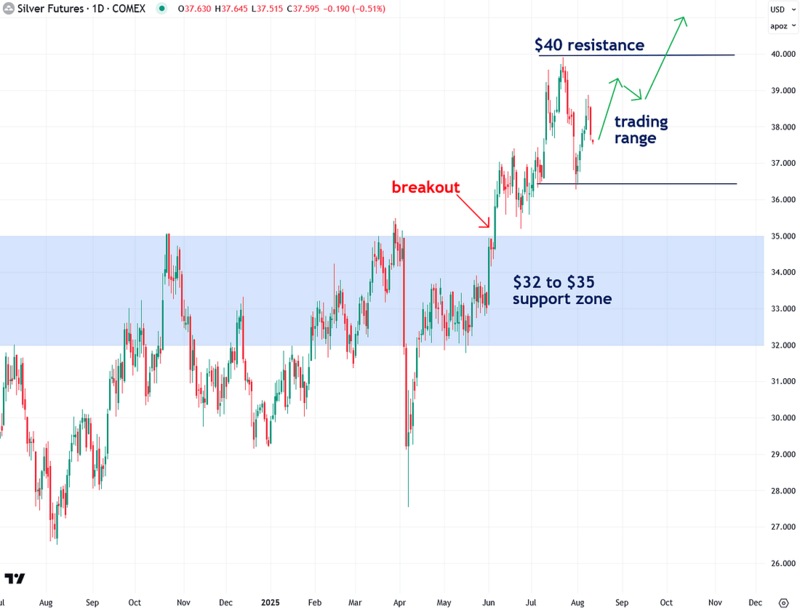
Now let’s turn to silver, represented here by COMEX silver futures. While silver has been relatively quiet lately and trading in a choppy fashion, which is typical for the summer months, it remains in a very strong technical position after recently breaking above the $32 to $35 resistance zone that capped gains for much of 2024 and early 2025.
Many investors and traders are growing discouraged and impatient with silver, as often happens, but that mindset misses the bigger picture. I see an asset in a confirmed, strong uptrend, and the trend is your friend. The bias remains firmly to the upside, and the only missing ingredient is trading volume, which I expect to return in force this fall.
I am genuinely excited for what lies ahead and anticipate another test of $40, with a strong likelihood of breaking through that level and moving significantly higher. This simply requires patience.
In the COMEX silver chart below, I’ve zoomed in to show silver’s current price action. After breaking above the critical $32 to $35 zone two months ago, silver has been holding its gains and is now trading in a choppy, sideways manner—likely forming a new range that will set the stage for its next leg higher.
The $40 resistance level is the key to watch, as this is where silver’s recent rally stalled before pulling back.
Once there is a decisive breakout above that level on strong volume, I believe silver’s bull market will truly start to accelerate.
When that happens, it will catch many people off guard and leave behind those who lacked the faith and foresight to hold on while silver methodically climbs the staircase from one consolidation to the next.
To wrap things up, I am admittedly frustrated with the way these tariff announcements have been handled, as they are creating unnecessary confusion, noise, and false signals.
My approach, however, is to step back and focus on the bigger picture, and as I have shown, both gold and silver remain in strong technical positions. I am not worried in the slightest.
In fact, I am seeing many inexperienced investors and analysts growing concerned or losing hope, which, from a contrarian perspective, is a very positive sign.
It reminds me exactly of last summer when sentiment was similarly negative. The most powerful market rallies often begin when the crowd is most pessimistic.
My bias is to expect a repeat performance of last year, although I am still waiting for confirmation in the form of a convincing high-volume liftoff in gold as summer winds down. Until then, I will remain objective and continue to keep you updated as always.
If you found this report valuable, click here to subscribe to The Bubble Bubble Report for more content like it.
Jesse Colombo is a financial analyst and investor writing on macro-economics and precious metals markets. Recognized by The Times of London, he has built a reputation for warning about economic bubbles and future financial crises. An advocate for free markets and sound money, Colombo was also named one of LinkedIn’s Top Voices in Economy & Finance. His Substack can be accessed here.
(Andrew Rice, The Center Square) Nvidia will pay the United States 15% of the money it makes from selling artificial intelligence chips to China, President Donald Trump said in a press conference on Monday.
Trump said he allowed Nvidia CEO Jensen Huang to sell H20 chips to China while the company provides the U.S. government with a kickback of the profits.
“The H20 is obsolete,” Trump said. “So we negotiate a little deal so he’s, essentially, selling an old chip,” Trump added, referring to Huang.
Trump said he initially asked for a 20% cut from sales of Nvidia’s chips but the two landed on 15%.
In April, Trump banned Nvidia from selling H20 chips to China. The administration later reversed the ban in July.
A coalition of democratic lawmakers, including Sen. Chuck Schumer, D-N.Y., criticized the administration’s July reversal.
“Limiting the PRC’s access to advanced compute has been a focus of Congress: one with a strong bipartisan commitment across both chambers and both parties,” The letter read.
“The PRC’s development of advanced AI capabilities represents a clear risk to the United States’ national and economic security, and the administration’s willingness to trade away that security is extremely troubling,” the letter continued.
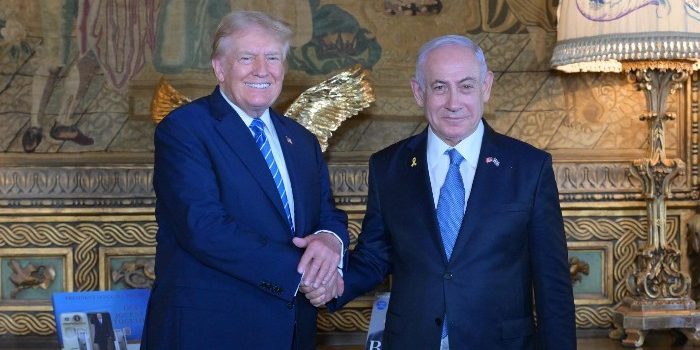
(Dave DeCamp, Antiwar.com) In an interview with Axios on Monday, President Trump provided backing for Israeli Prime Minister Benjamin Netanyahu’s plans to escalate in Gaza, suggesting that Israel needed to ramp up the pressure on Hamas.
The report said that Trump stopped short of directly endorsing the Israeli government’s plan to take over Gaza City but “seemed to agree” with Netanyahu’s “argument that more military pressure on Hamas is required.”
Israel’s plans to escalate its genocidal war have faced widespread international condemnation as the humanitarian situation in Gaza is as bad as ever, and Palestinians continue to starve to death every day. But the Trump administration has not wavered in its support for Israel.
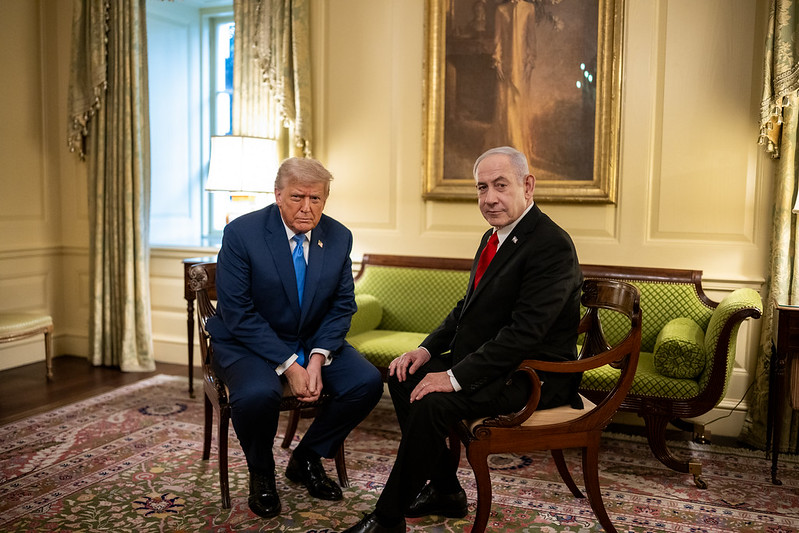
President Donald Trump and Israeli Prime Minister Benjamin Netanyahu speak privately in the Vermeil Room before a dinner, Monday, July 7, 2025, at the White House (Official White House Photo by Daniel Torok)
Many people inside Israel, including senior military officials, have raised concerns about the plans to escalate in Gaza due to the threat it will pose to the remaining Israeli captives. Trump told Axios that it was always going to be “very rough to get them” because Hamas “are not going to let the hostages out in the current situation,” although Hamas’s long-standing position is that it’s willing to release the remaining captives in exchange for a permanent ceasefire.
Echoing earlier comments, Trump said it was up to Israel what to do next, signaling he will continue providing military aid no matter what Netanyahu chooses to do. The president said it was also up to Israel whether Hamas can remain in Gaza, but said that in his opinion, “they can’t stay there.”
“I have one thing to say: remember October 7, remember October 7,” Trump told Axios.
Trump’s conversation with Axios came a day after he spoke with Netanyahu by phone to discuss Israel’s planned escalation. “The two discussed Israel’s plans to take control of the remaining Hamas strongholds in Gaza to bring an end to the war by securing the release of the hostages and defeating Hamas,” Netanyahu’s office said in a statement on the call.
According to Israeli media reports, Israel’s plans involve forcibly evacuating Palestinian civilians from Gaza City to the south with the goal of driving them out of Gaza altogether, as Netanyahu and other Israeli officials have made clear that ethnic cleansing is their ultimate goal.