Zelensky To Meet With US Senators as Russia Sanctions Vote Is Expected

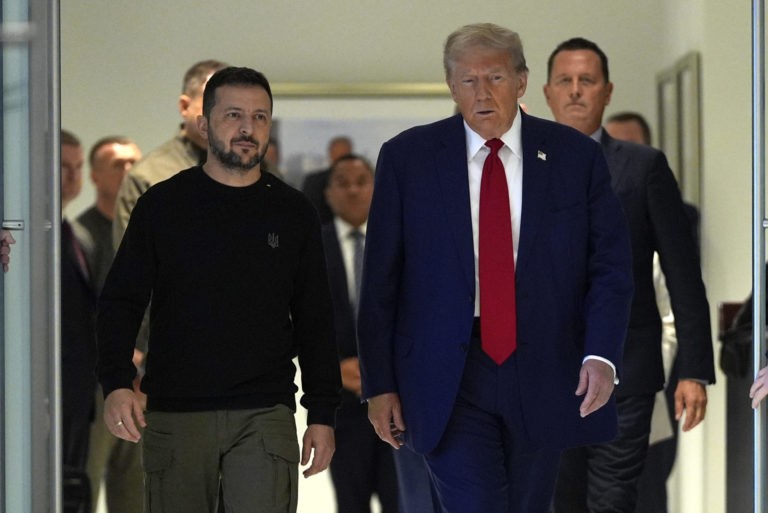
(Dave DeCamp, Antiwar.com) All 100 members of the US Senate have been invited to a meeting with Ukrainian President Volodymyr Zelensky on Tuesday evening, when he will be in the US to attend the funeral of Sen. Lindsey Graham, Reuters reported on Monday.

Zelensky’s meeting with US senators will be around the same time that the Senate is expected to vote on a Russian sanctions bill that US lawmakers have said was put forward to “honor” Graham, who died on July 11 after returning home from a trip to Ukraine where he met with Zelensky and announced the White House had agreed to move forward on more Russia sanctions.

The legislation would impose sanctions on Russian officials and companies and would also give President Donald Trump the power to impose 100% tariffs on countries that purchase Russian energy, with carve-outs for US NATO allies. The initial bill that Graham was pushing last year would have required 500% tariffs.

President Trump had called on the Senate to add Iran sanctions to the bill because it’s what “Lindsey would have wanted,” and Senate leaders said they would do so, but it’s unclear if the Iran measures will be included in the bill that will be voted on during Zelensky’s visit.

Zelensky will also hold talks with President Trump at the White House, a meeting that comes as Ukraine has continued launching long-range drone attacks inside Russia that are supported by US intelligence. On Saturday, a Ukrainian drone struck an Iranian commercial ship in the Caspian Sea, marking an escalation between Kyiv and Tehran.

Since Trump held a contentious Oval Office meeting with Zelensky in February of last year, relations between the two leaders have improved, and at the recent NATO summit in Ankara, Trump praised Zelensky and said he backed Ukraine’s drone attacks in Russia, which have killed an increasing number of civilians. Trump also said that he would grant Ukraine a license to produce Patriot missile interceptors, though it could take years for the production to start.

This article originally appeared at Antiwar.com.  

ActBlue Faces Scrutiny Over Michigan Woman’s $100K+ in Donations

(Elyse S. Apel, The Center Square) ActBlue is facing scrutiny after a report last week raised questions about thousands of political donations made in the name of an 88-year-old Michigan woman.

The story caught national attention after Michigan Enjoyer reporter Charlie LeDuff posted a video interviewing Elizabeth Waffle of Milan, Michigan.

“I doubt it,” Waffle said when asked by LeDuff if she’s made 14,696 donations totaling more than $150,000 in the past five years, which are the totals reported by Michigan Enjoyer.

Living in a trailer, Waffle said she didn’t think it was possible she’d donated that much.

“I don’t have that kind of money,” she said. “I can’t believe it.”

ActBlue is an online platform used nationally by Democratic candidates and progressive organizations to raise funds.

According to Federal Election Commission records pulled by The Center Square, Waffle’s name shows $100,295 in contributions processed through ActBlue across the 2021-2022, 2023-2024 and the 2025-2026 election cycles. That is a total of 12,900 donations ranging from $0.24 to $107.50.

The difference between the totals reported by Michigan Enjoyer and The Center Square could not be fully reconciled. However, The Center Square’s totals more closely aligned with Michigan Enjoyer’s figures when Waffle’s transactions were not filtered to only those listing ActBlue as the recipient.

While the donations are labeled on the FEC website as donations via ActBlue, they are then distributed to different candidates. In Waffle’s case, this was to campaigns across the nation, including ones in Arizona, Colorado and many more.

De’Andra LaBoo, the external communications director at ActBlue, addressed the story in a statement provided to The Center Square.

“ActBlue has reviewed all relevant contribution data, and our customer service team has already reached out to the donor for more information,” LaBoo said. “It is standard operating procedure that we take corrective action when a noncompliant donation is identified, which may include – but is not limited to – blocking accounts from making further contributions, issuing requested refunds to users, and reporting any fraudulent activity to the appropriate authorities.”

LaBoo also shared information about Tandem Fundraising, which is an option provided by ActBlue where donations can be made as a single contribution form but will then be split between a number of different campaigns or organizations. The contributions would then be listed as separate transactions to the FEC, though the contributor only filled out the form once.

Waffle’s story was picked up by conservative groups and commentators nationally, prompting renewed calls for a federal investigation into ActBlue and its donations.

The Center Square spoke with Parker Thayer, an investigative researcher with the conservative nonprofit Capital Research Center, who outlined his concerns with ActBlue’s contribution processing system.

“There’s long been a belief, with good reason behind it, that certain unknown people are using ActBlue to donate large amounts of money to political candidates, political parties under other people’s names,” Thayer said. “What the Michigan Enjoyer investigated . . . is exactly what people have thought for a long time was going on.”

The center has conducted multiple investigations into ActBlue.

“We’ve been trying to raise the alarm about the lack of security in ActBlue payment processing for a long time,” Thayer said.

According to Thayer, there are multiple fronts for concern with ActBlue. The first is how the FEC database makes public all the information needed to fake someone’s identity for donations.

“When you donate, the FEC website then makes public all the information you would need to fake that person’s identity to donate as them,” Thayer said. “You just type in a name, an address, and then provide a source of payment, which can be, for example, an untraceable prepaid debit cards bought in cash at any gas station . . . You don’t have to prove you’re the person that you say you are when you’re donating.”

He added that he thinks Waffle’s case could be an example of what is commonly known as “smurfing.”

“This coming out in Michigan is a pretty big deal because it seems to be proof of what a lot of people have been saying,” Thayer said. “The sums involved and this woman’s obvious destituteness suggests to me that there’s some kind of smurfing going on.”

ActBlue did not say specifically if it had identified unauthorized activity in Waffle’s account.

Another aspect flagged by Thayer is potential confusion over aspects of ActBlue like recurring payments.

“The pattern is always that people retired living in very small homes are donating enormous amounts of money because they are signed up for multiple recurring contributions, making donations to sometimes dozens of candidates at a time . . . that adds up to hundreds of thousands of dollars,” Thayer said. “The incentive structure that ActBlue has created encourages people to go after very vulnerable donors and sign them up repeatedly for multiple, recurring contributions every single month.”

Joe Biden Interview Audio Reveals Him Discussing Sensitive Information

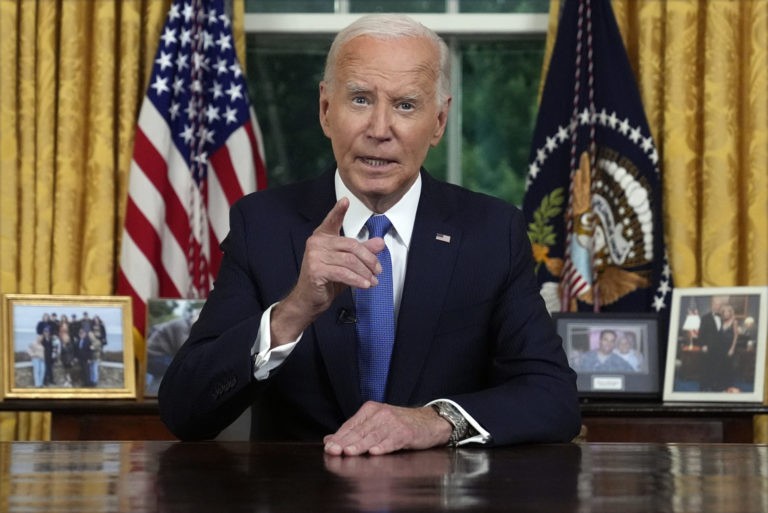
(Headline USA) Newly released audio tapes, disclosed by a conservative activist group, appear to show Joe Biden sharing classified information with a biographer and sometimes claiming memory lapses during interviews that occurred before his election to the presidency in 2020.

About three hours of audio and 117 pages of transcripts — with many redactions — were released by the Oversight Project, an arm of the Heritage Foundation, after Biden lost a prolonged legal fight to keep his conversations with his memoir ghostwriter, Mark Lewis Zwonitzer, private.

“They didn’t even know I had this,” Biden told Zwonitzer in October 2016, near the end of his second term as Barack Obama’s vice president, as he talked about sensitive foreign policy matters handled by the administration.

In one 2017 session, after Biden had left the West Wing and before he’d launched his own presidential campaign, he appeared to admit retaining classified information from his time as vice president.

“I just found all the classified stuff downstairs,” Biden said. “I wrote the President a handwritten 40-page memorandum arguing against deploying additional troops to Iraq — I mean, to Afghanistan on the grounds that it wouldn’t matter, that the day we left would be like the day before we arrived.”

The potentially classified information itself is redacted in both the audio and transcripts that the Oversight Project released.

The right-wing group first sued to obtain the tapes after Special Counsel Robert Hur decided in 2024 not to charge Biden for how he handled classified information. Biden cooperated with Hur’s inquiry and told the special prosecutor during his presidency that he did not intentionally mishandle any classified material.

Hur, who obtained the tapes as part of his inquiry, said in announcing his decision that he believed a jury would find Biden a sympathetic figure because of his age and what Hur described as a “poor memory” — a statement that became a flashpoint in public debate about Biden’s age and fitness for the presidency.

Biden was 74 when the interviews began. He was 81 and seeking reelection when Hur released his report in early 2024, though Biden later ended his campaign for a second term after a halting debate performance against Republican Donald Trump.

The tapes contain instances of Biden being unable to recall some dates and details of topics he was discussing with Zwonitzer. Biden also showed a command of many details, recalling meetings and details of conversations referenced in the notes he shared.

At the Oversight Project, Vice President of Litigation Jeff Clark insisted the tapes prove Biden’s decline.

“The tapes have always belonged to the American People, the Oversight Project just delivered them to their rightful owner,” Clark said in a statement. “The knowledge of his deterioration was well-established.”

A Biden spokesman blasted the release as politically motivated.

“President Biden’s conversations for a book a decade ago that discussed his late son are private, and were provided to the Department of Justice on the express condition they stay that way,” said TJ Ducklo. “Reversing course and making them public is just the latest example of this Administration weaponizing the DOJ for political retribution.”

Biden initially sued to stop the Department of Justice from releasing the material, claiming the conversations were private. But he dropped his suit after a divided panel of appeals court judges rejected his bid. Biden could have petitioned the Supreme Court to intervene or asked for a rehearing by the full U.S. Court of Appeals for the District of Columbia Circuit.

In a 2-1 ruling, a three-judge panel from the circuit court found a “substantial” public interest in disclosing the material.

Adapted from reporting by the Associated Press

Trump and Netanyahu Meet for the First Time Since Launching the Iran War

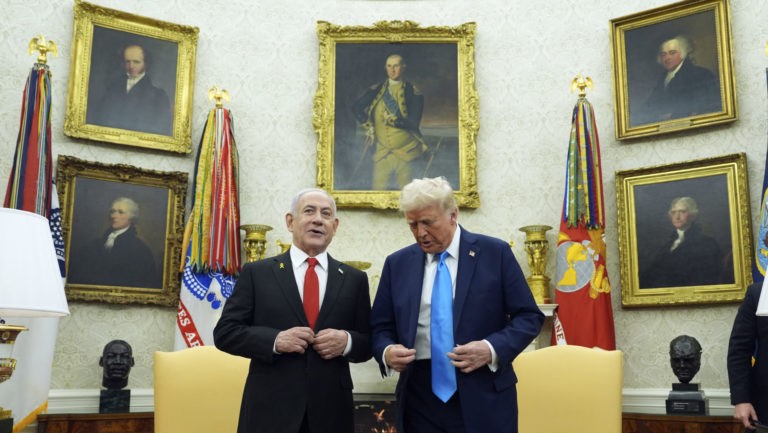
(Headline USA) Israeli Prime Minister Benjamin Netanyahu and President Donald Trump met at the White House on Tuesday for the first time since they launched a joint war against Iran, offering a chance for Netanyahu to smooth out strains in their relationship.

The closed-door meeting lasted nearly an hour and a half and was “positive and productive,” according to White House press secretary Karoline Leavitt. The White House did not immediately offer more details.

Despite signs of tension between the two ahead of the sitdown, Netanyahu was effusive afterward and called it “excellent” in a post on his Instagram profile.

“When I say excellent, I don’t mean it in a superficial way,” Netanyahu said in Hebrew. 

“A conversation with full partnership, with mutual support, with an understanding of the common goal of ensuring that Iran does not have nuclear weapons, and other goals as well. One of the best conversations I’ve had with the President of the United States, our friend Donald Trump.”

It comes as both face growing pressures at home. Netanyahu is up for reelection and is embattled in part because of his deteriorating relationship with Trump. Trump is under pressure to end an unpopular war that has wreaked economic havoc and driven prices higher ahead of midterm elections this November.

Trump revealed some tension with Netanyahu ahead of their meeting, complaining about reports that the Israeli leader plans to discuss intelligence on Iranian activities at Pickaxe Mountain, a potential nuclear site that the U.S. president has threatened repeatedly to bomb.

“I know exactly what’s going on at Pickaxe,” Trump told “Fox & Friends.” He insisted that whatever Iran is doing is “not a big problem” and that “Bibi’s telling me that because he wants me to stay involved.”

“Why do you have to announce to the world?” Trump added, flashing his frustrations with his ally.

Near the White House where the public was able to gather near fencing, a small group of protesters chanted, “Netanyahu, you’re a tyrant” and “Bibi, you’re not welcome here,” referencing the prime minister’s nickname.

The two leaders also planned to discuss the framework agreement the United States and Israel signed with Lebanon over the Israel-Hezbollah war and the expansion of the Abraham Accords, according to a White House official, who spoke on condition of anonymity to preview the meeting.

“We have a little difference,” Trump said Monday when asked by reporters if he and Netanyahu were on the same page on Iran. “But pretty close, yeah.”

Trump has had a hot-and-cold history with Netanyahu over the years, but upon his return to the White House last year, their alliance seemed stronger than ever. When they started the war together in February, it was with a united front, touting their respective militaries as acting in lockstep to take out Iran’s leadership and pave the way for a government more friendly to the West.

But as Iran fought back — sending drones and missiles slamming into U.S. bases and high-rises in cities in the Gulf, and choking off the Strait of Hormuz — Trump came under immense pressure both at home and by allies in the region to end the conflict.

Since then, Netanyahu, who wanted to continue the fighting in Iran and against its ally, Hezbollah, in Lebanon, has been sidelined as Trump sought a deal with Tehran. His visit to the White House this week comes as the disagreements with Trump and Vice President JD Vance have burst into the open over the war in Iran and more.

“The Americans are making it clear to the Israelis they are the ones who are running the war,” Israeli journalist and political analyst Amit Segal wrote Monday in the daily newspaper, Israel Hayom. “It is clear to everyone that Israel has been put in the back seat.”

With U.S.-Iran tensions flaring again in recent weeks, Netanyahu planned to share with Trump Israeli intelligence on Tehran’s nuclear program, according to a person familiar with Netanyahu’s visit, who spoke on the condition of anonymity because they were not authorized to speak to the media.

Israel’s United Nations Ambassador Danny Danon told reporters in New York on Tuesday that Netanyahu wants to hear what Trump would like to see over the coming days and weeks.

“I cannot tell you which direction it will go. There are different options,” he said. “We are prepared for all scenarios, and we will discuss it with the president.”

Netanyahu said Sunday that he hoped to sit down with Trump “to hear what he has in mind” for Iran.

“Because I think, in many ways, it’s his decision” on how to move forward, Netanyahu told Maria Bartiromo on Fox News Channel’s “Sunday Morning Futures.” “If he can do so without returning to intense military fighting, that’s fine. Why not?

“But one way or the other, they have to end their nuclear program,” he said of Iran.

But even as Netanyahu sees an opportunity, he also needs to persuade Trump that he won’t play spoiler to U.S. diplomatic and reconstruction efforts in Gaza and in Lebanon, where the president has previously complained that “too many people are being killed” by Israeli strikes.

Israel has taken recent steps in both places.

In Lebanon, where the Israeli military occupies much of the south, Israel agreed to allow the Lebanese army to deploy to some villages as part of a “pilot program” testing their ability to secure areas where Hezbollah once operated. The U.S. State Department said Monday that the next round of talks between Israel and Lebanon will take place next week in Rome with a focus on expanding the program.

On Gaza, Israel’s security cabinet green-lit on Sunday a measure that would, in theory, grant entry to the first members of an international stabilization force outlined last year in a U.S.-backed ceasefire deal between Israel and Hamas.

Few countries have pledged troops for the force, however, and Israel would approve their entry into Gaza on a case-by-case basis.

The troops — including from Morocco and Uganda — would only be allowed to operate in a small, desolate area in Rafah in the south, where the plan is to vet and house some displaced Palestinians.

The Israeli military continues to carry out strikes it says target militants but that have also killed civilians.

Israel has lost a significant amount of bipartisan support in the United States, particularly over its conduct in Gaza.

In June, Vance warned Israeli officials that Trump was their only friend among world leaders. Vance is expected to attend the meeting with Netanyahu, according to a person familiar with the plan who was not authorized to speak publicly and spoke on condition of anonymity.

An AP-NORC poll published earlier this month found a dramatic erosion of support among American adults for Israel.

“We’ve lost America. Thank you, Bibi,” wrote Ben Caspit, a political commentator for Israel’s Maariv newspaper.

Adapted from reporting by the Associated Press

Lindsey Graham Eulogized as an ‘American Original’ at Services Drawing World Leaders in Washington

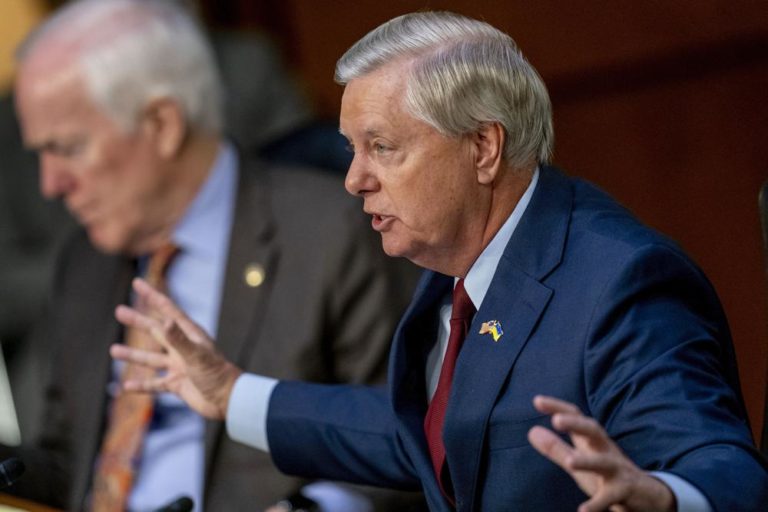
(Headline USA) Sen. Lindsey Graham, the son of pool hall owners who rose to become one of his generation’s more influential U.S. politicians at home and abroad, is being eulogized Tuesday as “a true American original” during memorial services in Washington.

Graham’s flag-draped casket arrived for a tribute at the U.S. Capitol, where the Republican served for more than 30 years as an indefatigable dealmaker who talked and laughed and badgered his colleagues into action. Later, President Donald Trump joined guests including foreign leaders at Washington National Cathedral, a testament to Graham’s stature on the global stage.

Trump called Graham “a giant of the United States Senate, a true American original who left us much too soon.”

In remarks the president described his onetime presidential rival turned ally as “the first person to make you laugh and one of the last people that you’ve ever really wanted to fight.”

Trump told the story of how he had publicly disclosed Graham’s cell phone number on the campaign trail, reciting the number in the cathedral, but said the senator had the last laugh because “Lindsey did not stop calling me for the next 10 years.”

Among those gathered were the leaders of two countries fighting separate wars, Israel’s Benjamin Netanyahu and Ukraine’s Volodymyr Zelenskyy, a nod to Graham’s role as a foremost believer in the power of the U.S. and its military to intervene in the world’s problems. Trump Cabinet officials, including Secretary of State Marco Rubio and Defense Secretary Pete Hegseth, as well as Supreme Court Justice Brett Kavanaugh, senators and current and former lawmakers also joined in the pews.

It’s the start of two days of services, with burial Wednesday in Graham’s home state of South Carolina. Joint Base Charleston will be renamed in his honor, the White House said. Graham died suddenly on July 11 at his home in Washington of a likely aortic tear, according to preliminary findings. He had just returned from a whirlwind trip to a NATO summit in Turkey, where he celebrated his birthday, and a visit to Ukraine. He was 71.

The morning service in the Capitol Rotunda drew Vice President JD Vance, other Trump administration officials and lawmakers as well as Graham’s sister, now- Sen. Darline Graham, who was appointed by the state’s governor to fill the remainder of her brother’s term.

Vance described Graham as a man of “swashbuckling” stature — “who swashbuckled into the Senate” with his suit jacket open — and was impossible not to like.

“Lindsey was a towering figure,” Senate Majority Leader John Thune said, choking back tears during his remarks.

First elected to Congress in the 1994 Republican revolt that swept the GOP to power, Graham was part of a new era of conservatives to take their seats in the House — and among the first Republicans from his Southern state since Reconstruction.

He quickly rose to prominence as a manager in Democrat Bill Clinton’s presidential impeachment, and he was elected to the Senate in the 2002 election. There, he formed an alliance with Sen. John McCain, a Republican from Arizona, and Sen. Joe Lieberman, an independent from Connecticut, in what would become the “three amigos,” globe-trotting the world focused on national security issues.

Vance described how he argued with Graham over the senator’s staunch support for aid to Ukraine, which has divided the GOP, but praised his legacy saying Kavanaugh “would not be on the Supreme Court” were it not for Graham’s “fierce advocacy” during the confirmation hearing.

For decades, Graham had been at the center of the action — a member of virtually every bipartisan gang in Congress — with a relentless ability to shapeshift and adapt to political realities, particularly when it came to Trump.

One by one, many of Graham’s colleagues said their goodbyes in the Rotunda. Sen. Katie Britt, R-Ala, placed both hands on his casket and then placed her hand on her heart. Sen. Tammy Duckworth, D-Ill., saluted from her wheelchair. Former Sen. Richard Burr, R-N.C., bowed and delivered a brief kiss and Sen. John Kennedy, R-La., gave a fist bump.

Perhaps nowhere was Graham’s political dexterity on display more as when he navigated his on-again, off-again relationship with Trump.

Graham had denounced Trump as a “kook” who was “unfit for office” when the two were early rivals during the 2016 presidential primary campaign.

Once Trump was elected, Graham gradually situated himself alongside the new president — until Trump sparked the mob who stormed the Capitol on Jan. 6, 2021, trying to overturn Democrat Joe Biden’s election.

“Count me out. Enough is enough,” Graham said that night in a fiery floor speech.

Weeks later, Trump invited Graham to his Mar-a-Lago estate in Palm Beach, Florida, rekindling their alliance. The senator had said he wanted the president to be successful, and as Trump won a second term in 2024, Graham also wanted to remain relevant.

Graham had become what Sen. Adam Schiff, D-Calif., called the “Trump whisperer,” someone other senators — and even world leaders — relied on to understand the president’s thinking.

Days before his death, Graham had won Trump’s support for a long-fought bipartisan proposal to impose sanctions on Russia over the war in Ukraine, one of the strongest U.S. efforts yet to hamper Russian President Vladimir Putin’s ability to prolong the conflict.

Senators were scheduled later Tuesday to take a first procedural vote to advance the sanctions package, in Graham’s honor. Zelenskyy is expected to be on hand and meeting with senators in the evening.

At the Washington cathedral, Fox News’ Sean Hannity delivered remarks and a roster of socially conservative and anti-abortion leaders are expected to participate in the services, including Tony Perkins of the Family Research Council, Marjorie Jones Dannenfelser of Susan B. Anthony Pro-Life America and the Reverend William Franklin Graham III.

Lindsey Graham never married, but he helped support his younger sister after both of his parents died while he was at college and then starting law school. He became the guardian for Darline, who was then 13, and he later in life often extolled the benefits of Social Security that helped keep them financially afloat.

Darline Graham is now running in a potentially crowded primary field for the fall election. The filing period for the special primary election closes Tuesday, with voting set for Aug. 11.

Graham went on to serve as a judge advocate general in the Air Force, and remained a reserve or National Guard member for decades. In the Senate, Graham briefly switched back to active status to help advise the Air Force during the Iraq War. He was awarded the Bronze Star medal for service in 2014 before formally retiring as a colonel in 2015.

Adapted from reporting by the Associated Press.

Inflation Pain Is Worse Than the CPI Indicates, But You Already Knew That!

(Mike Maharrey, Money Metals News Service) We all intuitively know that prices are rising faster than the Consumer Price Index (CPI) indicates. We feel the pain every time we go to the grocery store or gas station. But just how much is price inflation impacting us here on Main Street?

I started pondering this question the other day when I ran across a graph tracking the price of a can of Campbell’s Tomato Soup since 1895.

You’ll notice an interesting phenomenon. The cost of a can of soup remained relatively stable until around 1973, when it suddenly started to climb more rapidly.

And what happened in the early 1970s?

In 1971, President Richard Nixon severed the dollar’s last connection with the gold standard, making it a purely free-floating fiat currency.

When he announced the closing of the gold window, Nixon said, “Let me lay to rest the bugaboo of what is called devaluation,” and promised, “Your dollar will be worth just as much as it is today.

Well, Campbell’s begs to differ.

Since that fateful day, the U.S. government, supported by the Federal Reserve, has aggressively devalued the dollar by printing more and more of them. This would have been impossible with the monetary discipline imposed by a gold standard (which is exactly why Nixon did away with it).

According to the Consumer Price Index data released by the Bureau of Labor Statistics, the dollar has lost around 88 percent of its value since Nixon’s fateful decision. Meanwhile, the dollar value of gold has gone from $35 an ounce to about $4,000.

Of course, salaries have gone up as well, but inflationary boosts to income always lag behind prices, meaning this inflationary pressure is decimating the middle class and creating significant socio-economic shifts.

The Current Inflation Picture Is Much Worse Than Advertised

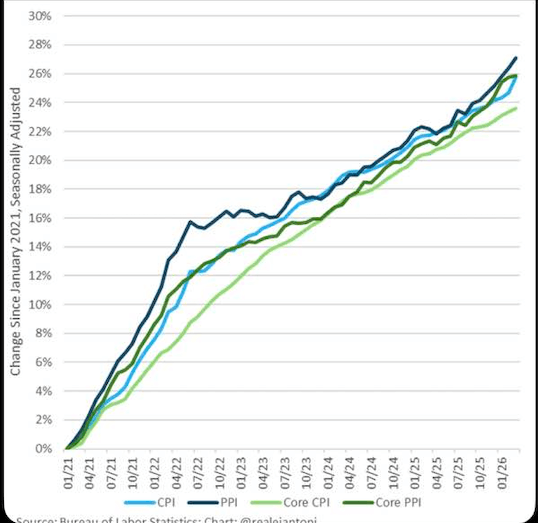
If you go shopping, you’re keenly aware of price inflation. Since January 2021, prices are up between 23.6 percent and 27.1 percent, depending on which metric you choose to use.

According to the latest CPI data, price inflation ran at 3.5 percent over the last year. That’s well above the mythical 2 percent target.

This paints a pretty bleak inflation picture, but the situation is worse than these dreary government numbers suggest.

How can this be?

Because the CPI formula is constructed to understate price inflation.

In fact, the government revised the CPI formula in the 1990s so that it understated the actual rise in prices even more.

However, the Bureau of Labor Statistics also collects and aggregates data on actual price increases. Using these numbers without all the formulaic manipulation and hedonic adjustments built into the process gives us a better sense of how much more we’re paying at the store.

I had an AI agent take 25 common items from the BLS data and calculate the price increase for that basket of goods over the last five years.

Based on this basket, price inflation is running at 29.3 percent.

The largest price increases were on the following items.

  • Ground coffee: 105.4%
  • All-purpose flour: 52.8%
  • Ground chuck: 52.8%
  • White sugar: 50.8%
  • Long-grain rice: 40.0%

The only price on the list lower than five years ago was bacon.

The bottom line is price inflation is worse than they’re telling you. And they’re telling you it’s pretty bad.

There are all kinds of ways to slice and dice data. We can debate the minutiae, but the trend is undeniable. You’re losing purchasing power at a rapid rate. And no matter how much Fed Chairman Keven Warsh screams about tackling price inflation, nothing will change. Even if they do get it under control (and they can’t), they will continue to devalue the dollar by 2 percent per year as a matter of policy. That means you lose more than 10 percent of your purchasing power every five years.

That’s the plan.

Therefore, you need to plan accordingly. If you’re trying to save and preserve your wealth in dollars, you’re making a huge mistake. You need to save in sound money – gold and silver.


Mike Maharrey is a journalist and market analyst for Money Metals with over a decade of experience in precious metals. He holds a BS in accounting from the University of Kentucky and a BA in journalism from the University of South Florida.

With a Struggling Bond Market and Persistent Inflation, Investors Are Turning to Tangible Assets Like Gold

(Mike Maharrey, Money Metals News Service) The bond market has been struggling for the last year-plus, with some analysts saying we’re in the early stages of a secular bear market. This has forced investors to reconsider the role of bonds in a balanced portfolio, with some pivoting to tangible assets with value – like gold.

Over the last couple of years, there has been persistent upward pressure on long-term bond yields. The 10-year Treasury spiked in 2022, rising from around 1.5 percent in late 2021 to a high of nearly 5 percent in the fall of 2023. Since then, yields have remained at those elevated levels despite the Fed cutting rates and geopolitical events that would have historically created significant safe-haven demand for Treasuries.

Reuters recently reported that “inflation, heavy government borrowing, policy uncertainty and bouts of stocks and bonds falling in tandem have weakened bonds’ role as a ballast, prompting some investors to look for more diversification.

Osaic chief market strategist Phil Blancato told Reuters that bonds only work as insurance in a portfolio when inflation is low. He said the wealth management firm has cut its fixed-income ratio from the traditional 40 percent to 31 percent with a 6 percent allocation to commodities.

Inflation certainly isn’t low. It has run well above the mythical 2 percent target for years. And while the CPI had cooled in recent months, the oil shock due to the U.S.-Iran war has restoked price inflation worries.

More significantly, the money supply has been on the rise for over a year, and despite the hawkish talk about slaying inflation once and for all, the Federal Reserve is currently expanding its balance sheet with a modest quantitative easing (QE) operation. This is inflation, by definition.

Last year, Morgan Stanley CIO Michael Wilson recommended an even more aggressive portfolio rebalancing, suggesting investors should cut their bond allocation to 20 percent and swap half of the bond portfolio to gold to serve as a “more resilient” inflation hedge.

“Gold is now the anti-fragile asset to own, rather than Treasuries. High-quality equities and gold are the best hedges.”

Northern Trust analyst Grant Johnsey told Reuters that bond returns are eroded over the long-term by persistent inflation, a weakening currency, and bond supply outpacing demand.

“Many investors are worried that one or more of these variables will play out in the coming years. The issue with the bonds is that when you go out past five years, there are too many potential downside headwinds and not enough tailwinds behind it.”

Johnsey’s observation underscores the fact that it is crucial to consider “real interest” rates when evaluating investment options. Conventional wisdom holds that higher inflation necessitates tighter monetary policy from central banks, meaning higher interest rates. Higher rates are considered a headwind for gold because it is a non-yielding asset. However, even as nominal interest rates rise, inflation suppresses the real rate.

In simplest terms, the real interest rate is the stated rate you see on the news, adjusted for price inflation. To calculate the real interest rate, you take the quoted nominal rate and subtract CPI. This tells you how much your investment will yield in real purchasing power over time.

For example, the 10-year Treasury bond is currently yielding just over 4.6 percent. That seems like a pretty good return. However, the CPI is running at 3.5 percent. That means the real interest rate on a 10-year Treasury is only 1.1 percent (4.6-3.5=1.1).

As the CPI increases, that real rate continues to fall.

Sagard Wealth Management CIO Stephen Harvey called the current economic environment “pro-growth and pro-inflation” and emphasized that fiscal policy now matters more than monetary policy.

In other words, investors are paying less attention to what the Fed and other central banks may do with interest rates and more attention to the rampant borrowing and spending by the world’s governments – particularly the U.S. Given America’s fiscal malfeasance, many investors have become reluctant to lend Uncle Sam more money. This is one of the primary drags on the bond market.

Harvey said Sagard is moving investors away from developed-market fixed income assets (bonds) and into a “preservation bucket” that includes commodities, gold, real estate and infrastructure. He called fixed income “the inflation loser.

Central banks are also spurning Treasuries and upping their gold reserves. Earlier this year, the European Central Bank confirmed that gold has passed Treasuries to become the world’s top reserve asset.

Last year was the fourth-largest expansion of central bank gold reserves on record, at 863 tonnes. That was down 21 percent year-on-year, but still well above the 2010-2021 annual average of 473 tonnes.

The all-time high was set in 2022 (1,136 tonnes). It was the highest level of net purchases on record, dating back to 1950, including since the suspension of dollar convertibility into gold in 1971.

State Street global market strategist Jenn Bender told Reuters that “real assets, tangible assets valued for their intrinsic physical qualities,” have gained appeal since the post-COVID inflation shock. She emphasized that the case continues to strengthen as “the bond outlook clouds and soaring equity markets appear vulnerable.

“The worry is that there is some downside risk in equities. Fixed income is not the place that people want ​to move their equity allocations over to. Basically, real assets is kind of where you end up.”


Mike Maharrey is a journalist and market analyst for Money Metals with over a decade of experience in precious metals. He holds a BS in accounting from the University of Kentucky and a BA in journalism from the University of South Florida.

HUD Opens Civil Rights Probes Into Campus Housing

(José Niño, Headline USA) Federal housing regulators have turned to college dormitories, opening civil rights investigations into two flagship public universities.

The U.S. Department of Housing and Urban Development is examining campus housing at the University of Connecticut and the University of Minnesota after complaints alleged both schools operate residential communities along racial lines, Just the News reported. The agency’s Office of Fair Housing and Equal Opportunity will decide whether the programs breach the Fair Housing Act by steering or advertising housing according to race or ethnicity.

The Equal Protection Project, founded by Cornell law professor William A. Jacobson, filed both complaints on July 12. As Just the News reported, the group maintains that themed residential communities sort students by race even when participation technically stays open to everyone, and that marketing a dorm around racial identity qualifies as discrimination under federal law.

The UConn filing names ScHOLA²RS House, BSOUL House, and La Comunidad Intelectual. The Minnesota filing names four Twin Cities communities, including Huntley House, CASA SOL, and Tsev Hmoob.

Minnesota quietly added disclaimer language to several program pages after March 2026, the complaint alleges, citing archived web records.

“Such perfunctory non-discrimination language does not cure the racial steering violation,” the complaint says.

Assistant Secretary for Fair Housing and Equal Opportunity Craig Trainor defended the probes.

“Too often, however, these young Americans arrive on campus only to be steered toward racially segregated housing arrangements that divide students, create unequal experiences, and betray the core principles of a classical liberal education,” Trainor said. “We will fully investigate the allegations against the University of Connecticut and the University of Minnesota to determine if they are, in fact, violating the Fair Housing Act and Title VI of the Civil Rights Act of 1964.”

Both universities reject the allegations.

“UConn does not discriminate on the basis of race, gender, or any other aspect of identity, including in our on-campus housing,” a school spokesperson said.

A Minnesota spokesperson pointed to the school’s web copy. “The University’s Living Learning Communities are open to all students, regardless of race or ethnicity, which is clearly stated on our website,” the spokesperson said. “The University is diligent in its compliance with federal regulations, guidelines and anti-discrimination laws.”

Just the News reported that HUD is weighing whether the programs satisfy federal fair housing rules. Should investigators find violations, the schools could face financial penalties or orders to overhaul or eliminate the programs.

José Niño is the deputy editor of Headline USA. Follow him at x.com/JoseAlNino 

Arrests Hit Record As ICE Resumes Detention Reporting

(José Niño, Headline USA) Immigration and Customs Enforcement broke a months long data blackout this week, and the figures it finally posted reveal an agency arresting people faster than at any point in Donald Trump’s second term.

Immigration researcher Austin Kocher reported on his Substack that ICE held 65,765 people in civil detention as of July 11. That total climbs above the 60,311 held April 4 but stays under the record 70,766 logged January 24. None of it counts people held briefly at the border, inside field offices, in courtrooms, or at other sites where the agency parks detainees.

ICE has spent the summer advertising record arrest totals, and Kocher confirmed the boast holds up. June averaged more than 1,300 arrests a day, the strongest month of this administration. The first 11 days of July pushed that figure to 1,474, a fresh high. He credited part of the jump to new leadership at Homeland Security, where Markwayne Mullin took over from Kristi Noem in late March after federal agents shot and killed two American citizens in Minnesota. Quieter tactics, Kocher wrote, have delivered more arrests while drawing less public fury.

Removal remains the standard exit. Even so, daily deportations slipped once Mullin arrived, averaging 1,246 from early April through early July, a pace Kocher noted still towers over prior years.

The surprise sits in a category ICE started publishing only this year. Court ordered releases numbered 119 last October. By May, they reached 2,017 in a single month and have hovered near that level since, totaling 10,649 since January.

José Niño is the deputy editor of Headline USA. Follow him at x.com/JoseAlNino 

Fauci’s Diary Expose Private Views at Odds With Public Messaging

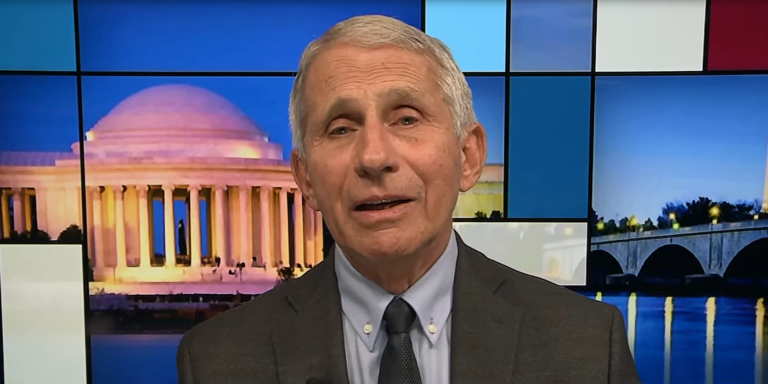
(Luis CornelioHeadline USA) The diary of disgraced former White House COVID czar Anthony Fauci reveals a stark contrast between his private views and his public messaging on several pandemic-era controversies, including the lab leak theory and school closures.

The diary, released Sunday by Senate Homeland Security Committee Chairman Rand Paul, R-Ky., spans more than 1,000 pages and chronicles Fauci’s government role from December 2019 through December 2022.

Among the entries, Fauci acknowledged that the theory COVID-19 leaked from a Wuhan laboratory was plausible, despite publicly dismissing the theory as fringe during the pandemic.

The diary also undercuts Fauci’s claims to the media that he had “nothing to do” with widespread school closures.

In one alleged entry, Fauci wrote that he “convinced” then-New York City Mayor Bill de Blasio to “close the NYC schools.” He added in the same entry that “he should close bars and restaurants in NYC.”

Fauci also wrote that California Gov. Gavin Newsom’s chief of staff, Ann O’Leary, told him Newsom decided to close schools, bars and restaurants based on Fauci’s television appearances.

Paul also released a 465-page prequel to the diary on Monday, covering Fauci’s government service from 2001 through 2015.

According to Paul, the earlier diary suggests Fauci knew the public “wasn’t getting the truth about anthrax” during the 2001 attacks.

One entry states that officials at the Army’s infectious disease laboratory reportedly told Fauci anthrax had been “weaponized.” Fauci said he was “floored” after he heard the head of the Office of Homeland Security seemingly appeared on television downplaying the threat.

Fauci warned that “someone is intentionally not telling Gov. Ridge the truth or he is masking the truth,” adding that “there will be hell to pay when the American public realizes that they have not been dealt with in a totally open manner.”

According to Paul, Fauci also asked then-Vice President Dick Cheney for “DARPA-like powers” when asked what he needed to run biodefense efforts at the National Institute of Allergy and Infectious Diseases.

As noted by Paul, “Part of what was driving that buildup, by his own account, was ‘CIA intelligence that Iraq has smallpox’ – the basis for plans to vaccinate as many as 10 million Americans.”

In another entry, Fauci criticized the CIA following a 2008 White House meeting on “drug- and vaccine-resistant anthrax.”

Fauci reportedly wrote that CIA officials delivered “vague, soft and even embarrassingly bad intelligence.” These meetings were the kind he had sat through “several times before,” the entry alleged.

“One gets a very bad impression of the quality of our intelligence based on meetings such as this,” Fauci wrote, according to Paul.

The documents are among a broader collection of records released by Paul ahead of what is expected to be a contentious Senate Homeland Security Committee hearing on Wednesday. Paul obtained the files through his oversight of the federal government.