Top Trump Officials Intensify Push for Regime Change in Venezuela

(Dave DeCamp, Antiwar.com) Senior Trump administration officials have intensified their push to remove Venezuelan President Nicolas Maduro from power and are discussing steps to escalate the military pressure, The New York Times reported on Monday.

The report said the effort is being led by Secretary of State Marco Rubio, who also serves as President Trump’s national security advisor. Other top officials on board for regime change in Venezuela include CIA Director John Ratcliffe and Stephen Miller, Trump’s chief domestic policy advisor.

The report cited Venezuelan opposition figures who say their movement has been planning what to do if Maduro is ousted, and that Rubio had met with five opposition figures who fled to the US back in May. During the first Trump administration, the US backed a failed coup attempt against Maduro led by opposition figure Juan Guaido.

Other Trump officials, most notably special envoy Ric Grennel, are pushing for diplomacy with Venezuela, and Maduro has sent a letter to Trump seeking talks, although it was dismissed by the White House.

Venezuelan Foreign Minister Yvan Gil pointed to the fact that his country continues to accept twice-weekly deportation flights from the US as a sign that Caracas is serious about diplomacy. He also said that a war would lead to “excessive migration” and economic collapse that would “destabilize the entire region.”

Officials told the Times that the administration is considering launching direct strikes inside Venezuela against alleged drug cartels, something that’s been reported by several other media outlets.

Since the US is claiming Maduro is the leader of a cartel, an allegation his government strongly rejects, that means the Venezuelan leader would be a potential target. So far, the US has bombed at least three boats in the Caribbean that it claimed, without evidence, were carrying drugs, extrajudicially executing at least 17 people.

Maduro and other Venezuelan officials have pointed to data that shows the majority of the cocaine that is produced in Colombia doesn’t go through Venezuela. President Trump has framed the military campaign in the region as a response to overdose deaths in the US due to fentanyl, but fentanyl isn’t produced in Venezuela, and it does not go through the country on its way to the US.


 This article originally appeared at Antiwar.com. 

Boeing To Get $123 Million Contract To Replace Bunker Busting Bombs the US Dropped on Iran

(Dave DeCamp, Antiwar.com) Boeing is set to receive a contract worth up to $123 million to replace the massive 30,000-pound bunker-busting bombs that the US dropped on Iranian nuclear facilities in June as part of the 12-day US-Israeli war against Iran, Bloomberg reported on Tuesday.

On June 22, US B-2 Spirit bombers dropped 14 GBU-57 Massive Ordnance Penetrator (MOP) bombs on Iran’s Fordow and Natanz nuclear sites, marking the first time the weapon was used in combat. A US submarine also fired Tomahawk missiles in strikes on an Iranian nuclear facility in Isfahan.

The attack, dubbed “Operation Midnight Hammer,” was launched on behalf of Israel. The Bloomberg report said that a Pentagon budget document from August says that funds are being shifted from operations and maintenance accounts to Air Force munitions procurement as “funds are required to replace GBU-57 munitions expended in Operation Midnight Hammer in support of Israel.”

Replacing the MOPs is just a fraction of the cost of the war against Iran, as the US used a significant number of interceptors to defend Israel throughout the 12 days. US officials told The Wall Street Journal that the US fired more than 150 THAAD interceptors during the war, accounting for about one-quarter of the Pentagon’s total stock of the interceptors and costing about $2 billion.

The US military also engaged in its largest use of Patriot missiles to repel the Iranian attack on the Al Udeid Air Base in Qatar, which Iran launched in retaliation for the bombing of its nuclear sites.

Bloomberg previously reported that the Pentagon was planning to spend at least $3.5 billion replenishing weapons it had used defending Israel before the 12-Day War. Most of the cost was related to the US defense of Israel when Iran launched an attack in April 2024 in retaliation for Israel bombing its consulate in Damascus.

 This article originally appeared at Antiwar.com. 

Federal Judge Rules Trump Administration’s Push To Deport Critics of Israel Is Unconstitutional

(Dave DeCamp, Antiwar.com) A federal judge in Boston ruled on Tuesday that the Trump administration violated the Constitution with its effort to deport critics of Israel, and affirmed that non-citizens in the US legally have the same right to free speech as Americans.

“This case — perhaps the most important ever to fall within the jurisdiction of this district court — squarely presents the issue whether non-citizens lawfully present here in the United States actually have the same free speech rights as the rest of us. The Court answers this Constitutional question unequivocally ‘yes, they do,” said District Judge William Young, who was nominated by President Reagan.

The ruling was the result of a lawsuit brought by several university associations that alleged the arrest of college students and faculty who participated in pro-Palestine protests violated the First Amendment and had a chilling effect on speech.

“In his 161-page opinion, the judge analyzed the Trump administration’s allegations against several non-citizens, including Mahmoud Khalil and Rumeysa Ozturk, and rightly recognized that they were targeted purely for their political views and speech,” Jenin Younis, a civil liberties attorney and legal director of the American-Arab Anti-Discrimination Committee, told Antiwar.com.

“He rejected the argument that non-citizens lack First Amendment protections, correctly observing that it serves as a restraint on government, without respect to the immigration status of the speaker,” Younes added.

In his ruling, Young said that Secretary of State Marco Rubio and Homeland Security Secretary Kristi Noem and their subordinates “acted in concert to misuse the sweeping powers of their respective offices to target non-citizen pro-Palestinians for deportation primarily on account of their First Amendment-protected political speech.”

Young said Rubio and Noem carried out this policy “in order to strike fear into similarly situated non-citizen pro-Palestinian individuals, pro-actively (and effectively) curbing lawful pro-Palestinian speech and intentionally denying such individuals (including the plaintiffs here) the freedom of speech that is their right.”

The judge added that the effect of the campaign against pro-Palestinian non-citizens “continues unconstitutionally to chill freedom of speech to this day.”

 This article originally appeared at Antiwar.com.

War Chief Hegseth Says US Military Is Done With ‘Politically Correct’ Rules of Engagement

(Dave DeCamp, Antiwar.com) US Secretary of War Pete Hegseth said in an address to hundreds of generals and admirals on Tuesday that there should be no more “politically correct” rules of engagement for the US military as he presented his recently rebranded Department of War as a ruthless force that can produce overwhelming violence.

“We’re training warriors, not defenders. We fight wars to win, not to defend. Defense is something you do all the time, it’s inherently reactionary and can lead to overreach and mission creep. War is something you do sparingly,” Hegseth told the crowd of senior officers at the US Marine Corps Base in Quantico, Virginia.

“On our own terms, and with clear aims, we fight to win. We unleash overwhelming and punishing violence on the enemy. We also don’t fight with stupid rules of engagement. We untie the hands of our warfighters to intimidate, demoralize, hunt, and kill the enemies of our country. No more politically correct and overbearing rules of engagement. Just common sense, maximum lethality, and authority for warfighters,” he added.

After Trump came into office at the beginning of the year, he eased restrictions on US airstrikes and raids, giving lower-level military commanders more freedom of action. As a result of the policy, the US has launched a record number of airstrikes in Somalia this year.

The Trump administration also conducted a brutal bombing campaign in Yemen, which Hegseth dubbed Operation Rough Rider, from March 15 to May 6, that involved strikes on residential buildings, energy infrastructure, and a migrant detention facility. While the campaign was brutal and killed more than 250 civilians, it failed to stop Yemen’s Houthis from ending their blockade on Israeli shipping and attacks on Israel, which the group has vowed will continue until there’s a ceasefire in Gaza.

Elsewhere in his speech on Tuesday, Hegseth said his message to US “enemies” was “FAFO,” a slang term that stands for “F** around and find out.”

“Since waging war is so costly in blood and treasure, we owe our Republic a military that will win any war we choose or any war that is thrust upon us. Should our enemies choose foolishly to challenge us, they will be crushed by the violence, precision, and ferocity of the War Department. In other words, to our enemies: FAFO,” he said.

President Trump also addressed the generals and admirals in Quantico, who came from across the US and around the world to attend the meeting. In his speech, Trump stressed that the US military was expanding its role on the domestic front, saying the US was facing an invasion from “within” and that US cities should be used as a “training ground” for US troops.

“We’re under invasion from within. No different than a foreign enemy but more difficult in many ways because they don’t wear uniforms,” the president said.

This article originally appeared at Antiwar.com. 

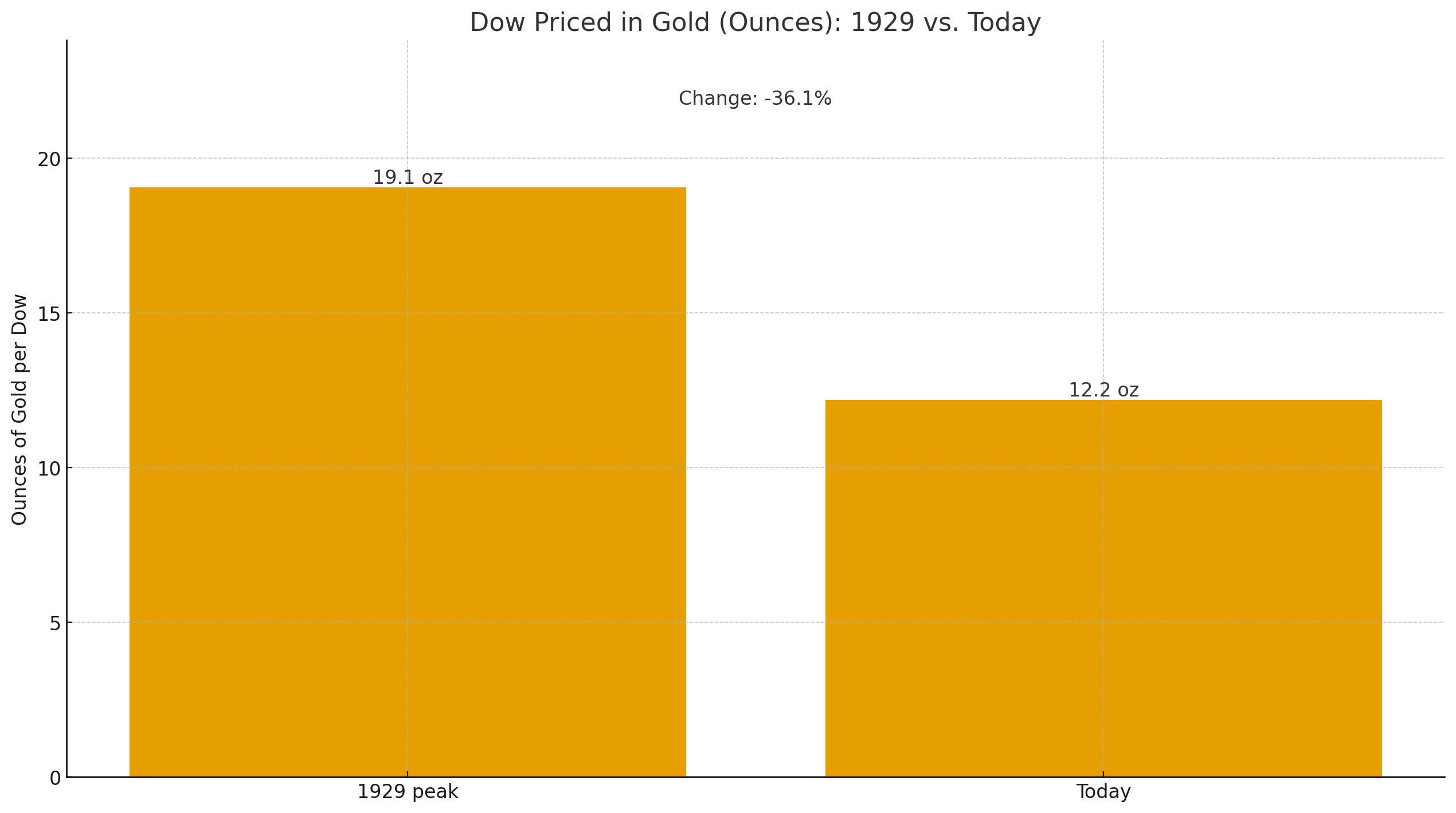
Inflation: The Dow Is Down 36 Percent in Gold Terms Since 1929

(Mike Maharrey, Money Metals News Service) Most people define inflation as rising consumer prices. Price inflation is part of the inflationary equation, but inflation also manifests in other ways, for instance, in asset inflation.

Keep in mind that inflation, properly defined, isn’t about prices. It is an increase in the supply of money and credit. Rising prices are symptomatic of monetary inflation.

When the Federal Reserve slashed interest rates to zero and launched quantitative easing for the first time in the wake of the 2008 financial crisis, many predicted there would be a spike in consumer prices. That never happened, leading some Keynesian economists to declare that money printing is harmless.

However, the monetary inflation created during the Great Recession did manifest, just not in consumer prices. It fed a major surge in asset prices that was clearly visible in the stock market. The S&P 500 rose by over 130 percent between 2010 and 2019.

We can see the inflationary pressure on the stock market even more clearly when we price the Dow Jones in gold.

At its peak in 1929, before the crash, the Dow was 381.17, and the price of gold was $20 an ounce. Priced in gold, the Dow was around 19 ounces.

Today, the Dow is just over 46,300, while gold is around $3,800 an ounce. That means priced in gold, the Dow is just over 12 ounces.

That represents a 37 percent decline in the Dow in gold terms over the last 96 years.

Since gold is real, stable money, pricing the Dow in the yellow metal reveals that the appreciation of the stock market over the last century was predominantly driven by inflation.

Don’t be fooled. Inflation is pernicious and ever-present.


Mike Maharrey is a journalist and market analyst for Money Metals with over a decade of experience in precious metals. He holds a BS in accounting from the University of Kentucky and a BA in journalism from the University of South Florida.

Asian Hubs Seeking to Usurp London as the Center of the Global Gold Trade

(Mike Maharrey, Money Metals News Service) Singapore and Hong Kong are seeking to usurp London as the center of the global gold trade, another indication of the yellow metal’s shift from West to East.

Western markets – London, New York, and Switzerland –  have dominated the gold trade for nearly two centuries. However, with gold progressively flowing from West to East, Singapore and Hong Kong are developing the infrastructure to challenge Western dominance.

However, there are plenty of challenges.

The Reserve opened last year in Singapore. It features one of the largest maximum-security bullion vaults in the world, designed to hold up to 10,000 tonnes of silver and 500 tonnes of gold.

The goal is to lease space to private banks and family offices so they can store their wealthy clients’ precious metals holdings in a secure facility a short distance from Southeast Asia’s busiest airport.

So far, the facility only holds a fraction of the metal it was designed for. However, Singapore Bullion Market Association chief executive Albert Cheng told the Financial Times it’s only a matter of time before Asia begins to challenge London’s dominance.

“London took 200 years to build the infrastructure to become the center of the world gold market. We have lots of work to do, but it won’t take us that long.”

In addition to building new vaulting facilities, players in the Asian gold market are also expanding wholesale warehousing and refining capabilities. Meanwhile, Abaxx Exchange, a Singapore-based bourse, recently launched a gold futures contract.

The Shanghai Gold Exchange has also launched a renminbi-denominated gold contract. It opened an offshore vault in Hong Kong to support the contracts and help market them to foreign investors.

Hong Kong city leader John Lee recently announced plans to increase gold storage capacity in the city from the current 200 tonnes to more than 2,000 tonnes in three years. He said the goal was to create a “regional gold reserve hub”.

Abaxx chief economist David Greely said this all points to the fact that “the center for gold trading is increasingly moving East.

“There is a big untapped demand for an Asian trading hub.”

Asian demand has been one of the primary drivers behind the recent gold rally that has seen the yellow metal gain more than 84 percent since January 2024.

For instance, in China, gold bar and coin demand grew by 44 percent year-on-year in H1. Chinese investors snapped up 115 tonnes of gold bars and coins in the second quarter alone. It was the strongest H1 for physical gold buying since 2013.

Meanwhile, year-on-year bar and coin demand in the U.S. plummeted by 53 percent. American investors bought a paltry 9 tonnes of gold coins and bars in Q2, the lowest quarterly total since 2019.

Trade uncertainty has increased the momentum to develop regional gold hubs in the East. A research analyst at a Swiss refinery told the Financial Times,

“There is a window for these hubs to explore ramping up their product availability.”

There are some obstacles facing those hoping to make Asia the center of the gold trade. Some Western players worry about political instability in the region. A former gold trader at JPMorgan and HSBC told the Times, “There is always this fear — is it a true international market, or is it something where, if the Chinese government didn’t like the result, they could change the rules?

As a neutral country, Singapore doesn’t have as much political baggage.

At this point, both Hong Kong and Singapore have their pluses and minuses. Gregor Gregersen, founder of Silver Bullion, the company behind The Reserve, told the Times, “On the vaulting side, we are ahead in Singapore; on trading, I would say Hong Kong is ahead. Both hubs have realized that the world is changing, and they need to revisit their role when it comes to gold.


Mike Maharrey is a journalist and market analyst for Money Metals with over a decade of experience in precious metals. He holds a BS in accounting from the University of Kentucky and a BA in journalism from the University of South Florida.

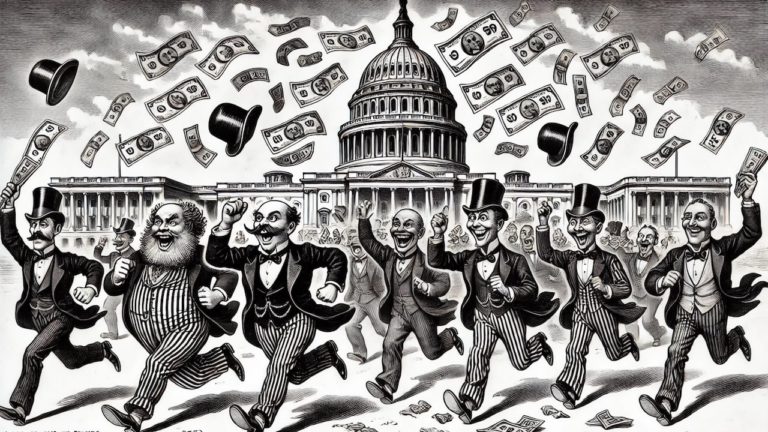
Government Shutdown Theater Fuels More Gold Gains

(Clint Siegner, Money Metals News Service) Rumors of a federal government shutdown are once again swirling. Absent a deal, non-essential agencies will have to suspend operations until legislators put together a spending deal.

Americans have another front row seat to the public relations battle between Republicans and Democrats to see which party is most to blame for the impasse.

Legislators on both sides of the aisle want citizens to know a shutdown is bad and that the other party is responsible. They don’t want people paying attention to just how little the difference is between the Republican and Democratic spending proposals.

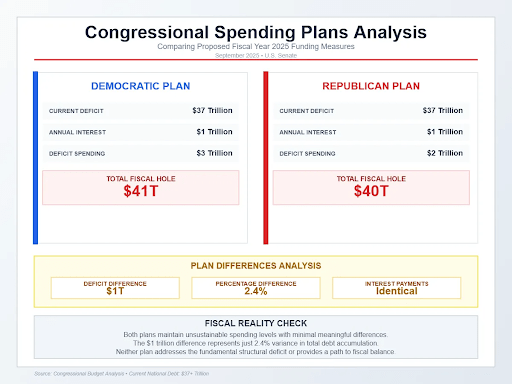
This difference is summed up in the chart below:

Congressional Spending Plans Analysis

The Democrats would be happy to spend $3 trillion more than the government collects in taxes. Republicans are pushing for a $2 trillion budget deficit.

Just a few years back, Americans were witness to budget drama, which included deficits a mere quarter of these amounts.

Republican legislators are proudly standing behind an offer which would extend the current Biden-era funding levels for 7 weeks. They aren’t embarrassed at all to be supporting spending levels they pretended to oppose just a couple of years ago.

Democrats insist that certain healthcare spending increases, which were tamped down via the “One Big Beautiful Bill,” must be restored.

Despite the looming October 1 deadline, there is no budget resolution or appropriations package currently up for debate or vote.

The Trump administration is threatening to permanently lay off some non-essential employees if there is a shutdown.

Democrats are howling about those threats and promising to stand firm.

Voters on both sides are expected to be proud of the principled stand their respective party leaders are making.

For fans of limited government and sound money, here’s a spoiler alert: Republicans in Congress aren’t planning a meaningful change in spending or deficits, and, of course, neither are Democrats.

In the end, and despite the drama, citizens are going to get stuck with a deal in which government spending rises and the national debt ratchets trillions higher.

The Federal Reserve Bank will enable the whole thing with artificially lower interest rates. It might even have to step in again as the buyer of last resort for the oceans of new debt the Treasury will be issuing.


Clint Siegner is a Director at Money Metals Exchange, a precious metals dealer recently named “Best in the USA” by an independent global ratings group. A graduate of Linfield College in Oregon, Siegner puts his experience in business management along with his passion for personal liberty, limited government, and honest money into the development of Money Metals’ brand and reach. This includes writing extensively on the bullion markets and their intersection with policy and world affairs.

Despite Record Prices, Indians Are Holding on to Their Gold

(Mike Maharrey, Money Metals News Service) Despite record-high prices, Indians are holding on to their gold.

Since the beginning of the year, gold has soared by 44 percent in rupee terms. That’s on top of a 21 percent gain last year.

High prices typically lead to increased selling and a surge of scrap metal into the market to satisfy increased demand on the buying side. For instance, when the yellow metal crossed $3,000 an ounce in March, Indian investors rushed to sell and book a profit. That led to a bug increase in scrap supply.

But with the recent record highs, that hasn’t happened.

Why not?

Indians believe gold prices will rise even higher.

Harshad Ajmera of wholesaler JJ Gold House in Kolkata told Reuters Indians believe prices could rise to ₹125,000 per 10 grams. (Gold is currently trading around ₹111,000 per 10 grams.)

A surge in scrap gold supply during periods of rapidly rising prices often results in discounted premiums. But with more people holding on to their gold, that’s not happening. There have been narrowing domestic price discounts in recent weeks. We even saw a brief period with a marginal premium in late August. The World Gold Council notes, “This marks a noteworthy change, as domestic gold prices had been trading at a near-sustained discount since December.”

Reuters called the limited scrap supply ahead of festival season “a boon for banks,” as jewelers turn to them to meet demand from imported gold.

A Mumbai-based jeweler with a bullion-importing bank told Reuters that limited supplies are allowing banks to charge a $1 premium, even with record-high prices.

Without a surge in scrap to feed growing demand, gold imports have increased over the last couple of months. August imports totaled $5.2 billion, a 37 percent month-on-month increase. The World Gold Council estimates India imported between 60 and 65 tonnes of gold. That was up from between 42 and 48 tonnes in July.

Gold demand could get a further boost from a reduction in the Goods and Services Tax that went into effect on Sept. 22.

Strong demand for gold and the lack of selling contrasts sharply with the U.S. market.

American investors have been aggressively selling gold.

While gold bar and coin demand increased by 11 percent globally in H1, year-on-year bar and coin demand in the U.S. plummeted by 53 percent. American investors bought a paltry 9 tonnes of gold coins and bars in Q2, the lowest quarterly total since 2019.

According to the World Gold Council, “U.S. net investor demand was again affected by a double whammy of elevated profit taking and subdued levels of new purchases.

Indians have long valued the yellow metal as a store of wealth, especially in poorer rural regions. Around two-thirds of India’s gold demand comes from beyond the urban centers, where large numbers of people operate outside the tax system. Many Indians use gold jewelry not only as an adornment but as a way to preserve wealth.


Mike Maharrey is a journalist and market analyst for Money Metals with over a decade of experience in precious metals. He holds a BS in accounting from the University of Kentucky and a BA in journalism from the University of South Florida.

Thief Steals Priceless Egyptian Gold Artifact, Has It Melted Down

(Mike Maharrey, Money Metals News Service) Some people have no appreciation for history. But pretty much everybody has an appreciation for gold.

This explains why thieves stole a priceless Egyptian artifact and ultimately had it melted down.

Police arrested an employee of the Egyptian Museum in Cairo, along with three accomplices, and charged them in connection with the theft of a gold bracelet that belonged to Pharaoh Amenemope, who ruled Egypt around 1,000 BC.

Police say a museum restoration specialist lifted the bracelet from a safe. He sold it to a silver trader, who passed it on to a jewelry worker in Cairo’s historic jewelry district. The workshop owner sold the bracelet to a gold smelter who melted it down and cast it with other items.

According to police, the thief earned 190,000 Egyptian pounds selling the bracelet, equal to about $4,000.

Yup. Just $4,000 for a priceless bracelet.

It kind of sounds like the rip-off artist got ripped off. But when you think more deeply about the situation, he made the right move.

Mind you, I’m not saying that stealing ancient artifacts is the right move. But if you’re going to pilfer Egyptian antiquities (don’t), this particular thief played it about as well as you can.

Well, other than getting caught.

The bracelet was a simple gold band with a lapis lazuli bead in the center. While it wasn’t fancy, the bracelet had deep religious significance to the ancient Egyptians. They believed gold represented the “flesh of the gods.” The lapis lazuli bead symbolized the god’s hair.

An Egyptologist told the Smithsonian Magazine that the bracelet was “not the most beautiful.”

“But scientifically, it’s one of the most interesting.”

Ancient Egyptians also associated gold with eternity and incorruptibility. That’s why it was used extensively in burials.

Interestingly, the Egyptians didn’t use denominated gold coinage. They typically relied on barter using commodities. Grain, especially barley, served as a primary means of exchange. But metals did play a role in the economy as a measure of value.

The ancient Egyptians employed a weight system called the “deben” as a unit of account. IN the New Kingdom, 1 deben equaled about 91 grams. For example, a tool might cost  1/4 deben of gold.

Instead of coins, metal ingots, rings, or pieces of metal were weighed out during transactions.

Gold served as an essential commodity in trade and diplomacy. Pharaohs sent gold as tribute and diplomatic gifts to other kings of other powerful nations, including the Mesopotamians and Hittites.

So, why did our intrepid thief sell a bracelet that was worth millions for $4,000? And why did the buyer melt it down?

Well, think about it. It was almost certain they would get caught if they tried to sell a priceless, stolen Egyptian artifact on the open market. Also, stealing an artifact with the intent to smuggle is punishable by life in prison under Egyptian law.

However, once it’s melted, gold is gold. And gold has value in and of itself. You can sell it virtually anywhere in the world. So, they went for the easy money.

I couldn’t find any information on the weight of the bracelet, but assuming it was a little over a troy ounce of pure gold, our thief basically got the value of the metal based on the current price. So, the return on his effort was pretty good, despite leaving the bracelet’s historical value on the table.

Of course, he’s also going to get jail. So, I guess the return on his effort wasn’t so great.

Photo courtesy of the Egyptian Ministry of Tourism and Antiquities


Mike Maharrey is a journalist and market analyst for Money Metals with over a decade of experience in precious metals. He holds a BS in accounting from the University of Kentucky and a BA in journalism from the University of South Florida.

Trump Trolls Dems Ahead of Government Shutdown

(Luis CornelioHeadline USA) President Donald Trump turned to mockery on Monday, ridiculing Democratic demands ahead of the government shutdown on Tuesday evening. 

He posted an AI-altered video on Truth Social of House Minority Leader Hakeem Jeffries wearing a sombrero and a mustache — a likely jab at Jeffries’s push to exploit the government shutdown to expand Obamacare subsidies, which Trump framed as benefiting illegal immigrants. 

In the clip, Senate Minority Leader Chuck Schumer stands beside Jeffries while a voiceover quips, “If we give all these illegal aliens free health care, we might be able to get them on our side so they can vote for us.” 

Democrats and legacy media attacked the post as racist, even though neither Jeffries nor Schumer is of Hispanic heritage. 

Trump’s quip appeared to reference illegal immigrants who use emergency rooms for care, costs that Trump says are later reimbursed by the federal government. 

Among the Democrats attacking Trump was Rep. Teresa Leger Fernández, D-N.M., chair of the Democratic Women’s Caucus, who said the video gave the impression that Trump “looks like a little 6-year-old having a temper tantrum.” 

A clip of Fernández addressing reporters outside the U.S. Capitol went viral. She appeared near tears and said, “You post something that draws a sombrero and a mustache on the leader.” 

Fernández fumbled the words “sombrero” and “mustache” in the clip, which added to the viral moment. 

Rep. Adriano Espaillat, D-N.Y., called the video “insulting” and said that Trump was “out of touch with the health care challenges of the American people. 

Rep. Yvette Clarke, D-N.Y., the chair of the Congressional Black Caucus, said that “the juvenile behavior coming out of the White House should not be dignified by any American.” 

Schumer reacted directly, saying, “If you think your shutdown is a joke, it just proves what we all know: You can’t negotiate. You can only throw tantrums.”