The report, which cited White House officials familiar with the meeting, said that Secretary of War Pete Hegseth and Chairman of the Joint Chiefs of Staff Dan Caine were involved in the briefing that presented potential options for the “coming days,” though no final decision was made.
The report comes after signs that the president was cooling on the idea of launching a war with Venezuela, though a US aircraft carrier, the USS Gerald Ford, and three US Navy destroyers, just arrived in the region, significantly bolstering US forces in the Caribbean.
The leaks to CBS about the briefing could be part of the psychological operation against Nicolas Maduro aimed at pressuring him to voluntarily step down from power, though that’s unlikely to happen. The Wall Street Journalreported on November 5 that the president expressed reservations about attacking Venezuela and that he was content with slowly building up US forces in the region and continuing the illegal bombing campaign against alleged drug-running boats in the region.
The push toward a regime change war in Venezuela is being driven by Secretary of State Marco Rubio, who also serves as Trump’s national security advisor. Reports have said that Stephen Miller, the president’s senior domestic policy advisor, also favors war, but there are concerns within the administration that taking out Maduro could plunge Venezuela into chaos and lead to another migrant crisis, akin to what happened in Libya after Muammar Gaddafi was brutally killed during a US and NATO bombing campaign.
Rubio has previously directly compared ousting Maduro with the killing of Gaddafi. Back in 2019, when the first Trump administration attempted to unseat Maduro, Rubio posted a photo on Twitter of Gaddafi in the moments before he was killed as a threat to the Venezuelan leader.
Last week, ahead of a Senate vote on a bill to block Trump from starting a war with Venezuela without congressional authorization, Trump officials told lawmakers that they didn’t currently have plans to bomb the country and that they lacked the legal authorization to do so. But the administration also conveyed that they planned on getting a legal opinion from the Department of Justice to justify strikes in Venezuela, which would still be illegal without approval from Congress, per the Constitution.
(Headline USA) With the longest U.S. government shutdown over, state officials said Thursday that they are working quickly to get full SNAP food benefits to millions of people, though it still could take up to a week for some to receive their delayed aid.
A back-and-forth series of court rulings and shifting policies from President Donald Trump’s administration has led to a patchwork distribution of November benefits under the Supplemental Nutrition Assistance Program.
While some states already had issued full SNAP benefits, about two-thirds of states had issued only partial benefits or none at all before the government shutdown ended late Wednesday, according to an Associated Press tally.
The federal food program serves about 42 million people, about 1 in 8 Americans, in lower-income households. They receive an average of around $190 monthly per person, though that doesn’t necessarily cover the full cost of groceries for a regular month.
A spokesperson for the U.S. Department of Agriculture, which runs the program, said in an email Wednesday that funds could be available “upon the government reopening, within 24 hours for most states.” But the agency didn’t say whether that timeline applies to when the money is available to states or when it could be loaded onto electronic cards used by beneficiaries.
West Virginia, which hadn’t issued SNAP benefits, should have full November benefits for all recipients by Friday, Gov. Patrick Morrisey said Thursday.
The Illinois Department of Human Services, which previously issued partial November benefits, said Thursday that it is “working to restore full SNAP benefits.” But it won’t happen instantly.
“We anticipate that the remaining benefit payments will be made over several days, starting tomorrow,” the department said in a statement, and that “all SNAP recipients will receive their full November benefits by November 20th.”
Colorado officials said late Wednesday that they are switching from delivering partial to full SNAP benefits, which could be loaded onto electronic cards starting as soon as Thursday.
Missouri’s Department of Social Services, which issued partial SNAP payments Tuesday, said Thursday that it is waiting for USDA guidance about how to issue the remaining November SNAP benefits but would move quickly once it gets that.
The delayed SNAP payments posed another complication for Lee Harris’ family since his spouse was laid off a few months ago.
Harris, 34, said the North Little Rock, Arkansas, family got help from his temple and received food left by someone who was moving. With that assistance — and the knowledge that other families have greater needs — they skipped stopping by the food pantry they had sometimes used.
They and their three daughters have been able to keep meals fairly close to normal despite missing a SNAP payment this week. But they still have experienced stress and uncertainty.
“Not knowing a definite end,” Harris said, “I don’t know how much I need to stretch what I have in our pantry.”
The USDA told states Oct. 24 that it would not fund SNAP benefits for November amid the government shutdown. Many Democratic-led states sued to have the funding restored.
After judges ruled the Trump administration must tap into reserves to fund SNAP, the administration said it would fund up to 65% of its regular allocations. When a judge subsequently ordered full benefits, some states scrambled to quickly load SNAP benefits onto participants’ cards during a one-day window before the Supreme Court put that order on hold Friday.
Meanwhile, other states went forward with partial benefits, and still others issued nothing while waiting for further USDA guidance about the situation.
Amid the uncertainty over federal SNAP funding, some states tapped into their own funds to provide direct aid to SNAP recipients or additional money for nonprofit food banks.
The legislation to reopen the U.S. government provides full SNAP benefits not only for November but also for the remainder of the federal fiscal year, which runs through next September. Citing that legislation, the Justice Department on Thursday dropped its request for the Supreme Court to continue blocking a judicial order to pay full SNAP benefits. Adapted from reporting by the Associated Press.
(Luis Cornelio, Headline USA) The House Judiciary Committee is investigating the DOJ’s Office of Inspector General over its involvement in the FBI’s illegal seizure of Rep. Scott Perry’s cellphone in 2022.
The seizure was part of a joint investigation between the OIG and the DOJ under the anti-Trump Arctic Frost operation, which targeted individuals who objected to the 2020 election’s certification. Arctic Frost later served as a precursor to Special Counsel Jack Smith’s probe.
In a letter to Acting Inspector General Don Richard Berthiaume, Judiciary Chairman Jim Jordan ordered the OIG on Wednesday to turn over all internal documents related to the seizure of Perry’s cellphone.
At the time, Perry was among the lawmakers targeted for planning to object to the congressional certification of the 2020 election on Jan. 6, 2021. The FBI seized his phone while he was traveling with his family on August 9, 2022.
A federal judge ruled that nearly 400 phone records seized by the FBI were protected by the Constitution’s Speech or Debate Clause. However, Perry maintained that over 2,000 of the seized files were privileged.
#NEWS: @Jim_Jordan probes Inspector General’s role in Arctic Frost investigation.
The FBI later returned the device only after making a full copy of its contents. The OIG reportedly assisted the bureau in conducting a forensic review of the phone’s data.
The OIG’s direct role in the seizure raised eyebrows, given that the supposedly independent watchdog is tasked with reviewing the FBI’s work.
“The OIG’s assistance in imaging Representative Perry’s phone raises serious concerns about why the OIG would be willing to sacrifice its independence to assist the FBI in advancing such a partisan investigation,” Jordan wrote.
Jordan is now demanding that the OIG explain its involvement in Arctic Frost and disclose whether it was involved in the seizure of other lawmakers’ phone records.
Perry was one of several members of Congress targeted by the Biden-led FBI. Among those lawmakers were GOP Sens. Marsha Blackburn, Tenn.; Ted Cruz, Texas; Ron Johnson, Wis., Bill Hagerty, Tenn.; Josh Hawley, Mo.
Others included GOP Sens. Cynthia Lummis, Wyo.; Lindsey Graham, S.C.; Dan Sullivan, Alaska, and Tommy Tuberville, Ala.; and Rep. Mike Kelly, Pa.
The report said that the construction of the base would cost about $500 million and would be designed to house thousands of US and international troops tasked with maintaining the Gaza ceasefire deal.
The US has already established a military outpost in southern Israel to oversee the ceasefire, known as the Civil-Military Coordination Center (CMCC), but the construction of such a large base would mark a significant escalation of the US military presence. It would also increase the US involvement in Gaza, where Israel is regularly carrying out attacks and killing Palestinians despite the truce deal.
“It’s hard to overstate the significance of building such a base,” an Israeli security official told Shomrim. “Since the Six-Day War, Israel has sought to minimize international involvement in the territories. The establishment of an American base on Israeli soil shows just how determined Washington is to be involved in Gaza and the broader Israeli-Palestinian conflict.”
The US has already deployed 200 troops to the CMCC, which has replaced Israel as the “overseer” of humanitarian aid deliveries into Gaza, according to a report from The Washington Post. Israel has continued to restrict aid deliveries to Gaza in violation of the ceasefire deal.
Shomrim said that it asked the US Embassy in Jerusalem for a comment on the report and was referred to the US Department of War, which in turn referred to US Central Command. Shomrim said it hasn’t received a response from CENTCOM. Antiwar.com has asked the State Department for a comment on the report and has yet to receive a reply.
Bloomberglater reported that the US military was exploring the possibility of building a “temporary” base capable of housing 10,000 people near Gaza. The report cited a Request for Information document dated October 31 that said the US Navy was seeking a cost estimate for “a temporary, self-sustaining military base of operations capable of supporting 10,000 personnel and providing 10,000 square feet of office space for a period of 12 months.”
In response to the Bloomberg report, White House Press Secretary Karoline Leavitt said, “This story is based on a single piece of paper produced by random people within the military. Such a plan has not been considered or approved by the highest levels of the United States government and should not be deemed as an official plan in the Middle East.”
(Luis Cornelio, Headline USA) The congressional campaign of Jack Schlossberg, the “nepo” grandson of President John F. Kennedy, is off to a rough start.
Schlossberg is an online influencer whose résumé amounts to a Vogue op-ed. He has built an internet career out of coasting on his family name, taking cheap shots at President Donald Trump and HHS Secretary Robert F. Kennedy Jr., and tagging along for interviews with his mother, Caroline Kennedy.
Schlossberg, who announced Wednesday his run to replace retiring Rep. Jerry Nadler in 2026, has faced growing mockery just a day into his campaign.
On social media, critics have slammed Schlossberg’s lack of real-life experience and ridiculed his campaign slogan, “Jack for New York,” with many pointing out the unintended sexual double meaning.
“Dude. Who’s gonna tell him his sign is about to be a MEME,” Newsmax host Carl Higbie predicted via X.
Some also mocked his campaign launch photos, as critics noted that both the New York City and American flags photographed behind him appeared wrinkled, as if freshly ordered online.
Schlossberg’s mother reportedly opposed his decision to run, fearing the relentless mockery, according to the New York Post.
“Caroline has pleaded with Jack not to run, but he seems determined to follow in the political footsteps of his grandfather [President John F. Kennedy] and generations of other Kennedys who have held political office,” a source told the Post.
“Jack’s decision to throw his hat in the ring has seriously frightened Caroline, who believes the political world has become too dangerous, too frightening, too crazy, and so she doesn’t want her only son … running for elective office in the current toxic environment,” the source added.
Nadler, who announced his retirement in September, dismissed Schlossberg’s bid given his inexperience.
“Well, there’s nothing particularly good or bad about a Kennedy holding my seat. But the Kennedy, unlike Schlossberg, should be somebody with a record of public service, a record of public accomplishment, and he doesn’t have one,” Nadler told CNN.
John Skelton is facing three counts of murder and tampering with evidence in the deaths of 9-year-old Andrew, 7-year-old Alexander and 5-year-old Tanner Skelton, according to Lenawee County District Court records.
The charges, filed Wednesday, came just days before Skelton, 53, was due to be released from prison after a 15-year sentence for failing to return the boys to their mother, the only conviction in the saga so far.
A message seeking comment from the prosecutor’s office was not immediately returned.
The brothers disappeared while with their father at Thanksgiving in Morenci, a small town near the Ohio border, 100 miles (160 kilometers) southwest of Detroit.
Skelton and his wife, Tanya Zuvers, were having problems and living apart in Morenci. The boys were supposed to return to Zuvers the next day. Instead, they were gone.
The brothers have not been found, despite countless searches of woods and water in Michigan and Ohio and tips from across the country.
Police said Skelton fed them a long string of lies about the boys’ whereabouts, sending investigators to an old schoolhouse in Kunkle, Ohio, and a dumpster in Holiday City, Ohio. Police said claims that the boys were handed to other people for their safety also turned out to be false.
A lead investigator, Michigan State Police Detective Lt. Jeremy Brewer, said in March that he has “no doubt whatsoever” that Skelton killed the brothers.
He was testifying at a hearing to declare the boys legally dead.
Skelton declined to participate in the court hearing.
“Anything I say isn’t going to make a difference,” he said on March 3 by videoconference from prison.
(José Niño, Headline USA) President Donald Trump ignited fresh controversy within his own political base during a Fox News interview on Monday, defending his plan to double Chinese student visas to 600,000 while dismissing concerns from MAGA supporters about espionage and intellectual property theft.
The contentious exchange centered onTrump’s August 2025 announcement to increase Chinese student visas from 300,000 to 600,000. Ingraham challenged the president directly, stating “Folks, are not thrilled about this idea of hundreds of thousands of foreign students in the United States.”
When Ingraham pressed about whether Chinese students are “fans of the United States,” Trump pivoted to economic arguments. “Yeah but you would have, as you know, historically black colleges and universities would all be out of business. You would have a system of colleges and universities,” Trump responded, suggesting that a wholesale collapse of American higher education would come about without international student revenue.
🚨MUST WATCH🚨
Laura Ingraham pushes back on President Donald Trump’s plans to bring potentially 600,000 Chinese students into our universities.
“It’s not that I want them. I view it as a business,” President Trump responds to Ingraham. pic.twitter.com/us450vh28Z
Ingraham challenged this dependency, asking “So we’re dependent on China to keep our university system going?” Trump broadened his defense beyond China, stating “No, not China, but I actually think it’s good to have outside countries. Look, I want to be able to get along with the world.”
The Fox News host then raised security concerns, noting “They’re not the French, they’re the Chinese. They spy on us, they steal our intellectual property.” Trump’s response surprised observers when he questioned whether French students posed less risk, asking “You think the French are better? Really? I’ll tell you, I’m not so sure.”
Trump criticized France’s trade practices, claiming “We’ve had a lot of problems with the French where we get taxed very unfairly on our technology. You know, they put 25% taxes on American products.” He added, “Look, assuming everyone treats us badly because that’s the way I am, but we’re taking trillions of dollars from students.”
The president emphasized the financial incentive, stating “The students pay more than double when they come in from most foreign countries. I want to see our school system thrive.” According to the Institute of International Education, international students contributed approximately $50 billion to the U.S. economy during the 2023-24 academic year and supported over 378,000 jobs.
The policy has previously generated significant opposition within Trump’s own base. Representative Marjorie Taylor Greene, a Georgia Republican, argued on X/Twitter on Aug. 25, 2025, “We should not let in 600,000 CHINESE students to attend American colleges and universities that may be loyal to the CCP. If refusing to allow these Chinese students to attend our schools causes 15% of them to fail then these schools should fail anyways because they are being propped up by the CCP.”
We should not let in 600,000 CHINESE students to attend American colleges and universities that may be loyal to the CCP.
If refusing to allow these Chinese students to attend our schools causes 15% of them to fail then these schools should fail anyways because they are being…
Greene continued, “Why are we allowing 600,000 students from China to replace our American student’s opportunities? We should never allow that.”
Trump dismissed the internal MAGA criticism by asserting ownership of the movement, stating “Don’t forget, MAGA was my idea. MAGA was nobody else’s idea. I know what MAGA wants better than anybody else, and MAGA wants to see our country thrive.”
José Niño is the deputy editor of Headline USA. Follow him at x.com/JoseAlNino
(Dave DeCamp, Antiwar.com) Israel is seeking a 20-year military aid deal with the US and is looking to increase the annual amount of military assistance it receives from Washington, Axios reported on Thursday.
A 20-year deal would double the usual term for US-Israel military aid agreements. The current Memorandum of Understanding (MOU), negotiated under the Obama administration, was the third 10-year military aid deal between the two countries.
The current MOU, under which the US provides Israel with $3.8 billion in military aid each year, expires in 2028, and the Axios report said that Israeli officials hope to have a replacement deal in place over the next year. Since October 7, 2023, the US has provided significantly more military aid to Israel to support the genocidal campaign in Gaza and other Israeli military operations in the region.
According to Brown University’s Costs of War Project, in the two years following the October 7 attack, the US government spent at least $21.7 billion on military aid to Israel and another $9.65 billion to $12.07 billion on wars in Yemen, Iran, and other military operations in the region in support of Israel.
According to Axios, initial discussions between US and Israeli officials on a new MOU began in recent weeks. Israeli officials are worried that it may be more complicated to negotiate due to growing criticism of Israel within the US, including among President Trump’s MAGA base, and for that reason, they have proposed so-called “America First” provisions for the deal.
One proposal the Israelis made was to use some of the funds for joint US-Israeli research rather than for direct military aid. “This is out-of-the-box thinking. We want to change the way we handled past agreements and put more emphasis on US-Israel cooperation. The Americans like this idea,” an Israeli official told Axios.
The idea is to make the argument that the deal would benefit the US military as well as Israel. But any agreement that involves the US footing the bill for more aid to Israel will face significant criticism as skepticism of the US-Israel relationship continues to grow among Americans.
“There is no such thing as ‘America first’ tweaks to such a deal,” Jon Hoffman, a research fellow for foreign policy at the Cato Institute, wrote on X in response to the news. “The Israelis want a 20yr MOU and will likely ask for an increase to current $3.8b they receive annually. This is the epitome of America LAST. Israel is a strategic liability—walk away.”
(Jesse Colombo, Money Metals News Service) A few days ago, I published a popular report called “Why Gold’s Bull Market Is Still Young,” where I analyzed gold’s current secular bull market by comparing it to its previous two secular bull markets in the 1970s and the 2000s.
I examined how gold stacks up not only in U.S. dollars but also across a range of other yardsticks, including the U.S. Consumer Price Index, the M2 money supply, the national debt, and the Dow. The purpose was to show that gold’s bull market is still in its early stages, with significant gains still ahead.
Now, as promised, I’ve created a similar report focused on silver, using the same format and methodology. The findings indicate that silver’s bull market is still in its early stages, with significant potential for further gains. So let’s get started.
For the purposes of the exercises in this report, the dates I’m using for the two prior secular silver bull markets are November 1971 to January 1980 for the 1970s bull market, and November 2001 to April 2011 for the 2000s bull market. These timeframes are widely accepted as the official start and end points of those respective bull markets.
As for the current secular silver bull market, while there is some subjectivity and debate around when it began, I’m using September 2022 as the starting point. I believe this is well justified based on where silver bottomed, both in dollar terms and relative to the other four yardsticks used in this report. This can be clearly seen in the charts I’ve included.
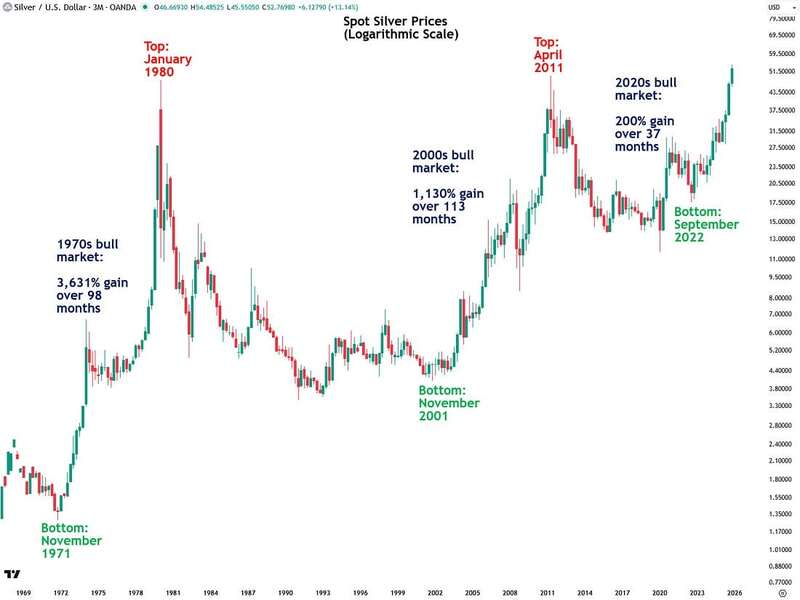
Let’s begin with the most rudimentary reference point: the spot price of silver in U.S. dollars. During the secular bull market of the 1970s, silver rose by 3,631% over 98 months. In the 2000s secular bull market, it gained 1,130% over 113 months.
By comparison, the current secular silver bull market is up only 200% over just 37 months. This is a clear indication that the current bull market is still in its early stages relative to the previous two, and I believe it has much further to run.
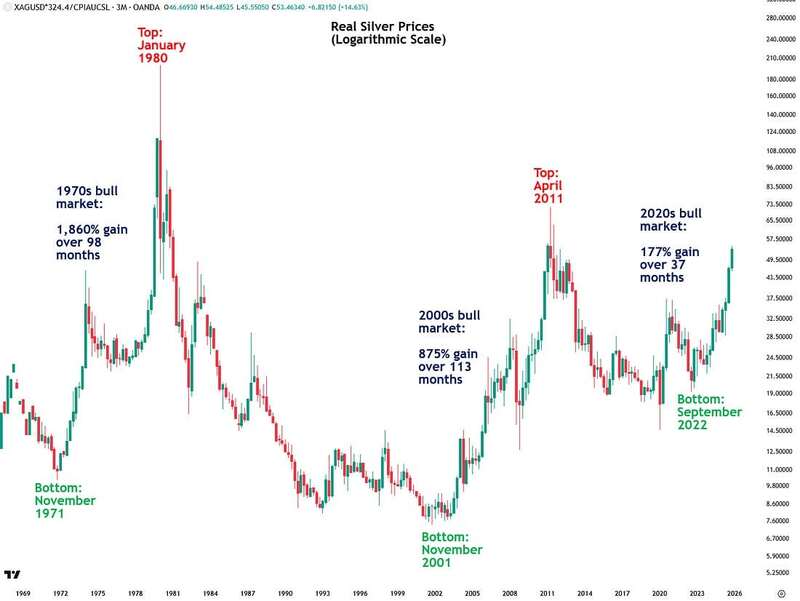
Next, let’s examine the real price of silver, which is silver adjusted for inflation using the U.S. Consumer Price Index (CPI). This is a more meaningful metric than the nominal price shown earlier because the key question is not how much silver has increased in absolute terms, but whether it is keeping up with inflation. After all, precious metals are the best hedges against inflation over the long run.
During the secular bull market of the 1970s, the real price of silver rose by 1,860% over 98 months. In the 2000s secular bull market, it gained 875% over 113 months.
In contrast, the current secular silver bull market is up only 177% over just 37 months. This further supports the view that the current bull market is still in its early stages compared to the previous two, and I believe it is just getting started.
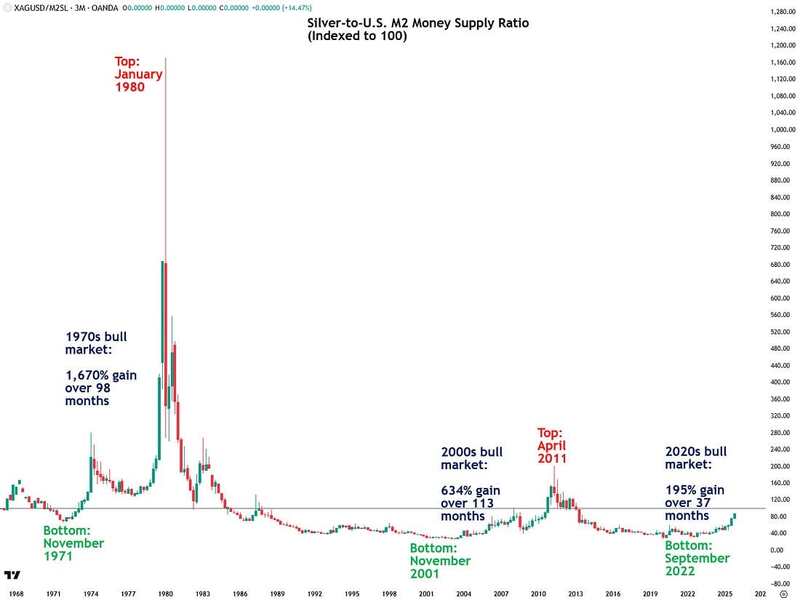
Now we will look at silver in relation to another measure of inflation: the U.S. M2 money supply. The money supply may be an even better indicator of inflation than the CPI, which is known to understate actual inflation.
Moreover, growth in the money supply is the underlying cause of inflation itself. As Milton Friedman, the Nobel Prize–winning economist, famously said, “Inflation is always and everywhere a monetary phenomenon.”
During the secular bull market of the 1970s, silver measured against the M2 money supply rose by 1,670% over 98 months. In the 2000s secular bull market, it gained 634% over 113 months. In comparison, the current secular silver bull market is up only 195% over just 37 months.
This is yet another indication that the current bull market is still quite young, and those claiming it is long in the tooth are clearly out of touch with the objective facts.
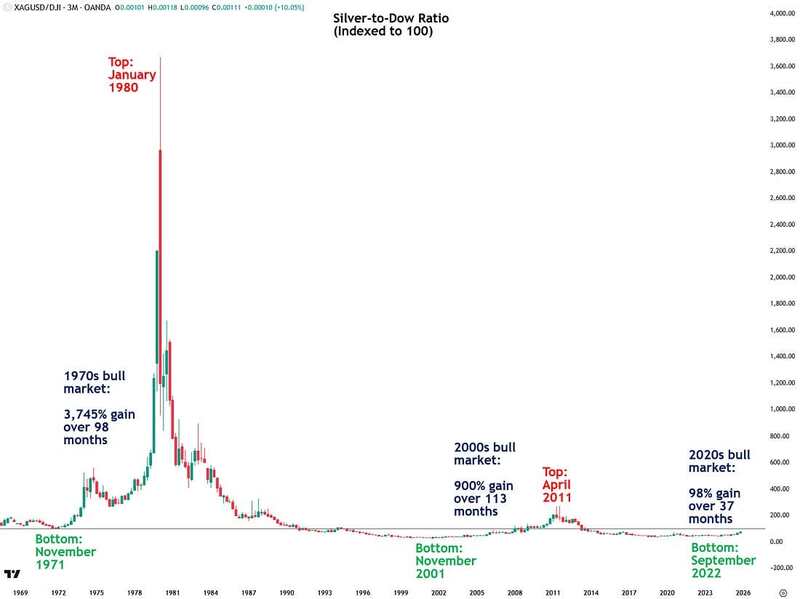
Finally, we measure gold against the Dow Jones Industrial Average, which I find to be a particularly useful yardstick. There is a well-established principle that equities and precious metals move in opposing long-term cycles, where one outperforms the other as large amounts of capital rotate between them.
When major secular bull markets in stocks come to an end, such as in the early 1970s or early 2000s, a significant amount of capital typically flows out of equities and into precious metals, and I believe we are about to see that dynamic play out again, which will send gold and silver current bull market into overdrive.
During the secular bull market of the 1970s, silver measured against the Dow rose by 3,745% over 98 months. In the 2000s secular bull market, it increased by 900% over 113 months. In comparison, the current secular silver bull market is up only 98% over just 37 months, which indicates that, by historical standards, it has barely even begun.
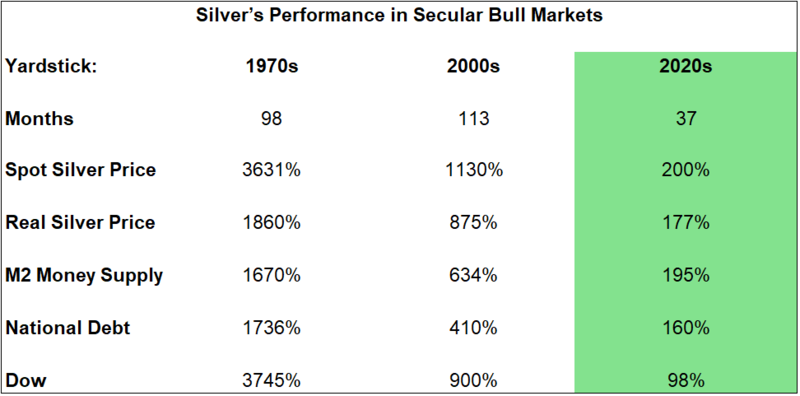
Now that we’ve looked at the various yardsticks in chart form, I’ve compiled all the data on silver’s performance in past and current secular bull markets into this helpful table to show how the current one compares.
As you can see, by every metric, the secular bull market that began in September 2022 still pales in comparison to the previous two. This is a clear indication that it has many more years and gains ahead.
For example, if silver were to match the performance of its 1970s bull market, it would reach a peak of $664 per ounce. If it were to replicate the performance of the 2000s bull market instead, it would peak at $219 per ounce. In both cases, these targets are significantly higher than the current price of $53.40 per ounce.
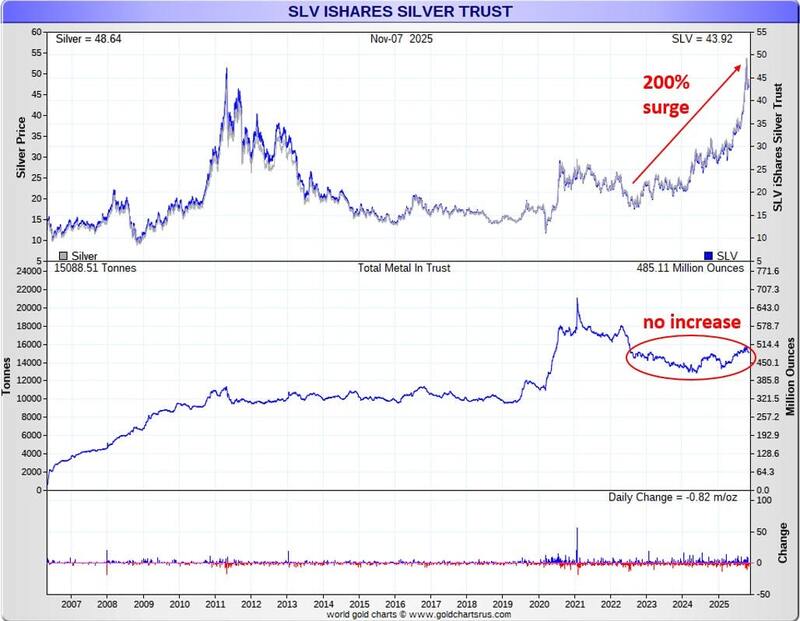
Despite silver’s impressive 200% price gain since September 2022, there is still very little participation from American investors, as evidenced by the largely unchanged silver holdings of the popular SLV ETF.
This indicates that silver’s bull market is far from being frothy or mature and has many more innings to go as American investors eventually pile in and drive it to much higher levels.
Another important factor to consider is that the yardsticks I used to compare the price of silver—the money supply, national debt, and the CPI/inflation—will continue to grow strongly and will even accelerate in the years ahead as we approach the fiscal and monetary endgame not just in the United States but around the world.
That factor alone will continue to push the nominal price of silver higher, even if it does not gain ground relative to those benchmarks, although I expect it will.
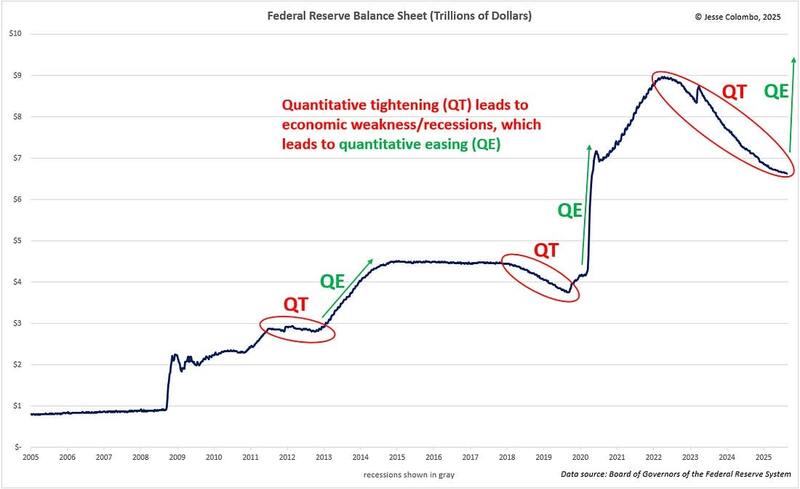
A return to quantitative easing (QE), which is essentially digital money printing, is only a matter of time. No government or central bank can resist using the printing press for very long if they have access to it, and that is the ultimate reason for owning precious metals.
The Fed’s quantitative tightening (QT), or shrinking of its balance sheet, since 2022 has set the stage for the growing financial stress now emerging, which is reminiscent of what occurred in late 2019 and ultimately led to massive QE that was officially attributed to the COVID pandemic.
Notably, at its October meeting, the Fed announced it is ending the drawdown of its still-substantial balance sheet, citing signs that money market liquidity conditions are tightening and bank reserve levels are falling.
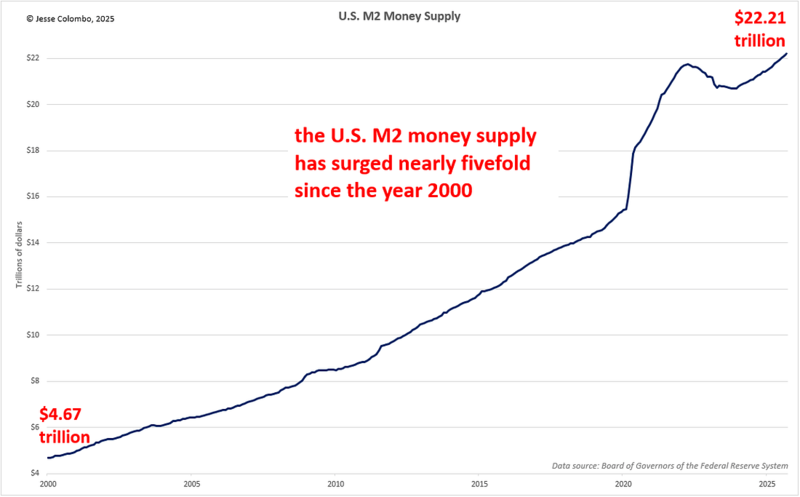
The lack of gold backing of the U.S. dollar and all other major world currencies since 1971 opened the door to rampant money supply expansion, which is the root cause of inflation. The introduction of quantitative easing in 2008 accelerated this trend significantly.
As a result, the U.S. M2 money supply has surged nearly fivefold since the year 2000. This is the underlying cause of the severe cost-of-living crisis we face today, where many hard-working people can no longer afford a middle-class lifestyle.
I expect money supply growth to accelerate even further as we approach the fiscal and monetary endgame, which will be a tremendous boon for gold and silver prices.
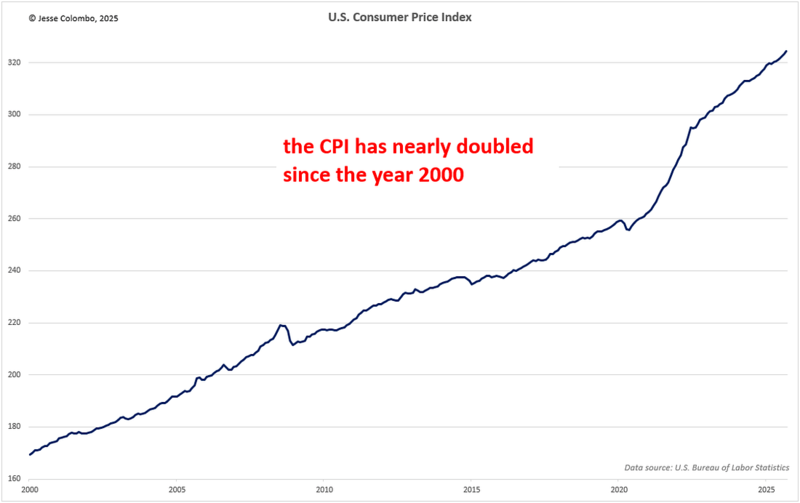
As Milton Friedman, the Nobel Prize–winning economist, famously said, “Inflation is always and everywhere a monetary phenomenon.” It is no surprise, then, to see the most widely referenced measure of inflation, the Consumer Price Index (CPI), surge alongside the money supply.
In fact, the CPI has nearly doubled since the year 2000, placing immense pressure on the middle class and fueling a wave of radical political movements.
An increasing number of politicians are unfairly and incorrectly blaming capitalism for the soaring cost of living, rather than acknowledging the real issue: the abandonment of sound money backed by gold and silver.
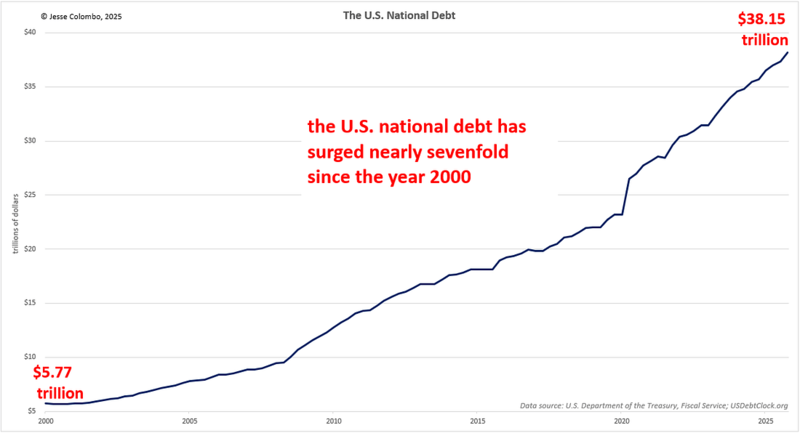
Finally, we turn to the chart of the U.S. national debt, which has ballooned nearly sevenfold since the year 2000, reaching a staggering $38.15 trillion. It is now growing by an astonishing $1 trillion every 100 days.
This trajectory is clearly unsustainable, and we are heading toward a breaking point that will ultimately lead to the collapse of the paper dollar, euro, pound, yen, and all other fiat currencies. And when that happens, precious metals will be the big winner.
Wrapping things up, I hope I have made it clear that silver’s current secular bull market is still in its very early stages, just as I demonstrated with gold in my previous report.
Although the nominal price of silver may appear high and potentially discouraging to some, nominal prices can be misleading. This is why it is important to compare them against other yardsticks to assess whether a precious metal or commodity is truly expensive.
As the findings in this report show, silver remains quite undervalued relative to those measures. This should ease concerns that silver’s price is too high or that its bull market is nearing an end.
If you found this report valuable, click here to subscribe to The Bubble Bubble Report for more content like it.
Jesse Colombo is a financial analyst and investor writing on macro-economics and precious metals markets. Recognized by The Times of London, he has built a reputation for warning about economic bubbles and future financial crises. An advocate for free markets and sound money, Colombo was also named one of LinkedIn’s Top Voices in Economy & Finance. His Substack can be accessed here.
(Mike Maharrey, Money Metals News Service) The S&P 500 to gold ratio has fallen to the lowest reading since the pandemic and is at a critical support level. This could signal more upside for the yellow metal.
Stocks and gold have risen in tandem in 2025. The S&P 500 is up nearly 16 percent on the year, and it has increased by 38 percent since the April selloff sparked by tariff worries.
According to DataTrek Research, gold is beating stocks by about 1.5 standard deviations above the long-term average.
This is an extremely unusual situation. We typically see gold outperforming equities to this extent during a crisis, such as the 2008 Financial Crisis and the pandemic. It’s particularly strange to see this when stocks are going up.
As DataTek co-founders Nicholas Colas and Jessica Rabe put it, “Not only is gold’s recent performance versus the S&P unusual in terms of magnitude, but it is also coming at the ‘wrong’ time in an investment cycle.”
“There is no analog to this price action over the last two decades.”
This indicates that the same factor is driving both equities and gold higher.
In fact, the Dow is down 36 percent in gold terms since 1939. Since gold is real, stable money, pricing the Dow in the yellow metal reveals that the appreciation of the stock market over the last century was predominantly driven by inflation.
In a nutshell, expectations that the Fed will continue to ease monetary policy are pumping more air into the stock market bubble and also driving gold higher.
What Is the S&P/Gold Ratio Telling Us?
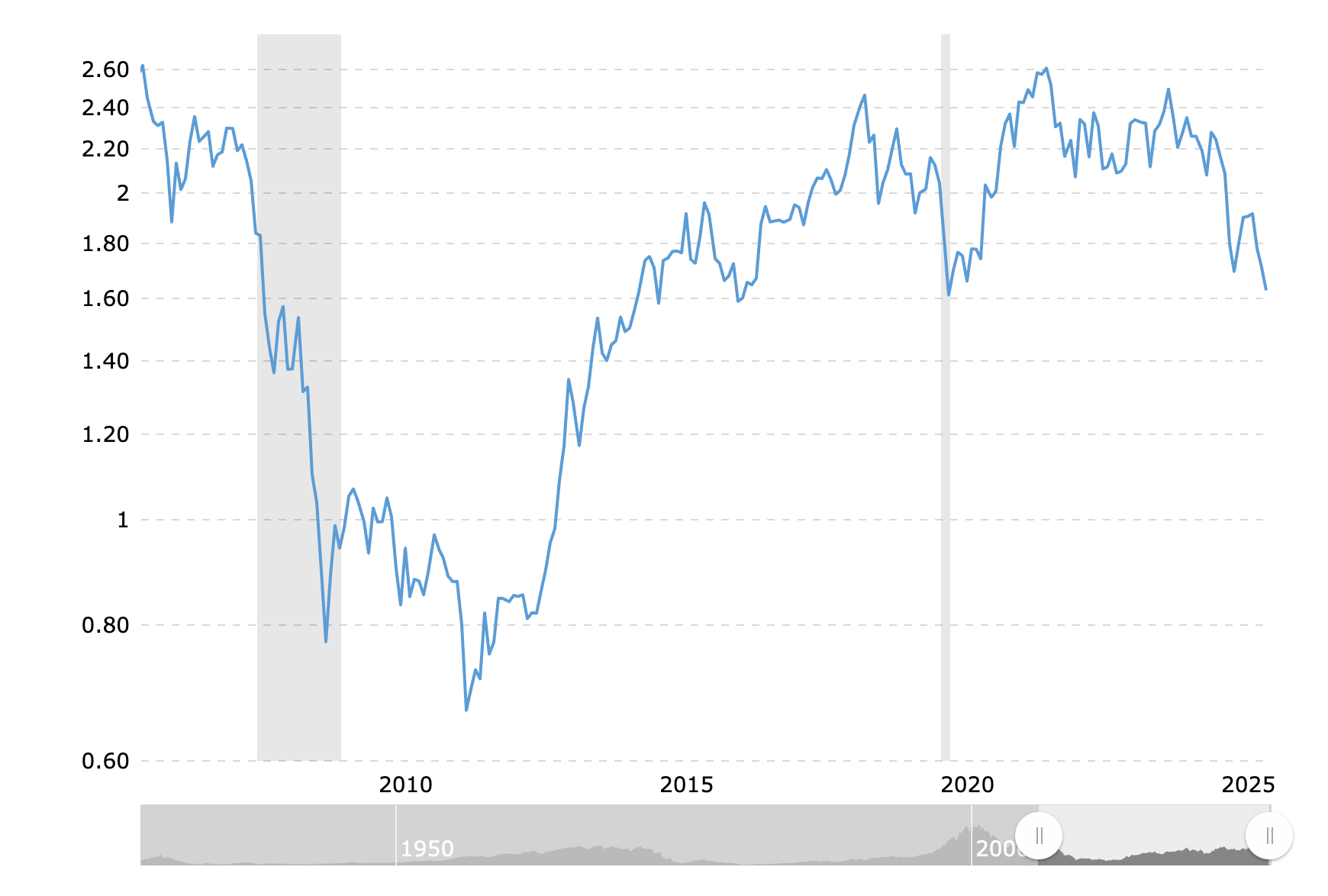
With gold rising faster than stocks, the S&P 500 to gold ratio has narrowed to around 1.66 points. That’s the lowest level since March 2020.
This indicates that the stock market is relatively cheap compared to gold. This typically happens during an economic downturn.
Bloomberg Intelligence senior market strategist Mike McGlone said, “At more than two times GDP, the U.S. stock-market wealth effect is the greatest in about a century.” Even so, he thinks the S&P 500 is on the brink of “breaching key support against gold.”
Again, we have an extremely unusual situation. Although stocks are at low levels when priced in gold, their valuation is around 2.3 times both GDP and global equities. The ratio was close to 1:1 a year ago. McGlone said a reversion to the mean, with these ratios falling in line with the S&P/Gold ratio, would be significant.
“Some reversion in SPX/GDP and SPX/MSCI toward where SPX/gold is now might look like a minor blip on the chart, but it would have severe deflationary implications.”
McGlone also said that market volatility could indicate gold will continue outperforming stocks. Current market volatility remains rather subdued based on the VIX.
“What we find concerning is that gold never rallied at such a high velocity as in 2025, with stock market volatility so low. The S&P 500 (SPX) rolling over versus gold, despite subdued stock-market volatility, might suggest greater downside risks for the SPX/gold ratio when market complacency reverses. The timing is emphasized as volatility always mean reverts; it’s a matter of time. For SPX/gold to avoid more declines, stock-market risk metrics might need to remain unusually subdued, a condition we think is increasingly unsustainable.”
The last time the S&P/Gold ratio fell below 1.7 was early in the Great Recession. It approached that level during the pandemic contraction but managed to hold support.
In a nutshell, the falling ratio could signal that the stock rally is nearing an end, with a drop in equities pushing that ratio even lower.
In other words, the stock market bubble might be about to pop as the gold rally continues.
Mike Maharrey is a journalist and market analyst for Money Metals with over a decade of experience in precious metals. He holds a BS in accounting from the University of Kentucky and a BA in journalism from the University of South Florida.