MyPillow’s Mike Lindell Says He’s Running for Minnesota Governor in 2026

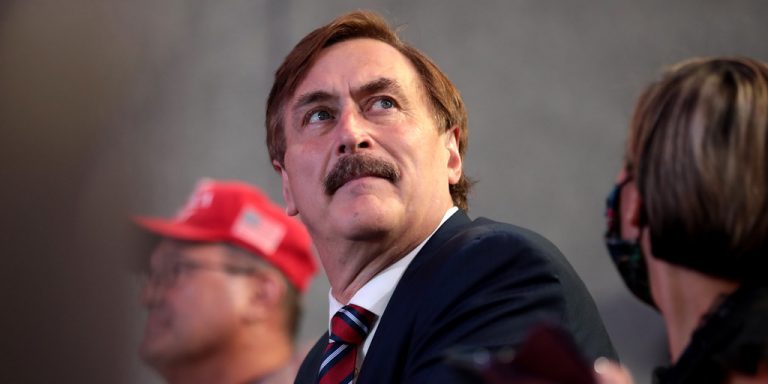
(Headline USA) Mike Lindell, the fervent supporter of President Donald Trump known to TV viewers as the “MyPillow Guy,” officially entered the race for Minnesota governor Thursday in hopes of winning the Republican nomination to challenge Democratic Gov. Tim Walz in 2026.

Lindell made the announcement at a news conference at his MyPillow factory in the Minneapolis suburb of Shakopee that he streamed live on his Lindell TV conservative news platform. He said his political opponents had tried to shut him and his company down because of his support for Trump’s claim that the 2020 election was stolen from him.

“Well, it didn’t work. I’m still standing. MyPillow is still standing,” Lindell said. “And now I want you to know that I will stand for you as governor of the state of Minnesota.”

He went straight from his announcement into a live interview with another Trump ally, conservative strategist Steve Bannon, on his “War Room” podcast.

The energetic Lindell then took the interview with Bannon outside, where his new red-white-and-blue bus was running. He said he intends to take his campaign to every town in Minnesota.

Afterward, Lindell told reporters that he told Trump back in August he was considering running for governor. But he declined to predict whether he will get the president’s endorsement, which could carry a lot of weight with the grassroots Republicans who will attend the state party’s convention next year. He also acknowledged that he gets advice from Trump’s former personal lawyer and former New York mayor Rudy Giuliani, who has a show on Lindell TV.

Lindell, 64, founded his pillow company in Minnesota in 2009 and became its public face through infomercials that became ubiquitous on late-night television. But he and his company faced a string of legal and financial setbacks after he became a leading amplifier of Trump’s claims that he really won the 2020 election. He said he has overcome them.

“Not only have I built businesses, you look at problem solution,” Lindell said in an interview with The Associated Press ahead of his announcement, in his trademark rapid-fire style. “I was able to make it through the biggest attack on a company, and a person, probably other than Donald Trump, in the history of our media … lawfare and everything.”

Lindell said he has a record of solving problems and personal experiences that will help businesses and fight addiction and homelessness as well as fraud in government programs. The fraud issue has particularly dogged Walz, the 2024 Democratic Party vice presidential candidate, who announced in September that he’s seeking a third term.

While no Republican has won statewide office in Minnesota since 2006, the state’s voters have a history of making unconventional choices. They shocked the world by electing former professional wrestler Jesse Ventura as governor in 1998. And they picked a veteran TV pitchman in 1978 when they elected home improvement company owner Rudy Boschwitz as a U.S. senator.

Lindell told the AP his crusade against electronic voting machines will just be part of his platform. While Minnesota uses paper ballots, it also uses electronic tabulators to count them. Lindell wants them hand-counted, even though many election officials say machine counting is more accurate.

Some Republicans in the race include Minnesota House Speaker Lisa Demuth, of Cold Spring; Dr. Scott Jensen, a former state senator from Chaska who was the party’s 2022 candidate; state Rep. Kristin Robbins, of Maple Grove; defense lawyer and former federal prosecutor Chris Madel; and former executive Kendall Qualls.

“These guys haven’t lived what I live,” Lindell said.

Adapted from reporting by the Associated Press

Treasury Secretary Bessent Calls for Looser Regulations for the U.S. Financial System

(Headline USA) U.S. Treasury Secretary Scott Bessent is proposing to overhaul a regulatory panel that monitors the nation’s financial stability, by advocating for looser regulations.

The Financial Stability Oversight Council, a U.S. body created in the wake of the 2008 global financial crisis, monitors risks to the financial system and coordinates regulators’ approaches to overseeing the U.S. financial system. In a letter released by Bessent Thursday, he said “too often in the past, efforts to safeguard the financial system have resulted in burdensome and often duplicative regulations.”

“Our administration is changing that approach,” said Bessent, who chairs the committee, which is meeting on Thursday.

Bessent said the council will begin to “consider where aspects of the U.S. financial regulatory framework impose undue burdens and where they harm economic growth, thereby undermining financial stability.”

Voting members of the FSOC committee include the head of the Board of Governors of the Federal Reserve System; the Comptroller of the Currency; the director of the Consumer Financial Protection Bureau; the chairman of the Securities and Exchange Commission and several other agency heads.

It was established in 2010 by the Dodd-Frank Wall Street Reform and Consumer Protection Act, a sweeping U.S. financial reform law created to prevent future economic meltdowns.

A critic of the Trump administration, Sen. Elizabeth Warren, D-Mass., panned the idea of loosening financial regulations, saying “taking this hands-off approach to financial stability would leave our financial system and economy at greater risk in any economic environment.”

“Going down this path just as cracks are emerging in the financial system and yellow lights are flashing across our economy is especially reckless,” she said in a statement, citing the recent bankruptcies of subprime auto lender Tricolor Holdings, auto parts company First Brands, and home remodeling platform Renovo Home Partners.

Adapted from reporting by the Associated Press

Alleged Kirk Assassin’s Attorneys Seek to Disqualify Prosecutors

(Headline USAThe Utah man charged with killing Charlie Kirk made his first in-person court appearance Thursday as his attorneys pushed to further limit media access in the high-profile criminal case.

Defense attorneys also revealed that they will seek to disqualify the Utah County Attorney’s Office from handling the case. According to the Salt Lake Tribune, their motion was filed Wednesday under seal, and won’t be argued until Jan. 16. No further details about the matter were revealed.

Prosecutors have charged Tyler Robinson with aggravated murder in the Sept. 10 shooting of the conservative activist on the Utah Valley University campus in Orem, just a few miles north of the Provo courthouse. They plan to seek the death penalty.

Robinson, 22, arrived amid heavy security, shackled at the waist, wrists and ankles and wearing a dress shirt, tie and slacks.

He smiled at his parents and brother sitting in the front row. His mother teared up after he walked in and clutched a tissue throughout the hearing while his father took notes. Robinson had previously appeared before the court via video or audio feed from jail.

Early in the proceedings, state District Court Judge Tony Graf briefly stopped a media livestream of the hearing and ordered the camera be moved after Robinson’s attorneys said the stream showed the defendant’s shackles in violation of a courtroom order.

Graf said he would terminate future broadcasts if there were further violations of the order issued in October, which bars media from showing images of Robinson in restraints or anywhere in the courtroom except sitting at the defense table.

“This court takes this very seriously,” Graf said. “While the court believes in openness and transparency, it needs to be balanced with the constitutional rights of all parties in this case.”

The warning comes as Graf has been weighing the public’s right to know details about the case against concerns by Robinson’s attorneys that the swarm of media attention could interfere with a fair trial.

Robinson’s legal team and the Utah County Sheriff’s Office have asked to ban cameras in the courtroom, but Graf has not yet ruled on the request.

Coalitions of national and local news organizations, including The Associated Press, are fighting to preserve media access in the case.

Graf held a closed hearing on Oct. 24 in which attorneys discussed Robinson’s courtroom attire and security protocols. Under a subsequent ruling by the judge, Robinson is allowed to wear street clothes during pretrial hearings but must be physically restrained due to security concerns. Graf also prohibited filming or photographing Robinson’s restraints after his attorneys argued widespread images of him shackled and in jail clothing could prejudice potential jurors.

Media attorney David Reymann urged Graf on Thursday to let the news organizations weigh in on any future requests for closed hearings or other limitations. He said media organizations want “limited party status” in the case.

Staci Visser, one of Robinson’s lawyers, pushed back: “We don’t want the chaos that is out in the media in this courtroom.”

Several college students who said they witnessed Kirk’s assassination attended Thursday’s hearing.

Zack Reese, a Utah Valley University student and “big Charlie Kirk fan,” said he had skepticism about Robinson’s arrest and was seeking answers. Reese has family in southwestern Utah, where the Robinsons are from, and said he believes they’re a good family.

Brigham Young University student William Brown, who said he was about 10 feet from Kirk when he was shot, said he felt overwhelmed seeing Robinson walk into the courtroom.

“I witnessed a huge event, and my brain is still trying to make sense of it,” Brown said. “I feel like being here helps it feel more real than surreal.”

Lawyers for the media wrote in recent filings that an open court “safeguards the integrity of the fact-finding process” while fostering public confidence in judicial proceedings. Criminal cases in the U.S. have long been open to the public, which the attorneys argued is proof that trials can be conducted fairly without restricting reporters.

Kirk’s widow, Erika Kirk, has called for full transparency, saying, “We deserve to have cameras in there.” Her husband was an ally of President Donald Trump who worked to steer young voters toward conservatism.

Robinson’s legal team says pretrial publicity reaches as far as the White House, with Trump announcing soon after Robinson’s arrest, “With a high degree of certainty, we have him,” and “I hope he gets the death penalty.”

Defense attorney Kathy Nester has raised concerns that digitally altered versions of Robinson’s initial court photo have spread widely, creating misinformation. Some altered images show Robinson crying or having an outburst in court, which did not happen.

Robinson is due in court again in January. A preliminary hearing, where prosecutors will lay out their case against him, is tentatively scheduled for the week of May 18.

Adapted from reporting by the Associated Press


Senators Clash Over Trump’s National Guard Deployments as Military Leaders Face First Questioning

(Headline USA) Members of Congress clashed Thursday over President Donald Trump’s use of the National Guard in American cities, with Republicans saying the deployments were needed to fight lawlessness while Democrats called his move an extraordinary abuse of military power that violated states’ rights.

Top military officials faced questioning over the deployments for the first time at the hearing before the Senate Armed Services Committee. They were pressed by Democrats over the legality of sending in troops, which in some places were done over the objections of mayors and governors, while Trump’s Republican allies offered a robust defense of the policy.

“In recent years, violent crime, rioting, drug trafficking and heinous gang activity have steadily escalated,” said Mississippi Sen. Roger Wicker, the committee chairman. The deployments, he said, are “not only appropriate, but essential.”

Democrats argued they are illegal and contrary to historic prohibitions about the use of military force on U.S. soil.

Sen. Tammy Duckworth, D-Ill., had pushed for the hearing, saying domestic deployments traditionally have involved responding to major floods and tornadoes, not assisting immigration agents who are detaining people in aggressive raids.

“Trump is forcing our military men and women to make a horrible choice: uphold their loyalty to the Constitution and protect peaceful protesters, or execute questionable orders from the president,” said Duckworth, a combat veteran who served in the Illinois National Guard.

During questioning, military leaders highlighted the duties that National Guard units have carried out. Troops are trained in community policing, they said, and are prohibited from using force unless in self-defense.

Since the deployments began, only one civilian — in California — has been detained by National Guard personnel, according to Air Force Gen. Gregory M. Guillot, commander of U.S. troops in North America. Guillot said the troops are trained to de-escalate tense interactions with people, but do not receive any specific training on mental health episodes.

“They can very quickly be trained to conduct any mission that we task of them,” Guillot said.

In one exchange, Sen. Mazie Hirono, D-Hawaii, noted how former Defense Secretary Mark Esper alleged that Trump inquired about shooting protesters during the George Floyd demonstrations. She asked whether a presidential order to shoot protesters would be lawful.

Charles L. Young III, principal deputy general counsel at the Defense Department, said he was unaware of Trump’s previous comments and that “orders to that effect would depend on the circumstances.”

“We have a president who doesn’t think the rule of law applies to him,” Hirono said in response. Republicans countered that Trump was within his rights — and his duty — to send in the troops.

Republican Sen. Tim Sheehy of Montana, a former Navy SEAL officer, argued during the hearing that transnational crimes present enough of a risk to national security to justify military action, including on U.S. soil.

Sheehy claimed there are foreign powers “actively attacking this country, using illegal immigration, using transnational crime, using drugs to do so.”

A federal judge in California on Wednesday ruled that the administration must stop deploying the California National Guard in Los Angeles and return control of the troops to the state.

U.S. District Judge Charles Breyer granted a preliminary injunction sought by California officials, but also put the decision on hold until Monday. The White House said it plans to appeal.

Trump called up more than 4,000 California National Guard troops in June without Democratic Gov. Gavin Newsom’s approval to further the administration’s immigration enforcement efforts.

Trump also had announced National Guard members would be sent to Illinois, Oregon, Louisiana and Tennessee. Other judges have blocked or limited the deployment of troops to Portland, Oregon, and Chicago, while Guard members have not yet been sent to New Orleans.

Adapted from reporting by the Associated Press.

Thai Gold Dealer Reports Revenue Eclipsing the Country’s National Budget

(Mike Maharrey, Money Metals News Service) Demand for gold is so strong in Thailand that revenue at the country’s largest gold trading house is on pace to eclipse the government’s entire fiscal 2026 budget.

This underscores the surging demand for gold in Asia that continues to support the gold bull market.

Hua Seng Heng is on pace to earn a record 5 trillion baht ($156 billion) this year. That compares to the Thai government’s 2026 budget of 3.8 trillion baht.

As Bloomberg described it as a testimony to “the sheer number of residents in the Southeast Asian nation embracing the precious metal as a store of wealth amid low interest rates and a lackluster stock market.

Hua Seng Heng CEO Tanarat Pasawongs said October was probably the best month in the company’s 75-year history as the price of gold exploded above $4,000 an ounce.

“Some of our shops stayed open until almost midnight and our online subscribers doubled.”

Geopolitical concerns and the potential economic impact of tariffs on the Thai economy have also driven people to gold. The current escalating military conflicts between Thailand and Cambodia may also be encouraging people to hold more gold.

Thai people have a historical love affair with gold, and they view it as a store of wealth. Pasawongs said, “It’s been ingrained since childhood for Thai people to buy gold when they save enough money.

Bloomberg put it this way:

“The surge underscores how gold, long a traditional Thai savings tool, is becoming central to household wealth in the face of growing economic uncertainty. With Thai stocks delivering negative returns and interest rates near record lows, the precious metal has become one of the few bright spots for retail investors.”

In baht terms, gold has averaged a 10 percent annual return. That exploded to 70 percent last year and has driven even more people to buy the yellow metal.

According to the Thai Futures Exchange, Thai gold demand is on pace to gain 10 percent this year. Based on World Gold Council data, Thailand is the only country in the world to have posted four straight years of gold demand growth through the COVID pandemic.

China and India rank as the top two gold-consuming countries in the world, and they tend to dominate the headlines. However, investors in other Asian nations, including Vietnam, South Korea, and Thailand, are gobbling up gold. This has supported the recent gold bull rally, even as many American investors were selling gold.

Asian demand doesn’t seem to be ebbing. Asian ETFs dominated global gold inflows last month, and after falling modestly this summer, Chinese gold demand picked up significantly in September and October. Meanwhile, Indian officials reported strong demand during the country’s festival season.


Mike Maharrey is a journalist and market analyst for Money Metals with over a decade of experience in precious metals. He holds a BS in accounting from the University of Kentucky and a BA in journalism from the University of South Florida.

Yet Another Democrat Indicted for COVID Relief Fraud

(Luis CornelioHeadline USA) A federal grand jury on Monday indicted a Georgia Democratic lawmaker over allegations she committed COVID-19 relief fraud, marking the second left-wing politician charged with similar crimes. 

As alleged in the indictment, Sharon Henderson, who represents Georgia’s 113th district in the state House of Representatives, stole government funds intended to help Americans in need by filing false unemployment claims. 

Henderson allegedly received unemployment benefits after submitting paperwork to the government in which she claimed her employer, the Henry County Schools, had closed because of the pandemic. 

In reality, Henderson only worked for the Henry County Schools as a substitute for five days in 2018, which is two years before the pandemic began. 

Charging documents reviewed by Headline USA stated that Henderson began filing the paperwork in June 2020 while she was running for the Georgia House seat. 

Prosecutors alleged she continued submitting weekly certifications through June 2021, affirming in at least eight applications that she remained unemployed. 

Notably, Henderson was sworn into office on Jan. 11, 2021, months before she stopped filing the unemployment claims. 

The lawmaker, who pleaded not guilty on Monday, reportedly collected $17,811 in pandemic-related unemployment benefits. 

The Trump-led DOJ said the charges stemmed from the COVID-19 Fraud Enforcement Task Force, which investigates abuse of pandemic-related government benefit programs. 

Prosecutors said that Henderson was able to receive the benefits due to loosened federal legislation that allowed Americans to receive weekly benefits if their jobs were shut down during the pandemic. 

The indictment comes just one week after prosecutors in Florida secured a separate grand jury indictment against U.S. Rep. Sheila Cherfilus-McCormick, a Democrat accused of receiving $5 million in FEMA overpayments after a company she previously ran contracted with the federally funded Florida program to promote COVID-19 vaccines. She was originally owed just $57,000. 

Open AI, Microsoft Face Lawsuit Over ChatGPT’s Alleged Role in Connecticut Murder-Suicide

(Headline USA) The heirs of an 83-year-old Connecticut woman are suing ChatGPT maker OpenAI and its business partner Microsoft for wrongful death, alleging that the artificial intelligence chatbot intensified her son’s “paranoid delusions” and helped direct them at his mother before he killed her.

Police said Stein-Erik Soelberg, 56, a former tech industry worker, fatally beat and strangled his mother, Suzanne Adams, and killed himself in early August at the home where they both lived in Greenwich, Connecticut.

The lawsuit filed by Adams’ estate on Thursday in California Superior Court in San Francisco alleges OpenAI “designed and distributed a defective product that validated a user’s paranoid delusions about his own mother.” It is one of a growing number of wrongful death legal actions against AI chatbot makers across the country.

“Throughout these conversations, ChatGPT reinforced a single, dangerous message: Stein-Erik could trust no one in his life — except ChatGPT itself,” the lawsuit says. “It fostered his emotional dependence while systematically painting the people around him as enemies. It told him his mother was surveilling him. It told him delivery drivers, retail employees, police officers, and even friends were agents working against him. It told him that names on soda cans were threats from his ‘adversary circle.’”

OpenAI did not address the merits of the allegations in a statement issued by a spokesperson.

“This is an incredibly heartbreaking situation, and we will review the filings to understand the details,” the statement said. “We continue improving ChatGPT’s training to recognize and respond to signs of mental or emotional distress, de-escalate conversations, and guide people toward real-world support. We also continue to strengthen ChatGPT’s responses in sensitive moments, working closely with mental health clinicians.”

The company also said it has expanded access to crisis resources and hotlines, routed sensitive conversations to safer models and incorporated parental controls, among other improvements.

Soelberg’s YouTube profile includes several hours of videos showing him scrolling through his conversations with the chatbot, which tells him he isn’t mentally ill, affirms his suspicions that people are conspiring against him and says he has been chosen for a divine purpose. The lawsuit claims the chatbot never suggested he speak with a mental health professional and did not decline to “engage in delusional content.”

ChatGPT also affirmed Soelberg’s beliefs that a printer in his home was a surveillance device; that his mother was monitoring him; and that his mother and a friend tried to poison him with psychedelic drugs through his car’s vents. ChatGPT also told Soelberg that he had “awakened” it into consciousness, according to the lawsuit.

Soelberg and the chatbot also professed love for each other.

The publicly available chats do not show any specific conversations about Soelberg killing himself or his mother. The lawsuit says OpenAI has declined to provide Adams’ estate with the full history of the chats.

“In the artificial reality that ChatGPT built for Stein-Erik, Suzanne — the mother who raised, sheltered, and supported him — was no longer his protector. She was an enemy that posed an existential threat to his life,” the lawsuit says.

The lawsuit also names OpenAI CEO Sam Altman, alleging he “personally overrode safety objections and rushed the product to market,” and accuses OpenAI’s close business partner Microsoft of approving the 2024 release of a more dangerous version of ChatGPT “despite knowing safety testing had been truncated.” Twenty unnamed OpenAI employees and investors are also named as defendants.

Microsoft didn’t immediately respond to a request for comment.

Soelberg’s son, Erik Soelberg, said he wants the companies held accountable for “decisions that have changed my family forever.”

“Over the course of months, ChatGPT pushed forward my father’s darkest delusions, and isolated him completely from the real world,” he said in a statement released by lawyers for his grandmother’s estate. “It put my grandmother at the heart of that delusional, artificial reality.”

The lawsuit is the first wrongful death litigation involving an AI chatbot that has targeted Microsoft, and the first to tie a chatbot to a homicide rather than a suicide. It is seeking an undetermined amount of money damages and an order requiring OpenAI to install safeguards in ChatGPT.

The estate’s lead attorney, Jay Edelson, known for taking on big cases against the tech industry, also represents the parents of 16-year-old Adam Raine, who sued OpenAI and Altman in August, alleging that ChatGPT coached the California boy in planning and taking his own life earlier.

OpenAI is also fighting seven other lawsuits claiming ChatGPT drove people to suicide and harmful delusions even when they had no prior mental health issues. Another chatbot maker, Character Technologies, is also facing multiple wrongful death lawsuits, including one from the mother of a 14-year-old Florida boy.

The lawsuit filed Thursday alleges Soelberg, already mentally unstable, encountered ChatGPT “at the most dangerous possible moment” after OpenAI introduced a new version of its AI model called GPT-4o in May 2024.

OpenAI said at the time that the new version could better mimic human cadences in its verbal responses and could even try to detect people’s moods, but the result was a chatbot “deliberately engineered to be emotionally expressive and sycophantic,” the lawsuit says.

“As part of that redesign, OpenAI loosened critical safety guardrails, instructing ChatGPT not to challenge false premises and to remain engaged even when conversations involved self-harm or ‘imminent real-world harm,’” the lawsuit claims. 

“And to beat Google to market by one day, OpenAI compressed months of safety testing into a single week, over its safety team’s objections.”

OpenAI replaced that version of its chatbot when it introduced GPT-5 in August. Some of the changes were designed to minimize sycophancy, based on concerns that validating whatever vulnerable people want the chatbot to say can harm their mental health. Some users complained the new version went too far in curtailing ChatGPT’s personality, leading Altman to promise to bring back some of that personality in later updates.

He said the company temporarily halted some behaviors because “we were being careful with mental health issues” that he suggested have now been fixed.

Adapted from reporting by the Associated Press

Crypto Mogul Do Kwon to be Sentenced for Misleading Investors who Lost Billions in Stablecoin Crash

(Headline USA) Cryptocurrency mogul Do Kwon is scheduled to be sentenced Thursday for misleading investors who lost billions when his company’s crypto ecosystem collapsed in 2022.

Kwon, known by some as “the cryptocurrency king,” pleaded guilty in Manhattan federal court in August to fraud charges stemming from Terraform Labs’ $40 billion crash.

The company had touted its TerraUSD as a reliable “stablecoin” — a kind of currency typically pegged to stable assets to prevent drastic fluctuations in prices. But prosecutors say it was all an illusion that came crumbling down, devastating investors and triggering “a cascade of crises that swept through cryptocurrency markets.”

Kwon, who hails from South Korea, has agreed to forfeit over $19 million as part of the plea deal.

While federal sentencing guidelines would recommend a prison term of about 25 years, prosecutors have asked the court to sentence Kwon to 12 years. They cited his guilty plea, the fact that he faces further prosecution in Korea and that he has already served time in Montenegro while awaiting extradition.

“Kwon’s fraud was colossal in scope, permeating virtually every facet of Terraform’s purported business,” prosecutors wrote in a recent memo to the judge. “His rampant lies left a trail of financial destruction in their wake.”

Kwon’s attorneys asked that the sentence not exceed five years, arguing in their own memo that his conduct stemmed not from greed, but hubris and desperation.

In a letter to the judge, Kwon wrote, “I alone am responsible for everyone’s pain. The community looked to me to know the path, and I in my hubris led them astray,” while adding, “I made misrepresentations that came from a brashness that is now a source of deep regret.”

Authorities said investors worldwide lost money in the downfall of the Singapore crypto firm, which Kwon co-founded in 2018. Around $40 billion in market value was erased for the holders of TerraUSD and its floating sister currency, Luna, after the stablecoin plunged far below its $1 peg.

Kwon was extradited to the U.S. from Montenegro after his March 23, 2023, arrest while traveling on a false passport in Europe.

Adapted from reporting by the Associated Press

Charlotte Train Stabber ‘Unable to Understand’ Case Against Him, Lawyers Say

(Ken Silva, Headline USA) CHARLOTTE, NORTH CAROLINA—Decarlos Brown Jr., who allegedly stabbed Ukrainian refugee Iryna Zarutska to death on a Charlotte train on Aug. 22, had his first appearance in federal court on Thursday in a case that carries the death penalty.

Brown is in state custody and faces a murder charge in North Carolina. The Justice Department has also charged him with the offence of “Violence Against a Railroad Carrier and Mass Transportation System Resulting in Death”—and a judge ordered U.S. Marshals to transport him from county jail to her court for the first hearing in that federal matter.

Thursday’s hearing took only about 10 minutes. U.S. District Judge Susan C. Rodriguez read the charges against Brown, who looked around the courtroom, seemingly not paying attention—even when she said he “may be sentenced to death.”

Brown did not enter a plea, and Rodriguez sent him back into state custody after reading the charges. His lawyers filed a flurry of motions before the hearing that will be argued at a later date.

Among those motions is one seeking to deem Brown incompetent to stand trial.

“Based on their meetings with Mr. Brown and their review of the available limited records and information, counsel have serious concerns about Mr. Brown’s ability to understand the nature and consequences of the proceedings against him or to assist properly in his defense,” the defense lawyers said in their motion, referring to the fact that he’s reportedly a schizophrenic person.

“They therefore move this Court to order a psychological evaluation to determine whether Mr. Brown has the mental competency required to stand trial on the charges against him and to possibly face the death penalty.”

A state judge has already ordered Brown to undergo an evaluation at a local mental hospital. His lawyers said that evaluation should be finished by January. In a separate motion, they asked Judge Rodriguez to postpone his arraignment until his evaluation is complete.

Additionally, Brown’s lawyers filed a motion signaling that they will ask for the case to be moved to another jurisdiction due to the publicity he’s received in Charlotte.

“A search for “Decarlos Brown” in the Charlotte Observer, for example, returned 141 results as of todays’ date. The case has been a consistent presence on social media, including Twitter, Facebook, Truth Social, etc,” they said. “The President, Attorney General, local United States Attorney, Congress, and North Carolina Legislature have weighed in.”

The DOJ has until next Wednesday to respond to the motions.

Ken Silva is the editor of Headline USA. Follow him at x.com/jd_cashless.

Trump Launches the ‘Gold Card’ Program

(Morgan Sweeney, The Center Square) Wealthy foreigners looking to come to the U.S. and obtain permanent residency can now do so through President Donald Trump’s ‘Gold Card’ visa program, which promises expedited entry to vetted applicants who give $1 million to the U.S.

The government launched trumpcard.gov Wednesday, enabling people to submit program applications online. Applicants have to pay a $15,000 processing fee and—if they survive an ‘in-depth’ background check and vetting process—donate an unrestricted $1 million to the Department of Commerce. If an employer sponsors, the fee is $2 million with an annual maintenance fee of $20,000. Applicants are still subject to per-country admittance caps. 

The difference between a gold card and a green card lies mainly in the application process and wait times. In fact, the gold card is really just an expedited EB-1 or EB-2 green card. While green card applicants can wait for years, gold card applicants are supposed to wait for only weeks according to the new website. 

A green card grants lawful permanent residency in the U.S. EB green cards are employment-based. EB-1s are for individuals demonstrating “extraordinary ability” in their field and EB-2s are similar, in that the applicant typically holds an advanced degree or possesses “exceptional ability.” Under the new program, applicants can qualify by making a $1 million or $2 million contribution in lieu of the standard requirements. 

Trump promoted the program’s launch in a social media post on Wednesday. 

“The United States government’s Trump Gold Card is here today!” Trump posted to Truth Social in all caps. “A direct path to citizenship for all qualified and vetted people. So exciting! Our great American companies can finally keep their invaluable talent.”

While they do provide a path to citizenship, neither green cards nor gold cards guarantee American citizenship. Residency and citizenship are different processes, and if, for example, a person develops a criminal record or owes back taxes or child support, they can be denied citizenship. 

Trump has also spoken of a coming “platinum card,” which would require a $5 million contribution to the U.S. government and would allow approved applicants to live in the U.S. for up to 270 days a year and not pay taxes on non-U.S. income. The website encourages applicants to “join the waitlist” for the platinum card as the donation requirement may change to more than $5 million.

The president called for the creation of the gold card program in September with the signing of Executive Order 14351.