


Abortion ‘Test Vote’ the Latest Political Theatre in Gridlocked Senate

(Headline USA) In a political ploy designed to incite radical abortion activists into further protest, rather than produce any actual result, leftist Democrats are holding a sham vote to legislate killing unborn babies.

The vote is expected to fail, giving rise to criticism that Democrats are simply using it to build a pro-abortion narrative. President Joe Biden has called on Democrats to enshrine the nearly 50-year-old Supreme Court ruling into law after the disclosure of a draft opinion that would overturn the landmark decision that declared a constitutional right to abortion services.

But passing bills is easier said than done in the narrowly split Congress — reflective of a deeply divided nation.

A test vote Wednesday in the Senate on a Democratic bill to protect access to abortions is expected to fail, blocked by a Republican-led filibuster.

At the same time, Republicans led by Sen. Mitch McConnell face similar political problems trying to ban abortions nationwide, even if they wrest control of the chamber in next fall’s midterm elections.

Instead, whatever the Supreme Court decides on Roe v. Wade in its final opinion this summer almost guarantees a new era of political fighting in Congress over abortion policy, filibuster rules and the most basic rights to health care, privacy and protecting the unborn.

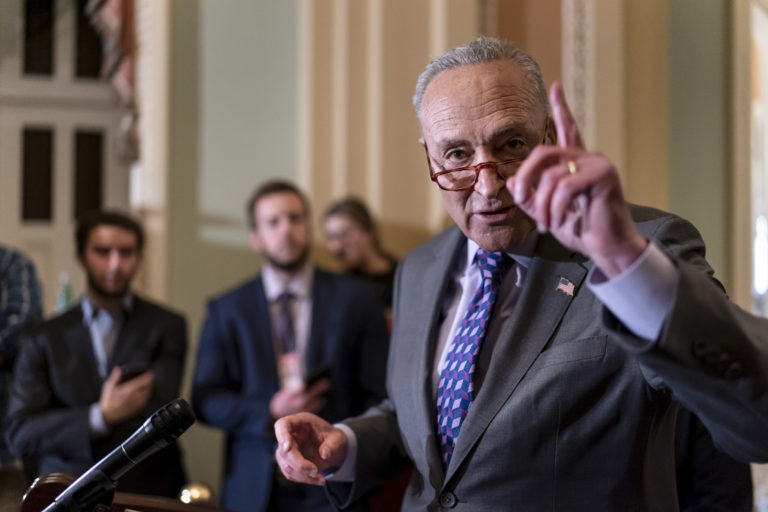
“All of us will have to answer for this vote for the rest of our time in public office,” said Senate Majority Leader Chuck Schumer ahead of Wednesday’s action.

In recent years, abortion access debates in many ways have come to a standstill in Congress, a political draw, as lawmakers faced the limits of trying to move public policy beyond the Roe v. Wade court decision. Bills would routinely come up for votes — to expand or limit abortion services — only to fall along typically party line votes or be stripped out of broader legislative packages.

But the Supreme Court’s conservative 6-3 majority, solidified during the Trump era, has ignited an urgent shift to the forefront in Congress. McConnell stunned Washington when he said “it’s possible” to see a national abortion ban.

In an interview with USA Today, McConnell recently said, “If the leaked opinion became the final opinion, legislative bodies — not only at the state level but at the federal level — certainly could legislate in that area.”

But on Tuesday McConnell acknowledged that if Republicans become the majority in the Senate they still are unlikely to have enough votes to ban abortion outright.

“The widespread sentiment in my conference is this issue will be dealt with at the state level,” McConnell said. He said Republicans won’t have the 60 votes needed to overcome a filibuster.

Likewise, Democrat Brian Schatz of Hawaii said for the other side, “I think we have to be explicit and tell the truth, which is, we don’t currently have the votes.” Still, he said hopefully that if voters elect more senators who favor abortion rights, “we will put this into federal law.”

The two Republican senators who support abortion access — Lisa Murkowski of Alaska, who faces her own reelection in November, and Susan Collins of Maine — have proposed a separate bill that would counter the Supreme Court’s action.

But both senators, who voted to confirm most of Trump’s justices, are expected to stick with the Republican Party this week and block the Democrat bill as too broad.

At the same time, Democrats have largely panned the Collins-Murkowski effort as insufficient, leaving no hopes, for now, of any compromise.

And rank-and-file Republicans distanced themselves from McConnell’s initial remarks, saying an all-out national ban on abortions is not something they can deliver.

“The reality is is that you would never get that done here,” said Sen. Mike Rounds, R-S.D.

Democrats are unconvinced that Republicans, who have fought for years to deny abortion services, would give that fight up now and let the states decide.

In the House, where Democrats have the slimmest of majority, lawmakers approved the Women’s Health Protection Act last year on a largely party-line vote once the Supreme Court first signaled it was considering the issue by allowing a Texas law’s ban on abortions to take effect.

But the bill has languished in the Senate, evenly split 50-50 with Democrat control because of Vice President Kamala Harris’ ability to cast a tie-braking vote. Unable to mount the 60 votes needed to overcome a filibuster, a test vote failed in February, with one Democrat, Sen. Joe Manchin of West Virginia, joining Republicans to block the bill’s consideration.

A similar outcome is expected Wednesday when the Senate tries again to pass the legislation, which would put the guaranteed right to abortion into law.

It’s the first of what Schumer promises will be repeated efforts to show voters where the parties stand, and continue to feed red meat to his party’s base and give them reasons to protest.

“This is no longer just a abstract exercise: Now we know women’s rights are at stake,” Schumer said. “So this vote is the first step. We are going to keep fighting.”

Adapted from reporting by the Associated Press
Skyrocketing Inflation Slows by Only 0.2% after Record-Breaking March

(Headline USA) Inflation slowed in April after seven months of relentless gains, a tentative sign that price increases may be peaking while still imposing a financial strain on American households.

But the near-double-digit rate still inflicted an unprecedented amount of pain on American househoulds, with President Joe Biden offering no concrete solutions during a speech Tuesday other than to blame his political rivals.

Consumer prices jumped 8.3% last month from 12 months earlier, the Labor Department said Wednesday. That was below the 8.5% year-over-year surge in March, which was the highest since 1981.

On a month-to-month basis, prices rose 0.3% from March to April, the smallest increase in eight months, but still nothing for Democrats in power to crow about as they brace for a punishing red-wave election in November.

Wednesday’s report contained some cautionary signs that inflation may be becoming more entrenched. Excluding the volatile food and energy categories, so-called core prices jumped 0.6% from March to April—twice the 0.3% rise from February to March.

Those increases were fueled by spiking prices for airline tickets, hotel rooms and new cars. Apartment rental costs also continued to rise steadily.

The sharp price gains from March to April “make clear that there is still a long way to go before inflation returns to more acceptable levels,” said Eric Winograd, U.S. economist at asset manager AB.

Some individual categories of goods have skyrocketed over the past year. Grocery prices, for example, have shot up 10.8%, the largest year-over-year jump since 1980.

The cost of a gallon of gas fell 6.1% in April but is still up nearly 44% from a year ago. And so far in May, prices at the gas pump have reached new highs.

Nationally, the average for a gallon of gas is at a record $4.40, according to AAA, though that figure isn’t adjusted for inflation. The high price of oil is the main reason. A barrel of U.S. benchmark crude sold for around $100 a barrel Tuesday. Gas had fallen to about $4.10 a gallon in April, after reaching $4.32 in March.

The escalation of consumer inflation has forced many Americans, particularly people with lower or fixed incomes, to reduce their spending on things like driving and grocery shopping.

Among them is Patty Blackmon, who said she’s been driving to fewer of her grandchildren’s sports events since gas spiked to $5.89 in Las Vegas, where she lives.

To save money, Blackmon, 68, also hasn’t visited her hairdresser in 18 months. And she’s reconsidering her plan to drive this summer to visit relatives in Arkansas.

She was shocked recently, she said, to see a half-gallon of organic milk reach $6.

“Holy cow!” she thought. “How do parents give their kids milk?”

Blackmon has cut back on meat, and “a steak is almost out of the question.” Instead, she is eating more salads and canned soups.

Beyond the financial strain for households, inflation is posing a serious political problem for Biden and congressional Democrats in the midterm election season, with Republicans arguing that Biden’s $1.9 trillion spending package last March overheated the economy by flooding it with stimulus checks, enhanced unemployment aid and child tax credit payments.

All of those disincentivized people from re-entering the workforce, creating a labor shortage, even while flooding massive amounts of new devt into the economy that devalued existing money.

Biden blamed chronic supply chain snarls related to the swift economic rebound from the pandemic, as well as Russia’s invasion of Ukraine, for igniting inflation.

He claimed his administration would help ease price increases by shrinking the government’s budget deficit and by fostering competition in industries, like meatpacking, that are dominated by a few industry giants.

Still, new disruptions overseas or other unforeseen problems could always send U.S. inflation back up to new highs.

If the European Union decides, for example, to cut off Russian oil, gas prices in the United States would likely accelerate. China’s severe COVID lockdowns are worsening supply problems and hurting growth in the world’s second-biggest economy.

Jose Torres, a senior economist at Interactive Brokers, noted that China’s weakening economy has reduced demand for oil. If China eases its lockdowns later this year and if more people drive, world oil prices could go higher and further inflate gas prices in the U.S.

Previous signs that U.S. inflation might be peaking didn’t last. Price increases decelerated last August and September, suggesting at the time that higher inflation might be temporary, as many economists—and officials at the Federal Reserve—had suggested.

But prices shot up again in October, prompting Fed Chair Jerome Powell to start shifting policy toward higher rates.

While food and energy have endured some the worst price spikes of the past year, analysts often monitor the core figure to get a sense of underlying inflation. Core inflation also typically rises more slowly than the overall price increases and can take longer to decline. Rents, for example, are rising at a historically fast pace, and there is little sign of that trend reversing anytime soon.

The unexpected persistence of high inflation has caused the Fed to embark on what may become its fastest series of interest rate increases in 33 years.

Last week, the Fed raised its benchmark short-term rate by a half-point, its steepest increase in two decades. And Powell signaled that more such sharp rate hikes are coming.

The Powell Fed is seeking to pull off the notoriously difficult—and risky—task of cooling the economy enough to slow inflation without causing a recession. Economists say such an outcome is possible but unlikely with inflation this high.

In the meantime, by some measures Americans’ wages are rising at the fastest pace in 20 years. Their higher pay enables more people to at least partly keep up with higher prices. But employers typically respond by charging customers more to cover their higher labor costs, which, in turn, heightens inflationary pressures.

Last Friday’s jobs report for April included data on hourly pay that suggested that wage gains were slowing, which, if it continues, could help ease inflation this year.

Adapted from reporting by the Associated Press
Warnock Accused of Harassment for Subpoena of Ex-Wife’s Transcripts

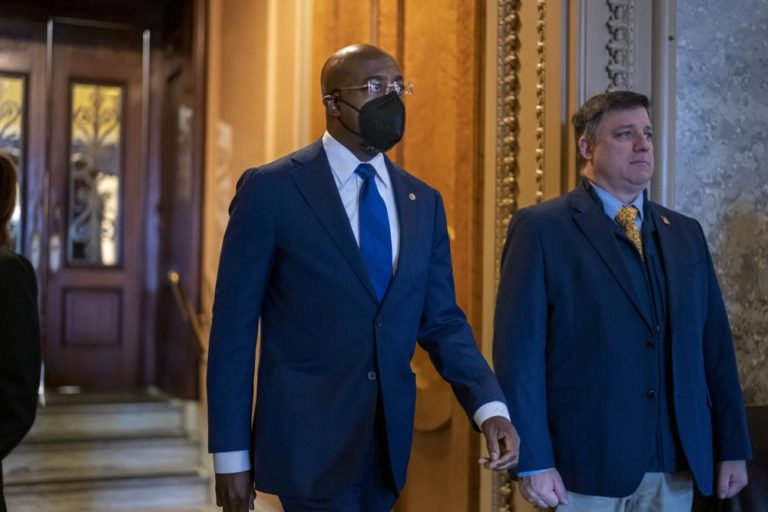
(Molly Bruns, Headline USA) Ouléye Ndoye, ex-wife of Senator Raphael Warnock, D-Ga., is fighting his attempt to subpoena her old college records, which he claims are relevant to their child custody battle, the Washington Free Beacon reported.

She is battling the subpoena on the grounds that it is irrelevant to the case and claims his intent is “purely for the purpose of embarrassing and harassing” her.

Warnock subpoenaed Ndoye’s records from Emory University, which would include her school transcripts, grades, immunization records and disciplinary files.

Her attorney requested that the court reject the subpoena, saying it “clearly has absolutely nothing to do with this litigation.”

“None of the requests are relevant, nor will they lead to the discovery of relevant evidence,” said Ndoye’s lawyer in a motion. “They are unduly burdensome, unreasonable, and oppressive.”

This is not the first time Ndoye has accused Warnock of mistreatment.

In 2020, she claimed that he ran over her foot with his Tesla during an argument. He denied the claim and was not charged.

The filings concerning her school records are the latest in a contentious custody battle. Ndoye divorced Warnock in 2020 after four years of marriage and two children. Ndoye claims Warnock has neglected his visitation time and childcare expenses.

She requested to the court that she be allowed to move out of state to attend a program at Harvard University.

The courtroom drama is unfolding in the midst of a competitive Senate race for Warnock, with his seat in jeopardy in the upcoming midterms.

He has asked the judge to seal the dispute, not allowing public access to the records, due to his current campaign and the fact that his opponent could use the information to “gain some political advantage.”

The court has not made an official statement on the matter.

WHO’s Tedros Catches Flak from China for Questioning ‘Zero-COVID’ Policy

(Headline USA) China on Wednesday defended sticking to its strict “zero-COVID” approach, calling critical remarks from the head of the World Health Organization “irresponsible.”

The response from the Foreign Ministry came after WHO Director-General Tedros Adhanom Ghebreyesus said he had been discussing with Chinese experts the need for a different approach in light of new knowledge about the virus.

“When we talk about the ‘zero-COVID,’ we don’t think that it’s sustainable, considering the behavior of the virus now and what we anticipate in the future,” Tedros said.

Ministry spokesperson Zhao Lijian said at a daily briefing Wednesday, “We hope that relevant people can view China’s policy of epidemic prevention and control objectively and rationally, get more knowledge about the facts and refrain from making irresponsible remarks.”

Although China has been dodgy about offering transparency to outside organizations since the pandemic first emerged from its Wuhan Institute of Virology—presumably on accident—the Asian superpower maintains that its draconian lockdowns helped it to achieve a substantially lower infection rate.

“The Chinese government’s policy of epidemic prevention and control can stand the test of history, and our prevention and control measures are scientific and effective,” Zhao said. “China is one of the most successful countries in epidemic prevention and control in the world, which is obvious to all of the international community.”

Globalists, and many on the American Left, initially took the same approach during the virus’s early phases but have now come around to agreeing that in its less virulent forms, COVID transmission may be beneficial in the long run to attaining a broader herd immunity.

Earlier Wednesday, Wu Huanyu, deputy director of Shanghai’s Center for Disease Control, reaffirmed the approach’s importance in eliminating a waning outbreak. He told reporters that while progress has been made, relaxing prevention and control measures could allow the virus to rebound.

“At the same time, now is also the most difficult and critical moment for our city to achieve zero-COVID,” Wu said at a daily briefing.

Wu gave no indication he was aware of the comments by Tedros.

Tedros was joined by Mike Ryan, the WHO’s emergencies chief, who said all pandemic control actions should “show due respect to individual and human rights.”

Countries need to “balance the control measures, the impact on society, the impact on the economy. That is not always an easy calibration to make,” Ryan said.

The incident marked a rare public show of friction between China and the WHO, which has been accused of succumbing to Chinese pressure to avoid criticism and awkward questions about the origins of the virus.

China’s ruling Communist Party has strictly controlled all discussion about its controversial approach, which aims to totally stamp out outbreaks, and said it would tolerate no criticism, questioning or distortion of the strategy.

The entirely state-controlled media did not report on the comments by Tedros and Ryan and references to them on the Chinese internet appeared to have been removed by censors.

The ruthless and often chaotic implementation of zero-COVID has stirred considerable resentment in Shanghai, where some residents have been under lockdown for more than a month. As of Wednesday, more than 2 million people in the city remained confined to their residential compounds, while restrictions had been slightly relaxed for most of the other 23 million.

However, the easing appears to now be on hold, even as the number of new cases falls in the city that is home to China’s busiest port, main stock market and thousands of Chinese and foreign firms.

People in some areas have been ordered to stay home again after having been let out for limited shopping in recent weeks. On Tuesday, service was suspended on the last two subway lines that were still operating.

Complaints have centered on shortages of food and other daily necessities and the forced removal of thousands of people to quarantine centers after having tested positive or having been in contact with an infected person, standard procedure in China’s zero-COVID approach.

Along with the human cost, the adherence to “zero-COVID” as many other countries loosen restrictions and try to live with the virus is exacting a growing economic toll.

However, the party under leader Xi Jinping shows no sign of backing off amid efforts to ensure stability and shore up its authority ahead of a major party congress this fall.

Chinese experts such as Wu have been careful to toe the party line, saying the strategy has been effective in limiting the official death toll in mainland China and that any let-up risks sparking a major new surge.

The daily number of new cases in Shanghai reported on Wednesday had fallen to less than 1,500, down from a peak of 26,000 in mid-April. Seven more COVID-19-related deaths were reported, raising the toll from the outbreak to 560.

While China says more than 88% of its population is fully vaccinated, the rate is considerably lower among the vulnerable elderly. Questions have also been raised about the efficacy of Chinese-produced vaccines compared to those from Europe and the United States.

In the capital of Beijing, residents have been ordered to undergo mass testing in a bid to prevent a major outbreak like that in Shanghai.

The city, which reported 37 new cases on Wednesday, has locked down individual buildings and residential compounds, shut about 60 subway stations and banned dining at restaurants, allowing only takeout and delivery.

The vast Forbidden City museum complex, the ancient home of China’s former emperors, will also be closing from Thursday to “reduce the danger of virus transmission in society posed by the circulation of people,” it said in a statement.

Adapted from reporting by the Associated Press

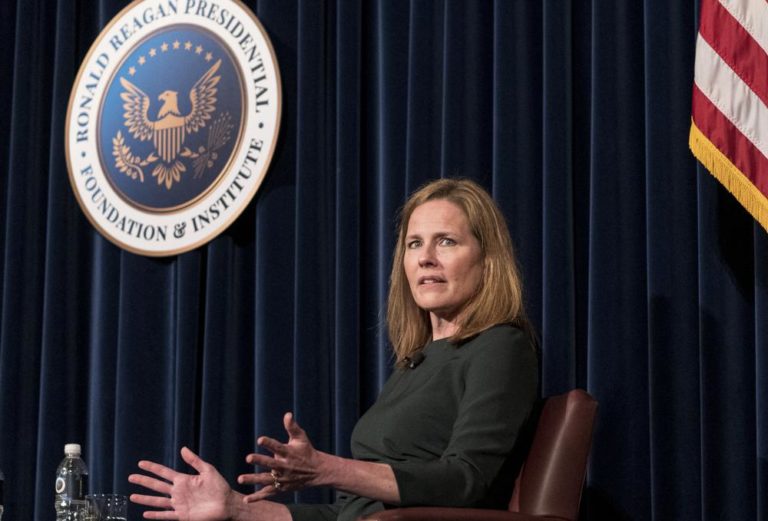
Left Fact-Checked for Falsely Attributing CDC Phrase to Amy Coney Barrett

(John McCann, Headline USA) As the fight over Roe v. Wade has intensified, civility and nuance on the issue has quickly become non-existent. With justices’ homes becoming targets by organized leftist mobs, spurred by Democrat leadership, the situation has continued to escalate.

Since the sudden leak of Justice Samuel Alito‘s draft majority opinion, which showed the court ready to overturn Roe, liberals on Twitter have combed through the document to find any quotes or statements that might give them ammunition. One quote that has been making the rounds has been attributed to Justice Amy Coney Barrett.

The quote in question has been framed by opponents as an example of Barrett’s pro-life bias, with her purportedly claiming that the U.S must maintain a “domestic supply of infants,” according to the Western Journal.

There is one big problem: Barrett did not state such an opinion. In fact, none of the justices made such a statement. The quote was footnoted within Alito’s draft and has been attributed to a Centers for Disease Control and Prevention report from 2008.

The report stated that “[N]early 1 million women were seeking to adopt children in 2002 (i.e., they were in demand for a child), whereas the domestic supply of infants relinquished at birth or within the first month of life and available to be adopted had become virtually nonexistent.”

Barrett was not speaking of human infants as mere commodities; the CDC was just noting that the high demand for adoptions was not being met by the supply.

Certain “fact checkers” argued that while the quote may not be attributed to Barrett, people may have “conflated” it with comments Barrett made during oral arguments regarding “safe haven laws.”

Falsehoods and misinterpretations such as these have aided in making the Roe v. Wade debate a toxic discussion. Smearing a justice for something she did not say has only created fodder for abortion advocates and has muddied the waters of an already complex issue.


Biden’s Spin Doctor Sister Claims He’s Totally Lucid: ‘His Gaffes Are Truths’

(Headline USA) President Joe Biden’s sister excused his embarrassing gaffes this week and claimed he is “totally capable” of being president.

Valerie Biden Owens, 76, told “Good Morning Britain” that her brother’s habit of misspeaking is not that big of a deal and dismissed criticisms of his mental state.

“His gaffes are truths,” she said. “He speaks the truth. And is he capable? I mean, watch him. Look at him. I mean, judge for yourself.”

“He speaks the truth,” she insisted. “Sometimes it comes out in a different way, and people call it a gaffe.”

Owens has defended her brother’s rhetorical blunders throughout his political career. Just last month, she tried to spin him out of an international crisis after he declared in a speech that Russian dictator Vladimir Putin “cannot remain in power.”

“Well, first of all, when anybody says Joe’s ‘gaffe,’ a gaffe is, he speaks the truth,” Owens said at the time.

“Joe had just come from spending the afternoon with moms and their children that have been, families destroyed by what’s happening in Ukraine. That’s Joe. He knows what grief and that pain is.”

Plenty of Americans, however, see a pattern in the president’s behavior and have attributed it to mental decline:

Garland: Judges Must Consider ‘Mental Health’ of Illegals Before Deporting

(Joshua Paladino, Headline USA) Attorney General Merrick Garland on May 9 directed immigration judges to consider the impact that deportation would have on each illegal alien’s “mental health” before issuing a judgment.

Garland updated the Justice Department‘s guidance based on a legal analysis of the Immigration and Nationality Act, according to the Western Journal.

The law states that non-citizens cannot apply for asylum or delayed deportation if they have “been convicted by a final judgment of a particularly serious crime” that “constitutes a danger to the community of the United States.”

Garland said that “immigration adjudicators may consider a respondent’s mental health” when determining if they pose a threat to the United States.

The decision to consider “mental health” in deportation decisions does not affect most illegal aliens but only those who committed a “particularly serious crime,” such as murder or rape.

Garland overruled a previous ruling, called G-G-S, that affirmed the clear text of the Immigration and Nationality Act. Former President Barack Obama‘s Justice Department made this ruling in 2014.

Fox News reporter Bill Melugin described the original intent of the INA.

President Joe Biden reportedly wants to transfer asylum decisions from the extra-constitutional immigration adjudicators, who do not operate like normal Article III courts, to Citizenship and Immigration Services, a bureaucracy that operates under the Homeland Security Department.

Biden also ended Title 42, an emergency health provision that former President Donald Trump enacted to quickly deport illegal aliens during the COVID-19 outbreak.

With loose immigration rules and partisan bureaucratic judges, Biden could streamline millions of asylum claims and further flood the nation with illegal aliens.

US, NATO Allies Fret over Uncertain Endgame in Ukraine Quagmire

(Headline USA) An interminable and unwinnable war in Europe? That’s what NATO leaders fear and are bracing for as Russia’s war in Ukraine grinds into its third month with little sign of a decisive military victory for either side and no resolution in sight.

The possibility of a stalemate is fueling concerns that Ukraine may remain a deadly European battlefield and a source of continental and global instability for months, or even years, to come.

Energy and food security are the most immediate worries, but massive Western support for Ukraine while the world is still emerging from coronavirus pandemic could deepen the toll on the global economy.

And should Russia choose to escalate, the risk of a broader conflict rises. Although Russia’s Foreign Ministry recently dialed back concerns that it might use nuclear weapons in the current conflict, a looming danger remains that some misunderstanding might draw other nuclear powers into the war and force it to once more wield the threat of an apocalyptic World War III scenario.

The U.S. and its allies are pumping a steady stream of lethal weaponry into Ukraine to keep it in the fight. While most analysts say Kyiv is holding its own at the least, those infusions must continue if they are to support President Volodymyr Zelenskyy’s vow to win, or at least continue to match or beat back, Moscow’s advances.

Just as Russian President Vladimir Putin has not signaled a willingness to intensify the invasion with either a general mobilization of troops or the use of unconventional arms, neither has he shown any sign of backing down.

Nor has Zelenskyy—who is now asserting that Ukraine will not only beat back the current Russian invasion but regain control of Crimea and other areas that Russia has occupied or otherwise controlled since the country’s CIA-sponsored color revolution in 2014.

“It’s very difficult to see how you could get a negotiated solution at this point,” said Ian Kelly, a retired veteran diplomat who served as U.S. ambassador to Georgia, another former Soviet republic on which Russia has territorial designs.

“Neither side is willing to stop fighting and probably the likeliest outcome is a war that lasts a couple of years,” he added. “Ukraine would be a festering sore in the middle of Europe.”

Bolstered by a recent aid package that includes $40 billion in US dollars for both weapons and other “humanitarian” relief—such as the salaries and pensions of Ukrainian public officials—there seems to be little incentive for Zelenskyy’s government to concede defeat.

“There’s no way that Ukraine is going to step back,” Kelly said. “They think they’re gonna win.”

At the same time, Kelly said that no matter how many miscalculations Putin has made about the strength and will of Ukraine to resist or the unity and resolve of the NATO allies, Putin cannot accept defeat or anything short of a scenario that he can claim has achieved success.

“It would be political suicide for Putin to withdraw,” Kelly said.

U.S. officials, starting with President Joe Biden, seem to agree—even after Defense Secretary Lloyd Austin raised eyebrows by saying after a visit to Kyiv last month that Washington’s goal is not only to help Ukraine defend itself but to “weaken” Russia to the point where it does not pose a threat.

Putin “doesn’t have a way out right now, and I’m trying to figure out what we do about that,” Biden said on Monday even after he signed legislation designed to reboot the World War II-era “lend–lease” program and appealed to Congress to approve the $40 billion spending plan.

So what to do? French President Emmanuel Macron has placed a premium on a negotiated settlement that saves face for both Russia and Ukraine.

“We will have a peace to build tomorrow, let us never forget that,” Macron said on Monday.

“We will have to do this with Ukraine and Russia around the table,” he continued. “The end of the discussion and the negotiation will be set by Ukraine and Russia. But it will not be done in denial, nor in exclusion of each other, nor even in humiliation.”

U.S. officials aren’t so sure, although they allow that the endgame is up to Ukraine.

“Our strategy is to see to it that Ukraine emerges from this victorious,” State Department spokesman Ned Price said this week.

“Ukraine will do so at the negotiating table,” he added. “Our goal is to strengthen Ukraine’s position at that negotiating table as we continue to place mounting costs on the Russian Federation.”

But, the high-stakes uncertainty over what constitutes a “victorious” Ukraine has alarmed officials in some European capitals, notably those in the Baltic states of Estonia, Latvia and Lithuania, which are NATO members bordering Russia and especially worried about Moscow’s possible future intentions.

For Baltic nations and other countries on NATO’s eastern flank, the threat is real—and memories of Soviet occupation and rule remain fresh. Concessions to Russia in Ukraine will only embolden Putin to push farther west, they say.

“To be honest, we are still not talking about the endgame,” Lithuanian Foreign Minister Gabrielius Landsbergis lamented to the the Associated Press in an interview on Monday.

He said any territorial concessions in Ukraine would usher in a world where the “rules-based order” has been replaced by a “jungle rules-based order.”

Landsbergis suggested that Western nations issue public statements about what success would be. “Where we would consider what we would take for victory, actual victory? What would be the scenario that we would like?”

Landsbergis has been outspoken in calls for Putin to be ousted as Russia’s leader, going well beyond the U.S. position and that of other NATO leaders.

He said regime change in Moscow is the only way to protect European and Western security in the long term.

“Coming from me it’s much easier to say we need regime change in Russia, so we’ve been quite blunt and open about it,” Landsbergis said. “Maybe for United States it’s much more much more difficult to be open about it, but still, at some point we have to talk about this because it’s so important.”

Adapted from reporting by the Associated Press
58-1: Nebraska Pick Spoil’s Trump’s Flawless Primary Record

0

(Headline USA) In a primary marred by scandal allegations and an establishment candidate backed by mainstream media, Republican voters in Nebraska narrowly picked Jim Pillen as their nominee for governor, siding with the University of Nebraska regent backed by the state’s outgoing governor over a rival supported by former President Donald Trump and accused of groping multiple women.

Pillen, a hog farm owner and veterinarian, defeated eight challengers, including Charles Herbster, a businessman who faced a hit job of groping allegations late in the campaign, and Brett Lindstrom, a state senator and Omaha financial adviser who was generally viewed as a more moderate choice.

“We live in the greatest place on the planet, right here in Nebraska,” Pillen said in a victory speech late Tuesday as a crowd cheered and chanted, “Let’s go, Jim!” He said his opponents had called to concede.

While Trump-endorsed candidates won primary races in West Virginia for the U.S. House on Tuesday, the statewide loss in Nebraska was a minor setback for Trump. His endorsed candidate, Herbster, was derailed by a barrage of late-breaking accusations of sexual misconduct. But even through all the negative noise, the Trump endorsement appeared to still carry weight, with Herbster pulling respectable numbers.

Trump has issued hundreds of endorsements and staged his signature campaign-style rallies in support of his preferred candidates, reeling off a mighty 58-1 record of Ws, further imprinting MAGA and America First as a driving force in the GOP ahead of another possible presidential run in 2024.

Herbster’s loss raises the stakes on other high-profile races this month in Pennsylvania and Georgia, where Trump has also intervened in campaigns.

In this Republican stronghold, Pillen will be a favorite in November’s general election against his Democrat opponent, state Sen. Carol Blood. Nebraska hasn’t elected a Democrat as governor since 1994.

Pillen was endorsed by many top GOP leaders in the state, including Gov. Pete Ricketts, former Gov. Kay Orr, and renowned former University of Nebraska football coach and congressman Tom Osborne. Ricketts was prevented by term limits from running again.

In Nebraska, the allegations against Herbster, a longtime supporter of Trump, didn’t stop the former president from holding a rally with him earlier this month.

“I really think he’s going to do just a fantastic job, and if I didn’t feel that, I wouldn’t be here,” said Trump, who has denied sexual misconduct allegations of his own.

Herbster alluded to the groping allegations in a concession speech late Tuesday.

“This is one of the nastiest campaigns for governor in the history of Nebraska,” and may have affected the results, Herbster said, adding that it was “in God’s hands.”

Lindstrom congratulated Pillen on his victory and said he would support him in the general election.

In a story last month, the Nebraska Examiner interviewed six women who claimed Herbster had groped their buttocks, outside of their clothes, during political events or beauty pageants. A seventh woman said Herbster once cornered her privately and kissed her forcibly.

One of the accusers, Republican state Sen. Julie Slama, said Herbster reached up her skirt and touched her inappropriately at the Douglas County Republican Party’s annual Elephant Remembers dinner in 2019.

Herbster filed a defamation lawsuit against Slama, saying she falsely accused him in an effort to derail his campaign. Slama responded with a countersuit against Herbster, alleging sexual battery.

Some voters said the allegations didn’t dissuade them from backing Herbster.

As she voted at an elementary school in northwest Omaha on Tuesday, Joann Kotan said she was “upset by the stories, but I don’t know if I believe them.” Ultimately, the 74-year-old said, she voted for Herbster “because President Trump recommended him.”

Lindstrom faced a barrage of attacks as well, with third-party television ads funded by Ricketts that portray him as too liberal for the conservative state. One digitally altered ad shows Lindstrom standing in front of a rainbow flag with a coronavirus mask superimposed over his face.

Devon Leesley said he backed the 41-year-old Lindstrom because “it’s time to hand over the politics to the next generation.” Pillen and Herbster are both in their 60s.

The 45-year-old Leesley, who lives in Omaha, said he didn’t pay much attention to the various endorsements in the race.

“I don’t trust any politician talking about any other politician. It’s all dirt,” he said. “We would never vote for anybody if we listened to their opponent.”

Nebraska Republicans and Democrats also picked their candidates for the seat previously held by Republican U.S. Rep. Jeff Fortenberry, who resigned from office and ended his reelection bid in March after he was convicted of federal corruption charges.

State Sen. Mike Flood, a former speaker of the Nebraska Legislature, won the Republican nomination, while state Sen. Patty Pansing Brooks won the Democrat nod. Flood will enter the race as a strong favorite in the Republican-heavy 1st Congressional District, which includes Lincoln, small towns and a large swath of eastern Nebraska farmland.

Despite Trump’s loss in the Nebraska governor’s race, his influence proved decisive in West Virginia, which also held primary elections Tuesday. In a race pitting two Republican incumbents against each other, Trump’s candidate, Rep. Alex Mooney, defeated Rep. David McKinley, a RINO candidate who supported the Biden infrastructure boondoggle and the creation of the J6 Inquisition.

Adapted from reporting by the Associated Press
CDC: Overdose Deaths Hit Record 107K, Up 15% Under Biden

(Headline USA) More than 107,000 Americans died of drug overdoses last year, setting another tragic record in the nation’s escalating overdose epidemic, the Centers for Disease Control and Prevention estimated Wednesday.

The provisional 2021 total translates to roughly one U.S. overdose death every 5 minutes.

It marked a 15% increase from the previous record, set the year before. The CDC reviews death certificates and then makes an estimate to account for delayed and incomplete reporting.

Dr. Nora Volkow, director of the National Institute on Drug Abuse, called the latest numbers “truly staggering.”

U.S. overdose deaths have risen most years for more than two decades. The increase began in the 1990s with overdoses involving opioid painkillers, followed by waves of deaths led by other opioids like heroin and—most recently—illicit fentanyl.

However, the problem has been exacerbated by the open-borders policies of the current Biden administration, which has enabled traffickers to slip past detection as Border Patrol agents get hamstrung with clerical duties of trying to process and care for asylum seekers.

Much of the opiate supply comes from China, which also has been emboldened during the Biden presidency to take a more hostile and confrontational approach, undermining US strength and sovereignty as it tests the bounds of diplomacy while pursuing an imperialist global expansion.

Last year, overdoses involving fentanyl and other synthetic opioids surpassed 71,000, up 23% from the year before. There also was a 23% increase in deaths involving cocaine and a 34% increase in deaths involving meth and other stimulants.

Overdose deaths are often attributed to more than one drug. Some people take multiple drugs—and inexpensive fentanyl has been increasingly cut into other drugs, often without the buyers’ knowledge, officials say.

“The net effect is that we have many more people, including those who use drugs occasionally, and even adolescents, exposed to these potent substances that can cause someone to overdose even with a relatively small exposure,” Volkow said in a statement.

Experts say the COVID-19 pandemic has compounded the problem as Democrat-driven lockdowns and other restrictions isolated those with drug addictions and made treatment harder to get.

Overdose death trends are geographically uneven. Alaska saw a 75% increase in 2021—the largest jump of any state. In Hawaii, overdose deaths fell by 2%.

Adapted from reporting by the Associated Press