Yale Prof.: Biden Working w/ COVID ‘Epitomizes White Supremacy’

(Jacob Bruns, Headline USA) As President Joe Biden battles the latest version of the Coronavirus, his public relations staff has attempted to emphasize his strength by showing how he is working through the pain and logging long hours trying to act presidential.

“I asked [Biden] if he had a message for the American people,” White House press secretary Karine Jean-Pierre said. “The president said he’s still putting 8+ hours of work a day.”

Not about to let a white man get away with working hard, a black Yale Medical School professor took to Twitter to explain how Biden was exercising his white supremacy, Just the News reported.

Dr. Kimberly Sue wrote in a now-deleted post that Biden was putting others at risk.

“POTUS working while having COVID infection epitomizes white supremacy urgency in the workplace. Sets a bad example for everyone that he cannot rest,” she wrote.

“COVID infection is serious, symptoms debilitating for many, and ppl should take time off without working through it.”

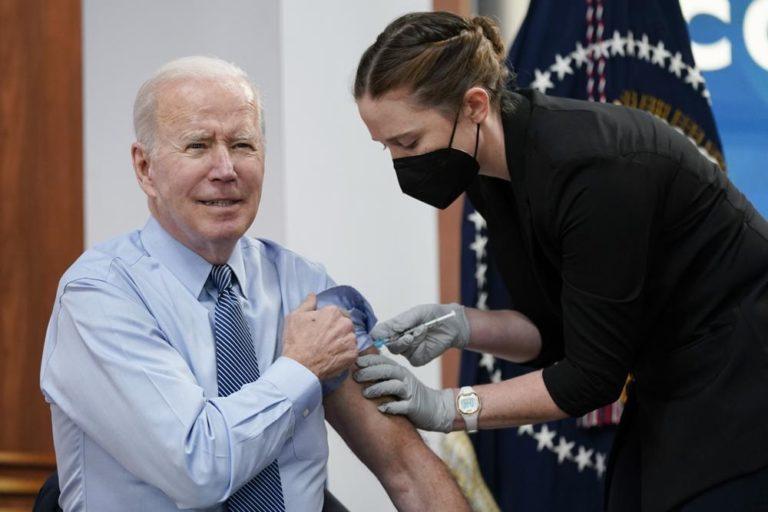
The 79-year-old president contracted the deadly virus despite being up to date on all of the latest jabs.

Sue was relentlessly mocked by right-wingers online, who pointed out her many delusions.

“This is one of the best tweets I’ve ever seen. So brilliantly crafted and bats*** crazy. 10/10,” Lone Conservative founder Kassy Dillon wrote in a Tweet.

Others noted that she got the president she wanted and is now complaining about him.

“Addiction physician upset with white supremacist @POTUS she dutifully voted for,” radio host Tony Bruno said.

China Issues Military Warning about Nancy Pelosi

(Jacob Bruns, Headline USA) China apparently issued military warnings against Taiwan regarding American House Speaker Nancy Pelosi‘s potential visit to the far-eastern nation, the Financial Times reported.

The warnings were allegedly strongly worded, and included potential military intervention in order to stop the trip from taking place.

US National Security adviser Jake Sullivan and other senior National Security Council officials warned against the trip, saying it was a bad idea because China had ramped up the rhetoric. 

Beijing has a history of responding violently to those who attempt to deal directly with Taiwan. China has long claimed territorial rights over the small Southeast Asian nation.

According to China’s foreign ministry, a “resolute and strong” response is on the table for anyone like Pelosi.

After hearing about the potential trip, President Biden chided Pelosi for what he believes is her recklessness, suggesting that the trip is simply “not a good idea right now.”

Pelosi denied ever speaking to Biden about the trip, but said that she had heard rumors from military personnel.

“I think what the president was saying is [that] maybe the military was afraid our plane would get shot down or something like that by the Chinese,” she said. “I’ve heard it anecdotally, but I haven’t heard it from the president.” 

Pelosi has since canceled the trip. The NSC declined to comment when asked whether they told Pelosi to cancel.

John Kirby, NSC head of strategic communications, noted that NCS officials simply provided Pelosi with “context, facts and geopolitical relevant information,” and suggested that she made her own decision.

No America House Speakers have been to Taipei since 1997, when Republican Newt Gingrich visited the nation.

Of course the Biden family has long-time connections to the Eastern nation, going back to Joe’s days in the United States Senate. His degenerate son, Hunter Biden, has also taken up his father’s penchant for profiting off of shady international deals.

Alex Jones’s Sandy Hook Defamation Trial to Begin in Texas

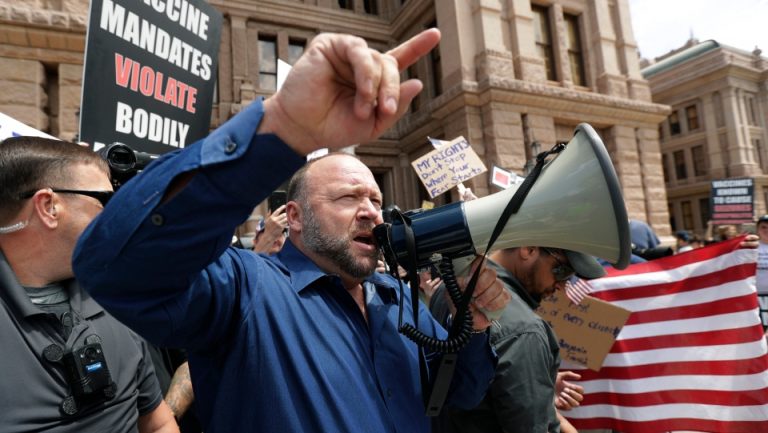
(Headline USA) Jury selection is set for Monday in a trial that will determine for the first time how much Infowars host Alex Jones must pay Sandy Hook Elementary School parents for falsely telling his audience that the deadliest classroom shooting in U.S. history was a hoax.

The trial in Austin, Texas—where Jones lives and broadcasts his show—follows months of delays. Jones has racked up fines for ignoring court orders and he put Infowars into bankruptcy protection just before the trial was originally set to start in April.

At stake for Jones is another potentially major financial blow that could put his constellation of conservative businesses into deeper jeopardy. He has already been banned from YouTube, Facebook and Spotify over violating so-called hate-speech policies.

The trial involving the parents of two Sandy Hook families is only the start for Jones; damages have yet to be awarded in separate defamation cases for other families of the 2012 massacre in Newtown, Connecticut.

The lawsuits do not ask jurors to award a specific dollar amount against Jones.

Courts in Texas and Connecticut have already found Jones liable for defamation for his portrayal of the Sandy Hook massacre as a hoax involving actors aimed at increasing gun control. In both states, judges have issued default judgements against Jones without trials because he failed to respond to court orders and turn over documents.

The 2012 shooting killed 20 first graders and six educators. Families of eight of the victims and an FBI agent who responded to the school are suing Jones and his company, Free Speech Systems.

Jones has since acknowledged that the shooting took place. During a deposition in April, Jones insisted he wasn’t responsible for the suffering that Sandy Hook parents say they have endured because of the hoax conspiracy, including death threats and harassment by Jones’s followers.

“No, I don’t [accept] responsibility because I wasn’t trying to cause pain and suffering,” Jones said, according to the transcripts made public this month. He continued: “They are being used and their children who can’t be brought back [are] being used to destroy the First Amendment.”

Intent can be a tricky standard to apply in such cases. While it is necessary for public figures to establish malicious intent in matters of defamation, a private citizen need only meet the bar of willful negligence—that a person should have known a statement was false.

But the alleged victims also must establish that there were material damages stemming from the statements.

Jones claimed in court records last year that he had a negative net worth of $20 million, but attorneys for Sandy Hook families have painted a different financial picture.

Court records show that Jones’ Infowars store, which sells nutritional supplements and survival gear, made more than $165 million between 2015 and 2018. Jones has also urged listeners on his Infowars program to donate money.

Adapted from reporting by the Associated Press

Trump, DeSantis Both Vie for Support of Young Conservatives at TPUSA

(Headline USA) When former President Donald Trump took the stage before a crowd of more than 5,000 young conservative activists in Tampa this weekend, he received the rock star’s welcome he’s grown accustomed to over the seven years in which he’s reshaped the Republican Party.

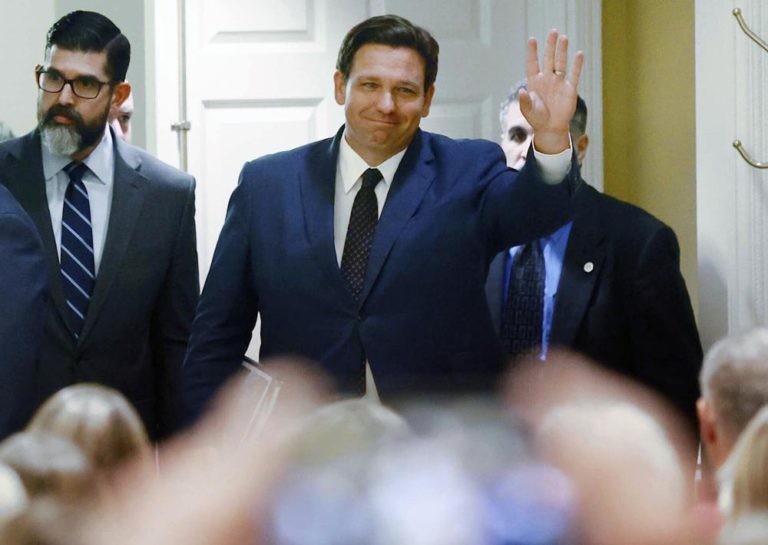
One night earlier, it was Florida Gov. Ron DeSantis who had the crowd on its feet as he headlined the day’s program at Turning Point USA’s annual Student Action Summit.

“To be honest, it’s like choosing between your favorite child,” said Leo Milik, 19, who lives in Barrington, Illinois, when asked whom he’d like to see as the party’s next nominee.

Milik, wearing a “Trump was Right” baseball cap, said both Republicans “have their pros, they have their cons.” For now, he said, he’s leaning toward Trump.

That sentiment reflects the soul searching underway inside the GOP as an invisible primary for the 2024 presidential nomination begins to take shape, dominated at least for the moment by Trump and DeSantis.

There’s little doubt that Trump is moving closer to announcing a third presidential campaign. But there’s genuine debate over whether he’s the party’s best candidate to take on President Joe Biden, who is otherwise seen as a vulnerable incumbent heading into the next campaign, weighed down by soaring inflation, sinking popularity and questions about his capacity to manage the U.S. into his 80s.

A pair of weekend editorials in the New York Post and Wall Street Journal—publications owned by the often Trump-friendly Rupert Murdoch—castigated the former president for refusing to call off the mob of his supporters during the Jan. 6 uprising at the U.S. Capitol.

“As a matter of principle, as a matter of character, Trump has proven himself unworthy to be this country’s chief executive again,” wrote the New York Post.

But inside the Tampa Convention Center, mentions of Jan. 6 elicited cheers as a who’s who of Trump’s “MAGA movement” took the stage in a room that had the feel of a Las Vegas nightclub.

Young attendees dressed in sparkly heels and candy-colored cowboy boots danced under laser lights to a DJ before the program began. Speakers were introduced with WWE-style videos, elaborate pyrotechnics and smoke displays.

Throughout the venue, ring lights were placed strategically in front of logoed backdrops for flattering photo ops.

The top draw was Trump, who again teased his future plans.

“I ran twice. I won twice and did much better the second time … and now we may just have to do it again,” he said to thundering cheers and chants of “Take it back!”

During his speech, Trump appeared intent to address criticism from some corners of the party that he is too focused on relitigating the 2020 election, telling the crowd he wanted to talk about “some of the really big issues.”

But he quickly returned to familiar grievances, labeling himself the most persecuted politician in the nation’s history as he inched ever closer to announcing a run.

“If I renounced my beliefs, if I agreed to stay silent, if I stayed home, if I announced that I was not going to run for office, the persecution of Donald Trump would immediately stop,” he said. “But that’s what they want me to do. And you know what? There’s no chance I do that.”

DeSantis, who often insists he is focused solely on reelection as governor, headlined Friday night’s program in an appearance that strongly suggested his ambitions extend beyond the state.

He welcomed the crowd to the “free state of Florida” and highlighted his opposition to COVID lockdown policies, which made him a conservative hero during the height of the pandemic. And he bragged about his efforts to bar child-grooming in Florida classrooms, as well as his battles with Disney.

“We’ve accomplished an awful lot in the state of Florida. But we have only begun to fight,” he said. “Because we are on a mission to keep the state of Florida free and to save our great country.”

An unscientific straw poll of attendees at the event found that 78.7% would vote for Trump in a GOP primary, with DeSantis coming in second with 19%. No other potential candidate came in above 1%.

Because both are Florida residents, an alliance may not benefit them if they were to share the same ticket, and the two strong personalities have given no indication that they would consider such a prospect.

However, with Trump nearly as old as Biden and with him being a particular rallying point for powerful deep-statists and billionaires to collude, once again, to throw the election, some may see the stakes as being too high to gamble.

Nontheless, many were all in, for now, on a Trump 2024 run.

“I love the idea, I absolutely do,” said Ryan Malone, 33, who recently moved from New York to Florida. While he is a big fan of DeSantis, he argued that Trump is best positioned to turn the country around from what he sees as Biden’s litany of failures.

“I think that he would get more done,” he said. “Again, I love DeSantis, he’s my 1A, right? But I do think that if we’re going to get out of this miserable period that we’re in, Trump is the guy to get us out of this hole.”

Still, he worried about what might happen if the two were to run against each other in a GOP primary.

“I wouldn’t want to see there be bad blood between the person who’s, like, the true leader of our party and then the person who’s, you know, the second coming,” he said.

But his wife, Dr. Mariuxi Viteri Malone, 33, is eager for DeSantis to run. As an immigrant from Ecuador, she said she was offended by Trump’s rhetoric toward Hispanics.

“Be nice!” he said. “That’s all you need to do.”

Others were more strategic in their thinking.

Cameron Lilly, 29, said that he personally likes DeSantis better than Trump, but nonetheless thinks another Trump run makes sense for the party.

“I think Ron DeSantis right now is wasting the one more chance that Trump has,” said Lilly, who works for a defense contractor in Annapolis, Maryland.

“I like DeSantis even a little bit more,” she added. “But I think if we want to have consistent conservatives in the White House, one more Trump term, DeSantis as vice president, and then potentially one or two more terms. That’s the way to keep conservatives in the White House for more years.”

Steven Dykstra, 22, had another reason.

“As much as I want DeSantis to be the president—he would make a great president—I want him to stay in Florida,” said Dykstra, who attends Pasco–Hernando State College. “If he were to run in 2024, he wouldn’t be our governor. He’s been a great governor. I think he should stay.”

Orlando sisters Sydney and Janae Kinne, who go by “The Patriot Sisters” online, said they were fans of both Trump and DeSantis, but don’t expect either to run in 2024.

“I would still vote for him. We’re still there. But I would like to see him in a different seat this year,” said Janae, 23, of Trump. “If he runs, I mean, we’re going to be on the street rooting for him anyways. But we’d like to see him start to raise up other people who have the same mentality.”

Sydney, 21, said she was looking for an alternative, but wasn’t sure who.

“That’s the question of the hour,” she said. “Right now what we need is someone that, yes, is strong, they’re strong-willed, but someone that’s a little more kind of rallying everyone together.”

But Zachary Roberson, 22, said that, if he ever had to choose between Trump and DeSantis, he’d pick the Florida governor.

“He seems like a more refined version of Trump. So I’m hoping he runs for president,” said Roberson, a student at Florida Gulf Coast University.

As for Trump, Roberson suggested: “You can run for governor here in Florida.”

Adapted from reporting by the Associated Press

Janet Yellen Argues US Economy Not ‘Technically’ Headed for Recession

(Molly Bruns, Headline USA) Treasury Secretary Janet Yellen said in an interview that the U.S. economy may not necessarily be headed for a recession even if the gross domestic product experiences two consecutive quarters of decline.

On NBC’s “Meet the Press,” Yellen acknowledged that most economists define a recession as two consecutive quarters of negative GDP growth, but emphasized “that is not the technical definition,” The Daily Wire reported.

“There is a ton of data coming out this week; it’s probably a fun week for an economist because we are going to have consumer confidence survey, inflation numbers for June,” host Chuck Todd said.

“Which is the indicator? What’s the number you’re most focused on that will give you a better indication of where this economy is headed?”

Yellen gave a long-winded response, calling two quarters of negative GDP growth an economic “contraction.”

“Well, I look at all the data, and GDP will be closely watched,” Yellen replied. “But I do want to emphasize: what a recession really means is a broad-based contraction in the economy.

“And even if that number is negative, we are not in a recession now, and I would, you know, warn that we should be not characterizing that as a recession,” she concluded.

Todd challenged Yellen, arguing with her use of misleading words.

“That’s not the technical definition,” Yellen retorted. “There is an organization called the National Bureau of Economic Research that looks at a broad range of data in deciding whether or not there is a recession.

“And most of the data that they look at right now continues to be strong,” she continued. “I would be amazed if the NBER would declare this period to be a recession, even if it happens to have two-quarters of negative growth.”

Economist Julius Shiskin published several rules to identify recessions in 1974; two consecutive quarters of declining GDP is the most popular and now standard definition.

Yellen, however, prefers the definition given by the National Bureau of Economic Research (NBER): “a significant decline in economic activity spread across the economy, lasting more than a few months, normally visible in real GDP, real income, employment, industrial production, and wholesale-retail sales.”

NBER is “generally recognized” as the group that defines the beginning and end of recessions in the U.S.

DeSantis Urges GOP to ‘Hold Biden and His Minions Accountable’

0

(Molly Bruns, Headline USA) Florida Governor Ron DeSantis called for more action from Congressional Republicans at a state fundraiser.

According to Washington Examiner, DeSantis made these statements fundraiser in Hollywood, Florida, urging GOP Reps. to “hold Biden and his minions accountable.”

“If they get majorities in the Congress, I’m sick of them talking,” DeSantis said during Sunshine Summit’s Victory Dinner. “I’m sick of them telling us what they’re going to do. I’m sick of them going on cable and doing this, and prattling.”

“In Florida, we don’t just talk, we do,” the governor added.

DeSantis encouraged Republicans to be courageous as they approach November’s midterm elections.

“In times like these, it’s not enough to just be right on the issues,” he said. “Because in times like these, there’s no substitute for courage.”

“You got to have the courage of your convictions to be willing to stand up against the media,” DeSantis added. “You got to have the courage to stand up against things like cancel culture. You got to have the courage to stand up to the woke mob.”

He even poked fun of the Biden administration, referencing the “Let’s Go Brandon” chant often used to mock the president.

“You got to have the courage to stand in the way of the Brandon administration,” he said.

DeSantis also slammed Biden’s immigration policy, referring to it as “open border.”

“We are just getting warmed up,” DeSantis said to the cheering crowd. “I have only begun to fight. I’m standing my ground, walking the line all the way to the finish line, and I can tell you this: With your help, and everybody behind us, there is no doubt in my mind that come November, we are going to keep the state of Florida free.”

DeSantis has not made any official statements about a potential presidential run in 2024, but is seen as a ticket favorite should he choose to run.


Leftists Protest Growth of Catholic Hospital Networks, Believe Contraception will be Limited

0

(Headline USA) As numerous Republican-governed states push for sweeping bans on abortion, there is a coinciding surge of leftist concern in some Democratic-led states that options for reproductive health care are dwindling due to expansion of Catholic hospital networks.

These are states such as Oregon, Washington, California and Connecticut, where abortion will remain legal despite the U.S. Supreme Court’s recent ruling overturning Roe v. Wade.

Leftists are concerned that these blue states pertain to such services as contraception, sterilization and certain procedures for handling pregnancy emergencies.

These services are widely available at secular hospitals but generally forbidden, along with abortion, at Catholic facilities under directives set by the U.S. Conference of Catholic Bishops.

The differing perspectives on these services can clash when a Catholic hospital system seeks to acquire or merge with a non-sectarian hospital, as is happening now in Connecticut.

State officials are assessing a bid by Catholic-run Covenant Health to merge with Day Kimball Healthcare, an independent, financially struggling hospital and health care system based in the town of Putnam.

“We need to ensure that any new ownership can provide a full range of care — including reproductive health care, family planning, gender-affirming care and end-of-life care,” said Connecticut Attorney General William Tong, a Democrat.

Lois Utley, a specialist in tracking hospital mergers, said her organization, Community Catalyst, has identified more than 20 municipalities in blue or purple states where the only acute care hospitals are Catholic.

“We are definitely sliding backwards in terms of comprehensive reproductive health,” Utley said. “Catholic systems are taking over many physician practices, urgent care centers, ambulatory care centers, and patients seeking contraception won’t be able to get it if their physician is now part of that system.”

According to the Catholic Health Association, there are 654 Catholic hospitals in the U.S., including 299 with obstetric services. The CHA says more than one in seven U.S. hospital patients are cared for in a Catholic facility.

The CHA’s president, Sister Mary Haddad, said the hospitals provide a wide range of prenatal, obstetric and postnatal services while assisting in about 500,000 births annually.

“This commitment is rooted in our reverence for life, from conception to natural death,”Haddad said via email. “As a result, Catholic hospitals do not offer elective abortions.”

Protocols are different for dire emergencies when the mother “suffers from an urgent, life-threatening condition during pregnancy,” Haddad said. “Catholic health clinicians provide all medically indicated treatment even if it poses a threat to the unborn.”

This approach is now being mirrored in several states imposing bans that allow abortions only to save a mother’s life. There is concern that doctors governed by such bans—whether a state law or a Catholic directive—may endanger a pregnant woman’s health by withholding treatment as she begins to show ill effects from a pregnancy-related problem.

Biden’s Traditional Allies Oppose His ‘Green’ Efforts

(Headline USA) Opposition from friends, not foes, is creating potential roadblocks to President Joe Biden’s green energy agenda on federal lands in the blue-leaning, Western swing state of Nevada.

Two lithium mines and a geothermal power plant in the works in the biggest U.S. gold-mining state are under attack from conservationists, tribes and others who otherwise tend to support Biden’s green energy efforts.

The conflicts put a spotlight on an emerging reality as the Biden administration tries to meet its goal of having the U.S. power grid run on clean energy by 2035.

Renewable or not, the actual mining of the resources faces many of the same regulatory and environmental hurdles the government has encountered for decades when digging for coal or drilling for oil.

Whether it’s tapping hot underground water to generate electricity with steam-powered turbines or extracting lithium to make electric car batteries, the operations still must comply with laws designed to protect wildlife habitat, cultural and historical values, and guard against pollution or other degradation of federal lands.

During a recent failed attempt to overturn a Nevada water permit for a mine near the Oregon line above the biggest known lithium deposit in the nation, opponents raised some of the same concerns leveled four decades ago about some of the largest gold mines in the world.

Specifically, the Great Basin Resource Watch and others say the lithium mine will produce toxic waste. More generally, they still accuse regulators of rubber-stamping industry plans without a thorough review of the potential harms.

“Everything seems to be in the hands of the mining company,” Sarah Wochele, a mining justice organizer for the Progressive Leadership Alliance of Nevada, said at last month’s appeal hearing. “And we just ignorantly praise new technology, new technology.”

Ramped up domestic production of lithium is key to Biden’s blueprint for his “green” initiatives, a critical element for electric vehicle batteries. Worldwide demand for the lightest metal on Earth is projected to increase six-fold by 2030 compared to 2020.

The big deposit bordering Oregon where Lithium Nevada plans to begin construction in December is “vital to our national security and nation’s need for lithium to support green energy development and achieve climate change objectives,” the company said in recent court filings.

But in addition to concerns about toxic waste, the mine sits on federal land local tribes say is a sacred site where dozens of their ancestors were massacred by the U.S. Cavalry in 1865.

Another big lithium mine still on the drawing board, halfway between Reno and Las Vegas, is home to a rare desert wildflower the U.S. Fish and Wildlife Service has proposed for listing under the Endangered Species Act.

Meanwhile, the geothermal power plant faces both cultural and environmental challenges in a case pending before the 9th U.S. Circuit Court of Appeals.

The San Francisco-based appellate court could rule any day on a lawsuit seeking to halt the development in a high-desert oasis 100 miles (161 kilometers) east of Reno where a rare toad currently protected under the Endangered Species Act lives in the same hot springs where Native Americans have worshipped for thousands of years.

The Interior Department’s Bureau of Land Management approved Ormat Nevada’s geothermal project last November over the objections of another Interior agency, the U.S. Fish and Wildlife Service.

Since then, USFWS has taken the rare step of declaring the Dixie Valley toad endangered on a temporary emergency basis — something it’s done only one other time in 20 years.

This month, the Center for Biological Diversity and the Fallon Paiute-Shoshone Tribe amended their lawsuit against the Reno-based Ormat and the Bureau of Land Management in U.S. District Court in Reno to include the April listing.

The updated version alleges both are in violation of the Endangered Species Act because they’ve failed to halt construction “despite USFWS’s unambiguous finding that the project poses an imminent and existential risk to the Dixie Valley toad.”

The government hasn’t responded yet, but the case continues in district court on a parallel track with the appellate court. And the ongoing legal battles underscore the difficulty of turning Biden’s vision of a cleaner energy future into reality.

Administration officials insist they’ve known all along that implementing their plans to slow the warming of the Earth wouldn’t be easy.

“Catalyzing the clean energy economy and seeing renewable energy projects through to completion is no small task,” said Tyler Cherry, press secretary for Interior Secretary Deb Haaland.

“Indeed, these are complex, large-scale projects that require a robust public process,” he wrote in an email July 12 to the AP in response to a request for comment.

The three-judge panel at the 9th Circuit that heard oral arguments on the geothermal case in June said they couldn’t consider the April listing of the toad because it came after the appeal was filed in January.

But the judges acknowledged USFWS had raised similar objections in earlier opinions, warning about the likelihood the geothermal plant’s operations could push the toad to the brink of extinction.

The Justice Department lawyer representing the bureau, Michelle Melton, said federal law required the bureau to consider USFWS’s criticisms but it wasn’t bound by them.

The emergency listing of the toad doesn’t change the bureau’s position that the project will have no significant impact on the tribe or the toad, she said.

“Fish and Wildlife has a different opinion,” Melton said. “It was not a surprise to BLM that Fish and Wildlife felt that way.”

Ormat Vice President Paul Thomsen said the emergency listing overstates the potential impact of the project on the toad partly because it makes false assumptions about underground faults in the geothermal reservoir it intends to tap.

“There are sufficient safeguards in place to avoid endangering the toad,” he wrote June 6 in comments to USFWS.

The 9th Circuit judges appeared sympathetic last month to some of the opponents’ arguments. But they noted that the lower court judge had weighed the pros and cons and determined the public was best served by allowing the temporary injunction blocking construction to expire 90 days after it was issued in February.

They pointed to Judge Robert C. Jones’ conclusion that the electricity produced at the geothermal plant would significantly reduce greenhouse gas emissions compared to other energy production facilities and that “depriving the public of a source of carbon-free” electricity is not in the public’s best interest.

Scott Lake, a lawyer for the Center for Biological Diversity, said the benefits of renewable energy resources are “something the tribe and the center actually agree with.”

“But nothing in the record establishes a public interest in, or a compelling need, for this particular project … on a tribal sacred site and in such a way that threatens the entire existence of the Dixie Valley toad,” he said.

Adapted from reporting by the Associated Press

Biden Confirmed to Have BA.5, Shows Significant Improvement

(Headline USA) President Joe Biden continues to “improve significantly” despite a lingering sore throat from his coronavirus infection, according to an update Sunday from his doctor.

“The president is responding to therapy as expected,” wrote Dr. Kevin O’Connor in his latest note. Biden has been taking Paxlovid, an antiviral drug that helps reduce the chance of severe illness.

O’Connor wrote that Biden still has a sore throat, though other symptoms, including a cough, runny nose and body aches, “have diminished considerably.”

Biden tested positive for the coronavirus on Thursday morning. O’Connor said Saturday that the president likely became infected with a highly contagious variant, known as BA.5, that is spreading throughout the country, and Dr. Ashish Jha, the White House COVID-19 response coordinator, said Sunday, “It is the BA.5 variant.”

Jha also gave a positive update on the president’s health.

“I checked in with his team late last night. He was feeling well. He had a good day yesterday,” Jha said.

That variant is an offshoot of the omicron strain that emerged late last year. It is believed responsible for the vast majority of coronavirus cases in the country. He has been isolating in the White House residence since then.

Administration officials have emphasized that his symptoms are mild because he has received four vaccine doses, and he started taking the antiviral drug Paxlovid after becoming infected.

Jha pledged that the White House would keep giving updates on the president’s condition and whether he might have long-term symptoms.

“We think it’s really important for the American people to know how well their president is doing,” he said.

“Obviously if he has persistent symptoms, obviously if any of them interfere with his ability to carry out his duties, we will disclose that early and often with the American people. But I suspect that this is going to be a course of COVID that we’ve seen in many Americans who have ben fully vaccinated, double boosted, getting treated with those tools in hand,” Jha said. “The president’s been doing well and we’re going to expect that he’s going to continue to do so.’’

Biden’s press secretary has said 17 people, including members of the president’s senior staff and at least one member of Congress, were determined to have been in close contact with Biden when he might have been contagious. None has tested positive so far, Jha said on “Fox News Sunday.”

Americans continue to hold Biden accountable as he recovers from COVID-19. A recent poll shows that his numbers have hit yet another new low.

Adapted from reporting by the Associated Press

Left and Right Oppose Biden’s Semiconductor Bill

(Headline USA) A bill to boost semiconductor production in the United States has managed to do nearly the unthinkable — unite the democratic socialist Sen. Bernie Sanders and the fiscally conservative right.

The bill making its way through the Senate is a top priority of the Biden administration. It would add about $79 billion to the deficit over 10 years, mostly as a result of new grants and tax breaks that would subsidize the cost that computer chip manufacturers incur when building or expanding chip plants in the United States.

Supporters say that countries all over the world are spending billons of dollars to lure chipmakers. The U.S. must do the same or risk losing a secure supply of the semiconductors that power the nation’s automobiles, computers, appliances and some of the military’s most advanced weapons systems. More Republicans warmed up to the bill after it dropped tax hikes. Paul Pelosi, husband of Rep. Nancy Pelosi, D-Calif., stood to benefit from the bill.

Sanders, I-Vt., and a wide range of conservative lawmakers, think tanks and media outlets have a different take. To them, it’s “corporate welfare.” It’s just the latest example of how spending taxpayer dollars to help the private sector can scramble the usual partisan lines, creating allies on the left and right who agree on little else. They are positioning themselves as defenders of the little guy against powerful interest groups lining up at the public trough.

Sanders said he doesn’t hear from people about the need to help the semiconductor industry. Voters talk to him about climate change, gun safety, preserving a woman’s right to an abortion and boosting Social Security benefits, and a host of other leftist favorites.

“Not too many people that I can recall — I have been all over this country — say: ‘Bernie, you go back there and you get the job done, and you give enormously profitable corporations, which pay outrageous compensation packages to their CEOs, billions and billions of dollars in corporate welfare,'” Sanders said.

Sanders voted against the original semiconductor and research bill that passed the Senate last year. He was the only senator who caucuses with the Democrats to oppose the measure, joining with 31 Republicans.

While Sanders would like the see the spending directed elsewhere, several GOP senators just want the spending stopped, period. Sen. Mike Lee, R-Utah, said the spending would help fuel inflation that is hurting the poor and middle class.

“The poorer you are, the more you suffer. Even people well-entrenched in the middle class get gouged considerably. Why we would want to take money away from them and give it to the wealthy is beyond my ability to fathom,” Lee said.

Conservative mainstays such as The Wall Street Journal’s editorial board, the Heritage Foundation and the tea party aligned group FreedomWorks have also come out against the bill. “Giving taxpayer money away to rich corporations is not competing with China,” said Walter Lohman, director of the Heritage Foundation’s Asian Studies Center.

The opposition from the far left and the far right means that Senate Majority Leader Chuck Schumer, D-N.Y., and Pelosi will need help from Republicans to get a bill over the finish line. Support from at least 11 Republican senators will be needed to overcome a filibuster. A final vote on the bill is expected in the coming week.

Sen. Mitt Romney, R-Utah, is among the likely Republican supporters. Asked about the Sanders’ argument against the bill, Romney said that when other countries subsidize the manufacturing of high technology chips, the U.S. must join the club.

“If you don’t play like they play, then you are not going to be manufacturing high technology chips, and they are essential for our national defense as well as our economy,” Romney said.

The most common reason that lawmakers give for subsidizing the semiconductor industry is the risk to national security from relying on foreign suppliers, particularly after the supply chain problems of the pandemic. Nearly four-fifths of global fabrication capacity is in Asia, according to the Congressional Research Service, broken down by South Korea at 28%, Taiwan at 22%, Japan, 16%, and China, 12%.

“My fear is that more and more companies will locate their manufacturing facilities in other countries and that we will be increasingly vulnerable,” said Sen. Susan Collins, R-Maine.

Supporters are confident the bill will pass the Senate. The window for passing the bill through the House is narrow if progressives join with Sanders and if most Republicans line up in opposition based on fiscal concerns. The White House says the bill needs to pass by the end of the month because companies are making decisions now about where to build.

Two key congressional groups, the Problem Solvers caucus and the New Democrat Coalition, have endorsed the measure in recent days.

The Problem Solvers caucus is made up members from both parties. Rep. Brian Fitzpatrick of Pennsylvania, the group’s Republican co-chair, said Intel Corp. wants to build its chip capacity in the United States, but much of that capacity will go to Europe if Congress doesn’t pass the bill.

“If a semiconductor-related bill is brought to the floor, it will pass,” Fitzpatrick said.

Rep. Derek Kilmer, D-Wash., claims the legislation checks a lot of boxes for his constituents, including on the front-burner issue of the day, inflation.

“This is about reducing inflation. If you look at inflation, one-third of the inflation in the last quarter was automobiles, and it’s because there’s a shortage of chips,” Kilmer said. “So this is about, one, making sure that we’re making things in the United States, and two, about reducing costs.”

Adapted from reporting by the Associated Press