UPDATE: RNC Chooses Hotbed of 2020 Vote Fraud to Host 2024 Convention

UPDATE: Republicans on Friday unanimously chose Milwaukee in swing state Wisconsin for the 2024 national convention.

Milwaukee’s Democrat mayor, Cavalier Johnson, joined with Reince Priebus, a former chief of staff to then-President Donald Trump, to praise the decision after it was announced in Chicago.

“I want you to take all your money to Milwaukee, spend it that week, and leave it in Milwaukee,” Johnson said.

“It’s a battleground state, it matters,” Priebus said. “I know sometimes we debate it, but it matters.”

Original story below:

(Headline USA) Republicans are to announce Friday whether the 2024 national convention, where the party’s presidential nominee will be officially named, will be held in Milwaukee or Nashville.

Milwaukee, in swing state Wisconsin, is the odds-on favorite to get the event given Nashville’s refusal to adopt an agreement for hosting the convention. There has been broad bipartisan support for holding the event in Milwaukee, which was selected to host the 2020 Democratic convention that had to be moved online due to the COVID-19 pandemic.

Milwaukee used its preparations for that convention to argue to Republicans that it had a “turnkey” operation ready to host for real in 2024. Milwaukee was the pick of the RNC’s site selection committee in July.

The Republican National Committee is to announce its decision on the final day of its summer meeting in Chicago.

Nashville’s bid hit a roadblock after Mayor John Cooper and others expressed concerns about security, the economic trade-off of having to mostly shut down the bustling downtown except for convention activity as well as the implications of tying up city resources for the event.

The Nashville common council on Tuesday rejected a draft agreement for hosting the convention, seemingly ending that city’s chances.

It was a different story in Milwaukee, where leaders in the Democrat stronghold joined together with Republican power brokers, including former RNC Chairman Reince Priebus, to make the pitch for hosting the convention. Priebus, a former White House chief of staff under former President Donald Trump and Wisconsin state GOP chairman, leads the local committee for the convention.

Trump narrowly won Wisconsin in 2016, but lost to President Joe Biden by a nearly identical margin in 2020.

Wisconsin could determine who wins in 2024, while Tennessee has not backed a Democrat for president since 1996. But choosing Milwaukee is in line with recent Republican choices for the convention. For two decades, Republicans have placed their nominating convention in swing states — North Carolina, Ohio and Florida.

Adapted from reporting by the Associated Press

True Conservative Wins GOP Nod for Nashville Mayoral Race: ‘Liberals, We’re Coming for You’

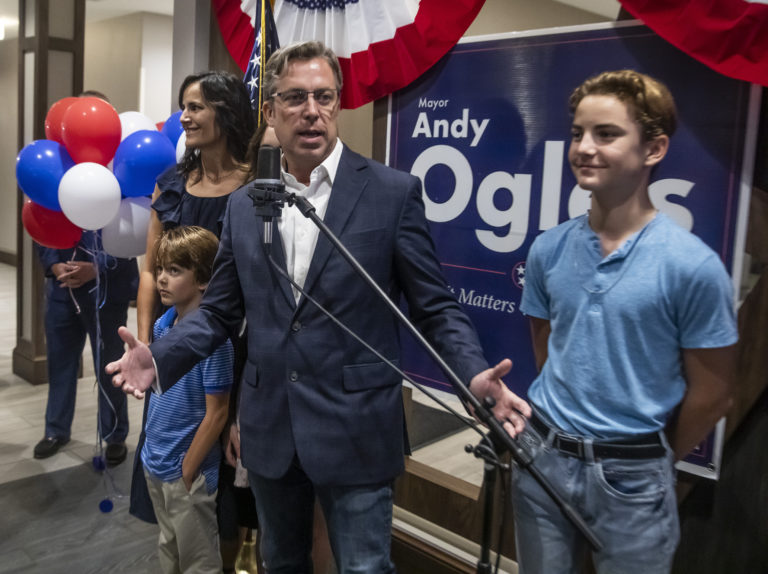
(Headline USA) Andy Ogles, a conservative county mayor, won Tennessee’s crowded Republican primary on Thursday in a reconfigured congressional district in left-leaning Nashville that the party is hoping to flip in November.

In a warning ahead of the general election, he said, “Liberals, we’re coming for you.”

Ogles, the Maury County mayor and onetime leader of the Koch-backed Americans for Prosperity’s state chapter, emerged among nine candidates after a hard-fought primary for the state’s 5th Congressional District. The seat drew heavy interest from Republicans after GOP state lawmakers carved Nashville into three districts, leading incumbent Democrat Rep. Jim Cooper to announce his retirement.

“We’re at war. This is a political war, a cultural war, and it’s a spiritual war,” Ogles said in his victory speech. “And as we go forward, we’ve got to get back to honoring God and country.”

Ogles will face Democrat state Sen. Heidi Campbell in November. The new district favored Donald Trump over Joe Biden by 12 percentage points in 2020.

Ogles described the GOP primary as “establishment versus the conservative wing of the party,” saying voters were getting a “true conservative” in his nomination. He didn’t shy from inflammatory comments during his victory speech, calling for the impeachment of President Joe Biden and Vice President Kamala Harris, as well as treason charges against the Department of Homeland Security secretary over the administration’s handling of immigration issues.

Voters in Tennessee’s primary elections also cast ballots for a Democrat gubernatorial nominee to take on Republican Gov. Bill Lee in November. The Democrat primary remained too early to call Friday morning between Nashville physician Jason Martin and Memphis City Councilman JB Smiley Jr.

Smiley would be the state’s first black nominee for governor. Martin, a political newcomer, said he was spurred to run by Lee’s hands-off response to the COVID-19 pandemic.

Lee will have a strong advantage in November in a state that has not elected a Democrat to statewide office since 2006. He defeated a Democrat opponent by 21 percentage points in 2018.

In the congressional race, Ogles scored Republican Sen. Ted Cruz’s endorsement and overcame a fundraising advantage from his top opponents, former Tennessee House Speaker Beth Harwell and retired Tennessee National Guard Brig. Gen. Kurt Winstead. He also benefited the most from third-party groups, which ran TV ads touting his opposition to COVID-19 mandates and dragging down his opponents as insufficiently conservative.

Campbell, who was unopposed in her Democrat primary, said the race was “symbolic of the crossroads” the country finds itself at.

“One where we move forward together, protecting working families, our freedoms, and future — or one where extreme politicians turn us backward, controlling our lives and ruling for the wealthy few,” she said before the GOP primary was called for Ogles.

Redrawn congressional districts helped put Tennessee among the states where Republicans hope to flip a seat in a push to reclaim control of the U.S. House. Tennessee held the only statewide elections in the nation Thursday.

In the other two Nashville-area districts, the Republican incumbents didn’t have primary opponents. The new maps weight their districts in their favor.

In the new 6th District, which includes more of the city, Republican U.S. Rep. John Rose brings a huge fundraising edge into a general election against Democrat Randal Cooper, who defeated a primary opponent. Over in the new 7th District, Republican U.S. Rep. Mark Green ran unopposed and will face Democrat Odessa Kelly, who also didn’t face an opponent.

Adapted from reporting by the Associated Press

W. Va. AG Wants Supreme Court to let School Choice Program go into Effect

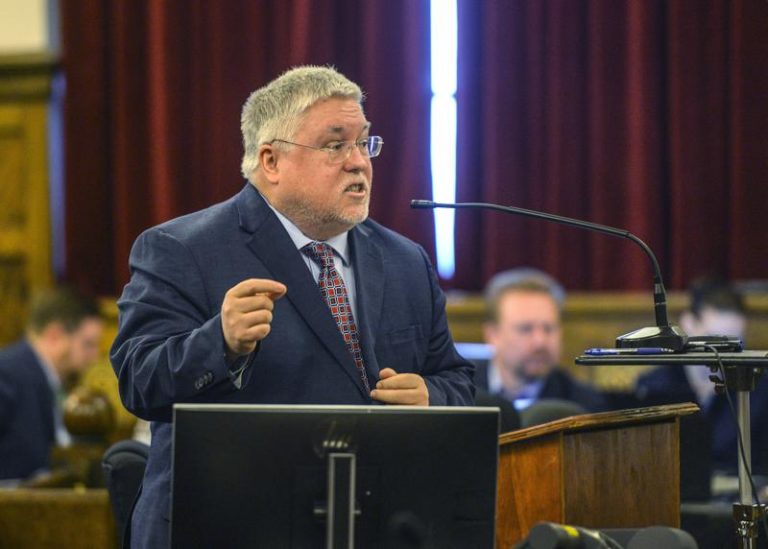
(The Center Square) After a West Virginia school choice scholarship program was halted by the courts, Attorney General Patrick Morrisey is taking the fight to the Supreme Court of Appeals.

A lower court issued an injunction to prevent West Virginia from implementing the Hope Scholarship Act and an appeals court upheld that injunction. The attorney general’s motion asks the Supreme Court to pause the injunction, which would allow the state to provide the scholarship benefits to the 3,146 children who were already enrolled in the program.

“This is a good law and I will not let this minor setback derail my office in fighting for Hope Scholarship’s constitutionality,” Morrisey said in a statement Thursday morning. “This delay of funds will only hurt the thousands of families who were set to receive money from the Act. This is about protecting the fundamental freedom of parents to choose the best education for their children.”

The scholarship program sets up education savings accounts, which allow parents to use public money to send their children to private schools or offset costs associated with homeschooling. The money diverts funds that would otherwise have been used to fund the child’s education in the public school system. Parents who were enrolled into the program were approved to receive grants up to $4,600 annually.

A group called Public Funds Public Schools sued the state on behalf of a few parents who send their children to public schools, arguing that the program does not allow the state to sufficiently fund public education because money is diverted away from public schools. The group’s lawyers argued that this violates the state constitution’s Education Clause, which states that the legislature must “provide, by general law, for a thorough and efficient system of free schools.”

“I am urging the state Supreme Court of Appeals to stay the decision so that thousands of West Virginia families can receive the money the Legislature intended for the upcoming school year—which starts in a matter of weeks,” the attorney general said.

Gov. Jim Justice signed the act into law in 2021. The bill received support from Republican leadership, but was opposed by Democratic leadership. Republicans argued that the law would give more choices to parents, but Democrats expressed concerns about how it could affect public school funding.

16 Blue States Join Lawsuit to Cancel Florida’s Anti-Grooming Law

(Ezekiel Loseke, Headline USA) Sixteen busybody blue states are suing Florida to overturn its anti-grooming law in a Northern Florida court.

The suing parties include Washington D.C., New Jersey, California, Colorado, Connecticut, Delaware, Hawaii, Illinois, Maine, Maryland, Massachusetts, Michigan, Minnesota, Nevada, New York and Oregon, according to Axios.

The amicus brief stated that the above-mentioned blue states’ “policies allow educators to address LGBTQ issues.” Accordingly, the brief argued that “these policies demonstrate that there is no legitimate reason to ban mentioning them.” This, of course, assumes that Floridians want their children educated in the same way as children in leftist states.

The lawsuit reads that the aforementioned blue states “also ordinarily leave educational decisions to schools and teachers, rather than allowing schools to be haled into court over even minor instructional choices.”

The blue states thus fail to noticed (or are gaslighting those who will not fail to see) that teaching Kindergarteners to 3rd graders about any sexual act is not a “minor instructional choice.” Indeed, for non-groomers and normal people it is apparent that parents have a duty to keep perverts away from their children.

The suit also whined that DeSantis’s Florida “stands alone in its censorship of instruction related to LGBTQ issues,”  and its law is unique in “its imposition of legal liability on school districts that do not censor LGBTQ issues.”

The lawsuit claimed that the act will “stigmatize and harm” the LGBT community.

Axios reported that Keith Ellison, the Minnesota attorney general, said, “It’s my job to stand up for people who are harmed by discrimination — and what harms Florida kids, parents, and teachers harms every one of us.”

The lawsuit, unlike Ellison, pretends to be about a relevant concern to the blue states. It suggests that some of the homosexuals and deviants the Florida law “stigmatize[s] and harm[s]” may end up in their states and cost them money to justify bringing suit over an issue outside their jurisdiction.

The lawsuit is the second public assault on Florida over its anti-grooming bill this week. The Department of Education threatened Florida’s funding over the bill earlier.

Sununu Rips Biden over Report on First Presidential Primary

(, The Center Square) Republican Gov. Chris Sununu is criticizing President Joe Biden over a news report that the Democrat mused about giving New Hampshire’s first-in-the-nation primary position to his home state.

The Politico report cited anonymous sources as saying that Biden had asked advisers about moving up Delaware in the primary calendar—possibly even to the first place spot.

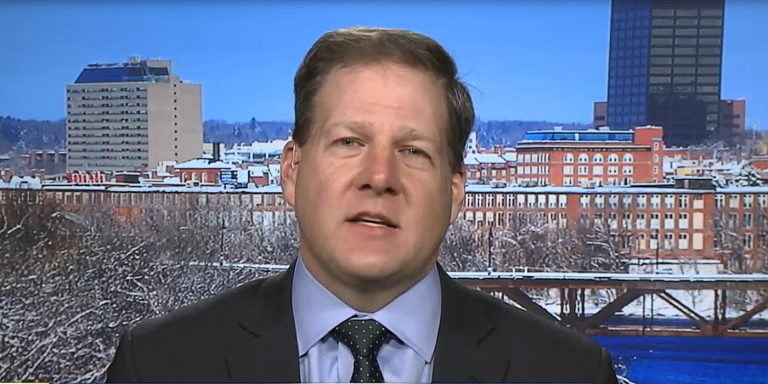
Speaking to reporters on Wednesday, Sununu ripped the idea of Delaware replacing his state in the pecking order as “brazen, bold and ignorant.”

“Imagine if a former Republican president were trying to do the same. Think of the outcry there,” Sununu said in televised remarks. “It’s an insult to all the voters of New Hampshire that the Democratic Party thinks it is just so easy to do this.”

The Democratic National Committee’s Rules and Bylaws Committee recently voted to upend the traditional order of presidential primary nominations by requiring state parties to apply to host primaries and make the case for why they deserve to be first in line.

Democrats from New Hampshire and 16 other states recently made their case before the DNC, which has delayed a decision until after the midterm elections.

In his comments, Sununu suggested that the delay was meant to give political shelter to incumbent Sen. Maggie Hassan, who is facing several Republican challengers in the upcoming election.

“The National Democratic Party has bad news for Democrats in New Hampshire, and they just don’t want to deliver it before November,” Sununu said. “Everybody reads the tea leaves and everybody knows where this is going.”

Not so, says New Hampshire Democratic Party Chairman Ray Buckley, arguing that Hassan and other members of the state’s all-Democrat congressional delegation have been “powerfully making the case” to remain first in the nation.

“Sununu’s meltdown was not only wildly inappropriate, but way off base and he knows it,” Buckley said in a statement.

Some Democrats have argued that the predominantly white electorate New Hampshire and Iowa – which holds its presidential caucuses ahead of New Hampshire’s primary – aren’t representative of Democratic voters or the nation as a whole.

That’s part of the case that Sen. Chris Coons, D-Delaware, made in his pitch to the DNC to make his state the first to host the next presidential primary.

New Hampshire’s first-in-the-nation primary gives the 11th-smallest state by population outsize influence on presidential politics.

Flashy national campaigns with multimillion-dollar advertising budgets turn into shoe-leather operations where candidates knock on doors, walk through neighborhoods in downtown, and press the flesh at local haunts.

This isn’t the first time that the state has had to defend its pole position in the nation’s presidential nominating process.

In 2012, when Nevada and several other states proposed to shift their primaries forward during the contested Republican contest, then-New Hampshire Secretary of State Bill Gardner threatened to schedule the state’s primary in December 2011 to prevent it from losing its first-in-the nation status.

The proposal by other states eventually fizzled out.

Financially Failing Facebook Is Finally Forced to Reassess Censorship Policies

Editor’s Note: In coordination with the Biden administration and others, social-media platforms including Facebook and the Associated Press have long used dogwhistle terms including “misinformation” to describe facts and opinions with which they disagree or find politically inconvenient.

While the AP article has been edited to provide some additional context, much of the language involved in their gaslighting rhetoric is retained here, with the Orwellian buzzwords in quotation marks.

(Headline USA) In the wake of its first negative-growth quarter in its roughly 20-year history, Facebook owner Meta is quietly curtailing some of aggressive, anti-conservative censorship—which it has long maintained is designed to thwart voting “misinformation” or “foreign interference” in U.S. elections as the November midterm vote approaches.

It’s a sharp departure from the social media giant’s multibillion-dollar efforts to “enhance” the accuracy of posts about U.S. elections by inserting leftist propaganda, and to placate Democrat lawmakers after their outrage over learning the company had mined people’s data and had allowed Donald Trump to leverage its algorithms during the 2016 campaign.

“It’s something that’s so politically fraught, they’re more trying to shy away from it than jump in head first.” said Katie Harbath, the former Facebook policy director. “They just see it as a big old pile of headaches.”

The pivot is raising alarm on the uber-censorious Left about Meta’s priorities and about how some might “exploit” the world’s most popular social media platforms to spread “misleading” claims, launch “fake” accounts and rile up partisan “extremists.”

“They’re not talking about it,” said Harbath, now the CEO of the tech and policy firm Anchor Change.

“Best case scenario: They’re still doing a lot behind the scenes,” Harbath said. “Worst case scenario: They pull back, and we don’t know how that’s going to manifest itself for the midterms on the platforms.”

Since last year, Meta has shut down an examination into how “falsehoods” are amplified in political ads on Facebook by indefinitely banishing the researchers—many of whom had a demonstrably left-wing bias—from the site.

Public communication about the company’s response to election “misinformation” has gone decidedly quiet.

Between 2018 and 2020, the company released more than 30 statements that laid out specifics about how it would stifle U.S. election “misinformation,” prevent “foreign adversaries” from running ads or posts around the vote and subdue divisive “hate speech.”

Top executives hosted question-and-answer sessions with reporters about new policies.

CEO Mark Zuckerberg wrote Facebook posts promising to take down “false” voting information and authored opinion articles calling for more regulations to tackle any “foreign interference” that might be harmful to Democrats.

But this year Meta has only released a one-page document outlining plans for the fall elections, even as potential “threats” to the Democratic vote remain clear.

Meta says that elections remain a priority and that policies developed in recent years around election “misinformation” or “foreign interference” are now hard-wired into company operations.

“With every election, we incorporate what we’ve learned into new processes and have established channels to share information with the government and our industry partners,” Meta spokesman Tom Reynolds said.

He declined to say how many employees would be on the project to “protect” U.S. elections full time this year.

During the 2018 election cycle, the company offered tours and photos and produced head counts for its election response war room.

But the New York Times reported the number of Meta employees working on this year’s election had been cut from 300 to 60, a figure Meta disputes.

Reynolds said Meta will pull hundreds of employees who work across 40 of the company’s other teams to monitor the upcoming vote alongside the election team, with its unspecified number of workers.

The company is continuing many initiatives it developed to limit election “misinformation,” such as a “fact-checking” program started in 2016 that enlists the help of “news” outlets to investigate the veracity of popular “falsehoods” spreading on Facebook or Instagram.

The Associated Press is part of Meta’s “fact-checking” program, as are many other partisan outlets compromised by funding from extremist operatives such as George Soros and the Chinese Communist Party.

This month, Meta also rolled out a new feature for political ads that allows the public to search for details about how advertisers target people based on their interests across Facebook and Instagram.

Yet, Meta has stifled other efforts to identify election “misinformation” on its sites.

It has stopped making improvements to CrowdTangle, a website it offered to newsrooms around the world that provides insights about trending social media posts.

“Journalists,” “fact-checkers” and “researchers” used the website to analyze Facebook content, including tracing popular “misinformation” and who is responsible for it.

That tool is now dying, former CrowdTangle CEO Brandon Silverman, who left Meta last year, told the Senate Judiciary Committee this spring.

“There’s no real shortage of ways you can organize this data to make it useful for a lot of different parts of the fact-checking community, newsrooms and broader civil society,” Silverman told the AP.

Not everyone at Meta agreed with that “transparent” approach, Silverman said.

The company has not rolled out any new updates or features to CrowdTangle in more than a year, and it has experienced hourslong outages in recent months.

Meta also shut down efforts to investigate how “misinformation” travels through political ads.

The company indefinitely revoked access to Facebook for a pair of New York University researchers who they said collected unauthorized data from the platform.

The move came hours after NYU professor Laura Edelson said she shared plans with the company to investigate the spread of “disinformation” on the platform around the Jan. 6, 2021, “attack” on the U.S. Capitol, which is now the subject of a House “investigation.”

“What we found, when we looked closely, is that their systems were probably dangerous for a lot of their users,” Edelson said.

Meanwhile, the possibility of regulation in the U.S. no longer looms over the company, with lawmakers failing to reach any consensus over what oversight the multibillion-dollar company should be subjected to.

Free from that threat, Meta’s leaders have devoted the company’s time, money and resources to a new project in recent months.

Zuckerberg—after devoting nearly half a billion dollars of his own private money to swinging the outcome of the 2020 election in Joe Biden’s favor—dove into this massive rebranding and reorganization of Facebook last October, when he changed the company’s name to Meta Platforms Inc.

He plans to spend years and billions of dollars evolving his social media platforms into a nascent virtual reality construct called the “metaverse”—sort of like the internet brought to life, rendered in 3D.

His public Facebook page posts now focus on product announcements, hailing artificial intelligence, and photos of him enjoying life. News about election preparedness is announced in company blog posts not written by him.

In one of Zuckerberg’s posts last October, after an ex-Facebook employee leaked internal documents showing how the platform magnifies “hate” and “misinformation,” he defended the company.

He also reminded his followers that he had pushed Congress to modernize regulations around elections for the digital age.

“I know it’s frustrating to see the good work we do get mischaracterized, especially for those of you who are making important contributions across safety, integrity, research and product,” he wrote on Oct. 5. “But I believe that over the long term if we keep trying to do what’s right and delivering experiences that improve people’s lives, it will be better for our community and our business.”

It was the last time he discussed the Menlo Park, California-based company’s election work in a public Facebook post.

With Facebook having posted its first losses ever, it’s clear, however, that the previous formula wasn’t working. The alienation of half its user base, paired with the deterioration of the product itself, was beginning to impact the company’s business in ways that conservatives have long expected—and prayed—that it would.

Whether Zuckerberg can modernize and reinvent the now damaged brand remains to be seen.

Adapted from reporting by the Associated Press

Texas Gov. Abbott Buses Illegals to NYC after Mayor Snubs Border Invitation

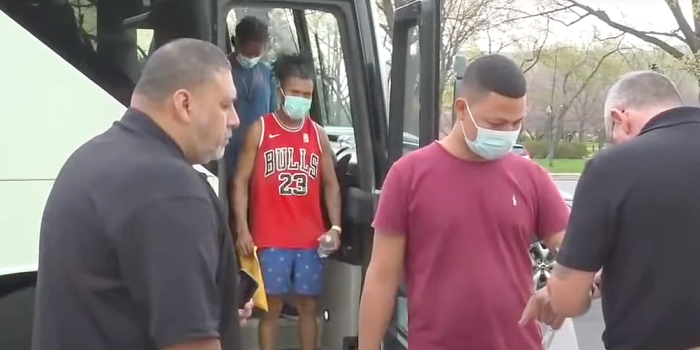
(Bethany Blankley, The Center Square) Texas Gov. Greg Abbott this week invited New York City Mayor Eric Adams to visit the southern border and see first-hand the costs Texans are bearing as a result of “President Biden’s border crisis.” By Friday, he’d announced the first bus of illegal immigrants had arrived in New York City from Texas.

Abbott’s invitation came after Adams publicly blamed the Texas governor for the influx of illegal immigrants being flown into his “sanctuary city,” calling it a “humanitarian crisis.” The city’s budget, its social services, including its homeless shelters, are all strained, and its public schools will be experiencing an influx of enrollment of non-English speakers he said the city doesn’t have the resources to support.

At the time, Abbott clarified the influx of people arriving in New York City were being transported by the Biden administration and Texas had only sent several thousand people to Washington, D.C.

But after Adams didn’t take up his offer to visit the southern border, Abbott began busing people to NYC.

On Friday, Abbott announced the arrival of the first bus that dropped off people Friday morning at the Port Authority Bus Terminal Gate 14.

“Because of President Biden’s continued refusal to acknowledge the crisis caused by his open border policies, the State of Texas has had to take unprecedented action to keep our communities safe,” Abbott said.

“In addition to Washington, D.C., New York City is the ideal destination for these migrants, who can receive the abundance of city services and housing that Mayor Eric Adams has boasted about within the sanctuary city. I hope he follows through on his promise of welcoming all migrants with open arms so that our overrun and overwhelmed border towns can find relief.”

Abbott also said he would continue to bus people to Washington, D.C. “until Biden does his job of securing the border.”

He told Fox News, “Public officials across the country … need to realize the magnitude of the chaos created by Biden’s open border policies. They’re up in arms about a few thousand people coming into their communities over the past few months. In any one sector of the state of Texas, we have more than 5,000 people coming across every single day. We’re full in the state of Texas. Our communities are overrun.”

Last week, Adams held a news conference saying the influx of people was “a real burden on New Yorkers as we’re trying to do the right thing. We already have an overburdened shelter system so now we’re talking about food, clothing, school. This is going to impact our schools because we do not turn away individuals because they are undocumented. There’s just a whole host of things that this is going to produce and that’s why we need help.”

As one of the few cities in the U.S. with “right to housing” laws, New York City is required to provide emergency shelter for every unhoused person.

Abbott pointed out that the mayor’s problem wasn’t with him but with Biden.

“President Biden’s open border policies created this ongoing humanitarian crisis,” he said, “allowing record-high illegal crossings and deadly drugs like fentanyl to flood into our state. A crisis that has overrun and overwhelmed our border towns and communities across our state, whose requests for help have gone ignored and unanswered by the Biden Administration.”

While Adams and the mayor of Washington, D.C., have complained about receiving several hundred people a day combined, Texas is dealing with over 5,000 people entering its five Border Patrol sectors every day.

In June in the Big Bend Sector, there were nearly 3,000 people who were apprehended or recorded as gotaways. In the Del Rio Sector. there were over 57,000; in the El Paso Sector, over 35,000; in Laredo Sector, over 14,000; in the Rio Grande Valley Sector, over 49,000.

The Biden administration has been releasing illegal immigrants from over 150 countries into the U.S. instead of deporting them or requiring them to remain in Mexico while their immigration-related claims are considered. The administration’s catch and release program is one of several policies that Florida has sued over.

U.S. District Judge T. Kent Wetherell of the Northern District of Florida Pensacola Division said the administration’s catch and release position “was as remarkable as it is wrong because it is well established that no one, not even the President, is above the law and the Court unquestionably has the authority to say what the law is and to invalidate action of the executive branch that contravenes the law and/or the Constitution. Thus, if Florida’s allegations that Defendants are essentially flaunting the immigration laws are proven to be true, the Court most certainly can (and will) do something about it.”

Texas also has sued over numerous border security and immigration-related policies, having already won several cases.

New IDs for Immigrants are Sparking Concerns of Abuse

(Headline USA) With immigration flooding America’s open borders under the Biden administration’s policies, U.S. authorities are planning to issue photo ID cards to immigrants in deportation proceedings in a bid to slash paper use and help people stay up-to-date on required meetings and court hearings, officials said.

The proposal from Immigration and Customs Enforcement is still being developed as a pilot program, and it was not immediately clear how many the agency would issue. The cards would not be an official form of federal identification, and would state they are to be used by the Department of Homeland Security.

The idea is for immigrants to be able to access information about their cases online by using a card rather than paper documents that are cumbersome and can fade over time, officials said. They said ICE officers could also run checks on the cards in the field.

“Moving to a secure card will save the agency millions, free up resources, and ensure information is quickly accessible to DHS officials while reducing the agency’s FOIA backlog,” an ICE spokesperson said in a statement, referring to unfulfilled public requests for agency documents. Homeland Security gets more Freedom of Information Act requests than any other federal agency, according to government data, and many of those involve immigration records.

The proposal has sparked a flurry of questions about what the card might be used for and how secure it would be. Some fear the program could lead to tracking of immigrants awaiting their day in immigration court, while others suggest the cards could advertised by migrant smugglers to try to induce others to make the dangerous trip north.

The Biden administration is seeking $10 million for the so-called ICE Secure Docket Card in a budget proposal for the next fiscal year. It was not immediately clear if the money would cover the pilot or a broader program or when it would begin, but if past performance is any indication it will increase the budget.

The administration has faced pressure as the number of migrants seeking to enter the country on the southwest border has increased. Border Patrol agents stopped migrants more than 1.1 million times from January to June, up nearly one-third from the same period of an already-high 2021.

Many migrants are turned away under COVID-19-related restrictions. But many are allowed in and either are detained while their cases churn through the immigration courts or are released and required to check in periodically with ICE officers until a judge rules on their cases, with thousands never showing for appointments and disappearing without any official knowledge of their location.

Those most likely to be released in the United States are from countries where expulsion under the public health order is complicated due to costs, logistics or strained diplomatic relations, including Cuba, Venezuela and Nicaragua.

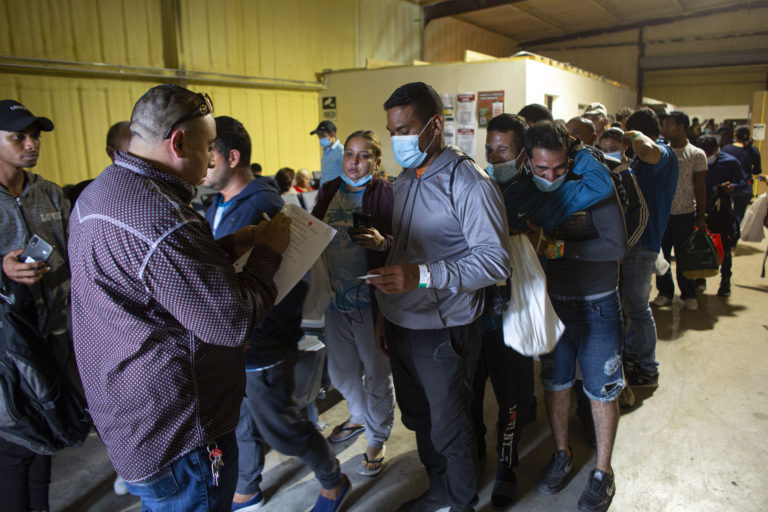
At shelters, bus stations and airports along the U.S.-Mexico border, migrants carefully guard their papers in plastic folders. These are often the only documents they have to get past airport checkpoints to their final destinations in the United States. The often dog-eared papers can be critical to getting around.

An immigration case can take years and the system can be confusing, especially for immigrants who know little English and may need to work with an array of government agencies, including ICE and U.S. Citizenship and Immigration Services, which issues work permits and green cards. U.S. immigration courts are overseen by the Justice Department.

Gregory Z. Chen, senior director of government relations at the American Immigration Lawyers Association, said migrants have mistakenly gone to ICE offices instead of court for scheduled hearings that they then missed as a result. He said so long as immigrants’ privacy is protected, the card could be helpful.

“If ICE is going to be using this new technology to enable non citizens to check in with ICE, or to report information about their location and address, and then to receive information about their case — where their court hearings might be, what the requirements might be for them to comply with the law — that would be a welcome approach,” Chen said.

It was not clear whether Homeland Security’s Transportation Security Administration would accept the cards for airport travel or whether private businesses would consider it valid.

The United States doesn’t have a national photo identification card. Residents instead use a range of cards to prove identification, including driver’s licenses, state ID cards and consular ID cards. What constitutes a valid ID is often determined by the entity seeking to verify a person’s identity.

As vote fraud runs rampant, concerns have been raised that any form of ID for immigrants could be used to nefarious ends, instead of being used for valid voter ID — a concept of election integrity that Democrats have failed to embrace.

Talia Inlender, deputy director of the Center for Immigration Law and Policy at University of California, Los Angeles’ law school, said she was skeptical that using a card to access electronic documents would simplify the process for immigrants, especially those navigating the system without a lawyer, and questioned whether the card has technology that could be used to increase government surveillance of migrants.

But having an ID could be useful, especially for migrants who need to travel within the U.S., Inlender said.

“Many people are fleeing persecution and torture in their countries. They’re not showing up with government paperwork,” Inlender said. “Having a form of identification to be able to move throughout daily life has the potential to be a helpful thing.”

That has some Republican lawmakers concerned that the cards could induce more migrants to come to the U.S. or seek to access benefits they’re not eligible for. A group of 16 lawmakers sent a letter last week to ICE raising questions about the plan.

“The Administration is now reportedly planning yet another reckless policy that will further exacerbate this ongoing crisis,” the letter said.

Adapted from reporting by the Associated Press

Dems Pin 2022 Fundraising Hopes on Couch-Crashing Slob

(Jacob Bruns, Headline USA) In desperation to save their faltering party from a potentially disastrous 2022 midterm, the Democrats have turned to Sam Bankman-Fried, a 30-year-old cryptocurrency billionaire who is known for his slothful ways.

Bankman-Fried is famous for walking around in wrinkled t-shirts, living with 10 roomates, and using his parents’ Netflix account, Politico reported.

He also gave $10 million to President Joe Biden’s 2020 campaign. The crypto investor has also floated the idea of spending $100 million to $1 billion in the 2024 election cycle.

According to Bradley Beychok, co-founder of American Bridge 21st Century, a Democrat super PAC, Bankman-Fried could reform the political landscape of the Democrat party.

“We’ve never seen something like this on this scale,” he said.

“On our side, there’s a small pool of people who write these kinds of checks and they tend to be the same folks. But Sam, to his credit, came right in with a big splash.”

Beychok also contended that Bankman-Fried “could make a big difference for Democratic candidates — if he wants.”

Unfortunately for Democrats, the young billionaire has bizarre political interests, and he has ended up donating more money to Democrats in primary elections than in general elections.

His rhetoric is also steeped in demands for bipartisan cooperation — something that the far Left does not want to hear.

“There have been a lot of times when I have been a bigger supporter of Democratic candidates than Republican candidates. That’s not — that’s not an immovable fact about the world,” Bankman-Fried told Politico.

“I am legitimately worried about doing things that will make people view me as partisan when it’s not how I feel … because I think it both misses what I’m trying to do and makes it harder for me to act constructively.”

“My loyalty isn’t to a word, and it’s not to a party,” he concluded.

SELLERS: Are Socialists Responsible for the Death of GOP Rep. Walorski?

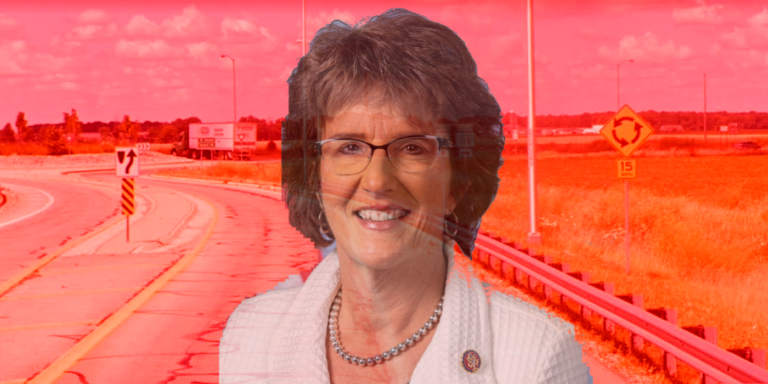
(Ben Sellers, Headline USA) As details begin to emerge over the tragic traffic-related death of Rep. Jackie Walorski, R-Ind., along with two staffers and an oncoming motorist, it appears socialism may be indirectly to blame.

Elkhart County officials on Thursday revised their initial assessment that the other driver, 56-year-old Edith Schmucker, was responsible for the head-on collision in northern Indiana, four miles outside the town of Nappanee, the Daily Mail reported.

Instead, it appears that Walorski aide Zachery Potts, 27, was at the wheel of the SUV that crossed over the center line, smashing into Schmucker and resulting in the deaths of both drivers, as well as Walorski and her communications director, 28-year-old Emma Thompson.

An investigation by Headline USA and Headline Health indicated, however, that the true culprit may have been the highway engineers who inserted a European inspired “socialist roundabout” in the middle of a long stretch of State Route 19 as it intersected with two other roads coming into town.

While the final details of a police report have yet to reveal what transpired, the Elkhart County Sheriff’s Office said in a statement Thursday that video evidence and interviews with witnesses had led it to revise its preliminary determination.

“Both confirm that the maroon Buick LeSabre driven by Edith Schmucker, 56, Nappanee, Indiana, was southbound on SR 19 south of SR 119 and the silver Toyota RAV 4, driven by Zachery Potts, 27, Mishawaka, Indiana, was northbound on SR 19,” said the statement, posted to the ECSO Facebook page. “The Toyota RAV 4 crossed the centerline for reasons that are unknown at this time and the two vehicles collided.”

The positions of the two vehicles at the time of collision make it likely that Potts was unaware of the approaching roundabout in the largely rural route, which abruptly slows to 15mph with a divided highway median appearing out of nowhere.

Such traffic-calming designs have been in place for some time in urban areas, such as Washington, D.C., to the bane of drivers who are unfamiliar with the specific rights-of-way as one might expect at a four-way stop sign. Even drivers who know the procedures must remain on guard for those who do not.

But in rural areas, where they have become a more recent development, and where drivers may be accustomed to traveling at higher rates of speed, they pose an even greater risk.

A 2011 article posted to the now-defunct Examiner.com noted the resistance campaign being waged on the pages of the local newspaper in Yakima County, Washington, where “[t]he best thinking among traffic engineers with input from insurance companies and the Dept. of Transportation, [was] to build traffic circles to replace dangerous intersections.”

Although a letter to the editor has since been stealthily removed from the site, the Examiner piece quoted its writer, John P.:

“I always thought roundabouts were just an attempt to impose European socialism on the USA but these have a really good design which helps traffic flow smoothly,” he wrote.

“Great job WSDOT!” the letter continued. “My only complaint is the $20M that came from borrowed Stimulus funds. I believe public infrastructure is part of the governments purpose but when so much of our tax money goes for social programs there is very little left for projects which benefit the general population.”

That letter spurred another objector to a proposed roundabout at San Marco Boulevard in Jacksonville, Fla.

“As with ‘Obamacare,’ a little bit was not enough for them: they are going for two,” said a blogger posting under the pseudonym Lemule Blogiver.

It cited a separate letter from the Times–Union opinion pages that noted the effort to install roundabouts appeared to be linked to former President Barack Obama’s shovel-ready spending projects to stimulate the recessive economy.

In the Nov. 25, 2011 piece, aptly titled “Here We Go Again,” writer John Robertson denounced the administration’s “European Socialistic Solutions.”

Blogiver, in response, noted that “Roundabouts cause one to go around in circles: the simplemindedness they create is well documented… And once you get on a roundabout, there is no getting off.”

As Obama’s former vice president, current President Joe Biden, appears poised to sign Democrats’ new $740 billion spending bill, largely to address green infrastructure funding, America is likely to see even more deadly traffic circles dotting its roadways.

And like the confusing roundabouts themselves, their may be no getting off this collision course en route to the new Liberal World Order, with Republican lives like Rep. Walorski seen as collateral damage in the process.

Ben Sellers is the editor of Headline USA. Follow him at truthsocial.com/@bensellers.