‘Yellowstone’ Disappoints Conservative Fans w/ Gay Kiss

(Headline USA) Conservatives blasted the hit show Yellowstone this week after the latest episode featured a lesbian couple kissing.

The show, which won over many conservative viewers because of its portrayal of the Dutton family’s fight against environmental activists and liberal bureaucrats, featured a lesbian kiss in the seventh episode of season five.

Clara (Lilli Kay), who works as an aide for Gov. John Dutton (Kevin Costner), is seen kissing a woman wearing a cowboy hat while at the Montana State Fair.

Clara is not the first gay character featured in Yellowstone. Journalist Sarah Nguyen, who was featured in one of the earlier seasons, also talked about her sexuality.

However, viewers slammed the show for going “woke,” ripping the kiss scene as unnecessary and gratuitous.

“Even Yellowstone has gone woke, and gay!” wrote conservative commentator Aubrey Huff. “Sellouts!”

Another Twitter user wrote: “I don’t have a problem with two women who want to kiss each other but why do you have to shove it in your face? What a turn off.”

Others pointed out that the show’s leftward turn was bound to happen eventually.

“Yellowstone just went woke with it’s first lesbian character and a kiss between two girls,” one person tweeted. “It was only a matter of time. It’s Hollywood after all. Was nice while it lasted.”

The show has attracted hundreds of thousands of viewers over its past five seasons and has even inspired a number of spin-off shows. In fact, it was the most watched non-football show on television in 2021-2022.

Just last week, Costner scored a 2023 Golden Globe nod for mention in the Best Performance by an Actor in a Television Series—Drama. It’s the first time “Yellowstone,” which premiered in 2018, has been recognized at the Golden Globes.

Costner also alienated many conservatives during the 2022 primaries by throwing his support to RINO Rep. Liz Cheney of Wyoming.

After losing her own race by nearly 40 percentage points, Cheney proceeded to endorse a raft of Democrats in the general election and recently voted with the House Jan. 6 committee to refer former President Donald Trump for criminal charges to the Justice Department.

Cheney’s younger sister, Mary, has been openly gay since at least the early 1990s.

FTX Founder Agrees to Extradition after Substandard Bahamian Jail Conditions

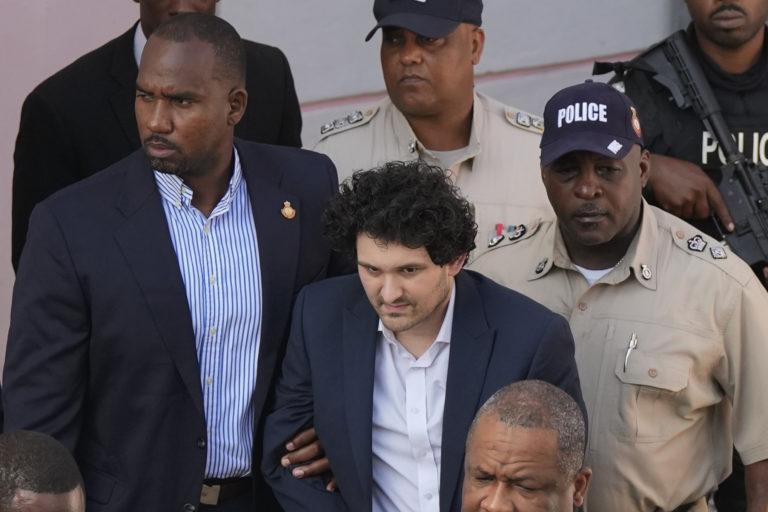
(Headline USA) Sam Bankman–Fried may be ready to come to the U.S. to face criminal charges related to the collapse of cryptocurrency exchange FTX following a chaotic court appearance in the Bahamas.

A lawyer for Democrats’ second-leading donor during the 2022 election cycle was quoted as saying Monday the disgraced FTX founder has agreed to be extradited to the United States. A court hearing was stopped earlier in the day when his attorneys said it was premature for him to stand before the court.

Jerone Roberts, a local defense attorney for Bankman–Fried, told the New York Times that lawyers will prepare the necessary documents for extradition. “Mr. Bankman–Fried wishes to put the customers right, and that is what has driven his decision,” the Times quoted Roberts telling reporters.

It was not immediately clear when extradition could occur.

The court appearance came just a week after Bankman–Fried’s lawyers had initially said that they planned to fight extradition. An extradition hearing had been scheduled for Feb. 8. The reversal could speed up the timetable for him to be sent to the U.S.

Bahamian authorities arrested Bankman–Fried last Monday at the request of the U.S. government.

U.S. prosecutors allege he played a central role in the rapid collapse of FTX and hid its problems from the public and investors.

The Securities and Exchange Commission said Bankma-n-Fried illegally used investors’ money to buy real estate on behalf of himself and his family. The 30-year-old could potentially spend the rest of his life in jail.

Bankman–Fried arrived at the courthouse in a black van marked “Corrections,” which was escorted by a SWAT vehicle and a police vehicle. Police quickly whisked him into an entrance at the back of the courthouse.

A handful of people who said they were either crypto enthusiasts or FTX customers came to the courthouse to witness the proceedings.

“We want him to feel the weight of what he’s done,” said Ben Armstrong, the founder of the BitBoy Crypto website. Armstrong said he’d come to the courthouse with a dozen people, some of whom had lost their money with FTX.

If he is brought to New York, Bankman-Fried will likely be held, at least temporarily, in a federal detention center in Brooklyn.

Other famous prisoners at the Metropolitan Detention Center in recent years have included the sexually-abusive singer R. Kelly, the pharmaceutical company executive Martin Shkrelli and the socialite Ghislaine Maxwell, who was convicted of helping the millionaire Jeffrey Epstein sexually abuse children.

During her time at the MDC, which houses around 1,600 prisoners, Maxwell’s lawyers repeatedly complained to a judge that it was unsanitary, plagued by cockroaches and rodents.

In recent years, three guards there have been convicted of sexually abusing inmates. In 2019, a power failure left inmates shivering for a week in the dead of winter.

Once he’s back in the U.S., Bankman–Fried’s attorney will be able to request that he be released on bail. A separate judge in the Bahamas denied Bankman–Fried’s request for bail last week on the grounds he was a flight risk.

Bankman–Fried’s downfall, from crypto evangelist to pariah, occurred with stunning speed. FTX filed for bankruptcy protection on Nov. 11 when it ran out of money after the cryptocurrency equivalent of a bank run.

Before the bankruptcy, Bankman–Fried was celebrated by many in Washington and on Wall Street as a wunderkind of digital currencies, someone who could help take them mainstream, in part by working with policymakers to bring more oversight and trust to the industry.

His appeal was particularly strong among left-wing politicians and their media allies, to whom Bankman–Friend funneled millions, His donations of $37 million in the midterm election cycle put him behind only George Soros on the list of Democrat mega-donors, and undoubtedly helped the party to stave off a widely expected red-wave of voter backlash in key battleground races.

Bankman–Fried had been worth tens of billions of dollars—at least on paper—and was able to attract celebrities like Tom Brady or former politicians like Tony Blair and Bill Clinton to his conferences at luxury resorts in the Bahamas. One prominent Silicon Valley firm, Sequoia Capital, invested hundreds of millions of dollars in FTX.

The new CEO of FTX, John Ray III, told a congressional committee on Tuesday that there was nothing sophisticated about what Bankman–Fried was up to.

“This is just old fashion embezzlement, taking money from others and using it for your own purposes,” he said.

Adapted from reporting by the Associated Press

House Dems Plot Final Annoyance for Trump by Releasing Tax Returns

(Headline USA) The Democratic-controlled House Ways and Means Committee was expected to vote Tuesday on whether to publicly release years of Donald Trump’s tax returns, which the former president has long tried to shield.

Previous leaks of many of the returns prior to the 2020 election appeared to show little of note given the amount of time Demcrats have invested in trying to obtain them and sell them to the public as a key to uncovering hidden financial scandals.

The new release would be unlikely to cause a significant ripple as Democrats desperately try to derail Trump’s third run for president in 2024. Already, the Justice Department has assigned a deeply partisan special counsel to investigate him while the House’s equally partisan Jan. 6 commission has referred him to the DOJ for criminal charges.

Publicly, Trump has appeared undeterred by the incessant witch hunt, although his campaign prospects were more rattled after loyal members of his base soured on him over recent attacks on likely primary challenger Ron DeSantis and a poorly conceived dinner meeting with Holocaust denier Nick Fuentes.

Nonetheless, the parting blow from House Democrats before they yield their majority power in the next term will be another thorn in Trump’s side and a distraction as he tries to gain traction on the 2024 campaign message and agenda he hopes to pursue in his second presidential term.

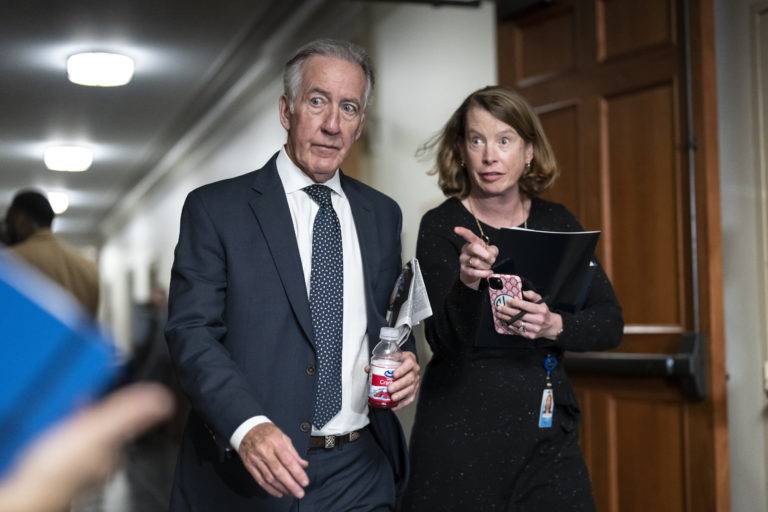
Out-going committee chairman Richard Neal, D-Mass., has kept a close hold on the panel’s actions, including whether the panel will meet in a public or private session. And if lawmakers move forward with plans to release the returns, it’s unclear how quickly that would happen.

But after a yearslong battle that ultimately resulted in the Supreme Court clearing the way last month for the Treasury Department to send the returns to Congress, Democrats are under pressure to act aggressively.

The committee received six years of tax returns for Trump and some of his businesses. And with just two weeks left until Republicans formally take control of the House, Tuesday’s meeting could be the last opportunity for Democrats to disclose whatever information they have gleaned.

Americans were largely in the dark about Trump’s relationship with the IRS until October 2018 and September 2020, when the New York Times published two separate series based on leaked tax records.

The decision among leftist media outlets not only to publish but to celebrate and promote the ill-gotten material stood in stark contrast to their quickly evolving policies to suppress Hunter Biden’s damning hard drive information after the FBI planted false claims that it could be Russian disinformation.

The Times had a Pulitzer Prize lavished upon it for the 2018 articles, which they said showed how Trump received a modern equivalent of at least $413 million from his father’s real estate holdings, with much of that money coming from what the Times called “tax dodges” in the 1990s. There is no evidence indicating that Trump’s decision to avail himself of existing tax-code loopholes was illegal in any way.

Trump sued the Times and his niece, Mary Trump, in 2021 for providing the records to the newspaper. In November, Mary Trump asked an appeals court to overturn a judge’s decision to reject her claims that her uncle and two of his siblings defrauded her of millions of dollars in a 2001 family settlement.

The 2020 articles showed that Trump paid just $750 in federal income taxes in 2017 and 2018—once again using good accounting to find the maximum deductions based on the valuations of his real-estate holdings. Trump paid no income taxes at all in 10 of the past 15 years because he generally lost more money than he made.

At the time of the 2020 articles, Neal said he saw an ethical problem in Trump overseeing a federal agency that he has also battled with legal filings—although he has made no known public comments criticizing the insider trading scandals of Democrats like House Speaker Nancy Pelosi, D-Calif.

“Now, Donald Trump is the boss of the agency he considers an adversary,” Neal said in 2020. “It is essential that the IRS’s presidential audit program remain free of interference.”

The Manhattan district attorney’s office also obtained copies of Trump’s tax records in February 2021 after after a protracted legal fight that included two trips to the Supreme Court.

The office, then led by District Attorney Cyrus Vance Jr., had subpoenaed Trump’s accounting firm in 2019, seeking access to eight years of Trump’s tax returns and related documents.

The DA’s office issued the subpoena after Trump’s former personal lawyer, convicted felon Michael Cohen, told Congress that Trump had misled tax officials, insurers and business associates about the value of his assets.

Those allegations are the subject of a fraud lawsuit that New York Attorney General Letitia James filed against Trump and his company in September.

Trump’s longtime accountant, Donald Bender, testified at the Trump Organization’s recent criminal trial that Trump reported losses on his tax returns every year for a decade, including nearly $700 million in 2009 and $200 million in 2010.

Bender, a partner at Mazars USA LLP who spent years preparing Trump’s personal tax returns, said Trump’s reported losses from 2009 to 2018 included net operating losses from some of the many businesses he owns through his Trump Organization.

The Trump Organization was convicted earlier this month on tax fraud charges for helping some executives dodge taxes on company-paid perks such as apartments and luxury cars.

The current Manhattan district attorney, Alvin Bragg, told the Associated Press in an interview last week that his office’s investigation into Trump and his businesses continues.

“We’re going to follow the facts and continue to do our job,” Bragg said, despite recent concerns that the investigations would soon encounter a statute of limitations.

Trump, who refused to release his returns during his 2016 presidential campaign and his four years in the White House while claiming that he was under IRS audit, has argued there is little to be gleaned from the tax returns even as he has fought to keep them private.

“You can’t learn much from tax returns, but it is illegal to release them if they are not yours!” he complained on his social media network last weekend.

Republicans, meanwhile, have railed against the potential release, arguing that it would set a dangerous precedent.

Rep. Kevin Brady of Texas, the Ways and Means Committee’s Republican leader, accused Democrats on the committee of “unleashing a dangerous new political weapon that reaches far beyond President Trump, and jeopardizes the privacy of every American.”

“Going forward, partisans in Congress have nearly unlimited power to target political enemies by obtaining and making public their private tax returns to embarrass and destroy them,” Brady said in a statement. “We urge Democrats, in their rush to target former President Trump, not to unleash this dangerous new political weapon on the American people.”

Adapted from reporting by the Associated Press

Suspense, Uncertainty at Border Loom over Title 42 Decision

(Headline USA) Suspense mounted at the U.S. border with Mexico on Tuesday about the future of a Trump-era safeguard holding back a flood of so-called asylum-seekers as the Supreme Court issued a temporary order to keep pandemic-rooted limits on migrants in place.

Conservative-leaning states won a reprieve—though it could be brief—as they push to maintain a measure that allows officials to expel many but not all asylum-seekers in the name of public health.

In a last-ditch appeal to the Supreme Court, they argued that an increased numbers of migrants would take a toll on public services such as law enforcement and health care and warned of an “unprecedented calamity” at the southern border.

Chief Justice John Roberts granted a stay pending further order, asking the administration of President Joe Biden to respond by 5 p.m. Tuesday, just hours before restrictions are slated to expire Wednesday.

The Department of Homeland Security, which is responsible for enforcing border security, acknowledged Roberts’s order—and said the agency would continue “preparations to manage the border in a safe, orderly, and humane way when the Title 42 public health order lifts.”

With the decision on what comes next going down to the wire, pressure is building in communities along both sides of the U.S–Mexico border.

In El Paso, Democratic Mayor Oscar Leeser warned that shelters across the border in Ciudad Juárez are packed to capacity with an estimated 20,000 migrants who are prepared to cross into the U.S.

Despite the court’s stay, the city of El Paso rushed to expand its ability to accommodate more migrants by converting large buildings into shelters, as the Red Cross brings in 10,000 cots.

Local officials also hope to relieve pressure on local shelters by chartering buses to other large cities in Texas or nearby states, bringing migrants a step closer to relatives and sponsors in coordination with nonprofit groups. A similar measure widely derided and condemned by the Left when Florida Gov. Ron DeSantis sent illegal immigrants to the blue enclave of Martha’s Vineyard earlier this year.

“We will continue to be prepared for whatever is coming through,” Leeser said.

Troops in tactical gear under Texas state command on Tuesday used razor wire to cordon off a gap in the border fence along a bank of the Rio Grande that became a popular crossing point in recent days for migrants who waded through shallow waters to approach immigration officials. They announced through a loudspeaker in Spanish that it’s illegal to cross there.

Texas said Monday that it was sending 400 National Guard personnel to El Paso, after city officials declared a state of emergency.

Leeser said the declaration was aimed largely at protecting vulnerable migrants, while the deployment included forces used to “repel and turn-back illegal immigrants,” according to a Texas National Guard statement.

A flashing signed warned motorists to “watch for unexpected pedestrians” on a highway that extends along the fenced-off border, near three bridges that connect El Paso with Mexico.

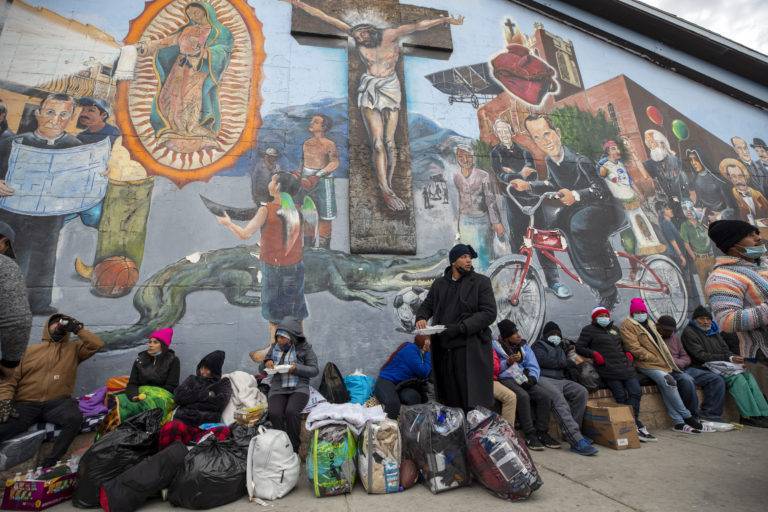
At a church-affiliated shelter a few blocks from the border, migrants including children lined up early afternoon Monday in hopes of securing a bed for the night, accepting donations of food from a succession of cars bearing gifts. Police and municipal garbage workers arrived to remove abandoned blankets and discarded possessions.

The Rev. Michael Gallagher, a priest at Sacred Heart Church in downtown El Paso, said local faith leaders have been trying to pool resources and open up empty space.

On Tuesday, a gym at the church gave shelter to 200 migrants—mostly women and children.

Outside the church Monday, Jose Natera, a 48-year-old handyman from the Venezuelan town of Guaicaipuro, said he traveled for three months to reach El Paso, sometimes on foot, with no money or sponsors to take him further.

“I have to stop here until I can get a ticket” out, he said.

El Paso residents Roberto Lujan and Daniela Centeno handed out fruit, Hostess cakes, soda and chips at a street corner.

“I have to do it,” said Lujan, a 39-year-old construction worker. “I have kids and I know the struggle.”

Conservative-leaning states have argued that the federal government has no plan to deal with an increase in migrants—while in Washington, Republicans are set to take control of the House and make immigration a key issue.

Biden administration officials claimed they have marshaled more resources to the border in preparation for the end of Title 42, even though all signals pointed to the administration having intentionally let the rule lapse.

The extra resources included more Border Patrol processing coordinators, more surveillance and increased security at ports of entry, it claimed, but not extra enforcement officers.

About 23,000 agents are currently deployed to the southern border, according to the White House, although they are mainly there to provide extra support including maid service and luxury accommodations for illegals rather than to deport them.

Adapted from reporting by the Associated Press

Harvey Weinstein Found Guilty of Rape in Los Angeles Trial

(Headline USA) After a month-long trial and nine days of deliberations, Los Angeles jurors on Monday found Harvey Weinstein guilty of the rape and sexual assault of just one of the four accusers he was charged with abusing.

But the three guilty counts involving an Italian actor and model known at the trial as Jane Doe 1 still struck a major blow against the disgraced movie mogul, and provided another #MeToo moment of reckoning, five years after he became a magnet for the movement.

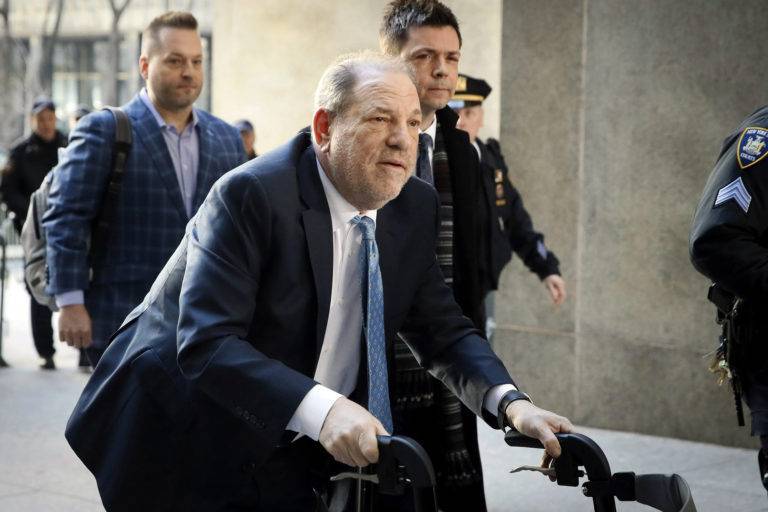
Weinstein, 70, who is two years into a 23-year sentence for a rape and sexual assault conviction in New York that is under appeal, could get up to 24 years in prison in California when he’s sentenced.

He was found guilty of rape, forced oral copulation and another sexual misconduct count involving the woman who said he appeared uninvited at her hotel room door during a Los Angeles film festival in 2013.

“Harvey Weinstein forever destroyed a part of me that night in 2013 and I will never get that back. The criminal trial was brutal and Weinstein’s lawyers put me through hell on the witness stand, but I knew I had to see this through to the end, and I did,” the woman said in a statement after the verdict. “I hope Weinstein never sees the outside of a prison cell during his lifetime.”

Weinstein was acquitted of a sexual battery allegation made by a massage therapist who treated him at a hotel in 2010.

The jury was unable to reach a decision on counts involving two accusers, notably rape and sexual assault charges involving Jennifer Siebel Newsom, a documentary filmmaker and the wife of California Gov. Gavin Newsom. A mistrial was declared on those counts.

Weinstein looked down at the table and appeared to put his face in his hands when the initial guilty counts were read. He looked forward as the rest of the verdict was read.

“Harvey is obviously disappointed in the verdict. He knows what happened and what never did,” Weinstein’s spokesperson Juda Engelmayer said in an email, saying there was a strong basis for an appeal on the convictions. “Harvey is grateful for the jury’s work on the other counts, and he’s determined to continue his legal challenges in ultimately proving his innocence.”

Los Angeles County District Attorney George Gascón applauded the accusers for their bravery to testify in the case, saying in a statement he was disappointed by the split verdict but hoped it brings “some measure of justice to the victims.”

“Harvey Weinstein will never be able to rape another woman. He will spend the rest of his life behind bars where he belongs,” Siebel Newsom said in a statement. “Throughout the trial, Weinstein’s lawyers used sexism, misogyny, and bullying tactics to intimidate, demean, and ridicule us survivors. The trial was a stark reminder that we as a society have work to do.”

Siebel Newsom’s intense and dramatic testimony, in which she described being raped by Weinstein in a hotel room in 2005, brought the trial its most dramatic moments. But only eight of the 12 jurors agreed to find Weinstein guilty of those counts.

Jurors were deadlocked 10-2 on a sexual battery count involving Lauren Young, the only accuser who testified at both Weinstein trials. She said she was a model aspiring to be an actor and screenwriter who was meeting with Weinstein about a script in 2013 when he trapped her in a hotel bathroom, groped her and masturbated in front of her.

Lacking any forensic evidence or eyewitness accounts of years-old allegations, the case hinged heavily on the stories and credibility of the four women at the center of the charges.

The women’s stories echoed the allegations of dozens of others who have emerged since Weinstein became a #MeToo lightning rod starting with stories in the New York Times in 2017. A movie about that reporting, “She Said,” was released during the trial, and jurors were repeatedly warned not to see it.

It was the defense that made #MeToo an issue during the trial, however, emphasizing that none of the four women went to the authorities until after the movement made Weinstein a target.

Defense lawyers said two of the women — including the one he would be found guilty of raping — were entirely lying about their encounters with Weinstein. They said the other two had “100% consensual” sexual interactions that they later reframed.

Defense attorneys said during the trial that if Siebel Newsom hadn’t reached her later prominence she would be “just another bimbo who slept with Harvey Weinstein to get ahead in Hollywood.”

“Regret is not the same thing as rape,” Weinstein attorney Alan Jackson said in his closing argument.

He urged jurors to look past the the women’s emotional testimony and focus on the factual evidence.

“‘Believe us because we’re mad, believe us because we cried,’” Jackson said jurors were being asked to do. “Well, fury does not make fact. And tears do not make truth.”

All the women involved in the charges went by Jane Doe in court. The Associated Press does not typically name people who say they have been sexually abused unless they come forward publicly or agree to be named through their attorneys, as the women named here did.

Prosecutors called 40 other witnesses in an attempt to give context and corroboration to those stories. Four were other women who were not part of the charges but testified that Weinstein raped or sexually assaulted them. They were brought to the stand to establish a pattern of sexual predation.

Weinstein beat four other felony charges before the trial even ended when prosecutors said a woman he was charged with raping twice and sexually assaulting twice would not appear to testify. They declined to give a reason. Judge Lisa Lench dismissed those charges.

Weinstein’s latest conviction hands a victory to victims of sexual misconduct of famous men in the wake of some legal setbacks, including the dismissal of Bill Cosby’s conviction last year. The rape trial of “That ’70s Show” actor Danny Masterson, held simultaneously and just down the hall from Weinstein’s, ended in a mistrial. And actor Kevin Spacey was victorious at a sexual battery civil trial in New York last month.

Weinstein’s New York conviction survived an initial appeal, but the case is set to be heard by the state’s highest court next year. The California conviction, also likely to be appealed, means he will not walk free even if the East Coast conviction is thrown out.

Adapted from reporting by the Associated Press

Competition Heats Up in Longshot Bid to Oust McDaniel as RNC Chair

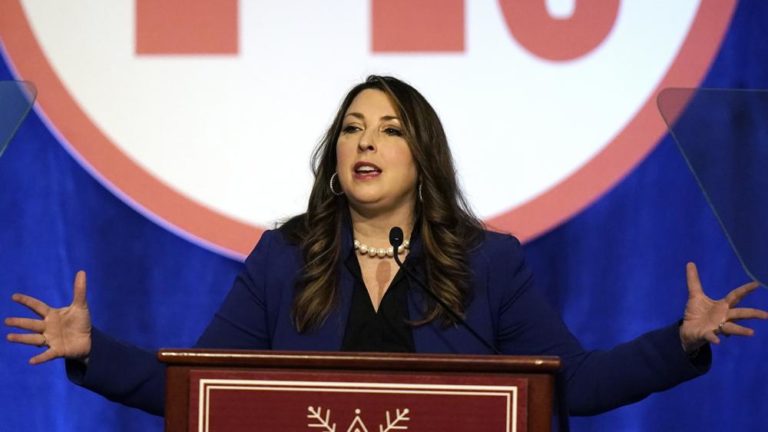
(Ezekiel Loseke, Headline USA) Ronna Romney McDaniel, the chairman of the Republican National Committee, is receiving steady heat in her bid for re-election, despite having overwhelming support from voting RNC members.

Harmeet Dhillon, a San Francisco-based conservative lawyer who has represented former President Donald Trump and Arizona gubernatorial candidate Kari Lake, appears to be the most formidable threat, according to Politico. 

Dhillon is the third high-profile RNC member to consider challenging McDaniel following criticism that the chairwoman used precious RNC funds on her own luxury lifestyle while neglecting many of the first-time candidates who foundered in the midterms after getting outspent by well-organized members of the Democrat establishment.

In November, conservative MyPillow CEO Mike Lindell  and Rep. Lee Zeldin, R-N.Y., both expressed interest in challenging McDaniel because of her underwhelming performance in the 2018, 2020 and 2022 election cycles.

McDaniel, the niece of longtime Trump rival Sen. Mitt Romney, R-Utah, began her run as RNC chair the day before Trump’s 2017 inauguration.

Zeldin—whose hopes of becoming the first Republican governor of New York since 2006 were dashed in the November election—has since announced he will not pursue the position, according to the New York Post.

He said in a statement that the outcome “appears to already be pre-baked, as if the disappointing results of every election during her tenure, including yesterday in Georgia, do not and should not even matter.”

Lindell, however, is continuing to go after McDaniel. “The current RNC leadership has failed for 3 election cycles,” he said recently. “…[W]hy would she even run again if she loves our country?”

Several big-name conservative pundits, such as Tucker Carlson, Mike Huckabee, Megyn Kelly, Dan Bongino, Lou Dobbs, Kurt Schlichter and Erick Erickson, have all attacked McDaniel for the GOP’s poor performance in elections and its recent spending controversy.

However, McDaniel defended herself against these accusations on Steve Bannon’s podcast.

“The vast majority of those expenses were in support of the White House and President Trump,” she claimed.

McDaniel addressed Dhillon’s criticisms specifically.

“We file an FEC report every month,” she explained. “She [Dhillon] had ample time to raise questions and clarify.”

Romney already has been endorsed by 107 of 168 RNC members and only needs a simple majority (85 votes) to maintain her chairmanship. 

Dhillon claims to have 50 endorsements, giving her a razor thin chance of securing the chair.

Gordon Kinne, a committeeman from Missouri, suggested that Dhillon was attacking the party to benefit her own brand.

“Are you actually running to become the chairman of the organization you’re currently trashing, or [are] you burnishing your own brand at the expense of your colleagues and the RNC itself?” he asked in an email on the subject.

Kinne suggested that if Dhillon has the votes she claims, she should make their identities known, so as to avoid the appearance of creating self-serving controversy.

Sen. Mike Lee Pushes Bill to Block Porn Sites from Kids

(Jacob Bruns, Headline USA) Sen. Mike Lee, R-Utah, has pushed a bill to stop porn websites from targeting children as clientele, CNS News reported.

His bill would make it so that all porn websites would require age verification from consumers before accessing online pornography.

Lee’s bill will doubtless be unpopular with a DC crowd that has a great deal invested in the physical and psychological manipulation of the American population for the purpose of political ends.

Lee argued for his bill in a recent statement, arguing that to expose minors to pornography is effectively to get them addicted to something, possibly for good.

“Every day, we’re learning more about the negative psychological effects pornography has on minors,” he wrote. “Given the alarming rate of teenage exposure to pornography, I believe the government must act quickly to enact protections that have a real chance of surviving First Amendment scrutiny.”

He also pointed out that internet pornography sites have received favorable treatment for years despite the mass psychological damage they are dealing.

“We require age verification at brick-and-mortar shops,” he added. “Why shouldn’t we require it online?”

Lee’s bill, requiring an age verification system — “the least restrictive means” — would fall within the legal precedent set by the Supreme Court regarding pornography, meaning that the bill, if passed, would likely hold up to scrutiny in court.

His report also included the citation of research which revealed that 80% of American teens ages 12 to 17 have seen online pornography.

According to his report, such exposure causes damage “because of the unique psychological effects pornography has on minors, including anxiety, addiction, low self-esteem, body-image disorders, an increase in problematic sexual activity at younger ages, and an increased desire among minors to engage in risky sexual behavior.”

Numerous states have categorized pornography as a public health crisis, including Alabama, Arkansas, Arizona, Florida, Idaho, Kansas, Kentucky, Louisiana, Missouri, Montana, Oklahoma, Pennsylvania, South Dakota, Tennessee, Utah, Virginia and Texas.

Bezos, Gates Want to Implant Computer Chips in 100M People’s Brains

(Dmytro “Henry” Aleksandrov, Headline USA) Two of America’s leading tech oligarchs have joined the push to develop microchips that will allow them to control and monitor plebian citizens who might otherwise try to disrupt their globalist plans.

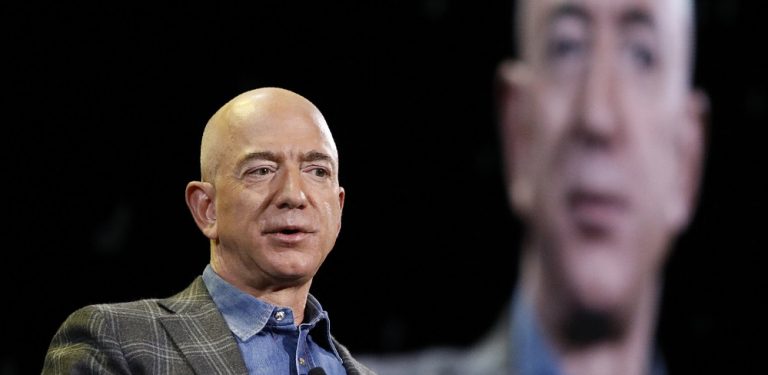
In a scenario befitting the dystopian series Black Mirror, billionaires Bill Gates and Jeff Bezos recently invested in Synchron, a new startup that plans to compete against Elon Musk’s Neuralink in trying to control people’s brains, according to Breitbart.

In March 2021, Synchron founder Tom Oxley, an expert in brain-computer interfaces, met with Bezos in Ojai, Calif., to discuss Oxley’s newly established company.

Synchron said last week that it had raised $75 million, with the Amazon founder’s Bezos Expeditions “contributing a portion of the investment,” Breitbart reported.

Other major contributors included ARCH Venture Partners and Gates Frontier, the venture capital branch of Microsoft co-founder Bill Gates.

Vinod Khosla, the founder of Khosla Ventures and the person who introduced Oxley to Gates, also invested in the company.

Oxley, like Musk, has insisted that the only reason the chip is being developed is that there are people with disabilities who will benefit from allowing multi-billionaires to control their neural systems.

“Brain-computer interfaces, also known as BCIs, have the potential to interpret and stimulate certain areas of the brain and are being explored as a possible treatment for brain injuries,” Breitbart noted.

The new investors all approached Synchron “through the lens of making an impact in neurology in an area of need,” it added.

According to Oxley’s estimate, around 100 million people worldwide with upper limb impairments may potentially benefit from the developing technology.

The recent funding haul more than doubles the company’s prior nest egg, bringing its total in raised capital to around $145 million.

According to Pitchbook, a firm that analyses the startup market, that makes it one of the highest-funded companies in the field of brain–computer interface research.

“While it may be behind companies such as Elon Musk’s Neuralink Corporation and Max Hodak’s Science Corp. in terms of fundraising, it is still far ahead of many other BCI companies,” noted Breitbart

Oxley also found three patients who agreed to become laboratory rats as part of a U.S. trial, two of whom already have received the implant with the other expected to do so “in the coming months.”

It hopes the trial will help it garner attention from the Food and Drug Administration, which already helped streamline Synchron’s approval process by granting it “breakthrough” status.

Police Seize on COVID-19 Tech to Expand Global Surveillance

(Headline USA) Governments across the globe, including a lead from the Biden administration, are continuing to abuse fundamental rights under the guise of COVID prevention, even as the virus wanes in impact and reach.

That hasn’t stopped government’s from using snooping tech to spy on individuals. Majd Ramlawi was serving coffee in Jerusalem’s Old City when a chilling text message appeared on his phone.

“You have been spotted as having participated in acts of violence in the Al-Aqsa Mosque,” it read in Arabic. “We will hold you accountable.”

Ramlawi, then 19, was among hundreds of people who civil rights attorneys estimate got the text last year at the height of one of the most turbulent recent periods in the Holy Land. Many, including Ramlawi, say they only lived or worked in the neighborhood, and had nothing to do with the unrest. What he didn’t know was that the feared internal security agency, the Shin Bet, was using mass surveillance technology mobilized for coronavirus contact tracing against Israeli residents and citizens for purposes entirely unrelated to COVID-19.

In the pandemic’s bewildering early days, millions worldwide were deliberately led to believe government officials who said they needed confidential data for new tech tools that could help stop coronavirus’ spread. In return, governments got a firehose of individuals’ private health details, photographs that captured their facial measurements and their home addresses.

Now, from Beijing to Jerusalem to Hyderabad, India, and Perth, Australia, The Associated Press has found that authorities used these technologies and data to halt travel for activists and ordinary people, harass marginalized communities and link people’s health information to other surveillance and law enforcement tools.In some cases, data was shared with spy agencies. The issue has taken on fresh urgency almost three years into the pandemic as China’s ultra-strict zero-COVID policies recently ignited the sharpest and largest public rebuke of the country’s authoritarian leadership since the pro-democracy protests in Tiananmen Square in 1989.

For more than a year, AP journalists interviewed sources and pored over thousands of documents to trace how technologies marketed to “flatten the curve” were put to other uses. Just as the balance between privacy and national security shifted after the Sept. 11 terrorist attacks, COVID-19 has given officials justification to embed tracking tools in society that have lasted long after lockdowns.

The AP found:

–Israel’s Shin Bet security agency repurposed phone surveillance technology it had previously used to monitor militants inside Palestinian territories to monitor people for COVID-19 contact tracing. Then, in 2021, the agency quietly began using the same technology to send threatening messages to Arab citizens and residents of Israel whom the agency suspected of participating in violent clashes with police. Some of the recipients, however, simply lived or worked in the area, or were mere passers-by.

–In China, the last major country in the world to enforce strict COVID-19 lockdowns, citizens have had to install cell-phone apps to move about freely in most cities. Drawing from telecommunications data and PCR test results, the apps produce individual QR codes that change from green to yellow or red, depending on a person’s health status.Now, as pandemic restrictions lessen, there is evidence that the health codes have been used to stifle dissent.Citizens who wanted to lodge complaints against the government suddenly found their codes turning red even though they hadn’t tested positive for COVID-19 or been near infected individuals.

–As early as May 2020 in India, the police chief of Telangana state tweeted about his department rolling out artificial intelligence-based software using CCTV to zero-in on people not wearing masks. S Q Masood, a social activist, was among the people stopped seemingly at random by police in a predominantly Muslim area of Hyderabad last year. Masood said officers told him to remove his mask so they could photograph him with a tablet. He’s now suing police to find out why. Although law enforcement denies using facial recognition in Masood’s case, the lawsuit is continuing and experts said it may set precedent for future policing activities.

—In Australia, people used apps to tap their phones against QR codes at restaurants, performance venues and other public spaces to record their presence so they could be contacted in case a COVID-19 outbreak was linked to a place they visited.But in multiple cases Australian law enforcement co-opted the state-level QR check-in data as a sort of electronic dragnet to investigate crimes. The practice came despite government assurances that the information would be used only to promote public health.

–Finally, in the U.S., the federal government used the pandemic as an opportunity to build out its surveillance toolkit. It signed two contracts in 2020 worth $24.9 million with the data-mining and surveillance company Palantir Technologies Inc. to support the Department of Health and Human Services’ pandemic response. Documents obtained by the immigrant rights group Just Futures Law under the Freedom of Information Act and shared with the AP show that federal officials considered integrating “identifiable patient data,” such as mental health, substance use and behavioral health information from group homes, shelters, jails, detox facilities and schools. The U.S. Centers for Disease Control does not use any of that individual-level information in the platform CDC now manages, said Kevin Griffis, a department spokesman.

“What COVID did was accelerate state use of these tools and that data and normalize it, so it fit a narrative about there being a public benefit,“ said John Scott-Railton, a senior researcher at the Toronto-based internet watchdog Citizen Lab. “Now the question is, are we going to be capable of having a reckoning around the use of this data, or is this the new normal?”

Adapted from reporting by the Associated Press

Freedom First House Reps Put GOP Leadership on Notice over $1.7T Spending Spree

(Mark Pellin, Headline USA) Scrambling to gain positive traction on what has been a struggle in his bid for U.S. House speakership,  Rep. Kevin McCarthy, R-Calif., endorsed demands from 13 conservative House Republicans promising political retribution for any Republican who supported the Biden administration’s staggering $1.7 trillion omnibus bill stuffed with funding for radical leftist grifts and agendas.

Passing the omnibus spending spree, and its underlying leftist agendas, would make it more difficult for Republicans to conduct “meaningful oversight and hold the Biden administration accountable” even though the GOP regains a slim House majority, according to the Daily Signal.

“Senate Republicans have the 41 votes necessary to stop this and should do so now and show the Americans who elected you that they weren’t wrong in doing so,” the lawmakers wrote in a letter to their “Dear Senate Republican Colleagues.”

“The American people did not elect us—any of us—to continue the status quo in Washington, as this bill will undoubtably do,” the 13 Republicans wrote.

The letter warned that “we are obliged to inform you that if any omnibus passes in the remaining days of this Congress, we will oppose and whip opposition to any legislative priority of those senators who vote for this bill – including the Republican leader.”

Several House Freedom Caucus leaders were among the 13 Republican lawmakers who signed the letter, including Reps. Chip Roy, Texas, Scott Perry, Pa., Dan Bishop, N.C. and Andy Biggs, Ariz.

“We will oppose any rule, any consent request, suspension voice vote, or roll call vote of any such Senate bill, and will otherwise do everything in our power to thwart even the smallest legislative and policy efforts of those senators,” the House Republicans wrote.

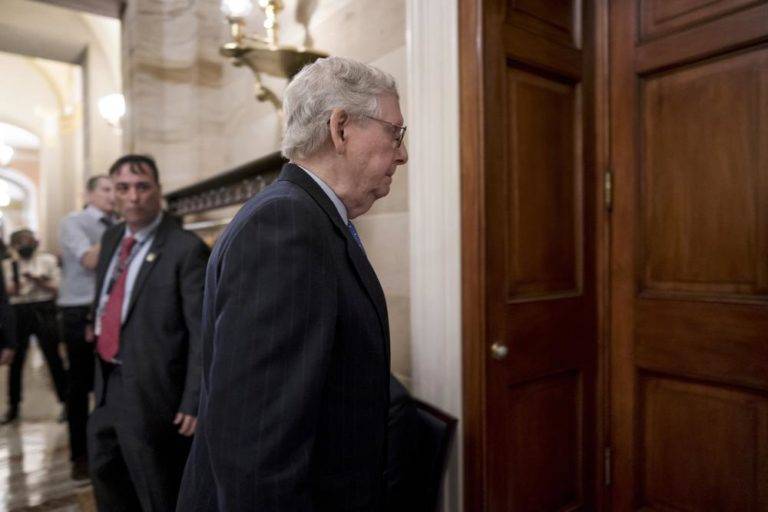
While reliably swampish Senate Minority Leader Mitch McConnell, R-Ky., has said he supports the spending splurge, McCarthy has opposed it and jumped on board to share the warnings of the 13 Freedom First Republicans.

“Agreed,” McCarthy tweeted. “Except no need to whip—when I’m Speaker, their bills will be dead on arrival in the House if this nearly $2T monstrosity is allowed to move forward over our objections and the will of the American people.”

Other House Republicans who signed the original letter included Matthew Rosendale, R-Mont.; Matt Gaetz, R-Fla.; Ralph Norman, R-S.C.; Bob Good, R-Va.; Byron Donalds, R-Fla.; Andrew Clyde, R-Ga.; and Reps.-elect Anna Paulina Luna, R-Fla.; Andy Ogles, R-Tenn.; and Eli Crane, R-Ariz.