Kellyanne Conway Insists Dinner w/ Cuomo Was ‘Nothing Romantic’

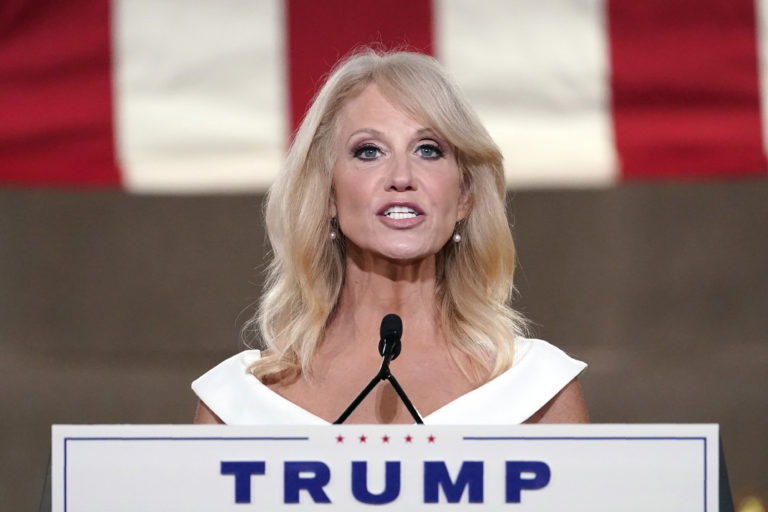
(Jacob Bruns, Headline USA) Former Trump adviser Kellyanne Conway dined at a ritzy restaurant with disgraced former New York Gov. Andrew Cuomo. And despite having gone out on a romantic date at a posh Italian restaurant, Conway insisted that the hook up was “not romantic.”

Conway, who was Trump’s campaign advisor in 2016 and adviser through 2020, was sure to squash rumors of a blossoming romance soon after her apparent date

“Italians prefer eating to Zoom. We could have invited his brother, Christopher [Cuomo], but it’s unclear that he eats carbs,” Conway said. “Nothing romantic. I’ve known the family for decades.”

“My policy portfolio included nonpartisan issues like veterans and the drug crisis, now worse than ever,” Conway explained to the New York Post on Tuesday. “Looking to re-engage on that and it requires working across the aisle.”

“Sharing a meal with Gov. Christie next week on same,” she added, alluding to former GOP Gov. Chris Christie.

Cuomo, who is currently single and has had difficulty controlling his sexual urges in the past, has not spoken publicly about the dinner. Conway is reportedly married to never-Trumper George Conway.

Andrew Cuomo’s sister spoke out about the meeting, complaining that a Republican and a Democrat cannot gather without rampant speculation.

“The idea that Andrew’s meeting with Kellyanne Conway has caused this much of a stir is frankly really sad, but speaks volumes about where we are as a people,” Madeline Cuomo said.

“The level of vitriol and animosity has risen to new heights and people no longer understand what it is they’re disagreeing about in the first place. No one talks about issues, but rather adopts the position of `their chosen leader’ and sticks to it, because that’s what they’re supposed to believe.”

Devout Catholic Joe Biden Avoids Mentioning Jesus in Christmas Address

(Molly Bruns, Headline USA) President Joe Biden, a self-proclaimed devout Catholic, delivered a Christmas address without speaking the name of “Jesus” or referring to “Christ.”

“How silently, how silently, the wondrous gift is given,” Biden began, as he delivered his address to reporters at the White House, Breitbart reported.

The president did reference the nativity and mentioned a “child” born on Christmas, but neglected to speak his name.

“We look to the sky to a lone star, shining brighter than all the rest guiding us to the birth of a child, a child that Christians believe to be the Son of God,” he said. He also mentioned the “light” and “peace” of the Christmas season.

“That light is still with us, illuminating our way forward as Americans and citizens of the world, a light that burned at the beginning and at Bethlehem,” he said.

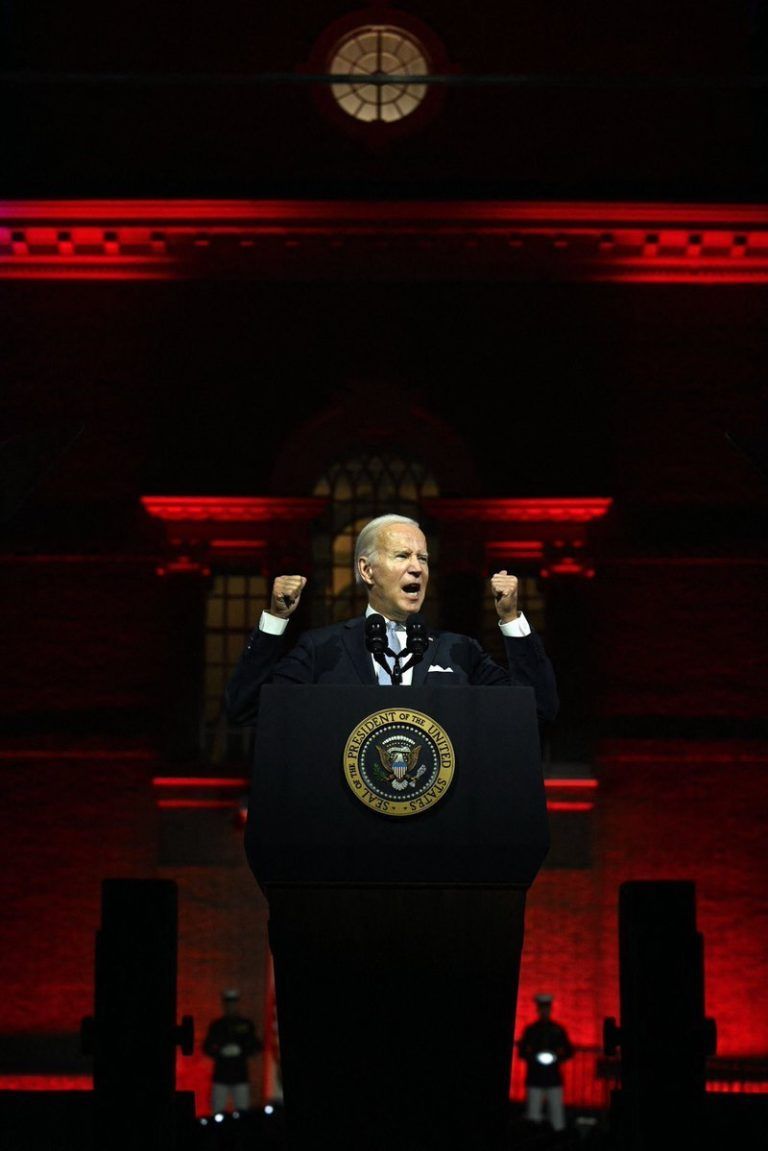
Biden requested that the American people unite around shared values and reject political vitriol, a request many found odd coming on the heels of the president’s recent Red Rally and ongoing demonization of Republicans.

“I sincerely hope this holiday season will drain the poison that has infected our politics and set us against one another,” he said.

He did not specify what shared values Americans on opposite sides of the aisle still have, but he did ask that citizens “really look at each other” as fellow citizens and perform acts of kindness.

“And look. Really look at each other. Not as Democrats or Republicans, not as members of team red or team blue, but as who we really are. Fellow Americans,” he said.

Many people caught on to the fact that Jesus was not directly mentioned, and requested that Biden say His name.

Many other Twitter users called out Biden on his hypocrisy, talking about peace when he is perpetuating a war between Ukraine and Russia.

Biden’s Catholic faith has been called into question several times through his political career, particularly with regards to the issue of abortion.

Biden even threatened to shove his Rosary down the throat of anyone who questions his faith.

Bill Clinton’s Impeachment Lawyer to Defend Hunter Biden in GOP Probes

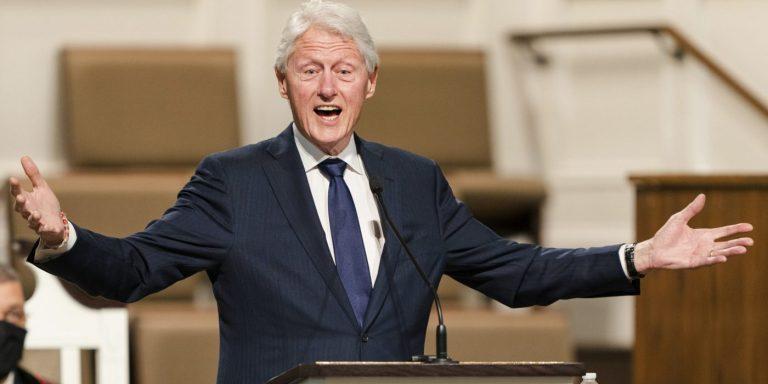
(Jacob Bruns, Headline USA) The very same lawyer who defended Bill Clinton in the wake of his Oval Office affair has agreed to defend the degenerate son of President Joe Biden, Hunter Biden.

With Republicans taking the House of Representatives in the recent midterms, they will presumably hold true to their promises to investigate Hunter Biden thoroughly, especially in relation to his dealings with foreign entities.

Anticipating such investigations, Hunter Biden and his team have hired legal counsel Abbe Lowell, a high-profile attorney who has represented the likes of Bill Clinton, to ensure that the House finds out as little as possible about the Biden family business, Slay News reported.

“Hunter Biden has retained Abbe Lowell to help advise him and be part of his legal team to address the challenges he is facing,” Hollywood Lawyer Kevin Morris, who is leading the Biden legal team, told NBC.

Lowell, per Morris, has a long history of defending clients who are engulfed in political scandals, including Sen. Robert Menendez, D-N.J., former Sen. John Edwards, lobbyist Jack Abramoff, Bill Clinton and Jared Kushner.

“Lowell is a well-known Washington-based attorney who has represented numerous public officials and high-profile people in DOJ investigations and trials as well as Congressional Investigations,” he added.

“Mr. Lowell will handle congressional investigations and general strategic advice.”

Questions have arisen as to just how Hunter can afford to bring on Morris, Lowell and two other lawyers, Chris Clark and Joshua A. Levy, who will defend him from potential Department of Justice allegations.

“Abbe Lowell ain’t cheap,” Chuck Ross, an investigative reporter at the Washington Free Beacon, wrote.

“Wonder how Hunter is paying for this after blowing all of his money on drugs and pros. Must be the art gig.”

UCSF Apologizes for Prisoner Experiments

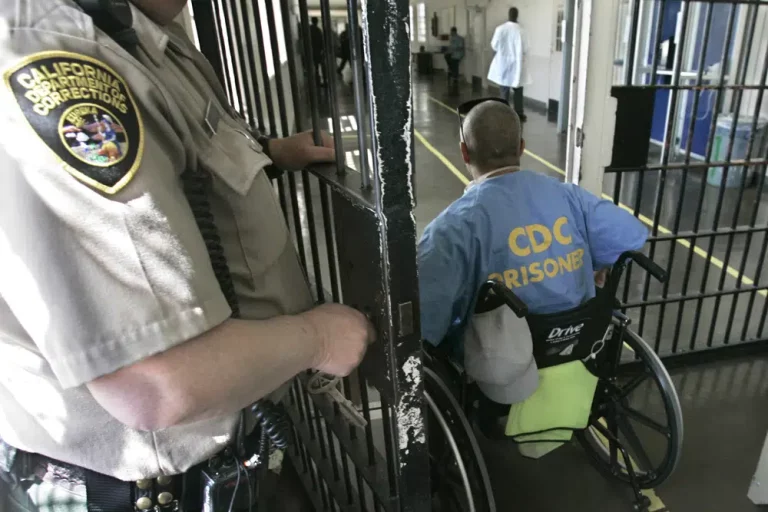
(Headline USA) A prominent California medical school has apologized for conducting dozens of unethical medical experiments on at least 2,600 incarcerated men in the 1960s and 1970s, including putting pesticides and herbicides on the men’s skin and injecting it into their veins.

Two dermatologists at the University of California, San Francisco—one of whom remains at the university—conducted the experiments on men at the California Medical Facility, a prison hospital in Vacaville that’s about 50 miles northeast of San Francisco. The practice was halted in 1977.

The university’s Program for Historical Reconciliation issued a report about the experiments earlier this month, writing that the doctors engaged in “questionable informed consent practices” and performed procedures on men who did not have any of the diseases or conditions that the research aimed to treat.

The San Francisco Chronicle first reported the program’s findings Wednesday.

“UCSF apologizes for its explicit role in the harm caused to the subjects, their families and our community by facilitating this research, and acknowledges the institution’s implicit role in perpetuating unethical treatment of vulnerable and underserved populations—regardless of the legal or perceptual standards of the time,” Executive Vice Chancellor and Provost Dan Lowenstein said in a statement.

The report said further analysis is needed to determine the extent of harms caused to the prisoners as a result of the experiments and what the university should do in response.

“We are still in the process of considering the recommendations and determining appropriate next steps,” the university said in a statement Thursday. “As we do so, it will be with humility and an ongoing commitment to a more just, equitable and ethical future.”

A spokesperson for the California Department of Corrections and Rehabilitation, Dana Simas, said officials had not yet read the report. However, the agency and California Correctional Health Care Services “strive to ensure the incarcerated population receive appropriate health care that meets the community standard of care and ethics,” Simas wrote.

The report focused on research by Dr. Howard Maibach and Dr. William Epstein. Maibach continues to work at the university, and Epstein died in 2006. It was not immediately clear whether Maibach would face any discipline in light of the report.

The experiments involved administering doses of pesticides and herbicides to the incarcerated men, who volunteered for the studies and were paid $30 a month for their participation—among the highest-paid roles at the prison and in high demand, according to a 1977 article of the university’s student newspaper, Synapse.

Other experiments included placing small cages with mosquitos close to the participants’ arms or directly on their skin to determine “host attractiveness of humans to mosquitos,” the report stated.

The research ended in 1977 when California prohibited human subject research in state prisons, a year after the federal government halted the practice.

But Epstein in 1977 testified in state hearings in support of biomedical experimentation at prisons, the report found, and investigators could not find any evidence that he changed his opinion before he died.

While Maibach wrote that he regrets having participated in research that does not meet current standards in a letter to the university’s dermatology department, he said he believed the experiments had offered benefits to some of the patients.

“What I believed to be ethical as a matter of course forty or fifty years ago is not considered ethical today,” he wrote. “I do not recall in any way in which the studies caused medical harm to the participants.”

The university says there is no evidence that the doctors’ research was directed specifically at black men, although they were trained by a now-deceased Philadelphia doctor whose research at a Pennsylvania prison was called unethical and disrespectful toward the subjects, many of whom were incarcerated black men.

The report also found that many of Maibach’s publications during his career perpetuate the biologization of race—which he addressed in his letter by saying he has now “come to the understanding that race has always been a social and not a biological construct, something not appreciated by so many of us in a prior era.”

“While one of his [Maibach’s] recent articles hints at a possible reconsideration of the biology of race, we believe the long history of his research of skin differences along racial lines, with race as a possible biological factor, perpetuated the continuance of racial science in dermatology and has yet to be publicly addressed,” the report stated.

Maibach’s son, Edward Maibach, wrote in an email Thursday to the Associated Press that his father had suffered a stroke last week and was unable to respond to press inquiries.

The younger Maibach said his father had not been allowed to meet with the report’s authors or access their documents.

The report and a press release from the university, he wrote, treated his father “as a ‘lone ranger’ who seemingly acted without knowledge or approval at others at UCSF. This, too, is incorrect,” he said.

“Dr. Maibach’s activities at Vacaville were known to, and endorsed by, UCSF administrators, including the UCSF ethicist,” Edward Maibach wrote.

Adapted from reporting by the Associated Press

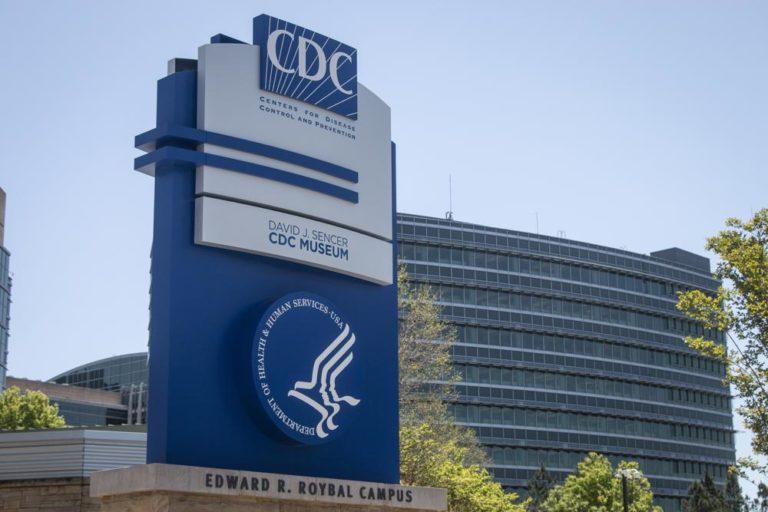
CDC Plays Partisan Politics by Injecting Itself into Gun-Control Debate

(John R. Lott Jr., RealClear Wire) For the second year in a row, the Centers for Disease Control and Prevention has been caught ignoring science and letting liberal interest groups set its policies.

In 2021, the American Pediatric Academy and the Children’s Hospital Association tracked COVID-19 statistics in children, and the data show no relationship between mask mandates and the rate at which children caught the disease.

In the face of this evidence—and other data showing that masks harm children’s development—the CDC supported masking students after being pressured by the National Education Association (the nation’s largest teachers union).

Now comes word that CDC is again allowing partisan politics to influence its policies.

This time, gun-control activists got the CDC to remove research from its website. Yet, the CDC is trusted to impartially dole out millions of dollars for public health research on firearms: From 2020 to 2022, the CDC and the National Institutes of Health each spent about $50 million on such research.

Until May of this year, the CDC cited a 2013 National Academies of Sciences report showing that the annual number of defensive gun uses ranged from about 64,000 to 3 million. The CDC website listed the upper figure at 2.5 million.

But now, the CDC has removed from its website all of those numbers and even the link to the NAS report.

Following introductions from the White House and Democratic Sen. Dick Durbin of Illinois, gun-control activists linked up with the CDC for a private meeting and numerous email exchanges, in which they lobbied hard to have the CDC remove the information.

“[T]hat 2.5 Million number needs to be killed, buried, dug up, killed again and buried again,” Mark Bryant, who runs the Gun Violence Archive, wrote to CDC officials after their meeting.

“It is highly misleading, is used out of context,” he continued. “And I honestly believe it has zero value—even as an outlier point in honest DGU [Defensive Gun Use] discussions.”

Brya t was upset that the 2.5 million number “has been used so often to stop [gun control] legislation.”

The Department of Justice’s National Crime Victimization Survey estimates that there are between 64,000 and 120,000 instances each year in which a firearm is used defensively. This is on the low end of all the other social science on this subject.

Some 20 such surveys have been conducted. Three of them show about 800,000 defensive gun uses a year. All the other estimates are over 1 million, with one as high as 3.5 million. The average estimate is about 2 million.

William English of Georgetown University surveyed 16,708 gun owners just last year, and estimated that there are 1.67 million such uses annually.

The National Crime Victimization Survey’s low numbers result from its choice of a screening question. It first asks a person if they have been a victim of a crime. Only respondents who answer “yes” are then asked if they have used a gun defensively.

Yet, people who successfully brandish a gun generally do not view themselves as having been victimized.

Devin Hughes, who runs another gun control group, GVPedia, argued in a July 6, 2021 email to the CDC that it should use the Gun Violence Archive (GVA) estimate of defensive gun uses.

Hughes claimed that the GVA is “the most widely accepted compendium of gun violence data.” Between January and mid-December this year, the GVA claims that there were only 1,112 defensive gun uses in the United States.

Last year, RealClearInvestigations examined Gun Violence Archive’s data from Jan. 1 to Aug. 10 and found 774 defensive gun uses. Ninety-five percent of these self-defense cases were from initial news reports.

I checked those cases against other lists compiled by the Heritage Foundation and the Crime Prevention Research Center, and found that the GVA had missed an additional 30 cases. But that wasn’t the important problem.

What makes defensive gun uses newsworthy doesn’t accurately reflect the real world. In GVA’s statistics, 43% of the GVA’s gun violence cases involve fatalities, 42% involve woundings, and 10% are cases in which shots were fired defensively that don’t hit anyone.

Less than 4% of cases involved no shots fired, and more than half of those involve the criminal being held at gunpoint until the police arrive. But as gun control experts know, these kinds of cases represent a tiny fraction of the instances in which firearms are used defensively for self-protection.

First of all, relying on the news media is not an accurate way to gather crime data. Criminologists know that less than one-quarter of violent crimes are reported to police.

Nor does the news media even cover most violent crimes reported to police. Second, and much more significantly, about 95% of defensive gun uses involve brandishing a weapon.

Bryant defends the reliance on media accounts, and discounts the argument that the media disproportionately covers the most violent cases.

“I don’t think it is a newsworthy issue … too many media really like the feel-good stories of homeowner standing up to home invader,” Bryant wrote me last year. “Even better if it was a granny doing it. They don’t just go with the ‘if it bleeds …’ newsworthiness.”

This is a naïve view of how newsrooms operate. Suppose an editor is presented with two stories, one with a dead body on the ground and another where no one was hurt because the would-be victim brandished a gun and the criminal ran away. And in the later story you can’t even be sure what crime would have been committed. Which story would you run in your hometown newspaper paper?

But even that isn’t really the point. When a law-abiding citizen scares off a would-be criminal by brandishing a legal firearm, journalists don’t typically wrestle with its newsworthiness for the simple reason that such cases are reported to neither the police nor the press. That’s why rigorous social science studies are necessary—the precise kind the CDC is censoring to benefit special interests.

Unfortunately, Democrats in Congress have earmarked the $100 million in research funding for public health researchers who are far to the left on gun control compared to criminologists or economists.

The CDC keeps making decisions based on politics, not science. It has shown that it is not able to divorce political views from decisions about who to fund. But, as researchers know all too well, the CDC isn’t unique. The government just can’t keep politics out of funding decisions.

After Operational Failures, Navy Splurges on Luxury Bidet

(Adam Andrzejewski, RealClear Wire) While Congress recently reviewed the U.S. Navy for operational failures, calling into question its performance, the Navy has attracted additional scrutiny for its purchase of a luxury bidet.

A requisition request obtained by the Washington Examiner shows that the Navy purchased a bidet for $553 from BioBidet in December 2021.

The remote-control operated bidet has a deodorizer, proximity sensor, heated seat, warm air dryer, massage and oscillating spray options, according to a description of the item on the requisition request.

“Pamper yourself with a gentle, warm aerated stream,” a description of a BioBidet toilet seat stated.

“A convenient remote control allows you to personalize several functions including water temperature, pressure, and even offers a gentle cycling massage feature,” it continued. “Follow cleansing with a touch of a button for an adjustable warm air-dry while enjoying the comfort of a gently heated seat.”

Navy officials bought the luxury warm water sprayer for use on the USNS Yuma, in service since 2017.

The ship is in a class called Expeditionary Fast Transport, which has a crew of 26 civilian mariners, “with airline-style seating for more than 312 embarked forces and fixed berthing for an additional 104.”

The purchase comes as a recent Congress-directed report followed “a series of high-profile and damaging operational failures in the Navy’s Surface Warfare community.”

The Navy incidents that kicked off the review are “a catastrophic fire on the USS Bonhomme Richard pier-side in San Diego, the collision of the USS McCain in the South China Sea, the collision of the USS Fitzgerald off the coast of Japan and the surrender of two small U.S. Navy craft to the Iranian Revolutionary Guard Corps Navy in the Arabian Gulf,” the report said.

“Perhaps the most concerning comment and consistent observation amongst interviewees was that the service does not promote or advance surface ship warfighting in a meaningful way,” the report said. “Finding and sinking enemy fleets should be the principal purpose of a Navy.”

It continued, “But many sailors found their leadership distracted, captive to bureaucratic excess, and rewarded for the successful execution of administrative functions rather than their skills as a warfighter.”

It recommended that the Navy “prioritize warfighting,” “get politics and media out of the wardroom,” and “eliminate distractions” among other things.

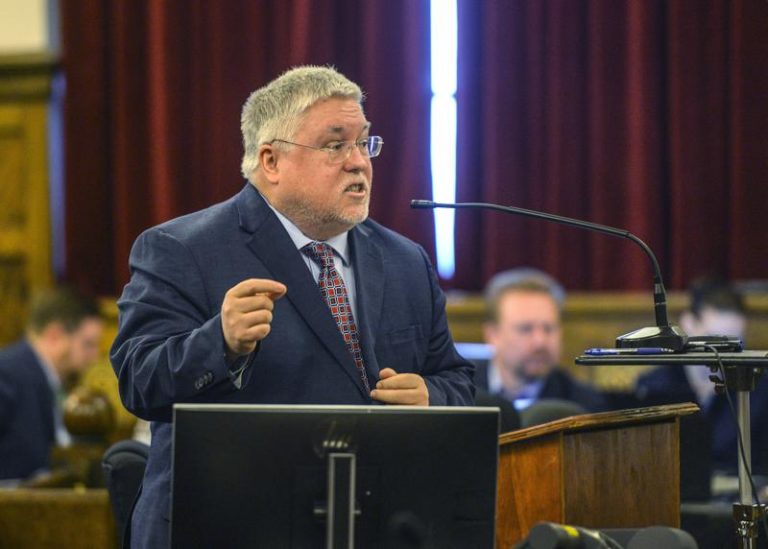
West Virginia’s AG Takes On the Administrative State

(Ben Weingarten, RealClear Wire) Montani Semper Liberi, Latin for “Mountaineers Are Always Free,” is West Virginia’s motto.

To that motto, the Mountain State’s attorney general would like to add a coda: “Where woke policies and federal overreach go to die.”

This is the stated aim of Patrick Morrisey, West Virginia’s thrice-elected Republican chief legal officer, soon to be entering his 10th year in office, as he revealed in a recent interview.

Morrisey has engaged in sustained litigation against the federal government, while jousting with the executive branch particularly over its embrace under the Obama and Biden administrations of ESG —Environmental, Social, and Governance— principles, and their efforts to codify and impose them by administrative fiat.

In Morrisey’s view, efforts to institutionalize ESG—“the weapon of choice for the woke left to destroy the free market”—not only punish West Virginians but undermine America’s national interest and constitutional order.

Morrisey’s rise to ESG and administrative state scourge began, in a classic twist of political fate, with a loss 22 years ago in a four-way Republican primary for the U.S. House in New Jersey (a race in which this reporter’s father also competed).

But it reached an apex of sorts in June when, after years of legal wrangling, Morrisey scored a victory at the Supreme Court in the case of West Virginia v. EPA.

At issue was whether the Environmental Protection Agency could, as West Virginia framed it in its brief, issue rules “capable of reshaping the nation’s electricity grids and unilaterally decarbonizing virtually any sector of the economy – with no limits on what the agency can require so long as it considers cost, non-air impacts, and energy requirements.”

West Virginia argued it could not. While the specific subject of the case was EPA efforts to curb emissions, the case raised more fundamental questions about executive authority.

To that end, the Supreme Court ruled in West Virginia’s favor on “major questions” grounds. Under the major questions doctrine, as the high court described it, should an agency pursue a policy of substantial “economic and political significance,” it “must point to ‘clear congressional authorization’ for the authority it claims.”

As Chief Justice John Roberts concluded in his majority ruling: “A decision of such magnitude and consequence rests with Congress itself, or an agency acting pursuant to a clear delegation from that representative body.”

The implications of the ruling therefore went far beyond the walls of the EPA. In theory, a whole raft of significant regulatory policies across the executive branch could be challenged under the major questions doctrine.

The durability of that theory is likely to be put to the test amid a mounting backlash against ESG-related regulatory policies that executive agencies have been promulgating under the Biden administration—part-and-parcel of a broader revolt against ESG in government and corporate America being led by the states and poised to be joined by the incoming Republican House.

West Virginia and like-minded states argue that the Biden administration is once again running afoul of the major questions doctrine with regulatory efforts from agencies even further unmoored from ESG matters like climate, from the SEC to the Commodity Futures Trading Commission.

What follows are excerpts from our interview, conducted with Attorney General Morrisey by telephone on Dec. 14, lightly edited for clarity.

Ben Weingarten: What’s your view as to the proper role of the administrative state, if any, in our republic?

AG Patrick Morrisey: The administrative state needs to take clear direction from Congress in terms of implementing the many laws that are passed. My concern about the administrative state stems from its incredible growth and the fact that the bureaucracy has received so much deference over a prolonged period of time. The bureaucracy has been able to grow organically on its own, even without express authorization of Congress. And that’s been disturbing to me because where the administrative state exists, it has an impact on states’ ability to function and the freedom of the individuals to act and to innovate. The larger it becomes, then you see freedom contracting within the states.

I’m a believer that the administrative state has grown way too big over a long period of time. And we need to right-size that pretty aggressively because the administrative state is not accountable to the people. We have to consistently look and ask the tough questions to make sure that the legislative branch is making the major decisions of the day because when that goes away, then you lose control of your government. You no longer have a government by the people and for the people. You have a government of people, bureaucrats, who don’t have any accountability and can make decisions that are wildly at variance with the laws. I think that’s a lot of what we’ve seen in recent decades.

BW: Administrative state proponents will say – particularly given how many different areas regulators oversee and bureaucrats interact with today – that we’re dealing with more complex and highly technical or scientific issues in more areas than ever before. And so it really ought to be the purview of experts who specialize in those areas to make decisions about how laws ought to be interpreted and applied, not the legislators themselves who don’t have that expertise. What’s your counter to that argument?

PM: The fact is there most certainly should be expertise that’s housed within our federal agencies. But it should never be an excuse to take constitutional shortcuts. And that’s what these bureaucrats want. One of the arguments that we used to hear in the context of West Virginia v. EPA, they said, “Well, climate change is a really important issue. And if the Congress doesn’t act, we need the regulatory body to step in.” But that’s wrongheaded on every single level because the executive agencies should only act when they have explicit authority from Congress. And I think that there are a lot of people that want to take those shortcuts, and they want to use the administrative bodies to advance their pet initiative of the week. But we continually lose freedom and we lose our way of life if we allow these bodies to keep seizing power when it doesn’t belong to them. And once again, there’s an effect when you seize power on the federal level, that obviously the states’ ability to function starts to contract. Individual communities and localities lose the ability to solve problems. And there’s an intrinsic value in local communities solving as many of the problems that they can as possible, as opposed to passing everything off to the federal government and the administrative state.

Most certainly there are going to be issues that raise interstate commerce concerns or are international in scope, but the vast majority of areas that the federal government has been walking into in recent years could probably be resolved at the local and the state level. And that’s always superior, so there’s political accountability with citizens.

BW: What, in your view, were the most overlooked or underappreciated aspects of West Virginia v. EPA?

PM: I think that the biggest takeaway is that the major questions doctrine and West Virginia v. EPA are going to apply well beyond the environmental arena. Major questions is a concept that is applicable to every single federal agency. So we expect that in the upcoming years we’re going to see the lower courts interpret West Virginia v. EPA and build out the case law all across the country. We’re going to see the executive branches have to come to grips with what West Virginia v. EPA and the major questions means to them. You’re going to start to see congressional oversight over federal agencies asking, “What are you doing to comply with West Virginia v. EPA?” And I think that’s all good and proper because once again this was a sea change. This sends a very strong message that if you have a major question of the day, something of great political or economic significance, Congress makes those decisions, not unelected bureaucrats. It’s sending a message that the days in the past where the unelected bureaucrats could reach down, seize authority from an ambiguous phrase, reorder the nation’s power grid if you will, that that’s not going to happen, at least not with this Court. That’s a net good for our country, for freedom, our constitution, and our separation of powers both in terms of the federal level and the cooperative federalism regime we have in place between the feds and the states.

BW: What’s at stake with respect to the SEC’s proposed climate-related risk disclosure rule, and what do you make of the delay in its issuance of a final rule?

PM: ESG is the weapon of choice for the woke left to destroy the free market in our country. So I would argue there’s a significant amount at stake when you have the federal government trying to transform the core mission of virtually every federal agency into an environmental regulator, a diversity regulator, a regulator in walks of life that those agencies have nothing to do with. That’s the opposite of what you want in your government. You want a government that is mission-oriented and they’re working to fulfill the charge that Congress set out for them.

Congress never set forth any authorities for the SEC to act in the ESG space. The FDIC doesn’t have authorities to act in ESG space. CFTC doesn’t have the authority to act in that space. So there will be litigation brought, and these SEC rules will come down.

BW: Do you foresee, to the extent one or several of these rules fail, there being a tipping point where these agencies realize that by proposing policies that will ultimately lose in court, that they’ll be doing greater damage to the administrative state itself than it’s worth – that is, that future losses could serve as a deterrent to overreach?

PM: I’m certainly hopeful that the federal agencies will start to learn their lesson but it’s clear to me that we still have a long way to go. When you win West Virginia v. EPA at the end of June, and a week later our president comes out and suggests that since he can’t get done his climate change agenda through Congress, he’s going to resort to regulatory fiat, you shake your head and say, “Did you not just see what happened?” And so it’s going to take time and it’s also going to take the right leadership within the executive branch and folks who want to be disciplined about protecting the integrity of the constitution, the separation of powers and our freedoms into the future even though it may be easier for them to take that shortcut in order to get a quick policy victory.

So I think that the major questions doctrine is going to advance, but the speed at which it advances may be dependent upon who our next president is because that next president is going to set up a lot of the executive rules as to when major questions apply to the federal agencies. And I’m personally excited about that prospect and looking forward to working with the next president and the next set of government officials who are actually going to care about principles such as reining in the administrative state, ensuring that there’s a balance, and that there’s a maintenance of cooperative federalism between the feds and the states.

BW: You’ve pushed back against a variety of agencies, including the CFPB of late. Are there other aspects of the administrative state, be they either specific policies or powers that have been usurped, that you see as particularly vulnerable to challenge, and that you might be pursuing via litigation going forward over the next couple of years?

PM: We’re going to continually look for different ways to whittle away deference to the administrative state and we are constantly looking at the right type of cases to bring so that we can continually right-size the administrative state. In West Virginia there’s a lot of concern about the power of the federal government and the administrative state, and obviously there’s been a lot of concern about the EPA because of what the EPA has done to our state over a prolonged period of time. But of course, there’s concern about a lot of different federal agencies. You don’t have to go any further than the vaccine mandates to point to examples of how people were looking and saying, “How on earth did the federal government have this kind of authority?” And the answer is it didn’t have that kind of authority. So we’re going to be looking constantly at different tools through the litigation process to right-size the administrative state and make sure that it’s complying with its constitutional direction that Congress provides to it.

But look, I would say that there’s a lot more that needs to be done as well. Congress needs to accept the responsibility that’s consistent with its constitutional obligations. And remember, Congress has been complicit in this process for many years because it’s sometimes easier to write an ambiguous phrase or bury something as a product of a political deal as opposed to having greater clarity because greater clarity might make the lawmaking process a little bit more difficult. And so sometimes people take the easy way out. They don’t resolve political dilemmas at the legislative level. They ship it up to the bureaucrats to deal with. And I’m hopeful that this sends a message to Congress: Congress, you have to do your job and provide the clarity and not just think that the administrative state is going to solve all your problems.

BW: What would your recommendation be for the Republican House in the way of working toward reining in the administrative state in the next two years?

PM: The House of Representatives should put together a list of every single federal agency and independent agency, and they should go through that, and have oversight hearings as to the nature of the rulemakings that are underway, and analyze the source of the authority that that agency is using. And they should raise major questions issues to the extent they’re applicable. This has to be an exercise that applies across the board to all federal agencies. So, that means the House Oversight and Reform Committee needs to do a lot of hearings. The Energy and Commerce Committee needs to do the hearings within its jurisdiction. The Ways and Means Committee, obviously Appropriations Committee, Financial Services Committee, across the board. This should be a broad part of the theme that Republicans have because this is actually what being a Republican is all about: Reducing the size and scope of the federal government; bringing decision-making powers back to representatives who are accountable to voters. Obviously, government is best that functions at the most local level where individuals are going to be able to make informed decisions, and they can interact with the people that are running for office.

BW: How should Republicans think about the use of administrative authority when they are in power – and considering the intransigence that they’ll be likely to face, as we saw under President Trump?

PM: I think that there’s still far too many federal agencies, and that we should be looking to slim down the powers of the federal government. I don’t think you have to look any further than the CFPB, which was an unconstitutional creature that was created, and people are beginning to look at that more closely about the unlawful funding mechanisms that are in place. We need to constantly question the role of government, and we shouldn’t be afraid to get rid of functions that don’t apply to the federal government, or are more proper for states or for the people. And I think we have to continue that. I wouldn’t give that up.

At the same time, I would also argue that constitutional conservatives should stand for limited government, and that means smaller government, but also agencies and policies that run like a Swiss clock. You should have as small a government as possible. However, when you have it, you have to make sure it works effectively. And I would have both of those visions in mind when I go about taking on the administrative state.

BW: Attorney General Morrisey, you’ve been very generous with your time, and I appreciate your thoughtful responses.

PM: The last point I would make is this: When you think of West Virginia, I want you to think West Virginia is going to be the state where woke policies and federal overreach go to die because this is a really big issue with our people. “Mountaineers Are Always Free.” That’s our motto, and we recognize the relationship between an overreaching federal government and loss of freedoms to our people. We felt it with the EPA. We’re seeing it with the ESG movement, which we know is a death sentence for West Virginia, and we’re going to stand up and fight. And quite frankly, we’re going to keep beating these people every single time. We’re correct on the law. The Supreme Court, I think, is supportive of a lot of the initiatives that we’ve been pursuing, and we’re not going to stop.


‘Cousin Eddie’ Display in Kentucky Leads to Police Response

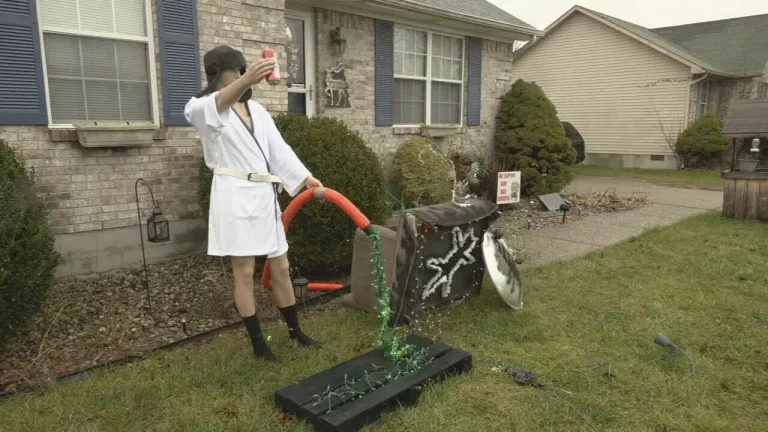
(Headline USA) A “Cousin Eddie” display in Kentucky that was inspired by the holiday classic National Lampoon’s Christmas Vacation apparently looked a little too real,  and police were called to check it out.

After receiving the call, a dispatcher described the scene to responding officers as “a male standing outside. He is naked. He has a robe covering part of his body. He is exposing himself, and he has a hose between his legs.”

Officers arrived at the Shepherdsville home to find a mannequin in the yard that looked like Cousin Eddie, the character portrayed by Randy Quaid in several of the comedy franchise’s films.

It was decorated with a robe, a hat, a cigar and a beer and was holding what appeared to be an orange hose, WDRB-TV reported.

Homeowner Joni Keeney said she decided to put up the display from her favorite Christmas movie to have some fun.

“Everybody has a ‘Cousin Eddie,’ in their family, everybody,” Keeney said. “I just want people to have a good Christmas and get a laugh,” Keeney said.

Responding officers did get a laugh and took some photos of the display, WDRB reported.

“Never a dull moment,” Shepherdsville Police Chief Rick McCubbin said.

Adapted from reporting by the Associated Press

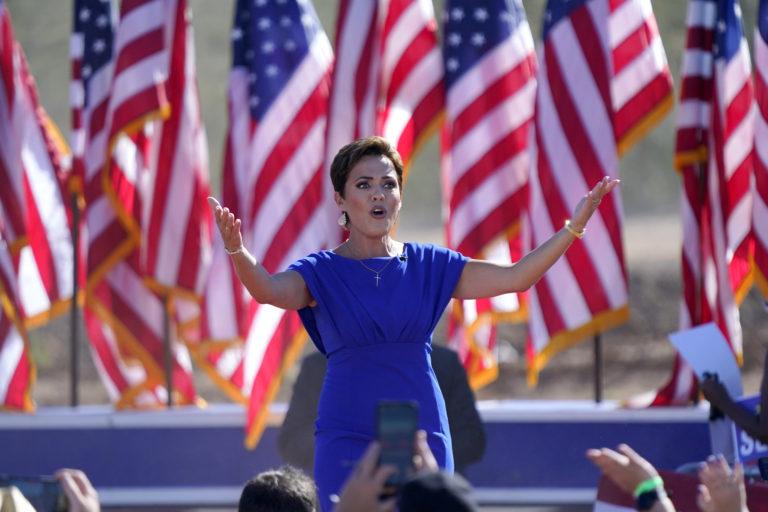
Kari Lake Closes Maricopa Vote-Fraud Case on Note of Confidence

(Headline USA) Arizona’s GOP gubernatorial candidate, Kari Lake, made her case in court Friday that she also is the state’s rightful governor-elect after proving that Maricopa County’s corrupt election officials conspired on Election Day to throw the race for her far-left opponent, Katie Hobbs, who also happens to be the state’s top election official.

“Our elections are a mess in this country, and I am so happy to stand up and say no longer will we as Americans put up with this,” Lake said in a statement at the conclusion of the two-day hearing.

“We demand fair, honest, transparent elections, and we will get them,” she continued. “And I pray so hard for this judge. I think that he really took in all of that information. I think he listened very closely to what happened.”

Superior Court Judge Peter Thompson, an appointee of former Republican Gov. Jan Brewer, didn’t say when he would issue a ruling.

Lake needed to prove not only that misconduct occurred, but also that it was intended to deny her victory and did in fact result in the wrong woman being declared the winner.

Outside the courthouse after the proceedings, Lake said her attorneys did just that.

“We proved without a shadow of a doubt that there was malicious intent that caused disruption so great it changed the results of the election,” Lake said. “We provided expert testimony. We provided experts. The other side brought in activists to try to save face. They admitted that they’ve known about these ballot problems.”

Her lawyers focused on problems with ballot printers at some polling places in Maricopa County, home to more than 60% of voters. The defective printers produced ballots that were too light to be read by the on-site tabulators at polling places. Lines backed up in some areas amid the confusion.

Kurt Olsen, one of Lake’s attorneys, said county officials tried to downplay the effects of the printer problems.

“This is about trust, your honor,” Olsen said. “It’s about restoring people’s trust. There is not a person that’s watching this thing that isn’t shaking their head now.”

Despite admitting in court that they had used the wrong size ballots on Election Day, county officials insisted that everyone had a chance to vote and that all ballots were counted.

They claimed ballots affected by printer issues were taken to more sophisticated counters at the elections department headquarters.

But Lake’s team noted the appearance of some 25,000 new ballots 25,000 new ballots that were mysteriously added to the final count in the week it took Maricopa to issue its final tally as evidence that the closed-door tabulation process was compromised.

Lake’s attorneys also argued that the chain of custody for ballots was broken at an off-site facility, where a contractor scans mail ballots to prepare them for processing. The county disputes that claim.

Her attorneys pointed to a witness who examined ballots on behalf of her campaign and discovered 14 ballots that had 19-inch images of the ballot printed on 20-inch paper, meaning the ballots wouldn’t be read by a tabulator. The witness said someone changed those printer configurations, a claim disputed by elections officials.

County officials say the ballot images were slightly smaller as a result of a shrink-to-fit feature being selected on a printer by a tech employee who was looking for solutions to Election Day issues. They claimed only about 1,200 ballots were affected by turning on the feature and that those ballots were duplicated so that they could be read by a tabulator. Ultimately, these ballots were counted, officials said.

But Lake’s own analyisis, based on a random sample, indicated that 42.5% of all Maricopa ballots were invalid.

During the trial, a lawyer for Hobbs was humiliated while trying to argue that “invalid” did not necessarily mean that the ballots were illegal.

Lake’s last witness was Richard Baris, a pollster who conducted exit polling in Arizona and said technical problems at polling places had disenfranchised enough voters that it would have changed the outcome of the race in Lake’s favor.

Baris said that 25,000 to 40,000 people who would normally have voted actually didn’t cast ballots as a result of Election Day problems—and that the voters that day were more likely to support Lake.

Baris said his estimate was primarily influenced by the number of people who started answering his exit poll but didn’t finish the process.

Kenneth Mayer, a political science professor at the University of Wisconsin-Madison who testified on behalf of election officials, said Baris’ claim was “a series of assumptions and speculation.”

Thompson had previously dismissed eight of the 10 claims Lake raised in her lawsuit.

Among those were Lake’s allegation that Hobbs, in her capacity as secretary of state, and Maricopa County Recorder Stephen RicherStephen Richer engaged in censorship by flagging social media posts with election misinformation for possible removal by Twitter.

He also dismissed Lake’s claims of discrimination against Republicans and that mail-in voting procedures are illegal.

Pending the outcome of the trial, Hobbs is expected to take office as governor on Jan. 2.

Meanwhile, a trial is scheduled Friday in Republican Abraham Hamadeh’s challenge of his narrow defeat to Democrat Kris Mayes in the Arizona attorney general’s race. Hamadeh, who reportedly lost by 511 votes, alleges in his lawsuit that problems with printers in Maricopa County led to issues involving disenfranchised voters.

Adapted from reporting by the Associated Press

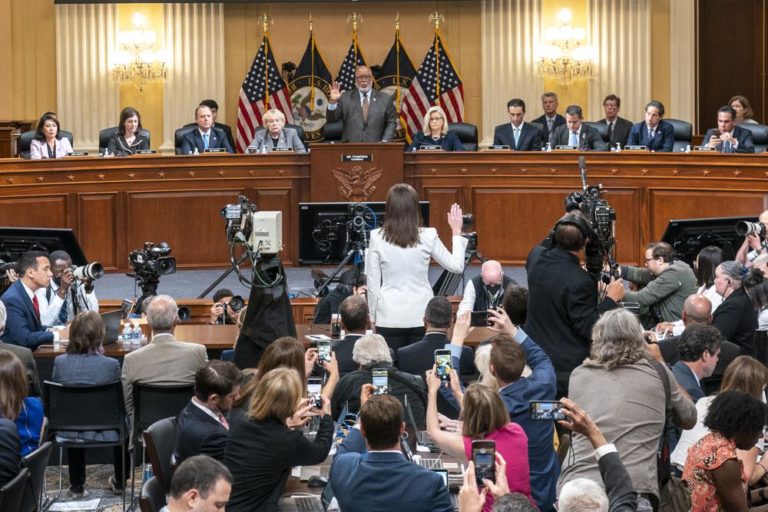
J6 Final Report Flops, as Inquisition’s Star Witness Cops to Major Lies

(Mark Pellin, Headline USA) As the J6 Inquisition made a lavish production Thursday of releasing the final report of its long-running witch hunt, one of the committee’s star witness was exposed as a recidivist liar, including whoppers she told J6 investigators under oath.

The committee’s 845-page clunker mostly rehashed allegations that former President Donald Trump was the mastermind responsible for a gaggle of overzealous LARPers storming the Capitol after Trump’s peaceful rally on Jan. 6, 2021.

The report recommended bringing four charges against Trump, to include obstruction of an official proceeding, conspiracy to defraud the U.S., making a false statement and inciting an insurrection, which if found guilty would bar Trump from ever again running for public office.

Cassidy Hutchinson, a former aide to White House chief of staff Mark Meadows during the Trump administration, featured prominently in the report. Hutchinson was touted as a bombshell witness earlier this year for her explosive testimony to the J6 committee, which played out on national TV during the Inquisition’s professionally produced miniseries.

Hutchinson wove a riveting tale about how President Donald Trump allegedly became enraged on Jan. 6 when his Secret Service detail wouldn’t take him to the Capitol after his rally had finished. Hutchison testified that she was told Trump “had a very strong, angry response” to being refused, and while riding in the presidential limo he maniacally lunged for the steering wheel, screaming, “I am the effing president. Take me to the Capitol now.”

The story quickly fell apart as officials emerged to call out the distortions.

How Hutchinson came to ultimately share the tale was revealed in documents released this week, which showed Hutchison had originally lied to investigators about the incident and her memories of it in sworn depositions. She claimed her original fabrications were coerced under the influence of her then-attorney Stefan Passantino, a Trump ally, who she said directed her to downplay testimony and provide only vague responses.

So that’s what she originally did, Hutchinson claimed, while conceding that Passantino told her not to lie.

“I want to make this clear to you: Stefan never told me to lie. He specifically told me, ‘I don’t want you to perjure yourself, but ‘I don’t recall’ isn’t perjury. They don’t know want you can and can’t recall,’” she testified.

When Hutchinson was first asked about the alleged incident of Trump raging at Secret Service agents, what would eventually become her key testimony, she claimed she panicked and said she couldn’t recall specifics that had been related to her.

After the first deposition, Hutchinson said she fretted to Passantino about her possibly having lied under oath during her sworn deposition.

“Stefan, I’m fucked. I just lied,” Hutchinson said she told Passantino. “I lied, I lied, I lied.”

Critics contend the only lies she told were on television, when she wove her tale about Ultra MAGA Man going ballistic and trying to hijack the presidential limo.

Hutchinson also repeatedly mocked the J6 committee and lampooned her involvement in testifying. In one text exchange with a former colleague, she claimed that the Jan. 6 panel was a “phony committee” and said she would have nothing to offer them if they subpoenaed her.

That was all before she proceeded to drop her alleged bombshell story that the J6 committee praised as solid gold, leaving many to wonder which pack of flip-flopping lies she told should be believed.

Trump didn’t need to do any wondering and derided the J6 committee’s final report, highlighting the twisted tactics used to convey a distorted version of events to fit a preconceived narrative.

“The highly partisan Unselect Committee Report purposely fails to mention the failure of Pelosi to heed my recommendation for troops to be used in D.C., show the “Peacefully and Patrioticly” (sic) words I used, or study the reason for the protest, Election Fraud. WITCH HUNT!” Trump posted on Truth Social.