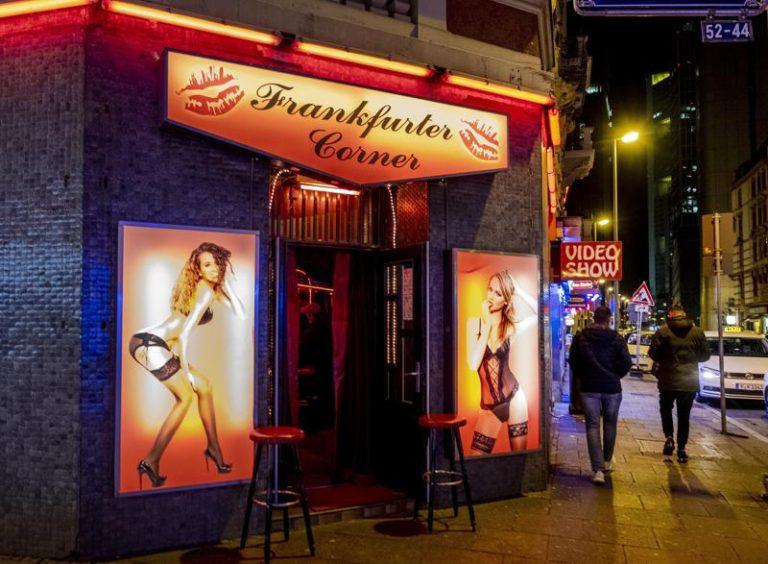
San Fran. Eyes Hooker Red-Light District for City

(Dmytro “Henry” Aleksandrov, Headline USA) The leftist San Francisco suffers from sex trafficking and sexual degeneracy prominent on its streets, and, according to local officials, the solution to the problem caused by leftist policies is more policies — normalizing and legalizing prostitution by implementing an Amsterdam-like sanctioned red-light district.

This is not the first time when leftists tried to encourage sexual degeneracy. In 2008, local politicians tried to push a ballot proposition that would have normalized and decriminalized prostitution, according to ABC 7 News. Back then, it failed, but now the idea has returned after people started to constantly complain about the problem that they face every day.

“It is constant. It is pretty much every night. Sometimes in the morning, you still see them around — sex workers soliciting,” Bertie, one of the residents of San Francisco, said.

Benson Lee said that people are afraid to go outside after 5 p.m. because of what they see happening on their streets.

“They are seeing people walk around with very little clothes,” he said. “A lot of the time there’s people having sex outside of their home. There are break-ins. It’s gotten more rampant lately.”

Santiago Lerma, legislative aid for Supervisor Hillary Ronen, said that local officials are very concerned about what happens on the streets. Ronen’s solution would be to push all the prostitutes into one area and give them free passes to ply their trade of choice.

“She’s very concerned about the situation out there right now,” Lerma said. “The last two weekends, we’ve walked out at night with some of the neighbors last week, we also walked with Assistant Chief David Lazar, who is also shocked at the magnitude of the situation.”

As a result, Lerma said that Ronen decided to create a sanctioned red-light district.

“What we want to do is push our state legislature to legalize sex trade in California. This would allow localities to regulate the trade and keep people safe,” Lerma said.

So far, neither a specific proposal nor information about the specific location in the city that would be targeted is available.

Biden Tries Calling McCarthy’s Bluff

(Philip Wegmann, RealClear Wire) “You can smile,” President Biden assured Speaker of the House Kevin McCarthy.

“It’s okay,” Biden added, handing the Republican a leader a hard copy of his speech. An unamused McCarthy, instead, sat stone-faced for much of the night.

With a laugh and his own smile, Biden was trying to call McCarthy’s bluff. The back-bench Republicans, who shouted at the president throughout Tuesday night’s State of the Union address, in turn, may have showed the new speaker’s cards.

Biden knew what he was doing. “Speaker, I don’t want to ruin your reputation,” he said moments later, “but I look forward to working with you.” The president was hinting at the defining characteristic of the current moment in divided government: McCarthy holds a precarious grip on the speaker’s gavel. His right flank has little interest in compromise with the White House, and under the negotiated rules that McCarthy accepted to become speaker, a single frustrated conservative can call a vote on his removal.

In a moment that was quickly overlooked, Minority Leader Mitch McConnell, an old Senate colleague of Biden’s, also got a shoutout from the president for being “the longest serving leader in history.”

It was the first time Biden addressed the new Republican majority. A stalemate underscored the evening. The White House refuses to negotiate on the debt ceiling, a message Biden delivered again in person. Pressed by hardliners on his right flank, McCarthy has demanded negotiations and sees the issue as a leverage point.

Exasperation was apparent. When the president claimed that some Republicans wanted to sunset Medicare and Social Security, the right side of the chamber booed so loudly that the House sounded like the more raucous British Parliament than the usually more reserved United States Congress. “I’ll give you a copy of the proposal,” Biden replied referring to a plan by Florida Sen. Rick Scott that would do exactly what he just described, despite the fact that McConnell and McCarthy have repeatedly rejected it and pledged that cuts to those entitlements are off the table.

Impatient for the official Republican rebuttal later that night, Republican Rep. Marjorie Taylor Greene shouted, “You lie!” at Biden and “Liar!” And the Georgia firebrand, who was spotted with a big white balloon earlier in the day, yelled again, this time when Biden was discussing China. “China is spying on us,” she shouted.

Over the president’s shoulder, McCarthy could be seen shaking his head and appeared to shush the interrupting member.

When Biden continued, he made only passing reference to the Chinese spy balloon that floated across the continent for a week before a U.S. F-22 fighter jet finally downed it in the Atlantic Ocean. The episode was evidence, Biden said before quickly moving on, that “if China threatens our sovereignty, we will act to protect our country.” The balloon had overshadowed good news that the White House wanted to tout last week: the creation of more than half a million jobs in January. The president took a second bite at the apple Tuesday, reminding the opposition party that doubted him that unemployment was at “a 50-year low.”

Biden also declared that “we have broken COVID’s grip on us,” plugged his infrastructure spending law, and encouraged continued bipartisan support for Ukraine. He spent more time, however, discussing the “junk fees” credit card companies attach to monthly bills, “baggage fees” charged by airlines, and “resort fees that hotels tack on to your bill” than either the threat from China or the continued chaos on U.S. southern border.

Arkansas Gov. Sarah Huckabee Sanders later slammed Biden for refusing “to stand up to China” and showing himself “unwilling to defend our border, defend our skies and defend our people.” In measured tones during the Republican rebuttal, the former Trump White House press secretary concluded that Biden was “simply unfit to serve as commander in chief.”

Republicans are focused on slowing Biden’s agenda to a crawl. The White House has maneuvered in response by trying to drive a wedge between the new speaker and the conservative House Freedom Caucus. Biden offered unwelcome sympathy last week when he said that McCarthy made commitments that are just absolutely off the wall” earlier in the year to win over his hard-right skeptics. And in recent days, his administration has assailed those members by name.

The attacks haven’t broken through. If anything, after the classified documents scandal and the spy balloon fiasco, Republicans seem united. At least for now, members of the House Freedom Caucus even seem invested in McCarthy’s success as speaker, especially during negotiations over the debt ceiling.

Republicans enjoyed a collective laugh at Biden’s expense when he said oil and gas would be needed “for at least another decade” after alleging fossil fuel executives were fleecing the American public.

There were olive branches, like when the president told his “Republican friends” that “if we could work together in the last Congress, there’s no reason we can’t work together and find consensus on important things in this Congress as well.” There were also thorns that the GOP won’t suffer now that they control the House, like Biden’s call to pass “my proposal for the billionaire minimum tax.”

That tax will not pass the House. Neither will a number of the president’s stated priorities, but Tuesday’s address sounded more like a stump speech for a second term, even as many in his own party hope he won’t run again. In the moment, the president clearly hit the fault lines between conservatives and GOP brass that he could exploit to soften up the opposition. He also previewed a line that could work as a campaign slogan in a pinch. A dozen times, Biden said it was time “to finish the job.”

McCarthy was happy to let Sanders have the last word. The Arkansas governor, he tweeted, “just knocked it out the park.” Her rebuttal was apt, he added, because “Republicans offer a vision for a future built on freedom, not fear-mongering.”

The fight over the debt ceiling, meanwhile, is ongoing. Biden may soon rely on the other Republican leader, the one he began the night by heralding. When then-Speaker John Boehner couldn’t wrangle unruly fiscal conservatives in the House during debt ceiling negotiations in 2012, then-Vice President Biden phoned Mitch McConnell at the last minute on New Year’s Eve. They struck a deal.

“It’s not so much a buddy thing,” a senior Republican aide told the Washington Post at the time. “The two of them can do business, they can find solutions together.”


Want Fentanyl Vapes? Keep Banning Flavors

(Lindsey Stroud, RealClear Wire) Across the country, government officials have warned the public about fentanyl-tainted electronic cigarettes and vaping devices. While there have been a handful of such incidents, regulators should resist the urge to restrict access to products that are legally on the market. Further limits or bans will only result in more negative impacts caused by consumers obtaining illicit vapor products.

In January, Gov. Chris Sununu (R-New Hampshire) remarked that “fentanyl is now in all different types of substances, whether that be cocaine, methamphetamine, fake pills, or vape cartridges.” In addition, Florida Attorney General Ashley Moody noted that fentanyl can “possibly” be found in “illicit vaping pods.”

In 2019, the Drug Enforcement Agency did find a vaping device that contained fentanyl, yet fentanyl has never been found in regulated and legal e-cigarette products that one would find in a licensed vape shop and/or gas station.

Despite this, policymakers are now routinely introducing legislation that would ban the sale of safe and legal flavored e-cigarette products, and the Biden administration remains committed to removing menthol cigarettes and flavored cigars from the entire U.S. market. There is already a booming marketplace on the web. Take for example this Craigslist ad in New York City that offers flavored e-liquid in a variety of flavors, from peach to cotton candy. The seller informs the potential customer to “[i]nteract with [them] the same way [one] would a sales person.” Alarmingly, this seller is not interested in providing potential customers with information regarding the products that they may be consuming, noting that any questions about their “cost, date purchased, where purchased, why selling is no one’s concern.” In California, which recently enacted a ban on flavored tobacco and vapor products, a dubious seller named “menthol man” is offering to deliver menthol cigarettes for $15 a pack.

Similar to the nation’s failed experiment with alcohol prohibition, bans on tobacco and vapor products will only help to strengthen the black market and increase the profits of clandestine actors that skirt both regulations and taxes. And, due to continued delay by the FDA authorizing the thousands of American e-cigarette manufacturers, these questionable international companies have already been able to infiltrate the existing marketplace with thousands of counterfeit vapes.

Officials in the UK seized more than 300,000 counterfeit vapes in December alone, with one official saying that “vapes being seized … has risen ‘dramatically.’” A widely circulated video of a manufacturing facility making fake ELFBAR disposable vapes depicts young-looking factory workers who are seemingly testing out the product by vaping on each fake disposable. ELFBAR has worked with Chinese officials to shut down more than a dozen such facilities.

Policymakers should avoid policies that would only further the illicit tobacco product. In 2017, the U.S. State Department declared the global illicit tobacco trade a “threat to national security,” and that it is a “lucrative crime for some terrorist groups.” Exorbitant excise taxes on cigarettes already cause consumers to seek out illicit tobacco products; banning regulated flavored vapor products will only force those consumers to seek out illicit vapor products. As such, this could create incentives for terrorist groups and other bad actors to add vapes to their illegal product portfolios.

Banning flavored vapor products has all been in reaction to youth vaping rates in 2019. While the media continues to decry a youth vaping epidemic, which fuels calls to ban e-cigarettes, youth use of e-cigarettes has significantly declined, halving between 2019 and 2021. Studies and surveys show that young people are also not citing using e-cigarettes because of flavors.

Meanwhile, similar studies and surveys show that adults do enjoy flavors and that flavors help adults maintain smoking cessation. These adults do not deserve to be exposed to fentanyl vapes, or any illicit vape.

The fentanyl epidemic is raging out of control in this country. Lawmakers must refrain from flavor bans as it will only lead to issues with vapes that are far greater than nicotine.

Philly Police Commissioner Laments Cops Are Not ‘Martyrs’

(Anthony Hennen, The Center Square) Philadelphia Police Commissioner Danielle Outlaw expressed frustration Thursday about rising violence after a fellow city officer was shot the day before.

“How many times do I have to say enough is enough? It is NOT our job to become martyrs,” she tweeted. “Attacks against our brave officers – and the people we serve – will not be tolerated. Those who seek to do harm can expect that PPD will fervently pursue all appropriate avenues of justice.”

Outlaw’s comments come after Officer Giovanni Maysonet was shot during a traffic stop in West Philadelphia while trying to detain a passenger that had fled the vehicle. 

Maysonet “sustained a non-perforating gunshot impact to his bulletproof vest in the chest area and a perforating gunshot wound through his stomach/abdomen area which exited through his back,” according to a Philadelphia Police Department news release. Police sources told Fox 29 that Maysonet’s bulletproof vest likely saved his life.

Maysonet was upgraded to stable condition, the department said Thursday.

On Thursday, police arrested Eric Haynes and charged him with homicide, aggravated assault, a Violation of the Uniform Firearms Act, and “related offenses,” according to the release.

Philadelphia had a record number of homicides in 2021 — 562 people killed in the city. Though that number fell to 516 in 2022, both figures are significantly higher than the 277 murders in the city in 2016.

So far in 2023, 45 people have been killed in the city, a 15% decline from the same time last year.

Violent crime in the city has been central to the city’s mayoral election this year. Candidate forums have already focused on gun violence, with discussions around more funding for police, returning to some controversial policies such as stop-and-frisk, and bringing in new leadership for the police department.

Philadelphia isn’t alone in facing more deadly violence on its streets. Pittsburgh saw a 25% rise in killings in 2022 compared to 2021, which some have blamed on a culture of gun violence becoming accepted.  

Bidenflation Spoils Super Bowl Spreads this Year

(The Center Square) – The Super Bowl has become something like an annual holiday for Americans full of football, food and beverages, but the recent spike in food prices means catering a Super Bowl gathering will cost Americans more than ever.

While pricing data isn’t available for all the typical brands, the U.S. Bureau of Labor Statistics’ latest data show food prices have soared in the past two years, outpacing the increased prices on other goods and service.

According to that data, which was released in January, food prices rose 10.4% over the past year.

For instance, deviled eggs may be off limits since egg prices have spiked in the last year, rising a whopping 59.9%.

“The remaining major grocery store food groups posted increases ranging from 7.7 percent (meats, poultry, fish, and eggs) to 15.3 percent (dairy and related products),” BLS said.

Alcohol has risen as well. BLS data for all urban consumers showed “beer, ale, and other malt beverages at home” rose 8.6% over the past year while alcoholic beverages overall rose nearly 6%.

Cheese dip may be a bit too pricey this year for some consumers. “Cheese and related products” rose 12.8% last year.

Fruit and vegetable platters will be more costly as well with fresh fruit and vegetable prices rising 6.4%.

Americans may be tempted to skip the fresh food and go for frozen, but frozen and freeze dried prepared foods rose 15% in the past year. And the snack category saw an 11% increase as well.

Americans ordering takeout this Sunday will not avoid the higher prices. BLS data shows the “food away from home” index rose 8.3%.

There are some bright spots for American football fans. The cost of chicken wings, for instance, has declined according to a report from Wells Fargo. Chicken overall, though, has risen in cost.

Burgers may also be a good choice as well, since uncooked ground beef rose 0.7% last year, according to BLS.

Mo. Senate Votes to End Income Taxes on Gold and Silver, Hold Monetary Metals in Reserve

(Jp Cortez, Sound Money Defense League) The Missouri Senate today passed legislation that would prompt the state treasurer to hold at least 1% of state funds in gold and silver while eliminating all state income taxes on monetary metals.

In a growing national backlash to the rampant inflation caused by massive federal spending, debt, and central bank money printing, more than a dozen states are already moving forward on sound money bills during their 2023 legislative sessions.

Sponsored by Sen. Bill Eigel, Senate Bill 100 passed the Missouri Senate by a vote of 21-12 and now heads to the House.

If ultimately signed into law, SB 100 would reaffirm that gold and silver are money in Missouri and: 1) exempt taxpayers from state income taxes on “capital gains” from gold and silver reported on their federal income tax returns; 2) require the state treasurer to hold “an amount of gold and silver greater than or equal to one percent of all state funds;” 3) require the state to “accept gold and silver coinage as payment for any debt, tax, fee, or obligation owed.”

The Show Me State rightfully exempted gold and silver from state sales taxes years ago. Removing income taxes from the precious metals, holding gold and silver as reserve assets, and accepting gold and silver as payment are among the next steps a state can take to promote sound money.

Arizona, Utah, and Wyoming have already enacted similar income tax exemptions into law.

Meanwhile, the Wyoming Senate just passed a measure last week that would similarly prompt its state treasurer to hold gold and silver in order to protect the state’s assets, as well as create a mechanism so certain state taxes could be paid in gold or silver.

Removing income taxation from gold and silver is good policy for several reasons:

  • Current Missouri law assesses taxes on imaginary gains. Under current law, a taxpayer who sells precious metals may end up with a capital “gain” in terms of Federal Reserve Notes. This capital “gain” is not necessarily a real gain, it’s often a nominal gain that results from the inflation created by the Federal Reserve and the attendant decline in the dollar’s purchasing power.

Yet this nominal gain is taxed at the federal level – and, because Missouri uses federal adjusted gross income (AGI) as a starting point for Missouri income calculations, this nominal gain is taxed again by the Show Me State.

  • Inflation harms the poorest among us. Inflation is a regressive tax. The hardest hit are wage earners, savers, and pensioners on fixed incomes – as well as those who own few or no tangible assets.
  • Taxing imaginary gains is harmful to citizens attempting to protect their assets. Investments in precious metals coins and bullion are rightly exempt from Missouri’s sales tax. Neutralizing Missouri’s income tax treatment of the monetary metals would remove the last major disincentive in Missouri that stands against the ownership and use of the monetary metals.

Meanwhile, Ohio is the only state currently known to hold physical gold as part of its state funds, even though the inclusion of precious metals in a financial portfolio has been shown to increase real returns while also reducing volatility.

Most states have substantial exposure to debt paper (such as bonds), most of which have a substantially negative real rate of return as a result of inflation rates that are substantially higher than the nominal yield on the bonds.

Current economic circumstances have sparked increased interest in many states to hold gold and silver as a form of financial insurance. Other bills to facilitate gold and silver holdings have also been introduced this year in Tennessee, West Virginia, and Wyoming… with another bill expected soon in Idaho.

Missouri is currently ranked 32nd on the Sound Money Index. If SB 100 becomes law, the Show Me State would rival Wyoming, the state currently at the top of the index with a score of 56 out of 100.

Following the Wyoming Senate’s passage of SF 101 last week, Missouri is the second state to pass sound money legislation out of a full state legislative chamber in 2023.

More than a dozen states have introduced pro-sound money legislation in 2023 so far, including Alaska, Minnesota, Mississippi, Oklahoma, Tennessee, Oregon, West Virginia, Wisconsin, Kentucky, Florida, and more.

Jp Cortez is policy director of the Sound Money Defense League.

Defense Officials Raise Concerns about US Military’s Reliance on China’s Minerals

(Headline USA) House Republicans and defense officials raised concerns during a hearing this week about the U.S. military’s dependence on China for important minerals.

A recent report found that the U.S. is almost completely dependent on China for antimony, a mineral used in a variety of military equipment, including night vision goggles, armor-piercing bullets, explosives and nuclear weapons. 

Defense officials warned the House Armed Services Committee that unless the U.S. creates its own supply chain of minerals like antimony, the U.S. military will always be vulnerable.

“Today, there is a mismatch between what our national strategies aim to achieve and how our defense industrial base is postured,” David Norquist, president of the National Defense Industrial Association, said in his opening statement. “Key industrial readiness indicators for great power competition are going in the wrong direction.”

Large defense companies have communicated to the Pentagon their concerns about China’s domination in the natural minerals market. But as of yet, no concrete actions have been taken by the federal government to address this problem, they told lawmakers.

Republicans on the House Armed Services Committee agreed to investigate the U.S.’s antimony supplies and ask the Pentagon for a five-year risk outlook on other critical minerals used in weapons.

“It is completely unacceptable that we are so heavily reliant on China for those minerals as well as their processing,” Chairman Mike Rogers, R-Ala., said.

Last year, the Pentagon proposed legislation to Congress to make the military less reliant on China.

The proposed legislation would raise spending caps under the Defense Production Act to enable government to spend up to $1.75 billion on rare earth elements in munitions and missiles and $350 million for microelectronics. It would also eliminate caps when it comes to hypersonic weapons.

Another bill introduced last year would force defense contractors to stop buying rare minerals from China by 2026.

AOC Claims Hunter Biden Laptop Story is ‘Half-Fake,’ Defends Twitter Censorship

(Headline USA) Rep. Alexandria Ocasio-Cortez, D-N.Y., claimed the Hunter Biden laptop story is “half fake” during a House Oversight Committee hearing on Big Tech censorship this week.

Ocasio-Cortez claimed the hearing was a waste of time and that concerns about Twitter’s collusion with the federal government are overwrought.

“We could be talking about the cost of prescription drugs, abortion rights, civil rights, voting rights, but instead we’re talking about Hunter Biden’s half fake laptop story. I mean, this is an embarrassment, but I’ll go into it,” she said.

She then cited a Washington Post article, the headline of which said, “New warning about Hunter Biden laptop disinfo: The guy who leaked it.”

Ocasio-Cortez went on to defend Twitter’s censorship of the Hunter Biden laptop story, claiming the New York Post deserved to be locked out of its account.

“The newspaper wasn’t sharing what it obtained. New York Post had this alleged information and was trying to publish it without any corroboration, without any backup information, they were trying to publish it to Twitter. Twitter did not let them, and now they were upset,” she said.

House Republicans have vowed to investigate Big Tech for its role in the suppression of the Hunter Biden laptop report, but also to find out exactly how the Hunter Biden laptop story implicates President Joe Biden. This week, House Republicans submitted formal requests to Hunter Biden and James Biden, the president’s brother, as well as their business partner Eric Schwerin, for all records related to the Biden family’s overseas business deals.

“If President Biden is compromised by deals with foreign adversaries and they are impacting his decision making, this is a threat to national security,” House Oversight Chairman James Comer, R-Ky., said in a statement. 

Hunter Biden and the others have until Feb. 22 to respond before Republicans will consider issuing a subpoena.

New York NHL Team Refuses to Don Pride Uniforms, Pander to LGBT Mob

(Ezekiel Loseke, Headline USA) The New York Islanders made official its decision to not wear rainbow jerseys or rainbow stick tape for ‘pride‘ night when it hits the ice.

The Islanders have an organizational policy against specialized warm up gear, according to Breitbart News. The franchise only wears alternative jerseys when mandated by the NHL, those jerseys are, Hockey Fights Cancer, Saint Patrick‘s Day, and Military Day.

The team has, in the past, used rainbow tape on pride, but will refuse to don it this year, reported the New York Post.

The New York Rangers, on the other hand, have no tradition of avoiding alternative jerseys, according to Post. The Rangers have been hosting a Pride Night, complete with the whole team donning rainbow jerseys and using rainbow stick wraps, for seven years.

In fact, the Rangers promised to don the uniforms “in solidarity” with “the LGBT ‘community.'” Then, suddenly, the Rangers announced that they would not don the homosexual themed jerseys.

Notably, the team wore warmup jerseys for Hispanic Heritage Night and Military Night.

Though the organization produced to justification for the sudden change, the New York Post’s Mollie Walker suggested that the move came from the recent controversy over pride night in Philadelphia.

“There is no question that the backlash the Flyers received over their Pride Night on Jan. 17, when defenseman Ivan Provorov refused to take warmups in the team’s custom jersey while citing his Russian Orthodox religion as the reason, influenced how the Rangers’ handled the event,” she speculated.

Walker is referring to the media‘s response to the Flyers defenseman and Eastern Orthodox Christian, who refused to wear the rainbow jersey because it contradicted his religious beliefs.

One example is the Canadian morning show hosts Sid Seixeiro, who attacked Povorov and Christians.

“The theme from the National Hockey League is ‘hockey is for everyone’,” he said. “The theme is not ‘hockey is for everyone … unless you don’t believe in gay rights otherwise do whatever you want.’ Figure this out and stop offending people on nights where its not about that; it’s supposed to be about inclusivity.”

Seixeiro betrayed his own bigotry in his rant.

“Nothing scares me more than any human being that says ‘I’m not doing this because of my religious beliefs.’”

Calif. Sec. of State Says They’ll ‘Lead the Nation’ in Reparations

(Headline USA) A leading force behind the California’s reparations task force claimed this week that the Golden State can “lead the nation” in providing reparations to its black residents.

“The process of creating this whole task force … was to create some sense of equity and fairness in the conversation, to create an opportunity for this state to basically lead the nation in what needs to happen with reparations,” said California Secretary of State Shirley Weber on Tuesday.

Weber authored the bill creating the state’s reparations committee, which has recommended that California pay each of its black residents $5 million to make up for the injustices of the past and current housing disparities.

“When we talk about the greatness and wealth of California, a lot of that was built on the backs of African Americans in communities around Sacramento State,” Weber said. “We decided that it would be important for Californians to talk about California’s true past and true history. And to then talk about reparations. And what we need to do as a state to repair the damage that has been done.”

California’s Reparations Task Force plans to release its final proposal within the next few weeks, according to reports. Its report on the long-term effects of slavery in the state concluded that California owes more than $569 billion in reparations to black residents because of housing discrimination practices used from 1933 to 1977.

“We are looking at reparations on a scale that is the largest since Reconstruction,” said Jovan Scott Lewis, a professor at the University of California, Berkeley, who is one of the nine members of the task force.

California was not a slave state, but Weber said this historical fact doesn’t matter because racism was still present in the state.

“Hopefully, the reparations would deal with changing our system so that our system becomes fair and have some sense of equity. … And then you have an investment that is long term and not just a splash in the pan because it seems to be convenient for us to do so,” she claimed.