San Fran. Reparations Panel Admits There’s No Basis For $5M Figure

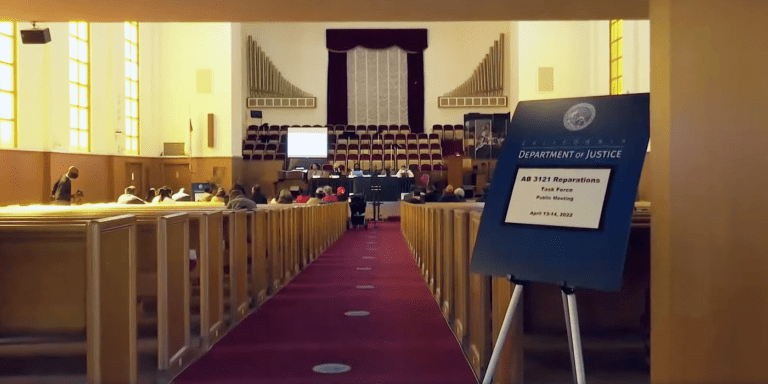
(Headline USA) San Francisco’s panel on reparations admitted this week that its recommendation that each black resident in the city receive $5 million was the result of a “journey” and not based on any objective reasoning as a matter of such delicacy might otherwise warrant.

“There wasn’t a math formula,” Eric McDonnell, chairman of the city’s African American Reparations Advisory Committee, told the Washington Post.

“It was a journey for the committee towards what could represent a significant enough investment in families to put them on this path to economic well-being, growth and vitality that chattel slavery and all the policies that flowed from it destroyed,” she said.

In January, the committee unveiled its recommendations to the city to repair the damage done by “decades of racist policies” in deep-blue San Francisco.

These policies, the committee said, were “explicitly created to subjugate black people in San Francisco by upholding and expanding the intent and legacy of chattel slavery.”

One of the recommendations is a $5 million check for each qualifying black resident.

City officials, however, have dismissed the proposal as “unrealistic.”

“I wish we had this kind of money in San Francisco’s general fund but if we want to maintain the services that exist today, we do not,” San Francisco Supervisor Hillary Ronen said last month.

Another official, Supervisor Shamann Walton, said one way to potentially fund reparations would be to use the revenue brought in by the city’s Cannabis Business Tax.

The tax, however, would raise only about $10.25 million annually—enough to cover two black residents per year—according to the San Francisco Standard.

San Francisco Republican Party Chairman John Dennis blasted the reparations committee for refusing to take its task seriously.

“This is just a bunch of like-minded people who got in the room and came up with a number,” he said.

“You’ll notice in that report, there was no justification for the number, no analysis provided,” he continued. “This was an opportunity to do some serious work and they blew it.”

The reparations committee also proposed debt forgiveness in addition to the $5 million payments.

Musk Exploring Possible Non-Woke Alternative to ChatGPT

(Jacob Bruns, Headline USA) Twitter and Tesla CEO Elon Musk has reportedly approached artificial intelligence developers to try to form a non-woke alternative to the notoriously left-wing ChatGPT, the Information reported.

Musk has publicly criticized OpenAI–the developer which created ChatGPT–in recent months because of the robot’s supposed “guardrails” that stop the bot from saying things that might offend people.


In order to head up the project, Musk has reportedly selected AI engineer Igor Babuschkin, who knows a great deal about machine-learning models, to begin development.

Babuschkin previously helped develop Alphabet’s DeepMind AI.

His prior comments suggest that his own AI chat bot would be decidedly un-woke.

The New York Post speculated that, with Musk at the head of Twitter as well, the AI that he develops might be integrated into that platform.

ChatGPT is so woke that it is unwilling even to imitate mainstream black comedians like Dave Chappelle due to his “offensive”; and “insensitive” remarks about “certain groups of people.”

In response, Musk said, “What we need is TruthGPT.”

Musk actually co-founded OpenAI in 2015, but left the company because he believed that it was training the robot to be woke.

According to OpenAI, they knew beforehand that the artificial intelligence tool would be likely to deliver responses that favor a left-wing view of the world–complete with Ivy League-style grammar prose–and disparage anything else.

“Since our launch of ChatGPT, users have shared outputs that they consider politically biased, offensive, or otherwise objectionable. In many cases, we think that the concerns raised have been valid and have uncovered real limitations of our systems which we want to address,” the company said in a recent statement addressing the accusations of bias.

Schumer Claims Trump Bowed to ‘Special Interests,’ but Was Top Recipient in 20 Industries

(Dominick Sansone, Headline USA) Pay-for-play special interests heavyweight Senate Majority Leader Chuck Schumer, D-Calif., wrongly blamed former President Donald Trump for the toxic train derailment in East Palestine, Ohio.

Speaking before the chamber, Schumer stated that the “Trump administration repealed requirements for an electronic braking system because, according to them, the safety benefits were not worth the cost.”

“It is so typical…for people like Donald Trump to do the bidding of special interests [by loosening railroad regulations] and then point the finger at someone else when something terrible happens.”

Schumer was referring to a 2018 decision by the Department of Transportation to repeal a 2015 rule mandating that trains moving highly flammable crude oil be equipped with special breaks to stop all rail cars simultaneously, according to reporting by the National Review.

However, the cause of the train derailment in East Palestine is still not determined. There is currently no evidence to support Schumer’s claim that the derailment would have been avoided if the 2015 regulation was still in place. Even Biden’s own transportation officials have called such claims disinformation.

In regard to the “special interests” that Schumer alluded to, the New York Senator is hardly free of association with funding from various groups seeking to influence policy.

Schumer was the top recipient of money coming from 20 major U.S. industries in the 2021-2022 election cycle, according to the research group Open Secrets.

Examples included Schumer as the top recipient of funds from industries such as “alternate energy productions & services”, “hedge funds”, “private equity & investment firms”, and “pro-Israel”.

He was also the Number 2 recipient of money from 14 additional industries, including “commercial banks”, “gay and lesbian rights & issues” and “marijuana”.

Georgia Democrat Sen. Raphael Warnock was the Number 2 recipient of aid in almost every single industry that Schumer ranked tops, while Schumer was Number 2 in almost every industry that Warnock was Number 1.

Opening the books helps to clarify who exactly it is that happens to be doing the “bidding” of special interest groups in U.S. politics.

New China Committee Will Seek to Bridge Bipartisan Gap on Nat’l Security Threat

(Headline USA) A special House committee dedicated to countering China will make its debut on Tuesday, the opening act in what lawmakers hope will be a robust effort to overcome partisan divisions and address a “generational challenge” to America’s national security.

The committee’s chairman, Rep. Mike Gallagher, R-Wisc., said he’s looking to bridge political differences rather than exploit them.

One of the retired Marine’s first efforts in that regard will be a hearing focused on informing Americans about precisely what constitutes the threat posed by the Chinese Communist Party.

“We’re doing some level-setting here: Why should someone care about the threat posed by the CCP?” Gallagher said. “Or to put it differently, what did we get wrong about the Chinese Communist Party and what do we need to get right about it so as to have a more successful and enduring strategy going forward?”

So far, Gallagher appears to have Democratic buy-in and support. The vote to create the committee was bipartisan, 365-65. Opponents on the Democratic side largely voiced the concern that the committee could stir a rise in anti-Asian hate crimes.

However, the supposed rise in such targeted attacks is largely attributable to a rise in the reporting of them as China-linked activist groups have sought to deflect from their culpability in the spread of the deadly coronavirus.

Many of the attacks in question have, in fact, been committed by homeless black men, who may see Asians as an easy mark for theft and other violent crimes that blue-run cities have tacitly enabled through soft-on-crime policies.

Anticipating the Left’s efforts to misdirect the focus of the committee’s work, Gallagher said he is committed to ensuring the focus is on the Chinese Communist Party, not on the people of China.

“We want to lead with that sort of human rights focused, values-focused agenda,” Gallagher said. “And that’s an area of unity, too, for a lot of Democrats and Republicans.”

Rep. Raja Krishnamoorthi, D-Ill., the ranking Democrat on the committee, said the CCP is counting on lawmakers to be “fractious, divided, partisan and we have to do the opposite.”

“We have no choice but to rise to the challenge at this point. It’s that serious,” Krishnamoorthi said.

Rep. Ro Khanna of California, another Democrat on the committee, said he expects Gallagher will set a sobering tone.

“The hope is that Congress can still rise to a generational challenge, and that is getting our China policy correct,” Khanna said. “And there are areas that can be bipartisan, from bringing good jobs back to making sure we’re deterring any invasion in the Taiwan Strait.”

The witnesses for Tuesday’s hearing includes two former advisers to President Donald Trump: Matthew Pottinger, the former deputy national security adviser; and H.R. McMaster, who was national security adviser from February 2017 to April 2018.

McMaster is no stranger to testifying about the threats he sees from China. He has warned Congress that the U.S. clung too long to the idea that China would liberalize its economy and form of governance as it was welcomed into international systems like the World Trade Organization.

He has recommend the U.S. not engage in trade or investment that transfers sensitive technology the CCP can use to gain military and economic advantages. He also has testified the U.S. should not do business in China in a way that helps the CCP stifle freedom and perfect its technology-enabled police state.

Tong Yi, a Chinese human-rights advocate, will amplify those concerns at the hearing. She was arrested in the 1990s after serving as an interpreter to a leading dissident who had urged the U.S. to condition trade on China’s human rights performance.

Tong spent nine months in detention before being handed a two-and-half year sentence for “disturbing social order” and sent to a labor camp, where she said authorities organized other inmates to beat her up.

“In the U.S., we need to face the fact that we have helped feed the baby dragon of the CCP until it has grown into what it now is,” she said in prepared remarks provided to the Associated Press. “Since the 1990s, U.S. companies have enriched themselves by exploiting cheap labor in China and have, in the process, also enriched the CCP.”

Scott Paul, president of an alliance formed by some manufacturing companies and the United Steelworkers labor union, will testify that “51 years of wishful thinking by American leaders” has failed to alter the dynamic that the CCP represents a “clear and present danger to the American worker, our innovation base, and our national security.”

The reaction to a suspected Chinese spy balloon in the U.S. earlier this month demonstrates the political tightrope that lawmakers will walk to prevent the committee from becoming a dividing force rather than a uniting one.

Republicans were highly critical of the Biden administration for not shooting down the balloon days earlier than it did, while Democrats defended Biden and stressed that he followed the military’s recommendation on when to take it down.

Gallagher said he suspects there are at least 10 pieces of legislation that the committee can endorse in a bipartisan fashion. Still, he said the members will be looking for support from House Speaker Kevin McCarthy, R-Calif., before it backs any legislation.

Given the known ties that many powerful lawmakers—including former Speaker Nancy Pelosi, D-Calif.; and Senate Minority Leader Mitch McConnell, R-Ky.—have with Chinese business interest, some remain skeptical that the committee’s work will ever see any meaningful action beyond public grandstanding.

McCarthy, too, remains a concern as a close friend of RINO strategist and pollster Frank Luntz, who has several globalist, pro-Chinese clients and a deep-abiding friendship with Hunter Biden going back to their college days. The Biden family’s business dealings are expected to be a central focus in the investigations of several GOP-led House committees.

One of the biggest challenges that the China committee will face is that jurisdiction over the issues involving China is spread across numerous other committees, and members of those committees will want a say.

“I think we can play a constructive coordinating function between the committees to ensure that good ideas don’t die just because of some committee’s cracks or they get referred to multiple committees,” Gallagher said.

An example of such an issue is a proposed ban on the purchase of farmland by entities affiliated with the CCP. He said about 10 bills have already been filed to enact that sort of ban.

“That’s a perfect of example of why this committee exists, because without it, you just have 10 individual members working in isolation and not necessarily cooperating, and thereby increasing the likelihood that this issue never gets addressed,” Gallagher said.

“So, we can, on behalf of the speaker, weigh all these various proposal and see if we can get the members who have the bills to agree on one approach and then work it through the committee process and get it passed on the floor,” he said.

Adapted from reporting by the Associated Press

Heineken to Become Official Beer of Bug-Eating, Vax-Pushing Globalists

(Jacob Bruns, Headline USA) Globalist tycoon Bill Gates has bought a large minority stake in the massive beer producing corporation Heineken Holding NV, Bloomberg reported.

Gates spent approximately $902 million to secure his investment in the world’s second-largest brewing company, coming out to 3.8% of the total holding, 6.65 million shares in his individual capacity, and 4.18 million shares through the fraudulent Bill & Melinda Gates Foundation Trust.

The billionaire reportedly swooped in to buy up the shares on the same day that Fomento Economico Mexicano SAB, the Mexican Coca-Cola bottler and convenience store operator, offloaded millions of shares of Heineken.

Interestingly, back in 2007, Gates bought a minority stake in FEMSA, a company that recently sold its Heineken stake and plans to continue offloading more Heineken shares in the coming years.

Though Gates presents himself as a health guru, his purchase of both Coca-Cola bottling and beer brewing mega-corporation stocks would indicate that he is more concerned with profits than he is with health.

Causing further intrigue is a post from Gates on Reddit in 2018, wherein he told fellow bloggers that he does not care much for beer.

“I am not a big beer drinker,” Gates wrote, noting that on rare occasions he will “drink light beer to get with the vibe of all the other beer drinkers.”

His own Bill & Melinda Gates Foundation has even funded studies warning against the consumption of alcohol.

The researchers, funded by their globalist captain, predictably found that “stronger interventions” are needed across the globe, especially among youths, “to reduce the substantial global health loss attributable to alcohol.”

Whether Gates—in true ESG form—plans to use his purchasing power to redirect the beverage industry in a more “sustainable” way, but it would not be the first time he was accused of using his billions for social-engineering projects.

Gates and his elite friends have zealously researched numerous ways to make the people of the world safe, including crop dusting them with mRNA vaccines. Gates is also said to be considering other ways to push vaccines through the food supply.

Some have also expressed their concern that his recent buyup of significant swaths of agricultural land in the U.S. might ultimately be to convert it from raising traditional livestock—such as delicious cattle—to more vegan options like cricket-farming.

Supreme Court Weighs Biden Overreach in $800B Loan-Amnesty Plan

0

(Headline USA) The Supreme Court heard arguments Tuesday in the legal fight over President Joe Biden’s controversial student-loan amnesty plan, which is projected to cost upward of $800 billion if it were to take effect.

Twenty-six million people have applied and 16 million have been approved to have up to $20,000 in federal student loans transferred from the debtors to taxpayers at large.

The high court was set to hear two challenges to the plan, which has so far been blocked by Republican-appointed judges on lower courts who determined Biden lacked the statutory authority to do what only Congress has the power to do.

Arguments were scheduled to last two hours, but likely will go much longer. The public can listen in on the court’s website.

Red-pilled liberal law professor Jonathan Turley also was offering a live-tweet play-by-play on Twitter.

He noted that while Solicitor General Elizabeth Prelogar had been effective in making Biden’s case, she faced an uphill battle against several moderate and conservative justices, who remained skeptical that there was any legal justification.

“I’m confident the legal authority to carry that plan is there,” Biden said Monday.

The president, who once doubted his own authority to broadly cancel student debt, first announced the program in August. Legal challenges quickly followed.

Republican-led states and lawmakers in Congress, as well as conservative and libertarian legal watchdogs, are lined up against the plan as a clear violation of Biden’s executive authority.

Democratic-led states and liberal interest groups are backing the Democratic administration in urging the court to allow the plan to take effect.

Without it, they claim that loan defaults would dramatically increase when the pause on loan payments ends no later than this summer due to their irresponsible borrowing and spending during the pandemic, when payments were temporarilty paused.

The administration claimed a 2003 law, commonly known as the HEROES Act, allows the secretary of education to waive or modify the terms of federal student loans in connection with a national emergency. The law was primarily intended to keep service members from being worse off financially while they fought in wars in Afghanistan and Iraq.

Nebraska and other states that sued say the plan is not necessary to keep the rate of defaults roughly where it was before the pandemic. The 20 million borrowers who have their entire loans erased would get a “windfall” that will leave them better off than they were before the pandemic, the states say.

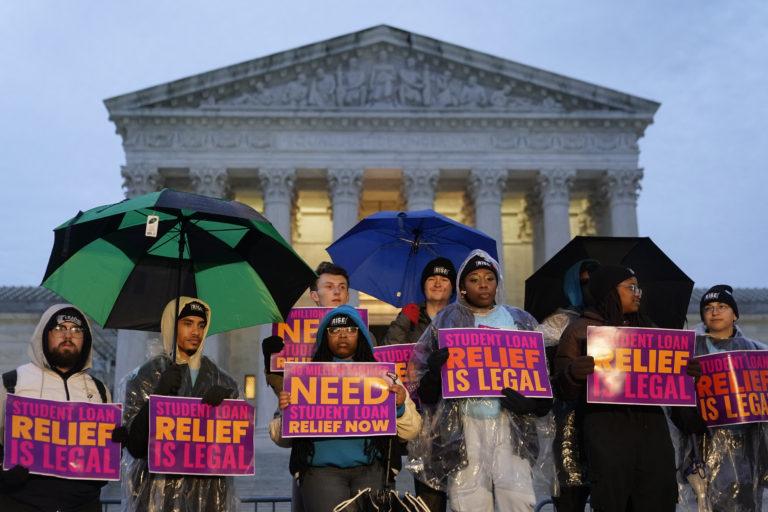
Dozens of borrowers came from across the country to camp out near the court on a soggy Monday evening in hopes of getting a seat for the arguments. Among them was Sinyetta Hill, who said that Biden’s plan would erase all but about $500 of the $20,000 or so she has in student loans.

“I was 18 when I signed up for college. I didn’t know it was going to be this big of a burden,” she whined.

“No student should have to deal with this. No person should have to deal with this,” said Hill, 22, who plans to incur even more debt by attending law school after she graduates from the University of Wisconsin–Milwaukee in May.

Biden’s plan could meet a frosty reception in the courtroom. The court’s majority has been skeptical of other Biden overreaching initiatives related to the pandemic, including vaccine mandates and an eviction moratorium.

Those were billed largely as public health measures intended to slow the spread of COVID-19 but ultimately became means for leftists to justify even more government overreach into the lives of law-abiding citizens.

The loan transfer plan, by contrast, is aimed at countering the economic effects of the pandemic, even though the result is likely to further increase inflation that has plagued the country since the very start of the Biden presidency.

Critics also contend that it will help already privileged individuals who took out loans irresponsibly while punishing those who paid them off or who decided to forgo college altogether due to the cost.

Despite Biden having already publicly declared the pandemic to be over, the national emergency is not expected to end until May 11.

Deflecting from their own policy failures, however, administration said the economic consequences will persist indefinitely.

In addition to the debate over the authority to forgive student debt, the court also will confront whether the states and two individuals whose challenge also is before the justices have the legal right, or standing, to sue.

Parties generally have to show that they would suffer financial harm and benefit from a court ruling in their favor. A federal judge initially found that the states would not be harmed and dismissed their lawsuit before an appellate panel said the case could proceed.

Of the two individuals who sued in Texas, one has student loans that are commercially held and the other is eligible for $10,000 in debt relief, not the $20,000 maximum. They would get nothing if they win their case but argue that they would have to pay more under the Biden plan than they would otherwise.

A decision is expected by late June.

Adapted from reporting by the Associated Press

Dem.-Run Enclaves Can’t Pay Their Bills, 66% of Largest Cities Combined Debt is $266.5 Billion

(Bethany Blankley, The Center Square) The majority of the 75 most populous U.S. cities can’t pay their bills and have a combined debt of $266.5 billion, according to new Financial State of the Cities report by Truth in Accounting.

The Chicago-based nonprofit’s seventh annual report evaluated fiscal 2021 data and found that 50 out of 75 cities evaluated – 66% – didn’t have enough money to pay their bills. Their combined debt totals $266.5 billion; combined pension debt totals $109.8 billion; and combined OPEB (other post-employment benefits) debt totals $168.7 billion.

The analysis ranks each city according to its taxpayer burden or taxpayer surplus, identifies them as sinkhole or sunshine cities, and assigns them letter grades. A taxpayer burden is the amount of money each taxpayer would owe if the city were to pay all of its accumulated debt to date. A taxpayer surplus is the amount of money the city has left over after all of its bills are paid, which is divided by the estimated number of taxpaying residents. Sinkhole cities can’t pay their bills; sunshine cities can and have a surplus.

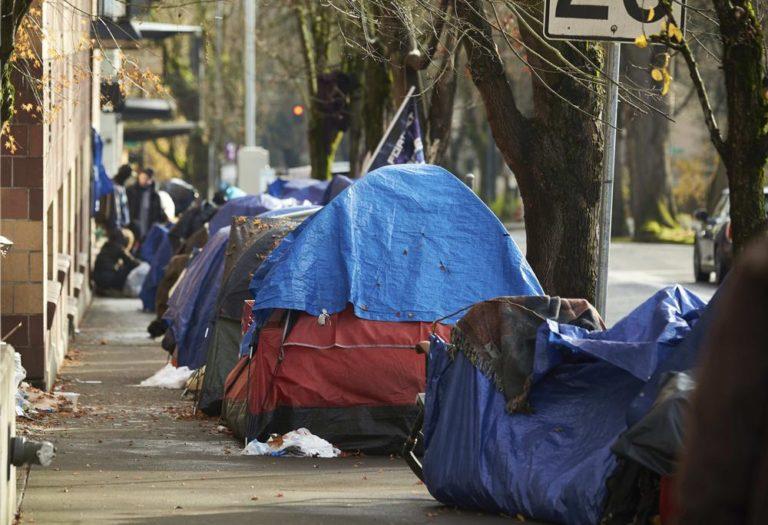
The 10 worst sinkhole cities with the highest taxpayer burden are run by Democrats, with the exception of Miami. New York City ranks the worst, followed by Chicago, Honolulu, Portland, New Orleans and Philadelphia, which all received F grades. St. Louis, Dallas, Pittsburgh, and Miami rounded out the worst 10 cities, all receiving D grades.

Their financial problems “stem mostly from unfunded retirement obligations that have accumulated over the years,” TIA says, compounded by other factors.

In New York City, for example, elected officials’ repeated financial decisions “left the city with a debt burden of $171.5 billion,” translating to a taxpayer burden of $56,900. “New York City’s financial problems stem mostly from unfunded retiree healthcare obligations that have accumulated over the years,” the report states. “While the city’s pension funds appear to be well funded due to the unrealized gains in pension investments, only four cents has been set aside for every dollar of promised retiree health care benefits.”

Chicago’s debt burden of $38.2 billion translates to a taxpayer burden of $41,900. The Wind City’s financial problems stem mostly from year-over-year claims of balanced budgets excluding employee compensation. As a result, these costs were pushed onto future taxpayers in the form of unfunded pensions and other retirement benefits, the report notes. City officials set aside only 25 cents for every dollar of promised pension benefits and no money for promised retiree health care benefits, the analysis found.

Portland’s debt burden of $5.2 billion would have been worse were it not for receiving federal stimulus money and record gains in the investment markets, the analysis found. The city’s taxpayer burden of $23,400 was primarily caused by unfunded retirement obligations that accumulated over the years, the report notes. The city set aside only 44 cents for every dollar of promised pension benefits and 20 cents for every dollar of promised retiree health care benefits, it found. “Not properly funding its pension and retiree health care promises places a burden on future taxpayers and puts pension holders at risk,” the report states.

All 75 cities TIA analyzed have balanced budget requirements designed to “to require financing and spending practices that enable governmental entities to avoid financial difficulty and to live within their means.”

“By definition, if a city has a balanced budget requirement, then spending should not exceed earned revenue brought in during a specific year,” the report states. “Balanced budget requirements are meant to prevent elected officials from shifting the burden of paying for current-year services onto future-year taxpayers.”

TIA says that despite having balanced budget requirements, the cities were in debt because politicians used “accounting tricks” to make them appear balanced. These “tricks” include inflating revenue assumptions, counting borrowed money as income, understating the true costs of government, and delaying the payment of current bills until the start of the next fiscal year so they aren’t included in the calculations, TIA says.

The most common accounting trick officials use, it notes, includes “hiding employee benefits” like healthcare, life insurance, and pensions “from the current budgeting process by not acknowledging they exist” even though they are obligated to pay them as employees earn them. Retirement benefits aren’t paid until employees retire but “they still represent current compensation costs because they were earned and incurred throughout the employees’ tenure,” TIA notes.

Cities are required to pay into the retirement fund to accumulate investment earnings but some elected officials have instead allocated them to other programs, TIA says. Instead of funding promised benefits now, what is owed is charged to future taxpayers, TIA says.

“Shifting these payments to future taxpayers allows the budget to appear balanced while city debt is increasing,” TIA notes. “Governments are able to accumulate debt while claiming balanced budgets because the vast majority of budgets are prepared on the cash-basis. This is an antiquated accounting method that includes cash inflows, including loan proceeds as revenue, and outflows – in other words, only checks written.”

Corporations Embracing ESG Must Lose Their Legal Protection

(Bruce Abramson, RealClear Wire) ESG, an acronym for Environmental, Social and Governance, is everywhere. If you work for, advise, invest in, regulate, study, or otherwise care about one or more corporations, you’ve likely encountered the term. Consultancies, banks, investment funds, managers, governments, and international organizations trip over themselves touting their ESG scores and credentials.

So what is ESG, and why should we care?

Though the term calls for incorporating concern with global warming (“E”), systemic racism (“S”), and other “woke” priorities into corporate governance (“G”), specifics can be elusive. The basic effect, however, is clear. ESG’s redefinition of “the corporation” threatens to undermine the stock market, the global economy, and large swathes of American law.

Its radicalism is hardly coincidental. ESG is an outgrowth of “stakeholder capitalism,” a theory first forwarded decades ago as an alternative to “shareholder capitalism.” Its earliest advocates thought that corporations whose sole purpose is to serve their owners—or shareholders—are cold and uncaring. Shouldn’t corporations also care about their employees, customers, neighbors, and all others whose lives they touch?

Under stakeholder capitalism, those people would gain a say over corporate decision-making. Under ESG, if all human activity affects problems like climate change and systemic racism, then all corporate decisions should incorporate such concerns. Corporations operating under this stakeholder model are thus a different species from the familiar shareholder corporation.

But corporations don’t exist in nature, and they don’t evolve. They’re legal constructs, subject to certain assumptions and constraints. Their legal and financial treatment is designed to make sense given the consequent model of corporate behavior. Alter the conceptual model of the corporation, and the bases of both corporate law and corporate finance collapse.

Shareholder corporations answer to a single moral imperative: maximize shareholder value. Whether you like the implicit morality or not, the behavior of entities following a single rule is predictable. Every existing element of both corporate law and corporate finance assumes that corporations are predictable profit-maximizers.

Stakeholder corporations undermine that assumption. Though stakeholder corporations can return value to shareholders, any corporation claiming proudly to consider multiple potentially conflicting tradeoffs cannot be assumed to work toward maximizing shareholder value. Stakeholder corporations are more complex entities than shareholder corporations—requiring corresponding complexity in their legal and financial treatment.

The World Economic Forum’s Klaus Schwab, arguably the most influential and prominent advocate of the ESG movement, was an early champion of stakeholder capitalism. In his recent Great Reset and Great Narrative books, Schwab shows how the stakeholder model, filtered through ESG, will centralize decision-making authority among a small cadre of corporate leaders and government bureaucrats—who, unencumbered by annoying shareholders or voters, will be free to focus on the common good.

For those of us who wish to prevent ESG’s takeover of the corporate landscape, corporate law offers a promising avenue of counterattack. The predictability of shareholder corporations earned them a simplified legal treatment subject to many helpful presumptions. Proud of their “evolved” ethical codes, stakeholder corporations have announced that such presumptions are misplaced.

Fair enough. Let the law take them at their word. Litigation and legislation must sever the legal treatment of stakeholder corporations from that of shareholder corporations.

Perhaps the cleanest—and potentially the most consequential—place to start is the Business Judgment Rule. This legal presumption allows every corporate defendant to arrive in the courtroom asserting that its decisions—including those that prove disastrous for shareholders—were made in the service of maximizing shareholder value. Plaintiffs—whether employees, shareholders, or business partners—complaining about corporate actions that failed to deliver bear the burden of proving bad faith, rather than mere errors in judgment.

The Business Judgment Rule makes sense when applied to shareholder corporations—but not to stakeholder corporations. Any corporation with an ESG statement has explicitly proclaimed that it will subvert some shareholder interests in favor of pressing environmental or social concerns.

The campaign to restore shareholder capitalism would snowball from there. Stakeholder corporations shorn of such legal benefits would sue the lawyers and consultants who guided them away from the legally beneficial shareholder model towards ESG—assuming only that even the most woke American corporations still value their own corporate interests. The legal and consulting classes will get the message.

ESG will persist as long as corporate leaders view it as cheap virtue signaling, would-be overlords see it as a path to power, and lawyers and consultants can milk it for revenues. The best way to defeat ESG is to rely on the same self-interest driving its current embrace: if the costs of ESG become exorbitant and obvious, the entire edifice will fall.

Like all utopian schemes, ESG is an attack on global freedom and prosperity. If you’re really dedicated to improving the lives of all stakeholders, you should work for an end to ESG.

U.S. Household Debt Rises Sharply

(Glenn Minnis, The Center Square) Household debt across the country is sharply on the rise, with U.S. households now collectively on the hook for about $17 trillion in total. The average family holds about $142,680 in debt, according to a new WalletHub report.

All told, the personal finance website concludes that 2022 ended with Americans roughly $320 billion more in total debt than they were at the start of the year. During the fourth quarter alone, consumers added at least $398 million in new debt, the fourth highest build-up for a fourth quarter over the past two decades and more than four times larger than Q4 2021.

In arriving at their tabulations, researchers said they used the latest data from the New York Fed, making adjustments for inflation.

“The sharp increase in household debt is mostly due to inflation and a rise in mortgage debt, which is based on strong consumer demand,” WalletHub analyst Jill Gonzalez told The Center Square, adding that though not included in the report credit card debt also factored in the overall rise in household debt.

As alarming as the new numbers might be to some, Gonzalez stressed it’s no time to panic.

“Although the rise in total household debt is for sure worrisome, WalletHub estimates that it’s still about $1 trillion below the breaking point,” she added. “This is a projection made based on debt levels during the Great Recession. On a household level, the debt is less than $12,000 below the projected breaking point for household finances, and this could spell trouble for families across the country. Having too much debt can send you into a downward spiral of late or missed payments, lower credit scores and even foreclosures or bankruptcies if the situation gets out of control.”

With mortgage debt increasing by $290 billion in 2022 or by the second highest annual jump since the end of the Great Recession, Gonzalez says it’s no surprise that area stands as the one where the most debt is now owed.

“About 70% is made up of mortgage debt,” she said. “This makes sense, considering a home is the largest purchase most people make during their lifetime.”

All the latest data comes just days after the New York Federal Reserve detailed that over the last 90 days of 2022, credit card balances ballooned by $61 million to $986 billion overall, easily smashing the previous high of $927 billion, registered before the COVID-19 pandemic commenced.

The rise in credit card usage and larger balances is raising eyebrows in light of interest rates being as high as they are. Earlier this month, Bankrate.com reported the average credit card APR, or annual percentage rate, set a new record high of 19.14%, eclipsing the July 1991 rate of 19%.

Wuhan Backlash Erupts after Stunning Biden Admin. Admission

(Casey Harper, The Center Square) Republicans erupted in outrage after the Biden administration admitted over the weekend that the Wuhan lab was the most likely source of COVID-19, the same lab taxpayers have funded for years.

The Wall Street Journal first reported that a classified briefing from the U.S. Energy Department to the White House and key members of Congress confirmed that the Wuhan research lab is the most likely origin source of COVID-19.

“This report affirms our belief that the substantial circumstantial evidence favors COVID-19 emerging from a research-related incident,” U.S. House Energy and Commerce Committee Chair Cathy McMorris Rodgers, R-Wash., Subcommittee on Oversight and Investigations Chair Morgan Griffith, R-Va., and Subcommittee on Health Chair Brett Guthrie, R-Ky., said in a joint statement. “These revelations also further strengthen the need to uncover why high-ranking government officials, with help from Big Tech and the media, sought early on to silence any debate into a plausible theory of a lab incident while the Chinese Communist Party stonewalled investigations by the global scientific community

The Republicans vowed to dig into the matter.

“The American people deserve answers if we are to restore trust in our public health agencies and be better prepared for possible future pandemics,” the Republicans said. “Our committee, in coordination with others in the House Republican Conference, will continue to push for the truth.”

The Biden administration’s admission comes after Republicans were roundly mocked by other lawmakers and the media during the pandemic for making the same assertion.

In 2020, the Associated Press called the idea a “myth.” The same year, the New York Times called it a “conspiracy theory,” and the Washington Post called it a “fringe theory.”

The Washington Post wrote an article in February 2020 blasting U.S. Sen. Tom Cotton, R-Ark., for pushing that “fringe theory.”

“Earlier versions of this story and its headline inaccurately characterized comments by Sen. Tom Cotton (R-Ark.) regarding the origins of the coronavirus,” the publication said in a later correction to their story. “The term ‘debunked’ and The Post’s use of ‘conspiracy theory’ have been removed because, then as now, there was no determination about the origins of the virus.”

Cotton posted WSJ’s story to Twitter with a short message.

“Well, well, well….,” he wrote.

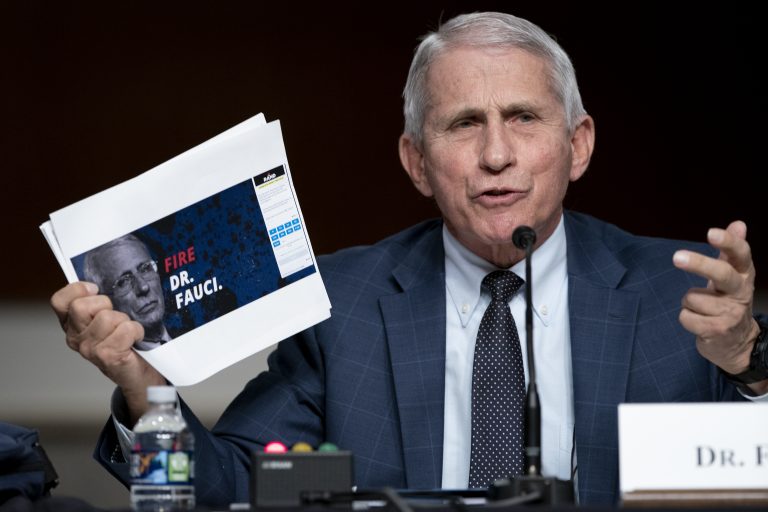
Sen. Rand Paul, R-Ky., said the documents behind this story should be declassified. He and others have blasted Dr. Anthony Fauci, who repeatedly discouraged the idea that the the virus originated from a lab.

“Fauci knew this immediately but dismissed it because of funding for the Wuhan lab,” said Sen. Eric Schmitt, R-Mo. “We know what happened next – when Fauci spoke Big Tech censored. I exposed this collusion as AG and I’ll work to ensure this type of censorship never happens again.”