Tennessee: Felons Must Restore Gun Rights (and All Citizenship Rights) Before Voting

(Headline USA) Tennessee’s toughened voting-rights restoration policy requires people convicted of a felony to get their gun rights restored before they can become eligible to cast a ballot again, the state’s elections office said Tuesday, confirming a mandate that officials had been debating internally.

Last summer, election officials interpreted a state Supreme Court ruling as requiring that all convicted felons applying for reinstated voting rights first get their full citizenship rights restored by a judge or show they were pardoned. Voting-rights advocates have argued the legal interpretation was way off-base.

The change, instituted by elections officials in July, has since halted almost all voting rights restorations: More than 60 people were denied, and just one person approved. In the nearly seven months before it was implemented, about 200 people were approved and 120 denied, according to data from the secretary of state’s office.

State Elections Coordinator Mark Goins revealed the gun rights decision Tuesday when asked about it by the Associated Press.

Pointing to the court’s ruling, he reiterated that someone’s full citizenship rights must be restored before they can regain the right to vote, and added, “Under the Tennessee Constitution, the right to bear arms is a right of citizenship.”

As recently as last month, Tennessee election officials expressed uncertainty about restoring the vote to convicted felons who hadn’t regained their gun rights, saying in court depositions that they were holding up 12 such applications while consulting with the state attorney general’s office.

All Tennessee felony drug crimes and felonies involving violence specifically strip away someone’s gun rights, and high-level action such as a pardon by a governor is needed to restore their voting rights, according to the Campaign Legal Center, an activist group funded by a litany of leftist donors that pursues legal challenges and other efforts to undermine election integrity laws.

The center had already filed a federal class-action lawsuit against the state over its previous voting rights restoration process—before the new rules even took place—arguing that it amounted to the suppression of black voters.

The suit argues that the state fails to make clear which officials can sign the necessary forms, provides no criteria for denial, and offers no avenue for appeal. Tennessee also requires that applicants are up to date on restitution, court costs and child support payments. The state also already bars voting-rights restoration for certain categories of crimes, if they were committed within certain date ranges.

The lawsuit was scheduled to go to trial last November. The policy change sparked by the high court’s decision spurred delays in court, making it unlikely that a trial will take place until after this year’s elections.

“Despite the Tennessee legislature’s clear intent to create meaningful pathways for voting rights restoration, the Elections Division, with help from the Attorney General’s office, continues to twist the law into tortured knots to prevent the 475,000 Tennesseans, including over 20% of voting age black Tennesseans, with past felony convictions from voting,” said Blair Bowie, director of Campaign Legal Center’s Restore Your Vote.

In its June decision, the high court ruled against a man who sought to register to vote in the state after receiving clemency for a crime committed decades ago in Virginia. The court ruled that he still had to go through the process of restoring his voting rights.

Though Tennessee elections officials have acknowledged that the court ruling applied only to the specific circumstances of that case, they have said the wording was close enough to the requirements under state law to necessitate the broad policy change.

Even as lawmakers returned to work at the state capitol early this month, it remained unclear whether supermajority Republicans would push to return to the old reinstatement system. Senate Speaker Randy McNally, for one, would prefer even more restrictions, showing how tough it is to sell the issue in Tennessee.

“Overall, I’m not in favor of felons voting. I think they’ve committed a serious crime, serious offense against the state,” McNally told the AP earlier this month. “And until they’re out of jail and either been pardoned or exonerated for what they did, then they forfeit that right.”

The only person approved for voting-rights restoration under the new system didn’t hit any snags in court, at least. A judge restored his “full rights of citizenship” in September, and the state elections office restored his voting rights in November.

Criminal defense attorney John Pellegrin said he helped his client get a judge to reinstate his citizenship rights, but wasn’t involved in helping him submit voting restoration documents. The new stricter requirements were news to him.

“I didn’t really find out about the change until after we had already done it,” Pellegrin told the AP.

Adapted from reporting by the Associated Press

FBI Waited 4 Years before Arresting Alleged Right-Wing Bomb Maker

(Ken Silva, Headline USA) Last month, the Justice Department charged Wisconsin man James Morgan, an alleged right-wing extremist, with unlawfully possessing a destructive device after FBI agents found six homemade grenades in his residence.

In an unsuccessful bid to have his client released on bail before trial, Morgan’s attorney said in recent court filings that the FBI monitored him for at least four years before arresting the alleged bomb maker last month.

A search warrant obtained by Forbes reportedly shows that the defense attorney is telling the truth. Forbes reported Tuesday that the FBI was first alerted to a Facebook video from Morgan, which contained a tutorial on how to produce an “acid gun” that would spray sulfuric acid at targets and potentially disfigure or seriously injure them.

“The FBI was particularly interested in his plan to share his weapon-making skills with the public,” Forbes reported, adding, “It is unclear why the government decided to arrest Morgan last month, four years after becoming aware of his online activity.”

An FBI report filed by Morgan’s attorney provides more details about his past, stating that the Department of Homeland Security previously investigated him for a sulfuric acid thrower weapon made from a plastic syringe.

When FBI agents interviewed Morgan last month, he reportedly told them he used to be an anarchist, but that the George Floyd riots changed his ideology.

“MORGAN used to be anarchist but was no longer interested in having a “fuck the government” mindset … BLM was crazy about criminals and not helping society by burning down their neighborhoods,” an FBI interview report stated.

“The Government was only trying to do its job by protecting people in the riots after Floyd’s death,” the report said.

“All of MORGAN’S experiments were meant for the battlefield, not for use on civilians – even back when he held anarchist views. MORGAN’S experiments were more to create irritants to protect his house from BLM.”

Morgan also reportedly told agents that if he was going to attack some place, it would have been the Federal Reserve.

Along with the grenades, FBI agents reportedly found copies of The Anarchist Cookbook and The Poor Man’s James Bond at his trailer. Both books were also owned by Oklahoma City bomber Tim McVeigh, and the latter was written by a former member of the Ku Klux Klan and “eight Satanic cults.”

Morgan reportedly told agents that he made the grenades with his dad, who is now dead. Morgan has yet to file any petitions in his case, and no hearings have been scheduled.

Ken Silva is a staff writer at Headline USA. Follow him at twitter.com/jd_cashless.

Fed. Judge Rejects N.M. Gov.’s ‘Emergency Order’ Denying Open-Carry Rights to Gun Owners

(Headline USA) A U.S. District Court judge stood by her decision to block portions of a “public health” order from New Mexico’s radical leftist governor that was designed to exploit emergency powers loopholes in order to curtail the Second Amendment rights of gunowners.

As part of the widely derided political gambit, Gov. Michelle Lujan Grisham sought to suspend the right to carry firearms in many public parks in the Albuquerque area, with appeals pending before a higher court.

The Monday order from Albuquerque-based Judge Kea Riggs denied a request from the governor to leave in place a temporary ban on firearms in some public places in greater Albuquerque, including most public parks.

Riggs earlier concluded that Lujan Grisham has not yet demonstrated a historical tradition of banning firearms in public parks or similar areas in the past, in response to a lawsuit by Torrance County resident James Springer—a plaintiff in one of several lawsuits filed against the governor by gun rights advocates.

“Our position is that’s not something that is contemplated under the Second Amendment,” said Springer’s attorney, A. Blair Dunn, applauding the judge’s order.

Last year, U.S. District Judge David Urias ruled in the other direction in a victory for the governor, rejecting a request from other gun-rights advocates to block temporary firearms restrictions while challenges move forward. It will likely fall to the U.S. 10th Circuit Court of Appeals in Denver to reconcile the orders from Urias and Riggs.

Gun rights advocates also are urging the New Mexico Supreme Court to block the orders. The court recently heard oral arguments in the lawsuit brought by Republican state legislators, the National Rifle Association and several residents of the Albuquerque area.

Lujan Grisham spokesperson Maddy Hayden said Tuesday that the governor “respectfully” disagrees with Riggs.

“Judge Riggs’ opinion ignores this caselaw and the massive amount of historical evidence in the record supporting the constitutionality of the temporary restrictions imposed by the public health order,” Hayden said in an email. “We respectfully disagree with the opinion and are confident that our ongoing appeal to the Tenth Circuit Court of Appeals will be successful.”

Lujan Grisham, a second-term Democrat, invoked the emergency orders last year in response to a spate of gun violence including the fatal shooting of an 11-year-old boy outside a minor league baseball stadium.

In response she was met with criticism not only from conservatives and libertarians, who were stunned by her brazen attack on the U.S. Constitution, but even by some on the far Left who saw an inherent risk from her overplaying her hand.

The rest of the public health orders have remained intact, including directives for monthly inspections of firearm dealers statewide, reports on gunshot victims at New Mexico hospitals, wastewater testing for illicit substances at schools and more.

During a 30-day legislative session that concludes Feb. 15, Lujan Grisham also is advocating for a broad suite of legislative proposals on gun control and enhanced penalties for violent crime.

On Tuesday, a proposal to shore up New Mexico’s red-flag gun law advanced past its first House committee hearing on a 4-2 party-line vote with Democrats in support of the bill from legislators including state Rep. Christine Chandler, of Los Alamos.

Proposed changes would expedite procedures for obtaining an “extreme risk” order to seize firearms and expand the range of people who can petition to temporarily remove guns to include health care professionals.

Votes against the bill were cast by two Republican lawmakers who are pursuing impeachment proceedings against the governor for her emergency health orders on gun violence.

Adapted from reporting by the Associated Press
Wisc. GOP Makes Last-Ditch Effort to Avert Billionaire-Bought Court’s Gerrymandering

(Headline USA) Wisconsin Republicans made a last-ditch effort Tuesday to prevent letting the leftist idealogues on the state Supreme Court put in place new legislative district boundaries for the November election.

Dark-money billionaires invested massive amounts of outside money last year to install Justice Janet Protasiewicz, upending the court’s narrow conservative majority.

She campaigned largely on overturing the state’s longstanding ban on abortion, which dated back to 1849; gerrymandering the legislative districts at the state and congressional levels to give Democrats more seats; and helping derail any challenges to the upcoming election, as Republicans sought to do following the highly disputed 2020 race.

Although Democrat Gov. Tony Evers already submitted redrawn maps that the legislature has signaled a willingness to compromise on, the court has again reopened the case, with notorious election-meddling lawfare attorney Marc Elias leading the charge, in the hopes of making them even less favorable to the GOP.

The Republican-controlled Senate passed new Senate and Assembly maps just over an hour after unveiling them, not giving the public or Democrats a chance to review them ahead of their release. Democrats said they didn’t have time to analyze the proposal before the vote.

Republican Senate Majority Leader Devin LeMahieu said that the new maps approved by the Senate were the same as what Evers proposed, but with changes to reduce the number of Republican incumbents who would have to face one another in November.

The governor’s map was “clearly a partisan attack on us,” LeMahieu said. “We just wanted to make things somewhat fair.”

In yet another twist, Republican Assembly Speaker Robin Vos said he supports passing the maps as proposed by Evers with no changes. He said Republicans can win under the lines drawn by Evers.

“We would basically be giving Gov. Evers a huge win,” Vos said shortly after Evers concluded his State of the State speech. “Adopting his maps, stopping the lawsuit seems like something to me we could agree on, but I’m waiting on Gov. Evers to get back to us.”

Evers’s spokesperson did not immediately return a message seeking comment.

The Assembly could vote on the maps Wednesday.

The Wisconsin Supreme Court last month tossed the current Republican-drawn district boundaries as unconstitutional and ordered new maps. Evers, Republicans, Democrats and others submitted maps that two consultants hired by the court are now reviewing. Their recommendation is due Feb. 1, and the court is expected to release new maps shortly after.

But the court said it would defer to the Legislature if it could pass maps that Evers would sign into law.

Evers and Democrats appeared unlikely to back the new Republican maps passed by the Senate which made changes to what he proposed.

“This is about one thing: Republicans desperately trying to retain power,” Evers’s spokesperson Britt Cudaback posted before the maps were released. “Full stop.”

Cudaback tweeted that any maps that differed from the maps as Evers submitted them to the Supreme Court “aren’t the governor’s maps. Period.”

If Evers vetoes the new Republican maps, it ”will just show his true intent of trying to disenfranchise Republican voters around the state,” LeMahieu said.

Democrats said the maps, detailed in a 169-page amendment, were an attempt by Republicans to protect their majorities that sit at 22-11 in the Senate and 64-35 in the Assembly.

“This is not a serious proposal that we have before us,” Democratic Sen. Mark Spreitzer said. “These maps make changes that protect Republican incumbents.”

The Senate passed the bill 17-14, with four Republicans joining 10 Democrats against. No Democrats voted for it.

All maps under consideration by the Wisconsin Supreme Court are expected to shrink Republican majorities.

Under the Evers map, Republicans would have a seven-seat majority in the Assembly, down from 29 seats now, and just a one-seat edge in the Senate, based on an analysis by Marquette University Law School research fellow John D. Johnson.

His analysis used a statistical model to predict the results of the 2022 state legislative election had they taken place in the newly proposed districts.

LeMahieu said the changes Republicans were proposing to Evers’s maps would not affect the partisan breakdown of each district.

In September, three months before the court ordered new maps, the Assembly passed a sweeping plan that took the power of drawing maps out of the hands of lawmakers and gives it to nonpartisan staff. But Evers rejected the plan, calling it “bogus,” even though it largely resembled a nonpartisan redistricting plan he’s pushed for years.

It was that bill that Senate Republicans amended before passing it Tuesday. It was passed just hours before Evers delivered his State of the State address.

Adapted from reporting by the Associated Press
Disney Seeks to Delay Lawsuit on DeSantis-Controlled District Overseeing Theme Park

(Headline USA) Disney for the second time attempted to forestall a state court case involving its legal battle with Gov. Ron DeSantis’s appointees over who controls Walt Disney World’s governing district.

The company accused the board of the Central Florida Tourism Oversight District (formerly the Reedy Creek Improvement District) and the governor’s office of stonewalling requests for documents that were part of the litigation.

The Republican governor, who withdrew on Sunday from the GOP presidential race, dialed back Disney’s longstanding special-use permits last year, with help from the GOP-led legislature, after the woke company dove headlong into a political battle over school indoctrination and parental rights related to the promotion of controversial classroom topics, specifically the LGBT agenda.

Disney publicly opposed the state’s anti-grooming law, which bans classroom lessons on sexual orientation and gender identity in early grades, when sexuality is not an essential part of child development and is viewed by many as an inappropriate topic to broach with youngsters.

The entertainment giant’s request came as a district employee said in a deposition that the takeover of the district’s board by DeSantis’s appointees last year had caused around 50 of its 370 employees to leave. The board has a scheduled monthly meeting Wednesday.

“There is a very, very, very politically motivated board, and I know we try not to acknowledge that, but that is a huge reason why a lot of people are leaving,” Erin O’Donnell, the district’s public records administrator, said in a deposition, sections of which were filed in court last week. “Other people may have had their own issues with leadership … but a lot of people have left just due to the entire shakeup of the district.”

The governing district provides municipal services such as planning, mosquito control and firefighting in the roughly 40 square miles in central Florida that make up Disney World.

Disney, DeSantis and the district have taken their fight over who controls the district to state and federal courts.

In its request for a delay, Disney claimed that it needed another six months to prepare for filing a motion since it hasn’t gotten the documents in a timely manner.

The district said in court papers that it had provided the appropriate documents. It accused Disney of going on “a fishing expedition to score political points” and “accusing the district of misbehavior when there is none.”

Disney’s motion will argue against a request by the district for the judge in the state case to make an immediate ruling without the need for a full-blown trial. The judge previously granted a delay last year at Disney’s request for the same reason.

In court papers, Disney said DeSantis’s office hadn’t produced a single requested document and “relied on excuses that are as inconsistent as they are unbelievable.”

Nick Meros, an attorney for the governor’s office, said Tuesday that his office doesn’t comment on pending litigation. In an email to Disney attorneys, filed in court papers, he said Disney’s requests were “broad and unwieldy.”

O’Donnell’s testimony provides insight into the turmoil since the takeover of the district, which previously was controlled by Disney supporters. The departure of longtime senior leaders has hampered day-to-day operations, and morale has taken a hit, she said.

Some procedures that had been ad hoc have been formalized by the new leadership, she added, but the attention given to the shakeup and the backgrounds of the DeSantis appointees have been distracting.

Among those appointees is Bridget Ziegler, a co-founder of the conservative activist group Moms for Liberty who has been accused of hypocrisy after admitting to a sexual relationship she and her husband had with another woman.

Last week Sarasota police cleared her husband, Christian Ziegler, of rape allegations involving the woman but said they asked prosecutors to charge him with illegally recording video of the sexual encounter he had with her. Earlier this month the Republican Party of Florida ousted Christian Ziegler as chairman of the state party.

“It’s just very hard to go through our day-to-days not hearing about all the extra news happening,” O’Donnell said. “So I think that just, in their own personal lives, and what they’ve done, or what affiliations they’re a part of, have just been extra noise, so to speak, at the district.”

Adapted from reporting by the Associated Press

Canadian Court: Trudeau’s Attacks on Freedom Convoy Were Illegal

(Jacob Bruns, Headline USA) A Canadian Court has ruled that the country’s prime minister, Justin Trudeau, took unjustified actions against Canadian truckers who protested the liberal nation’s stringent lockdowns in February of 2022, the Guardian reported Tuesday.

Justice Richard Mosley called Trudeau’s actions as Prime Minister “unreasonable and illegal” in a recently released decision.

At the time, Trudeau enacted the Emergencies Act, bequeathing himself limitless powers to crush his political opposition.

Trudeau used military-style force along with financial powers, having his government tell institutions to freeze all assets and personal bank accounts associated with Freedom Convoy participants.

According to the ruling, the Freedom Convoy posed enough of a threat to warrant some government action, but did not trigger the Emergencies Act that Trudeau used so eagerly to crush his political opponents.

“While the Court recognized that the occupation of downtown Ottawa and the blockades of the ports of entry were matters of serious concern calling for government and police action, the threshold of national emergency required by the Act was not met,” Mosley wrote in his ruling, noting that Trudeau could have had recourse to several other less severe laws.

At the time, the Prime Minister justified his decision by arguing that, in enacting the Emergency Act, he would only use it a little bit.

“We are not preventing the right of people to protest legally,” he said. “The act is to be used sparingly and as a last resort.”

Trudeau’s administration will fight the ruling.

In the wake of the court’s decision, Chrystia Freeland, the deputy prime minister, noted that the Canadian government would appeal the ruling, arguing that she and the rest of the administration acted to protect the Canadian people.

“The public safety of Canadians was under threat, our national security, which includes our national economic security was under threat,” she said. “It was a hard decision to take.”

NYPD Sergeant Charged w/ Homicide for Hurling Plastic Cooler at Fleeing Drug Dealer

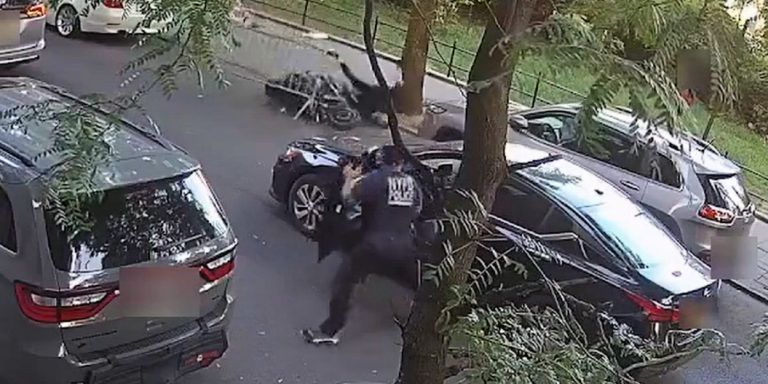
(Headline USA) A New York City police sergeant who hurled a plastic cooler at a man fleeing officers on a motorcycle, causing a crash that killed the rider, was charged with manslaughter, criminally negligent homicide and assault.

Erik Duran pleaded not guilty at his arraignment Tuesday in the Bronx and made bail, which was set at $150,000. Dozens of police officers came to court in his support.

Duran, 37, was suspended shortly after the incident and later placed on modified duty.

The indictment was announced by state Attorney General Letitia James’s office, which investigates all deaths at the hands of police officers.

Messages seeking comment were left with Duran’s union and his defense attorney.

Motorcyclist Eric Duprey, 30, was pronounced dead within minutes of being struck on a Bronx sidewalk last August. Police said Duprey had tried to flee on a friend’s motorcycle after he was caught selling drugs to an undercover police officer.

Duran had been standing on the sidewalk as part of the “buy-and-bust” operation carried out by the Bronx Narcotics Unit.

Surveillance video showed Duprey driving the motorcycle on a sidewalk toward a group of people, including the sergeant, who was not in uniform.

As he approaches, the video shows Duran pick up the red picnic cooler and throw it. Duprey is struck, loses control, and is tossed toward a tree as the motorcycle veers into the street. The bike smashes into a metal barricade before coming to rest against a parked car.

Duprey had three young children and worked as a delivery driver.

Duran, a 13-year veteran of the department, joined the Bronx Narcotics Unit in 2022. He has been recognized by the department dozens of times for what it deems excellent and meritorious police service, according to a police personnel database.

Duran’s disciplinary record includes a substantiated complaint in 2022 for abusing his authority during a stop, according to the city’s Civilian Complaint Review Board.

Duran’s next court date is April 18.

Adapted from reporting by the Associated Press

9th Circuit: FBI Illegally Raided Hundreds of Safe-Deposit Boxes

(Ken Silva, Headline USA) The 9th Circuit Court of Appeals ruled Tuesday that the FBI acted unlawfully in March 2021, when it raided hundreds of renters’ safe-deposit boxes in Beverly Hills, conducted criminal searches of them all, and attempted to permanently keep everything in the boxes worth more than $5,000—all without charging any box renter with a crime.

The 9th Circuit’s Tuesday decision stems from an investigation the FBI opened into US Private Vaults, or USPV—a company that, unlike typical banks, provided safe-deposit boxes to customers without requiring identification. The FBI had been investigating individual USPV customers, but determined the “real problem” was USPV, which they believed served as a “money laundering facilitator.”

Accordingly, the FBI raided the entire USPV vault in 2021.

Even though the warrant authorizing the raid only permitted the FBI to open boxes to identify their owners and safeguard the contents, agents rummaged through hundreds of boxes, ran currency they found in front of drug sniffing dogs, and made copies of people’s most personal records, according to the Institute for Justice, which filed a lawsuit on behalf of multiple non-criminal USPV customers.

The Justice Department then filed a massive administrative forfeiture claim to take more than $100 million in cash and other valuables, again, without charging any individual with a crime, the IJ added.

Among the FBI’s victims were Paul and Jennifer Snitko, who used their USPV box to store legal documents, watches with sentimental value, hard-drive backups, coins, and gold jewelry. The Snitkos used USPV because there was a waiting list to obtain a safe-deposit box at their local bank.

Another FBI victim was Joseph Ruiz, who stored $57,000 in cash in his box and used USPV because he was concerned that “the COVID pandemic would make it impossible for [him] to withdraw [his] funds from a bank account.”

Initially refusing to give the victims their property back, the FBI changed course and returned the stolen valuables after the plaintiffs filed a lawsuit in June 2021.

A district court initially ruled that the FBI didn’t violate the Fourth Amendment with the conduct described above, but the 9th Circuit reversed that ruling on Tuesday.

Judge Milan D. Smith, writing for the court, likened the FBI’s actions to the abuses that motivated the Bill of Rights.

“The government failed to explain why applying the inventory exception to this case would not open the door to the kinds of ‘writs of assistance’ the British authorities used prior to the Founding to conduct limitless searches of an individual’s personal belongings,” he said.

“It was those very abuses of power, after all, that led to adoption of the Fourth Amendment in the first place.”

Jennifer Snitko said she felt validated by the court’s decision.

“We knew that what the FBI did to us and so many others was wrong and today’s decision is a validation,” she said in a press release from IJ.

“It took courage for Paul and I to be among the first people to stand up publicly and call out the government but we are proud to have fought for our rights. This is a good day for our country and the principle that the government’s power to search our property has limits.”

Ken Silva is a staff writer at Headline USA. Follow him at twitter.com/jd_cashless.

Bush Judge Blocks N.C. Lawmakers’ Efforts to Tighten Same-Day Registration Rules

(Headline USA) A federal judge has blocked, for now, a new law recently approved by North Carolina lawmakers that tightens a rule on when a ballot cast by someone who is simultaneously registering to vote is removed from election counts.

Thomas Schroeder
Thomas Schroeder / PHOTO: Federalist Society

The preliminary injunction from U.S. District Judge Thomas Schroeder tells elections workers they can’t nullify ballots by screening citizens who register and immediately vote during a 17-day period before a primary or general election through an altered method unless applicant protections are created.

Over 100,000 new registrants have sought “same-day registration” in North Carolina during each of the last two presidential general elections, so slight adjustments in the closely divided state could make a difference in this November’s elections for president, governor and other statewide positions.

Early in-person voting—and thus same-day registration—for the March 5 primaries begins Feb. 15.

The new law is contained within broader voting administration legislation enacted by the Republican-controlled General Assembly in the fall over Democratic Gov. Roy Cooper’s veto. It would, in part, remove a registrant’s ballot from the count after one mailed notice to the person’s address by election officials is returned as undeliverable, instead of two under the previous law.

The new provision has been challenged in at least three lawsuits. Schroeder’s 94-page ruling Sunday involved two of the lawsuits filed in October, one by the state and national Democratic parties and the other by national and local voter advocacy groups and a voter.

Schroeder, who was nominated to the bench by President George W. Bush, wrote that the one-mailer procedure doesn’t provide due-process protections for voters to learn that their registrations were rejected and to appeal the decision to officials so the ballots could still count.

The plaintiffs said the new procedure would increase the risk that U.S. Postal Service mishaps and paperwork errors would lead to more registration denials. Schroeder’s order cited evidence from a plaintiff called Voto Latino about election worker errors leading to verification cards being returned as undeliverable in 2022.

The plaintiffs have demonstrated a likelihood that the provision giving people only one chance to verify by mail will impose a “substantial burden on same-day registrants who cast a ballot,” Schroeder said.

They “will face a non-trivial risk of being erroneously disenfranchised by failing address verification due to governmental error, rather than factors related to their eligibility to vote, without any notice and opportunity to be heard,” the judge’s ruling said.

Schroeder, whose ruling can be appealed, said his injunction would remain in force until due process concerns are addressed.

Two GOP state House leaders, Speaker Tim Moore and elections committee chair Rep. Grey Mills, said Monday in a news release that Schroeder’s order “requires relatively minor changes” and that they were working with the State Board of Elections “to ensure that the entire bill is in effect before the primary and general elections this year.”

Representatives of some of the plaintiffs praised the ruling as a “major victory” and will “continue working to ensure that the [mail provision] does not wrongfully disenfranchise eligible North Carolinians in 2024,” attorney Aria Branch said in a news release.

Lawyers for the state board and GOP legislative leaders defending the new verification rule in court have said reducing the number of mailers to confirm the applicant’s mailing address attempts to address a problem with same-day registration.

The previous law could lead to situations where the second verification mailer is returned as undeliverable after vote totals are finalized, meaning the ineligible registrant’s ballot is still counted. State lawyers also said a ruling in a previous lawsuit discourages efforts by local election boards to challenge such votes before the final count.

Schroeder acknowledged there are legitimate interests in using address verification to promote preserving the integrity of the election process and instilling voter confidence. But he wrote the plaintiffs have shown the state’s “precise interests asserted in this case likely do not outweigh the substantial burden on the rights of same-day registrants who cast a ballot.”

For the November 2020 election, for example, about 2,150 new same-day registration applicants in North Carolina failed the address verification. But Schroeder said the state board and Republican legislators “have presented no evidence that address verification has ever filtered out a single ineligible same-day registrant.”

Schroeder refused to issue preliminary injunctions sought by the Democratic National Committee, state Democratic Party and others on other provisions related to same-day registration. The new law contains other provisions that also remain in effect, including increasing access by partisan poll observers at voting sites and requiring mail-in absentee ballots be returned by election night in order to count.

The state Republican Party and Republican National Committee also joined the lawsuit as defendants.

Adapted from reporting by the Associated Press
MAHARREY: Understanding the Hidden Impact of Taxes and Inflation

(Mike Maharrey, Money Metals News Service) In our complex financial landscape, few things are as pervasive and recurrent as taxes. From the obvious ones like income, sales, and property taxes to the less apparent ones embedded in our daily bills, the spectrum of taxation is wide and deep. However, a closer examination of our economic system reveals a more insidious fiscal phenomenon – the ‘inflation tax.’

Debt and Inflation Taxes: Understanding the Hidden Impact of Taxes and Inflation on the Economy

Despite the multitude of revenue streams flowing into government coffers, inefficiency in government operations remains a stark reality. The United States’ staggering national debt, now over $34 trillion, and a recent half-trillion-dollar deficit under the Biden administration, are testaments to this inefficiency. This situation draws into question: how does a nation so rich in tax revenue find itself buried in debt?

The answer lies partly in the concept of the inflation tax – a term less about actual taxation and more about the erosion of purchasing power due to inflation. This subtle yet powerful mechanism is often overshadowed by more direct forms of taxation, but its impact is profound.

Governments finance their expenditures in two primary ways: direct taxation and borrowing. Direct taxation, although transparent, is unpopular and politically sensitive. Consequently, governments often resort to borrowing, which, while deferring the tax burden to the future, accrues interest and ultimately costs more in the long run.

The United States, for instance, spends more on interest expenses monthly than on its national defense. This staggering fact illustrates the long-term implications of borrowing as a means of government financing. Moreover, the improbability of completely repaying the national debt, given its enormity, highlights the unsustainable nature of this approach.

The Federal Reserve’s role in debt monetization is crucial in understanding the inflation tax. By creating money to buy government bonds, the Fed effectively turns debt into cash, a process that has accelerated since the COVID-19 pandemic. This influx of created money reduces the purchasing power of existing currency, leading to inflation. As a result, even though nominal wages may rise, real wages – adjusted for inflation – often decline, disproving the idea that wage increases can keep pace with rising prices.

Interestingly, despite declining real wages, consumer spending remains buoyant, a phenomenon largely attributed to the increased use of credit cards. This trend indicates a deeper issue where consumers are essentially borrowing to maintain their spending power, mirroring the government’s own borrowing habits.

A historical perspective underscores the severity of this issue. Since the detachment of the US dollar from the gold standard in 1971, the dollar has lost over 85% of its value, while the value of gold has skyrocketed. This disparity highlights the importance of investing in real money, like gold and silver, as a hedge against inflation.

In conclusion, while taxes are a visible and often discussed component of our economic system, the inflation tax operates silently, eroding our wealth and purchasing power. Understanding and mitigating its impact through informed financial decisions, such as investing in stable assets, is crucial for preserving personal wealth in an ever-changing economic landscape.