Musk Wins Sharholder Approval for $44.9B Tesla Stock Package Blocked by Delaware Judge

(Headline USA) Tesla shareholders voted Thursday to restore CEO Elon Musk’s record $44.9 billion pay package that was thrown out by a Delaware judge earlier this year, sending a strong vote of confidence in his leadership of the world’s largest electric vehicle maker.

The ruling (along with a subsequent X poll) inspired Musk to move the official incorporation of his company from Delaware—a popular state due to its reputation for business friendly legal and liability protections—to Texas, where the actual headquarters is (after Musk previously relocated it from California under similar circumstances).

The favorable shareholder vote doesn’t necessarily mean that Musk will get the all-stock compensation anytime soon. The package is likely to remain tied up in the Delaware Chancery Court and Supreme Court for months as Tesla tries to overturn the Delaware judge’s rejection.

Musk has raised doubts about his future with Tesla this year, writing on X that he wanted a 25% stake in the company in order to stop him from taking artificial intelligence development elsewhere. The higher stake is needed to control the use of AI, he has said.

Tesla also has struggled with falling sales and profit margins as demand for electric vehicles slows worldwide.

But at the company’s annual meeting Thursday in Austin, Texas, Musk reassured shareholders that he will stick around, telling them he can’t sell any stock in the compensation package for five years.

“It’s not actually cash, and I can’t cut and run, nor would I want to,” he said.

The company said late Thursday that shareholders had voted for Musk’s compensation plan, which initially was approved by the board and stockholders six years ago.

Tesla last valued the package at $44.9 billion in an April regulatory filing. It was once as much as $56 billion but has declined in value in tandem with Tesla’s stock, which has dropped about 25% so far this year.

Chancellor Kathaleen St. Jude McCormick ruled in January in a shareholder’s lawsuit that Musk essentially controlled the Tesla board when it ratified the package in 2018, and that it failed to fully inform shareholders who approved it the same year.

Tesla has said it would appeal, but asked shareholders to reapprove the package at Thursday’s annual meeting.

A separate vote approved moving the company’s legal home to Texas to avoid the courts in Delaware, where Tesla is registered as a corporation.

“Its incredible,” a jubilant Musk told the crowd gathered at Tesla’s headquarters and large factory in Austin, Texas. “I think we’re not just opening a new chapter for Tesla, we’re starting a new book.”

Musk and Tesla didn’t win everything. Shareholders approved measures that trimmed board member terms from three years to one and cut the required vote on shareholder proposals to a simple majority.

Legal experts say the issue of Musk’s pay will still be decided in Delaware, largely because Musk’s lawyers have assured McCormick they won’t try to move the case to Texas.

But they differ on whether the new ratification of the pay package will make it easier for Tesla to get it approved.

Charles Elson, a retired professor and founder of the corporate governance center at the University of Delaware, said he doesn’t think the vote will influence McCormick, who issued a decision based on the law.

McCormick’s ruling essentially made the 2018 compensation package a gift to Musk, Elson said, and that would need unanimous shareholder approval, an impossible threshold. The vote, he said, is interesting from a public perception standpoint, but “in my view it does not affect the ruling.”

John Lawrence, a Dallas-based lawyer with Baker Botts who defends corporations against shareholder lawsuits, agreed the vote doesn’t end the legal dispute and automatically give Musk the stock options. But he says it gives Tesla a strong argument to get the ruling overturned.

He expects Musk and Tesla to argue that shareholders were fully informed before the latest votes, so McCormick should reverse her decision. But the plaintiff in the lawsuit will argue that the vote has no impact and isn’t legally binding, Lawrence said.

The vote, he said, was done under Delaware law and should be considered by the judge.

“This shareholder vote is a strong signal that you now have an absolutely well-informed body of shareholders,” he said. “The judge in Delaware still could decide that this doesn’t change a thing about her prior ruling and doesn’t require her to make any different ruling going forward. But I think it definitely gives Tesla and Musk strong ammunition to try to get her to revisit this.”

If the ruling stands, then Musk likely will appeal to the Delaware Supreme Court, Lawrence said.

Multiple institutional investors have come out against Musk’s sizeable payout, some citing the company’s recent struggles. But analysts said votes by individual shareholders likely put Musk’s pay over the top.

Early Friday, Tesla disclosed that shareholders voted for Musk’s pay package by 1,760,780,650 to 528,908,419, with about 77% of all votes in favor. The company’s shares jumped 3% by the time the markets closed Thursday and were up 1.2% in premarket trading early Friday.

After the votes were announced, Musk began telling shareholders about new developments in the company’s “Full Self-Driving” system. He has staked the company’s future on development of autonomous vehicles, robots and artificial intelligence.

“Full Self-Driving” keeps improving with new versions, and its safety per mile is better than human drivers, Musk said.

“This is actually going to work. This is going to happen. Mark my words, this is just a matter of time,” he said.

Despite its name, “Full Self-Driving” can’t drive itself, and the company says human drivers must be ready to intervene at all times. Tesla’s “Full Self-Driving” hardware went on sale late in 2015, and Musk has used the name ever since as the company gathered data to teach its computers how to drive.

In 2019, Musk promised a fleet of autonomous robotaxis by 2020, and he said in early 2022 that the cars would be autonomous that year. In April of last year, Musk said the system should be ready in 2023.

Since 2021, Tesla has been beta-testing “Full Self-Driving” using volunteer owners. U.S. safety regulators last year made Tesla recall the software after finding that the system misbehaved around intersections and could violate traffic laws.

Musk also said the company is making huge progress on its Optimus humanoid robot. Currently it has two working at its factory in Fremont, California, that take battery cells off a production line and put them in shipping containers, he said.

Despite laying off the team working on Tesla’s Supercharger electric vehicle charging network, Musk said he thinks the company will deploy more chargers this year “that are actually working” than the rest of the industry. In the second half of the year, he expects to spend $500 million on Superchargers, Musk said.

Adapted from reporting by the Associated Press
Fed Now Envisions Just One Rate Cut This Year as Bidenflation Persists Above Expectations

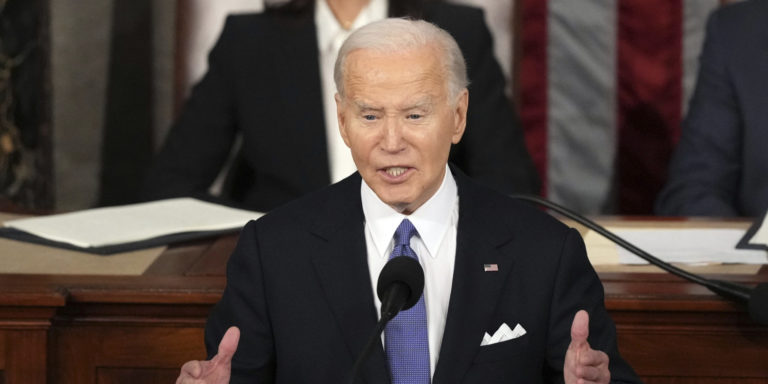
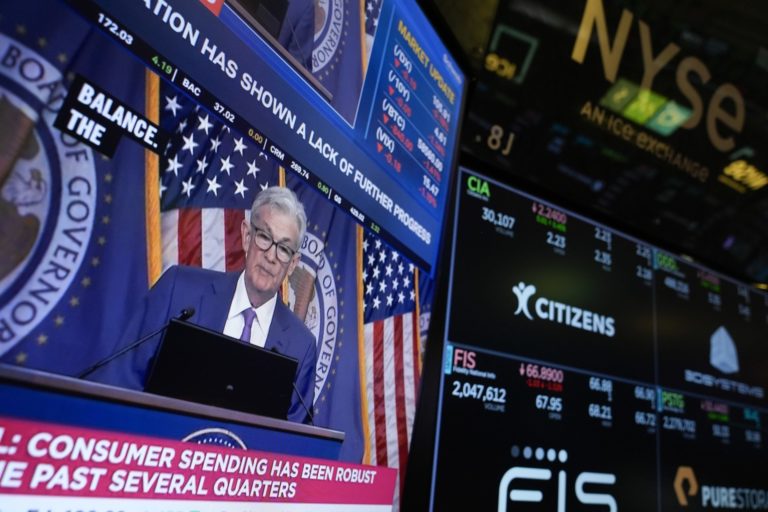
(Headline USA) Federal Reserve officials signaled Wednesday that they expected to cut their benchmark interest rate just once this year due to the ongoing scourge of Bidenflation, which has yet to come anywhere close to reaching its target level at around 2%.

The policymakers’ forecast for one rate cut was down from their previous projection of three cuts.

The scaled-back estimate for rate cuts came as something of a surprise, given that the government reported earlier Wednesday that consumer inflation eased in May more than most economists had expected. That report suggested that the Fed’s high-rate polices are succeeding in taming inflation.

Nonetheless, the root cause of inflation—which is the government’s continuing to print and spend new money it doesn’t have—has persisted under the Biden administration as a matter of policy, with many of those dollars going out the door to Ukraine and other countries.

Meanwhile, the Democrat president has relied on an open-border immigration policy to artificially bolster certain segments of the job market, providing a false sense of a stable economy due to the fact that the government is continuing to hire people to meet the additional needs of its own social services.

Financial markets took encouragement, though, from the policy statement the Fed issued after its latest meeting ended, which underscored that it sees progress in its fight against high inflation. Broad stock indexes rose sharply, and bond yields fell in response.

The policymakers, as expected, kept their key rate unchanged Wednesday at roughly 5.3%. The benchmark rate has remained at that level since July of last year, after the Fed raised it 11 times to try to slow borrowing and spending and cool inflation.

Whenever the Fed does begin to reduce its benchmark rate, now at a 23-year high, it would eventually lighten loan costs for consumers, who have faced punishingly high rates for mortgages, auto loans, credit cards and other forms of borrowing.

The central bank’s rate policies over the next several months could also have consequences for the presidential race. Voters have taken a generally sour view of the economy under President Joe Biden. In large part, that’s because prices remain much higher than they were before the pandemic struck. High borrowing rates have imposed a further financial burden.

Speaking at a news conference after the Fed meeting ended, Chair Jerome Powell seemed to downplay the significance of the policymakers’ collective forecast of just one rate cut in 2024. That forecast is derived from the individual predictions of 19 policymakers, and Powell noted that 15 of the officials projected either one or two rate cuts this year.

“I would look at all of them as plausible,” he said.

“No one,” the Fed chair added, “brings to this a really strong commitment to a particular rate path. It’s just what they think in a given moment in time.”

Economists say two rate cuts, with the first one coming as early as September, are still possible despite the central bank’s prediction of just one.

“I don’t think September’s off the table,” said Matthew Luzzetti, chief U.S. economist at Deutsche Bank. “To get there, you’d have to have a string of inflation reports like the one we got this morning.”

At his news conference, though, Powell cautioned, “We’ll need to see more good data to bolster our confidence that inflation is moving sustainably toward 2%.”

He also underscored that with the economy still overall healthy, Fed officials feel little urgency to cut rates.

“What we’ve been getting is good progress on inflation, with growth at a good level and with a strong labor market,” the Fed chair said. “Ultimately, we think rates will have to come down to continue to support that. But so far they haven’t had to.”

Uncertainty over when borrowing rates might come down is keeping some consumers on edge, especially those seeking to buy a home who face painfully high mortgage rates, now averaging around 7%.

David Goines, who owns a four-bedroom, two-bath mobile home in Lexington, Oklahoma, began looking for a new house last year but was put off by the elevated mortgage rates.

“Once we calculated what our payments would be for the house that we were looking at, it was just unfeasible,” he said.

Goines, a 36-year-old information technology director, has been holding out hope that rates would ease this year. He’s still waiting.

“We’re pretty pessimistic of the rates even getting down to 5% in the next 12 months,” he said. “Right now, we’re just pretty much stuck.”

On Wednesday morning, the government reported that inflation eased in May for a second straight month, a hopeful sign that an acceleration of prices that occurred early this year may have passed.

Consumer prices excluding volatile food and energy costs—the closely watched “core” index—rose just 0.2% from April, the smallest rise since October. Measured from a year earlier, core prices climbed 3.4%, the mildest pace in three years.

“We welcome today’s [inflation] reading and hope for more like that,” Powell said.

Inflation has tumbled from a peak of 9.1% two years ago. The policymakers now face the delicate task of keeping rates high enough to slow spending and fully defeat high inflation without derailing the economy.

Measures of inflation had cooled steadily in the second half of last year, raising hopes that the Fed could achieve a rare “soft landing,” whereby it would manage to conquer inflation through rate hikes without causing a recession.

But inflation came in unexpectedly high in the first three months of this year, delaying hoped-for Fed rate cuts and potentially imperiling a soft landing.

As part of the updated quarterly forecasts the policymakers issued Wednesday, they projected that the economy will grow 2.1% this year and 2% in 2025, the same as they had envisioned in March.

They expect core inflation to be 2.8% by year’s end, according to their preferred gauge, up from a previous forecast of 2.6%. And they project that unemployment will stay at its current 4% rate by the end of this year and edge up to 4.2% by the end of 2025.

The expectation that the unemployment rate will remain around those low levels indicates that the officials believe that while the job market will gradually slow, it will remain fundamentally healthy.

“By so many measures,” Powell said, “the labor market was kind of overheated two years ago, and we’ve seen it move back into much better balance between supply and demand.”

Adapted from reporting by the Associated Press
Trump Floats Eliminating U.S. Income Tax in Meeting w/ Congressional Republicans

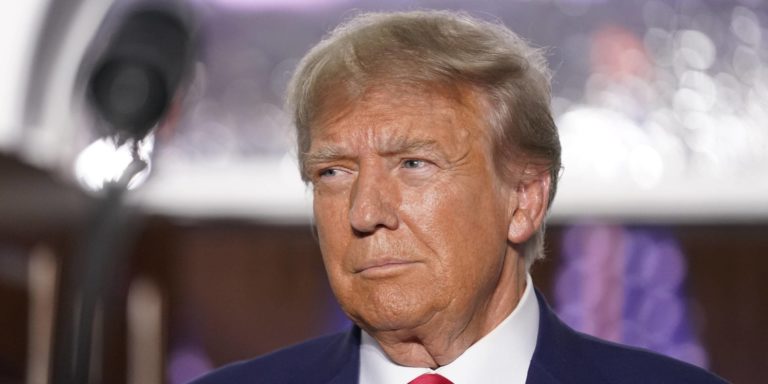
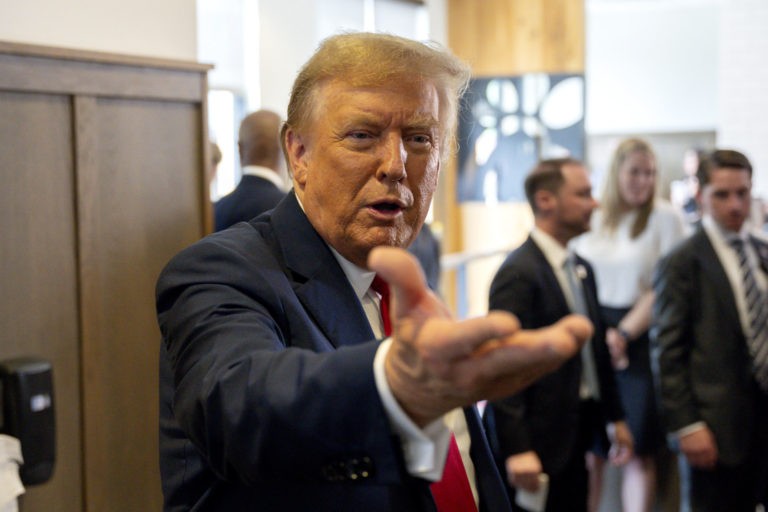
(Headline USA) Former President Donald Trump reportedly suggested to congressional Republicans this week that one of his legislative priorities would be eliminating the U.S. income tax if he wins the White House in November.

The presumptive GOP presidential nominee brought up the proposal during his meeting with GOP lawmakers on Capitol Hill on Thursday, according to Rep. Thomas Massie, R-Ky.

“Most intriguing policy idea from the GOP meeting at the Capitol Hill Club this morning,” Massie wrote on X. “Trump briefly floated the concept of eliminating the income tax and replacing it with tariffs.”

The 16th Amendment gives Congress the power to levy taxes on income. But prior to its passage, the federal government’s main source of revenue was tariffs.

Rep. Marjorie Taylor Greene, R-Ga., confirmed the report.

“I was thrilled to hear President Trump suggest we raise tariffs and reduce the income tax for Americans to zero as a new tax policy after the tax plan expires this year. This will really help struggling Americans get back on their feet after 4 bad years of Bidenomics,” she wrote on X.

Economists expressed skepticism of Trump’s plan, arguing increased tariffs would not generate enough revenue to match revenue brought in by income taxes, and would potentially hurt the U.S. dollar’s global standing.

The Trump campaign has not yet commented on the former president’s comments. But Trump repeatedly has made clear on the campaign trail that he intends to increase tariffs, especially on Chinese goods. He’s even floated tariffs of 60% or higher on all Chinese imports.

“They’ve also got to do it on other vehicles and they have to do it on a lot of other products,” he said last month after the Biden administration announced its own tariffs on Chinese electric vehicles. “Because China’s eating our lunch right now. … They have to do it on much more than electric vehicles.”

Wisconsin Town Preserves the Legacy of Flag Day, the Oft-Forgotten U.S. Holiday

(Headline USA) Each June, the people of Waubeka, Wisconsin, venerate perhaps the nation’s most enduring symbol, celebrating Flag Day, a holiday that escapes the notice of many Americans.

But this unincorporated town about 35 miles north of Milwaukee takes the day seriously. After all, it lays claim to being the birthplace of Flag Day, thanks to a tenacious teacher in a one-room schoolhouse.

Flag Day commemorates June 14, 1777, when the Continental Congress determined the composition of the nation’s banner: “Resolved, That the flag of the thirteen United States be thirteen stripes, alternate red and white; that the union be thirteen stars, white in a blue field, representing a new constellation.”

Flag Day isn’t like Thanksgiving, Memorial Day and a smattering of other federal holidays that generally mean Americans can spend the day off work.

Although it’s officially recognized nationwide, government services are still open and the mail still gets delivered. Only Pennsylvania marks it as a state holiday, allowing residents to stay home from work and school.

But another backyard barbecue isn’t required to feel the love in Waubeka, according to David Janik, a native of the town and second-generation president of the National Flag Day Foundation.

“Our passion for the flag here is very deep,” Janik said.

“The flag is the symbol of our country—it symbolizes individualism, success, loss, daring, chivalry,” he added. “People need a compass to guide them, and the flag is a great compass.”

Yes, Independence Day—celebrated just a few weeks later—also makes prominent use of the flag. But the emblem is important enough to have its own day, Janik contended.

“July 4th, we’re celebrating our independence,” Janik said. “But on Flag Day, we’re celebrating the birth of our flag, which is the symbol of our country, the symbol that is seen all around the world as the helper, the people who won’t leave you out in the cold.”

The earliest mention of Flag Day involves a man named George Morris who organized such a commemoration on June 14, 1861, in Hartford, Connecticut, marked by a patriotic program and prayers for Union Army success in a young Civil War. But apparently, the festivities were never repeated.

On June 14, 1885, Bernard J. Cigrand, an 18-year-old Waubeka native teaching at Stony Hill School, put a flag in his inkwell and assigned his students an essay about what the flag meant to them.

Cigrand left the next year for dental school in Chicago, but he never gave up his advocacy for a national day dedicated to the flag. He realized his dream in 1916, when President Woodrow Wilson issued a 1916 proclamation of June 14 as Flag Day.

In 1949, President Harry S. Truman signed the formal observance into law. And it falls during Flag Week, after another congressional dictum in 1966.

Although he died in 1932, Waubeka never forgot Cigrand—and, in 1946, community leaders established the town’s Flag Day celebration, which has run continuously since then.

Pennsylvanians, however, will challenge Cigrand’s coronation as “Father of Flag Day.”

Pittsburgh native William T. Kerr began his advocacy in 1888 and, a year later, became national chairman of the American Flag Day Foundation, holding that position for a half a century. Kerr was among those standing beside Truman when he signed the Flag Day law.

As for the expected friendly rivalry, Janik said his father, the late Jack Janik, “took care of that.” The elder Janik traveled to Washington and lobbied Congress, which in 2004 adopted a resolution naming Waubeka “the birthplace of Flag Day.”

Along with the parade, the bands, the patriotism awards, the military honor guards and a dog named Harlow—who turns 8 on Flag Day and sported a red, white and blue boater on her head during last weekend’s parade—there are the essays.

In the spirit of Cigrand and his students of 139 years ago, the Waubeka Flag Day celebration includes an annual essay contest and draws entries from across the nation—this year from New York to Nevada and Wisconsin to Texas.

The Stars and Stripes “represent a nation where immigrants like my grandparents are welcomed, where diversity is celebrated and where justice is present for all,” wrote Neel Sood, a 4th-grader from Bridgewater, New Jersey.

Ryan Spang, a 7th-grader from Adell, Wisconsin, wrote that “the American flag represents unity. We are one nation, united by our similarities and differences. We support people in our communities in times of need and we cheer them on in times of achievement.”

Adapted from reporting by the Associated Press

House GOP Proposes Naming Coastal Waters after Trump

(Luis Cornelio, Headline USA) A Republican lawmaker has introduced legislation to name certain U.S. coastal waters after former President Donald Trump, who is currently leading in polls ahead of the 2024 presidential election.

Rep. Greg Steube, R-Fla., cited Trump’s record during his four years as president as the reason for this significant move.

“I’m honored to introduce legislation that will rename our coastal waters after President Trump and serve as a reminder of his many contributions to our nation for generations to come,” Steube said in a press statement. 

“Floridians know the great value of our coastal natural resources and how important it is to have a president who cares about the strength and resilience of our oceans. During his time in office, President Trump took several commendable actions for our oceans as part of his work to make America strong, secure, and economically prosperous,” he added. 

The legislation would rename the U.S. exclusive economic zone (EEZ) as the “Donald John Trump Exclusive Economic Zone of the United States.” 

According to Steube, the EEZ is the zone where the U.S. and other coastal nations have jurisdiction over natural resources, spanning over 4,383,000 square miles, which is larger than the total U.S. landmass. 

At the center of Steube’s proposal are Trump’s four presidential ocean proclamations. In 2018, Trump ordered federal action on ocean science and technology.  

In November 2019, he signed a presidential memorandum directing federal agencies to develop a national strategy to map the United States’ EEZ and the Alaskan coastline, aiming to advance the nation’s understanding of oceans and coastlines. 

In December 2020, Trump signed three pieces of legislation benefiting oceans: the National Sea Grant College Program Amendments Act of 2020, the Digital Coast Act and the Save Our Seas 2.0 Act. 

Biden Official Claims ‘Plates Are Full’ to Justify Concealing Major Policy Changes

(Luis Cornelio, Headline USA) A top Biden official offered an alarming excuse for why her agency failed to notify Congress and a key state of a crucial policy change, as reported by the Daily Caller. 

Bureau of Land Management (BLM) Director Tracy Stone-Manning astonishingly claimed that the agency was too overwhelmed to inform Alaska about new energy and mining restrictions.

These remarks came during a heated exchange with Sen. Lisa Murkowski, R-Ala, at a Senate Energy and Natural Resources Committee hearing, highlighting the administration’s apparent disregard for transparency and communication. 

“BLM is restricting development wherever and however it can,” Murkowski told Stone-Manning, according to the Daily Caller. “We’ve seen this in our petroleum reserve, we’ve seen this in the Tenor 2 area, with the public land orders, resource management plans, the rejection of the Ambler Access project, it feels like an onslaught to me.”

Murkowski emphasized the Biden administration’s recent reversal of Public Land Order (PLO) 5150, revealing that she was informed of the decision only a day before by Alaska Gov. Mike Dunleavy. 

“I don’t understand how you can sit here and how those in your department, all up to the Secretary can sit here and make these empty promises and break them whenever you feel like you want to break them,” Murkowski lashed out at Stone-Manning. “So, I want to know, who canceled BLM’s commitment to move forward on the state of Alaska’s compromise on PLL 5150 and if it wasn’t you, who was it?” 

Murkowski did not hold back, condemning Stone-Manning for providing “zero word” notice about the policy reversal. 

“My conversation with the commissioner last week was about how we’re up against some timing issues and some workload issues throughout the department,” Stone-Manning claimed as Murkowski interrupted to ask a question, “Our plates are full and that we’re not moving forward with the EA in the timeline that we had originally.” 

Biden Wanders Off in G7 Summit, Prompting World Leader’s Intervention 

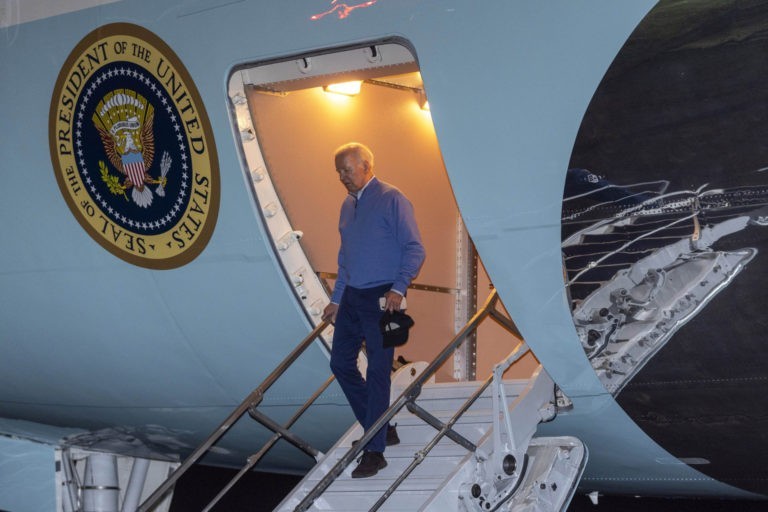
(Luis Cornelio, Headline USA) President Joe Biden appeared lost during a G7 summit event on Ukrainian aid on Thursday, even wandering away at one point, reported the New York Post.

The incident occurred during a skydiving demonstration in southern Italy.

As world leaders watched the skydivers land, Biden began to wander off, prompting Italian Prime Minister Giorgia Meloni to intervene. 

While other leaders applauded the skydivers, Biden seemed confused and looked in the opposite direction, missing the main event.

Meloni then approached Biden, tapping him to guide him back to the main area. It turned out Biden was watching a group of technicians packing a parachute. 

The video captured French President Emmanuel Macron, Canadian Prime Minister Justin Trudeau and UK Prime Minister Rishi Sunak, among others.  

Meloni then posed for a photo-op with the leaders, including Biden, before they gathered for a group photo.

The video quickly went viral on social media, with the Republican National Committee’s Research account leading the charge.

“WHAT IS BIDEN DOING?” the account wrote.

Former Wisconsin Governor Scott Walker called the incident “a national embarrassment,” while National Review Senior Writer Dan McLaughlin tweeted, “As if Meloni doesn’t have enough on her hands, now she’s stuck playing chaperone to Grandpa Joe.” 

Podcast host Comfortably Smug reacted to the video, saying, “Joe Biden didn’t notice the dude parachuting, got lost looking in the opposite direction, then wandered off before world leaders looked around wondering who would help the dementia guy.”

He added sarcastically, “The adults are back in charge!” 

Twitter user Jeff Carlson simply wrote, “We need Trump back.”

Garland Whines about Backlash after Labeling MAGA an ‘Election Threat’

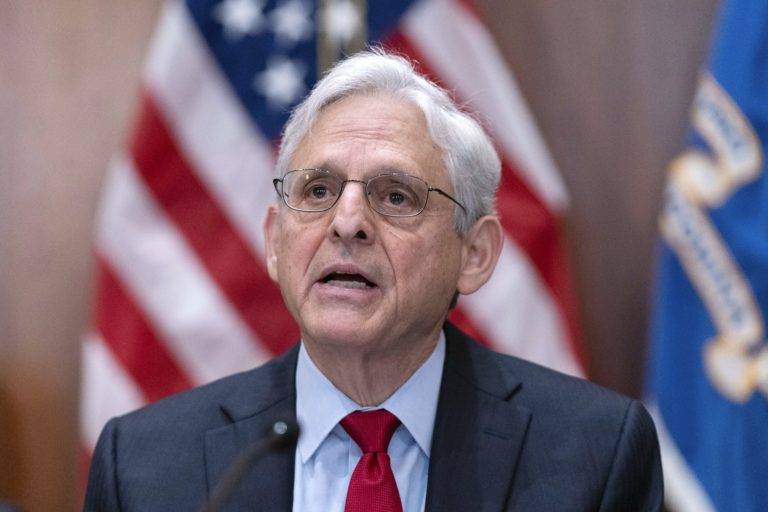
(Dmytro “Henry” Aleksandrov, Headline USA) U.S. Attorney General Merrick Garland started indirectly getting involved in the 2024 election by going after “conspiracy theorists.”

According to Garland’s opinion piece in the Washington Post, Donald Trump supporters are supposedly undermining the judicial process in the United States by questioning the witchhunt on the politician and the now infamous New York trial. 

To show how the Department of Justice staff operates in a very dangerous environment where “threats of violence have become routine” Garland used an anecdotal example of a man convicted for threatening a local FBI office.

Aside from “conspiracy theories,” Garland also presents himself as a completely partisan individual by defining a threat as calls to defund the department that was responsible for going after Trump.

In his opinion piece, Garland also went after those who claim that the DOJ is politicized to influence the election.

Garland then quoted unidentified, and probably leftist, “media reports” that stated that Americans should expect more “threats” in the future.

“Media reports indicate there is an ongoing effort to ramp up these attacks against the Justice Department, its work and its employees,” he wrote.

Garland then pledged that the DOJ won’t be “intimidated” by these by-and-large nebulous “threats” and “attacks.”

Additionally, during a DOJ Election Threats Task Force meeting, Garland and FBI Director Chris Wray recently discussed plans to counter “election threats,” Reclaim the Net reported.

Wray also proved that he is a radical leftist activist after it was revealed that the FBI has been infiltrating pro-Trump groups and doing many other things.

Garland’s opinion piece was not the only example of the DOJ trying to absolve itself of accusations of being far-left activists, instead of serving the interests of Americans.

For example, Assistant Attorney General Carlos Uriarte accused House Judiciary Chairman Jim Jordan of making “completely baseless” accusations against the DOJ for orchestrating the New York trial of Trump.

“The conspiracy theory that the recent jury verdict in New York state court was somehow controlled by the Department is not only false, it is irresponsible,” he wrote.

Disney’s New ‘Star Wars’ Features Lesbian Witches Using Force to Get Pregnant

(Dmytro “Henry” Aleksandrov, Headline USA) A recent episode of the woke Star Wars show went overboard with its anti-male, pro-feminism rhetoric by including a scene where lesbians use Force to immaculately conceive babies.

The scene appeared in the showrunner Leslye Headland’s newest addition to the Star Wars universe in the form of The Acolyte which was previously called the “gayest Star Wars ever,” the Post Millennial reported.

The fans of the universe pointed out that not only is this causing concern for being off canon, but the scene is another example of the far-left politics injected into the universe.

Disney head Kathleen Kennedy, the showrunner Headland and others were blamed for the scene after it became viral on social media platforms.

The clip showed a group of women performing some kind of ritual in the dark where they praise the “power of one, the power of two” and “the power of many.”

The news source also reported that the new addition to the story changes the status of the concept of midichlorians, a chemical that causes a human being to use Force if he or she has enough of it in one’s blood.

An abnormally high number of midichlorians is what made Anakin Skywalker, who grows up to be Darth Vader, so special when he is encountered by Jedi Master Qui-Gon. Anakin was also immaculately conceived by his mother on the desert planet Tatooine.

The third episode of the show, a prequel some 100 years before the beginning of George Lucas’ space opera, revealed that Anakin was not the first child to have been conceived without the act of reproduction in the Star Wars universe. Many fans of the universe took issue with this brand-new concept.

The decision to include the scene in the show is not surprising considering the far-left politics of Disney and a recent interview with Headland and one of the stars of the new series Amandla Stenberg, in which Headland completely agreed that the show is “the gayest Star Wars yet by a considerable margin.”

Communist Terrorist Donated to Jerry Nadler, ‘Squad’ Members

(Dmytro “Henry” Aleksandrov, Headline USA) It was revealed that the infamous communist and a domestic terrorist donated money to Rep. Jerry Nadler, D–N.Y., and members of the “Squad” to destroy the United States. 

In June 2021, then-House Judiciary Committee chairman Nadler whined about “the right-wing extremists” and “terrorists” who entered the U.S. Capitol on Jan. 6, 2021, and weeks after, an old friend of his, Susan Rosenberg, who led a communist group that firebombed the U.S. Senate offices and other buildings to overthrown the government, donated $1,000 to his political campaign, the Washington Free Beacon reported.

Campaign finance records showed that Rosenberg gave to Nadler’s campaign on July 26, 2021.

Aside from her desire to destroy the United States, one of the other reasons why Rosenberg decided to donate to Nadler was because he was the person responsible for obtaining a presidential pardon for her in 2001 after she was sentenced to more than half a century in prison.

In addition to Nadler, since 2020, Rosenberg has donated to “Squad” members Reps. Alexandria Ocasio-Cortez, D-N.Y., Cori Bush, D-Mo., Ilhan Omar, D-Minn., Summer Lee, D-Pa. and Jamaal Bowman, D-N.Y.

Rosenberg was a member of the Weather Underground and May 19th Communist Organization, a female-led Marxist-Leninist group that bombed the U.S. Senate offices in 1983.

The May 19th Communist Organization sought “armed revolution” and the “overthrow of the United States government,” the FBI said, adding that Rosenberg was an associate of “revolutionary organizations which have a great propensity for criminal activity and violence against law enforcement officers.”

The news source reported that in 1988, Rosenberg was sentenced to 58 years in prison for her activities with the groups. However, she was pardoned by President Bill Clinton in 2001, after an aggressive lobbying campaign from Nadler.

In addition to his support of the communist terrorist Rosenberg, Nadler also previously claimed Antifa was a “myth.”

Ocasio-Cortez, who also became well-known for her calls to investigate the “Jan. 6th domestic terrorist attack,” gladly accepted $410 from Rosenberg through in 2024.

Bush who serves on the Judiciary subcommittee on crime, terrorism and homeland security is also extremely biased since she received $362 from Rosenberg. As expected, Bush has used that perch to call for more aggressive investigations into the “domestic terrorists roaming around inside the Capitol,” while criticizing the government for investigating “black identity extremists.”