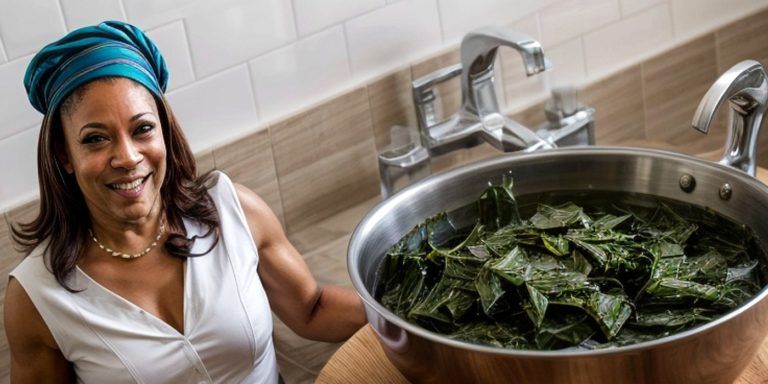
Kamala Admits to Cheating at Southern Black Tradition

(Molly Bruns, Headline USA) In an attempt to pander to black Americans, Vice President Kamala Harris, the current Democrat presidential candidate, posted a video clip over the weekend from her recent stop in Savannah, Ga., during which she claimed be an expert in soul food.

“I have a friend who had a Christmas Party, Christmas Eve every year, and she asked me to make the greens for her every year,” Harris claimed during a visit to the historic city downtown area.

“And I am not lying to you that I would make so many greens that I’d need to wash them in the bathtub,” she added. “I’m telling you the truth!”

For Southern black families, it is a time-honored tradition to spend the weekend cooking up a whole mess of collard greens in a large batch due to the time-intensive process of soaking them and their tendency to cook down into a smaller portion.

The leafy vegetables—along with the turnip and mustard varieties, kale and spinach—flourished in the hot weather and were cultivated by slaves, who were sometimes allowed to maintain a private vegetable garden on large plantations to feed their families.

Harris—who was born in Berkeley, Calif., and brought up in Canada by her Indian mother—was then asked how she prepared her greens.

Harris claimed she let her spices, bacon and stock boil for a couple of hours before adding collard greens and allowing them to cook for a few hours.

However, she then elicited controversy by admitting that she “cheated” by adding Tabasco sauce at the end to give them an extra “tang.”

“I cheat and do a little Tabasco … I mean, I like Louisiana [brand] hot sauce, but Tabasco has that right amount of vinegar,” Harris claimed.

Despite the skepticism some social-media users expressed over her recipe’s authenticity, others praised Harris for actually giving a detailed answer to a question.

The candid exchange stood in stark contrast with Harris’s only sit-down interview since becoming the Democratic nominee.

During the interview Thursday with CNN’s Dana Bash, which also took place in Savannah, Harris wormed her way out of several questions and even directly refused to answer one about former President Donald Trump, the current GOP nominee, questioning the half-Jamaican Harris’s claim to African–American heritage.

“[Trump] suggested that you ‘happened to turn black’ recently for political purposes, questioning a core part of your identity,” said Bash, before pausing to allow Harris to comment.

Harris paused for a moment before insisting that Trump used the “same old, tired playbook” against her and immediately requested to move on to the next question, laughing awkwardly.

Harris’s history of concocting wordy, meaningless non-answers to questions backfired in the interview, especially as she refused to solidly commit to any consistent policy positions and  acknowledged that the radical views expressed during her 2019 primary run had not changed.

While her astroturfed, style-over-substance campaign following the Joe Biden bait-and-switch may, in many ways, be unprecedentedfor American politics, Harris’s shameless embrace of black stereotypes follows a tradition that dates back to presidential precursors including Bill Clinton and Barack Obama.

Several people have compared Hariss’s so-called code-switching to when failed 2016 candidate Hillary Clinton claimed to carry hot sauce in her purse during a radio interview with Charlamagne tha God.

Her dramatic change of accents has also received notice on social media.

Fox News correspondent Peter Doocy even grilled White House press secretary Karine Jean-Pierre over the bizarre dialect—although the Biden administration’s top propagandist insisted she hadn’t noticed anything.

Most recently, Harris shed the Southern drawl and revealed her new urban accent while discussing labor unions in Detroit over the weekend.

“Ya betta thank a union memba for sick leave!” Harris yelled. “You betta thank a union memba for paid leave! You betta thank a union memba for vacation time!”

Some expressed optimism that Harris’s outreach efforts could make her the most fluent non-native “jive” speaker since June Cleaver.

Headline USA’s Ben Sellers contributed to this report.

Philadelphia Eagles Accused of ‘War on Alpha Males’ w/ Fake Kamala Ads

(Jacob Bruns, Headline USA) The Philadelphia Eagles franchise came under fire Monday after advertisements using the NFL team’s branding popped up around the City of Brotherly Love, appearing to endorse Vice President Kamala Harris for president, NBC Philadelphia reported.

Unverified reports suggested that the provocative displays might have been part of a guerilla “street art” installation by local activist Winston Tseng, according to the Gateway Pundit.

Tseng has put up ads featuring Joe Biden and Donald Trump that employ a similar artistic style.


View this post on Instagram


A post shared by @winstontseng

The ads, which declare Harris the “official candidate of the Philadelphia Eagles,” depict an image of a woman, presumably Harris, wearing an Eagles helmet and holding a football.

Many people were unhappy with the ads, which were posted at various bus stops across the city.

Some went so far as to accuse the Eagles of declaring “war” on Trump supporters while asserting that recent personnel changes had turned the Super Bowl LII champions into a squadron of wimpy beta males.

In response to the criticism, the organization quickly distanced itself from the ads, claiming in a post on X that they were “aware counterfeit political ads are being circulated and are working with our advertising partner to have them removed.”

The ads do, however, include a link to a live URL, the Philadelphia Eagles official website, which contains nonpartisan resources and information encouraging fans to vote, along with a collection of links to make voting more “accessible” and help “first time voters” get “voter ID assistance.”

And though it appeared that the Eagles had nothing to do with these particular ads, it may have seemed plausible for the team to endorse the radical leftist Democrat, in light of past examples of virtue-signaling.

Last season, Eagles management censored George Norcross, a New Jersey businessman and Democrat Party organizer, for flying a half American–half Israeli flag from his private box seats in the stadium during a game.

After the confrontation, which resulted in his removal from the premises, Norcross issued a statement arguing that the NFL was guilty of having a double-standard in its enforcement of rules about political speech.

“As a longtime passionate fan and season ticket holder, I have watched the Eagles/NFL make clear and strong statements on numerous important civil justice issues and ethnic and world conflicts, including supporting the people of Ukraine,” Norcross said.

“[A]s a strong supporter of Israel—a country which was viciously attacked by the terrorist group Hamas less than a month ago—I thought it was an important statement to make,” he added.

Who Took Johnny? Reporter Breaks New Ground on Infamous Case 4 Decades Later

(Ken Silva, Headline USA) This week 42 years ago, a 12-year-old paperboy named Johnny Gosch disappeared in a case that would become infamous for decades to come.

Thrust into the national spotlight in 1992 by America’s Most Wanted, the Sept. 5, 1982, abduction of Gosch was one of the key drivers in popularizing the notion of government-sponsored pedophile rings. Today, the idea that the U.S. government allows the nation’s powerful to molest children with impunity is common in American political discourse.

But while much of the public is starting to notice the relatively high-profile cases against the human-trafficking network allegedly operated by Jeffrey Epstein and Ghislaine Maxwell, one reporter is still searching for answers 42 later to the haunting question: Who took Johnny?

Moreover, that reporter, Nick Byrant, may have found an answer to that question—if only law enforcement would listen.

Who Took Johnny?

About 10 years after Gosch’s abduction, America’s Most Wanted ran a segment on the case. When it did, a human-trafficking victim named Paul Bonacci went public with allegations that he participated in Gosch’s disappearance.

Bonacci’s information was deemed credible by America’s Most Wanted producers when he accurately described a Colorado house that was allegedly used to imprison Gosch. Among other details, Bonnaci told investigators about a chamber beneath the home that was apparently used as a dungeon.

However, the FBI dismissed Bonacci as non-credible, and law enforcement failed to follow up on his leads.

Fast forward another 30 years, and Bryant reported new details on the Colorado home, including about its owner, ex-prison guard Charles Crouch—who turned out to be a serial pedophile. Bryant also tracked down Crouch’s ex-wife, who told Bryant that Crouch molested their oldest son, as well as her brother.

Bryant published a podcast and article about his new findings last year, but they received little attention. In an interview with Headline USA, Bryant later said he believes the FBI may have covered up the case.

“I talked to my friend in California, who connected me with a former police chief in California who had been the head of an anti-trafficking task force. He seemed gung-ho. I had the goods. I had the recording of his wife talking about his depravities,” Bryant told this publication.

“He really jumped on it, but like a lot of these cases, all the sudden he stopped returning my calls, and I haven’t heard from him for quite some time. And I do believe this guy was clean, but I do believe he bumped up against someone—probably the FBI.”

Bryant said Crouch is still alive in and living in New Mexico, and that he’s willing to provide information to law enforcement.

However, “Since the FBI covered it up, who am I going to go to?” he asked.

Since Bryant published his findings last October, the FBI has started to release records online about the Gosch case, as well as another pedophile scandal involving Gosch and Bonacci called the Franklin Scandal.

However, the FBI still has yet to make any arrests in the Gosch case. The bureau did not respond to an email inquiry about the matter.

Ken Silva is a staff writer at Headline USA. Follow him at twitter.com/jd_cashless.

Chinese Silver Demand Surges; Is This a Calculated Move?

(Mike Maharrey, Money Metals News Service) Gold demand in China has been strong this year, reflecting a broader movement of the yellow metal from the West to the East. But the Chinese aren’t just accumulating gold. They have also been hoarding silver in recent months.

The Shanghai Metals Exchange has reported a significant surge in silver volume with prices consistently higher than Western exchanges. The price premium in China compared to the West has been as high as 10 percent. This signals an extremely strong demand for silver in China.

Chinese silver imports have also surged, hitting a three-year high of 390 tons last December. In June and July this year, imports broke through the 400-ton level. A year ago, import levels were half that, averaging in the 200-ton range. 

According to the Jerusalem Post, “This suggests that China may be deliberately driving up the price of silver to drain the West’s resources. 

Last year, China held the second-largest silver reserves in the world, trailing only Peru. Chinese reserves were reported at 71,000 tons. Peru, a major silver producer had a silver stockpile of 98,000 tons. U.S. silver reserves were 23,000 tons, ranking seventh globally.

If the Chinese can push the silver price higher, it could have major implications for the West, the Post reported.

“If the price of silver continues to rise, it could increase production costs for a wide range of industries, from electronics to solar panels. This could lead to higher consumer prices and a further slowdown of economic growth as China out-produces the West in electronics and solar panels.”

Silver’s outstanding electrical conductivity and reflectivity make it a crucial input in the ever-growing tech and green energy sectors. 

The rapid expansion of solar energy use is one of the key factors pushing silver demand higher. As the Silver Institute reported, “Higher than expected photovoltaic (PV) capacity additions and faster adoption of new-generation solar cells raised global electrical & electronics demand by a substantial 20 percent. At the same time, other green-related applications, including power grid construction and automotive electrification, also contributed to the gains.”

However, there is some indication the growth in Chinese solar panel production could go beyond market-driven demand. According to a recent Bloomberg report, the Chinese are producing solar panels at an excessive clip. There is some speculation that the Chinese are engaging in some low-level economic warfare hoping to put the squeeze on Western economies.

According to the Post, the country has produced so many solar panels, some Chinese citizens are using them as garden fences.

China supplies about 80 percent of the world’s photovoltaic panels.

U.S. officials have voiced concern about Chinese trade practices in the solar sector, signaling they may be concerned that the policy goes beyond economic competition. In a memo released last May, the Biden administration said, “The U.S. Trade Representative, the Department of Energy and the Department of Commerce will closely monitor import patterns to ensure the U.S. market does not become oversaturated and will explore all available measures to take action against unfair practices.”

Growing industrial demand for silver globally could also put upward price pressure on the metal. 

Industrial demand set a record of 654.4 million ounces in 2023 and is expected to hit new highs this year.

China isn’t the only Asian country with an increasing appetite for silver. Indian silver imports are set to double. Analysts cite increasing solar power production and demand from the electronics sector as the primary drivers.

Silver demand has outstripped production for three straight years and the Silver Institute projects another market deficit this year.

In 2023, the silver market charted a structural deficit of 184.3 million ounces. The projection is for an even larger supply shortfall this year in the neighborhood of 215 million ounces. This would be the second-largest silver market deficit ever recorded.

The Post report raises the specter of a silver squeeze.

“Analysts warn that the growing demand for silver, coupled with limited supply, could lead to a ‘silver squeeze’ similar to the silver squeeze of 1980. If investors begin to panic and rush to buy silver, the price could skyrocket, causing significant disruptions to the global economy.”

Silver seems to be underpriced for these market dynamics.

The gold-silver ratio is over 87:1, meaning that it takes 87 ounces of silver to buy an ounce of gold. To put that into perspective, the average in the modern era has been between 40:1 and 60:1. 

In other words, from a historical perspective, silver is underpriced. 

Historically, the ratio has always returned to the mean. And when it does, it does it with a vengeance. The ratio fell to 30:1 in 2011 and below 20:1 in 1979.


Mike Maharrey is a journalist and market analyst for MoneyMetals.com with over a decade of experience in precious metals. He holds a BS in accounting from the University of Kentucky and a BA in journalism from the University of South Florida.

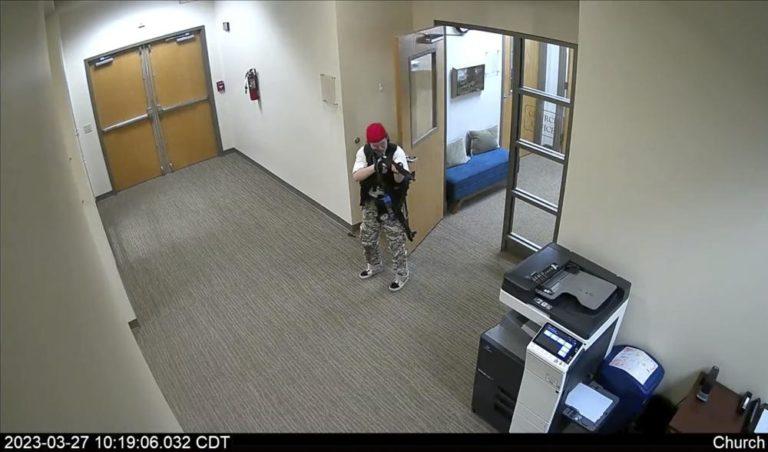
Newspaper Releases Full Copy of Nashville Trans Shooter’s ‘Manifesto’

(Ken Silva, Headline USA) The Tennessee Star released on Tuesday the purported manifesto of Nashville school shooter Audrey Hale, who killed three 9-year-old children and three adult staff members at the Covenant School on March 27, 2023.

Much of the material in Hale’s 90 pages of writings has already been reported, including her rantings about her gender.

“So now in America, it makes one a criminal to have a gun or, be transgender, or non-binary,” Hale wrote in one journal entry. “God I hate those s***head politicians.”

Michael Patrick Leahy, editor-in-chief of The Star, said on Tuesday that he’s releasing the entire document for the public to see.

“We legally obtained this handwritten journal – which we refer to as The Covenant Killer’s 2023 Journal to distinguish it from the many journals written by Hale prior to 2023 – in early June of 2024 from a source familiar with the MNPD investigation,” Leahy said.

“We have had a First Amendment right to publish these unredacted documents from the moment we legally obtained them.”

Leahy did say that he hesitated to publish the documents after he was threatened with contempt proceedings by NashvilleJudge I’Ashea Myles, who has ruled that the materials should be kept secret.

“This ‘Sword of Damocles’ has been held over my head by Judge Myles since June 17, 2024, and we have held off on publishing The Covenant Killer’s 2023 Journal, in part, until our legal defense financial resources have reached a sufficient level such that I can hire counsel to represent me in the event Judge Myles seeks to resurrect this false claim against me,” he said.

The Star has an appeal pending against Myles’ ruling.

According to Myles’s July ruling, the evidence held by law enforcement includes more than 100 gigabytes of data—far more evidence than her 90-page manifesto.

Ken Silva is a staff writer at Headline USA. Follow him at twitter.com/jd_cashless.

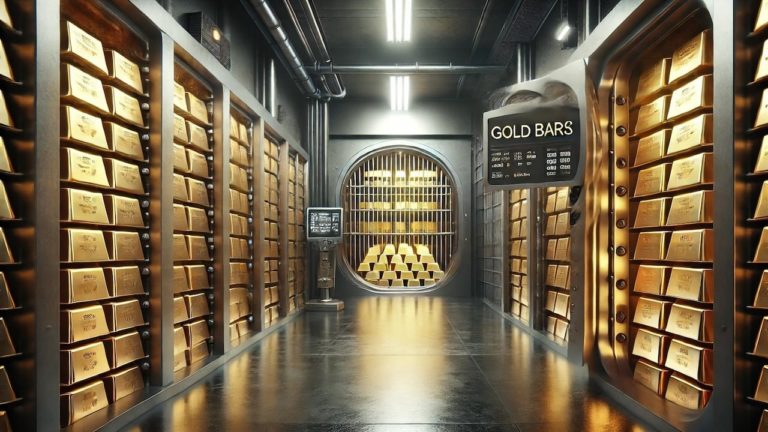
Central Bank Gold Buying Doubled in July

(Mike Maharrey, Money Metals News Service) Central bank gold buying more than doubled in July, as policymakers showed a continued commitment to increasing the percentage of yellow metal in their reserves. 

Globally, central banks added a net 37 tons of gold to their holdings in July, according to the latest data compiled by the World Gold Council (WGC). It was a 206 percent month-on-month increase and the highest level of central bank gold purchases since January.

This comes on the heels of record central bank gold purchases through the first half of the year.

This gold buying spree has continued despite record gold prices. The WGC noted that while the pace of buying slowed in Q2, it consistently remained positive.

“Central banks have shown an ongoing commitment to accumulating gold in recent months. … We expect central bank demand for gold to continue in the coming months.”

Poland was the biggest central bank gold buyer in the second quarter and it continued that trend in July, adding 14 tons of gold to its reserves. It was the largest monthly increase for the National Bank of Poland since November 2023. With the purchase, the country’s reserves climbed to 392 tons and 15 percent of total reserves. 

NBP Governor Adam Glapiński recently indicated the Bank of Poland will continue adding to its reserves with a goal of holding at least 20 percent of the country’s reserves in gold.

“This makes Poland a more credible country, we have a better standing in all ratings, we are a very serious partner, and we will continue to buy gold.”

In 2021, Glapiński announced a plan to expand the country’s gold reserves by 100 tons. The central bank reached that goal in September of ’23 and kept buying.

When he announced the initial plan to expand its gold reserves, Glapiński said holding gold was a matter of financial security and stability.

“Gold will retain its value even when someone cuts off the power to the global financial system, destroying traditional assets based on electronic accounting records. Of course, we do not assume that this will happen. But as the saying goes – forewarned is always insured.

“And the central bank is required to be prepared for even the most unfavorable circumstances. That is why we see a special place for gold in our foreign exchange management process.”

Glapiński also pointed out that “Gold is free from credit risk and cannot be devalued by any country’s economic policy. Besides, it is extremely durable, virtually indestructible.”

The Central Bank of Uzbekistan bought 10 tons of gold in July. It was the second consecutive month of gold buying. The Uzbek central bank tends to shift back and forth between buying and selling. It is not uncommon for banks that buy from domestic production – such as Uzbekistan and Kazakhstan – to switch between buying and selling.

India added another five tons of gold to its holding in July. The Reserve Bank of India has added gold every month this year with purchases totaling 43 tons. 

The RBI has been buying gold since 2017. Over that period, it has increased its gold holding by over 260 tons. 

An Indian economist told the Times of India that the push to accumulate gold was based on both political and economic reasons. He said that the “reliability” of the U.S. dollar has “diminished.” He noted the “noticeable decline” in the confidence in U.S. dollar assets.

Another economist told the Times, “It makes a lot of sense (to invest in gold), given the increased volatility in the FX market, elevated interest rates in the U.S., and, of course, also as the central banks in each economy would like to diversify the asset classes in which they are parking their reserves.”

India recently transported 100 tons of its gold from the UK back into India.

The Central Bank of Jordan added another 4 tons of gold to its reserves in July. It was the third straight month of Jordanian gold buying. 

Turkey continued to expand its gold holdings, although at a slower pace, adding 4 tons of gold to its reserves. 

Turkey was the biggest buyer through the first half of 2024, adding 45 tons to its gold hoard. The bulk of its buying was in Q1, with the pace slowing to 15 tons in the second quarter.

The Turkish central bank has bought gold for 13 straight months after liquidating 160 tons of gold in the spring of 2023.

Other significant buyers in July were Qatar and the Czech Republic, both with 2-ton purchases. The Czechs have added gold to their holdings for 17 straight months.

Kazakhstan was the only notable seller, shrinking its reserves by 4 tons. The Central Bank of Kazakhstan holds 55 percent of its reserves in gold. 

According to the most recent World Gold Council survey released in June, 29 percent of central banks plan to add more gold to their reserves in the next 12 months. The WGC said it was the highest level since the survey began in 2018.

Only 3 percent said they had plans to decrease gold reserves.

Earlier this year, the World Gold Council said the continuation of gold buying supports its expectation that “2024 will be another solid year of central bank gold demand.”

“Last year central banks placed great emphasis on gold’s value in crisis response, diversification attributes, and store-of-value credentials. A few months into 2024 the world seems no less uncertain meaning those reasons for owning gold are as relevant as ever.”

Last year, central bank gold buying fell just 45 tons short of 2022’s multi-decade record.

According to the World Gold Council, central banks net gold purchases totaled 1,037 tons in 2023. It was the second straight year central banks added more than 1,000 tons to their total reserves.

Central bank gold buying in 2023 built on the prior record year. Total central bank gold buying in 2022 came in at 1,136 tons. It was the highest level of net purchases on record dating back to 1950, including since the suspension of dollar convertibility into gold in 1971.

China was the biggest buyer in 2023.

Analysts at ANZ Bank recently said they expect central bank gold buying to remain hot for at least the next six years.

According to these analysts, “Depleted trust in the U.S. fixed-income assets and the rise of non-reserve currencies are other themes that could support central bank gold buying.“


Mike Maharrey is a journalist and market analyst for MoneyMetals.com with over a decade of experience in precious metals. He holds a BS in accounting from the University of Kentucky and a BA in journalism from the University of South Florida.

BLUNDER: Miners Are Dumping Every Single Ounce They Produce

(Stefan Gleason, Money Metals News Service) On an annual basis, global silver supply generated by mines seems to have run into a ceiling of about 1 billion ounces. Supply has essentially flat-lined over the past several years.

At the same time, explosive growth in demand from photovoltaics (solar panels) and electric vehicles is driving widening projected supply deficits for physical silver.

Rising silver prices will, in theory, incentivize more production. But the costs of extraction are rising sharply.

Metals markets analyst Steve St. Angelo estimates that in the first half of 2024, the total weighted average of cost of production among the leading silver miners rose to at least $26 per ounce. More marginal, higher-cost operators are facing the prospect of selling their product at a loss even with silver fetching $30 per ounce.

The silver price tends to find major support at its average all-in sustaining cost of production at any given time. That figure is likely to trend higher, possibly much higher, in the future.

In estimating the costs mining companies will face in the future to replace the metals they are selling today, we cannot simply extrapolate from their historic operating costs.

Operating an existing mine is one thing. Having to undertake the costs associated with exploring for new deposits and developing new mines is quite another.

A mine is by its nature a depreciating asset. The economic value of its extractable deposits will eventually be exhausted, and the mine abandoned.

New mines must be developed in order to keep the market supplied with metals. That takes a lot of capital – and time.

S&P Global estimates that it takes an average of 20.8 years worldwide to develop a new gold mine.

The time-frame is even longer for copper, nickel, and other base metals – which often produce silver as a byproduct.

Regulatory hurdles can delay viable projects for years – or shelve them indefinitely.

Thanks to stifling layers of red tape in the United States in particular, as noted by S&P Global, “The US has the second longest mine development times in the world, at almost 29 years on average from first discovery to first production.”

To say that it is difficult to get a new mine up and running is an understatement. Per the Colorado School of Mines, only 1 in 750 projects makes it.

Importantly, the sunk costs associated with the extraordinary number of failed projects aren’t included in the mining industry’s estimated annual production costs.

In other words, the true cost of newly mined gold and silver and gold ounces is substantially higher than anyone ever reports.

These sunk costs on failed projects also represent huge opportunity costs – specifically, the missed opportunity to buy above-ground gold itself instead of pouring capital into long-shot dreams of digging it out of the ground at a profit.

SilverCrest Metals president Chris Ritchie
SilverCrest Metals president Chris Ritchie believes in his product

SilverCrest Metals (NASDAQ: SILV) is one of the only companies willing to talk about the true all-in costs of exploring, developing, and producing ounces. And that knowledge has led the miner to sock away bullion on its balance sheet, rather than dumping every single ounce produced in exchange for depreciating Federal Reserve notes at whatever the price of gold or silver happens to be at the time.

With the benefit of a fantastic producing mine, SilverCrest president Chris Ritchie told Money Metals his company began accumulating its precious metal reserves right after paying off all its debts in 2023.

“SilverCrest added bullion alongside our other capital allocation opportunities because of the functionality of our product – and we want to give our investors more of what they want while also hedging against some of the risks associated with mining,” said Ritchie.

“The irony is that the gold and silver mining industry invests huge sums of money over long periods of time, and yet we choose to hold fiat currencies as our preferred store of value versus the gold and silver ounces we work so hard to get.”

Today, SilverCrest has almost one-third of its working capital in gold bullion, i.e. $30 million.

The nominal price of gold has since risen 30%, already making this strategy look like a pretty genius move.

The allure of striking it rich by prospecting for gold has driven countless individuals and enterprises to financial ruin over the ages. It will sadly continue to do so.

But that doesn’t mean gold itself is a risky asset. Quite the opposite is true. Hard money in the form of gold has held its value over time far better than any fiat currency or financial instrument. It provides protection from the ravages of inflation and insurance against calamities in paper asset markets.

Silver, meanwhile, offers more upside potential due to its low market price relative to gold and its more glaring supply deficit.

Physical precious metals belong on the balance sheet of any individual or corporation that is concerned with mitigating risks associated with financial assets in general and fiat currency in particular.

While cash reserves may be necessary in order to cover everyday expenses and provide for immediate liquidity needs, cash itself is not a yielding asset.

Cash, even when invested in money markets that offer positive nominal yields, almost certainly will not generate a positive real (after-inflation) return over time.

By contrast, even though physical gold offers no nominal yield, it has nevertheless delivered an impressive real yield. Gold’s cumulative gains over the past two decades have absolutely clobbered the returns on money markets and bonds.

As for silver, its most impressive gains may be yet to come.


Stefan Gleason is President of Money Metals Exchange, the national precious metals company named 2015 “Dealer of the Year” in the United States by an independent global ratings group. A graduate of the University of Florida, Gleason is a seasoned business leader, investor, political strategist, and grassroots activist. Gleason has frequently appeared on national television networks such as CNN, FoxNews, and CNBC, and his writings have appeared in hundreds of publications such as the Wall Street Journal, Detroit News, Washington Times, and National Review.

Ohio Prisoners Serve Five-Course, Garden-to-Table Meals to Public on Facility Grounds

(Headline USA) A state prison in northeast Ohio said last week that for the first time in the state’s history, a five-course meal was served to members of the public with food prepared by incarcerated men from fruits and vegetables grown in the prison garden.

Almost 60 people dined at Grafton Correctional Institution, where incarcerated men in the prison’s EDWINS Leadership and Restaurant Institute hosted the event in two prison gardens: the “EDWINS’ Garden” and “Hope City Garden.”

EDWINS, an organization dedicated to education in prisons, hosted the dinner as part of its culinary course, offered in 652 prisons and jails around the country. The six-month course provides training to incarcerated people, teaching them cooking techniques, safety and sanitation, knife skills and other certifications needed to work in a fine dining establishment.

“Figuratively what is happening is that we’re reframing what’s possible in prison,” said Chef Brandon Chrostowski.

Chrostowski—a James Beard Award semifinalist and finalist for Outstanding Restauranteur—formed a partnership with the staff at Grafton Correctional Institution in 2012, and designed a class to teach incarcerated men about culinary arts and hospitality.

The program was born out of the belief that “every human being, regardless of their past, has the right to a fair and equal future,” Chrostowski said.

Bouquets of magenta roses, lilies and other flowers lined a table covered with white linen cloth. Fresh bread and olive oil was set out for each diner. The table was placed in the middle of the two gardens.

Inmates grow a range of fruits, vegetables and herbs ranging from parsley to corn and beets.

Greg Sigelmier, 40, a prisoner at GCI, said he looks forward to attending the program every week. He added that the class has helped him come out of his shell.

He first signed up to work in the kitchen for the dinner party because he didn’t want guests to see how nervous he was.

After some thought and conversation with others close to him, he thought it would be good to challenge himself by doing something that makes him feel uncomfortable. Sigelmier said he’s considering working in the industry when he is released in a year.

“This could be the rest of my life. And they’re doing this for everybody. They’re not looking at me as a number. They’re looking at me as a person,” Sigelmier said.

The five-course meal began with a beet salad with goat cheese and greens, followed by a kale “purse” with farmer cheese. Guests ate roasted salmon topped with a béarnaise sauce and braised garden greens. Roasted lamb with tomato provencal followed. Dessert included a corn cake with blueberry compote and Chantilly cream.

Each course was paired with a mocktail, one of them named the “botinique”—soda with a thyme-infused honey syrup and lemon.

The program also requires participants to learn each other’s working styles and behaviors, and helps them to build relationships over preparing and sharing a meal.

“Working together as the community that we are and at the end getting to eat the food, it’s the best part. You should see the faces on these guys when they’re eating just the regular chicken noodle soup that we just all worked together. It’s incredible,” 28-year-old Efrain Paniagua–Villa said.

Before his incarceration, Paniagua–Villa said he spent a lot of his time cooking at home with his mother and sister. He said cooking with his classmates has helped fill the gap that was left when he began his stint in prison 2½ years ago.

The incarcerated men in the EDWINS culinary program at GCI are serving a variety of sentences from short to life and range in age from 20 to 70, according to the organization.

Some of the men in the EDWINS program will graduate and have the option to apply to work at many restaurants in the Cleveland area upon their release.

“Many of our guys that live here are going home, so they’re going home to be our neighbors,” said GCI warden Jerry Spatny.

“We want our neighbors to be prepared to be law-abiding citizens, and that’s what this program is about,” he continued. “It’s not just about teaching guys how to cook or how to prepare food.bThis gives them reentry level skills so that when they go home, they can be successful in that environment.”

Adapted from reporting by the Associated Press

AI Chatbots Writing Crime Reports May Revolutionize Policing, but Concerns Abound

(Headline USA) A body camera captured every word and bark uttered as police Sgt. Matt Gilmore and his K-9 dog, Gunner, searched for a group of suspects for nearly an hour.

Normally, the Oklahoma City police sergeant would grab his laptop and spend another 30 to 45 minutes writing up a report about the search. But this time he had artificial intelligence write the first draft.

Pulling from all the sounds and radio chatter picked up by the microphone attached to Gilbert’s body camera, the AI tool churned out a report in eight seconds.

“It was a better report than I could have ever written, and it was 100% accurate. It flowed better,” Gilbert said. It even documented a fact he didn’t remember hearing—another officer’s mention of the color of the car the suspects ran from.

Oklahoma City’s police department is one of a handful to experiment with AI chatbots to produce the first drafts of incident reports.

Police officers who’ve tried it are enthused about the time-saving technology, while some prosecutors, police watchdogs and legal scholars have concerns about how it could alter a fundamental document in the criminal justice system that plays a role in who gets prosecuted or imprisoned.

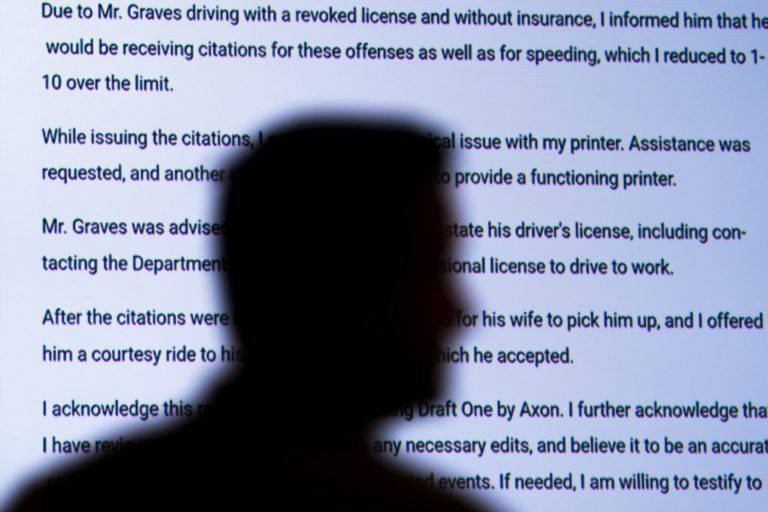
Built with the same technology as ChatGPT and sold by Axon—best known for developing the Taser and as the dominant U.S. supplier of body cameras—it could become what Gilbert describes as another “game changer” for police work.

“They become police officers because they want to do police work, and spending half their day doing data entry is just a tedious part of the job that they hate,” said Axon’s founder and CEO Rick Smith, describing the new AI product—called Draft One—as having the “most positive reaction” of any product the company has introduced.

“Now, there’s certainly concerns,” Smith added. In particular, he said district attorneys prosecuting a criminal case want to be sure that police officers—not solely an AI chatbot—are responsible for authoring their reports because they may have to testify in court about what they witnessed.

“They never want to get an officer on the stand who says, well, ‘The AI wrote that, I didn’t,’” Smith said.

AI technology is not new to police agencies, which have adopted algorithmic tools to read license plates, recognize suspects’ faces, detect gunshot sounds and predict where crimes might occur. Many of those applications have come with privacy and civil rights concerns and attempts by legislators to set safeguards. But the introduction of AI-generated police reports is so new that there are few, if any, guardrails guiding their use.

Concerns about society’s racial biases and prejudices getting built into AI technology are just part of what Oklahoma City community activist aurelius francisco finds “deeply troubling” about the new tool, which he learned about from The Associated Press.

“The fact that the technology is being used by the same company that provides Tasers to the department is alarming enough,” said francisco, a co-founder of the Foundation for Liberating Minds in Oklahoma City.

He said automating those reports will “ease the police’s ability to harass, surveil and inflict violence on community members. While making the cop’s job easier, it makes Black and brown people’s lives harder.”

Before trying out the tool in Oklahoma City, police officials showed it to local prosecutors who advised some caution before using it on high-stakes criminal cases. For now, it’s only used for minor incident reports that don’t lead to someone getting arrested.

“So no arrests, no felonies, no violent crimes,” said Oklahoma City police Capt. Jason Bussert, who handles information technology for the 1,170-officer department.

That’s not the case in another city, Lafayette, Indiana, where Police Chief Scott Galloway told the AP that all of his officers can use Draft One on any kind of case and it’s been “incredibly popular” since the pilot began earlier this year.

Or in Fort Collins, Colorado, where police Sgt. Robert Younger said officers are free to use it on any type of report, though they discovered it doesn’t work well on patrols of the city’s downtown bar district because of an “overwhelming amount of noise.”

Along with using AI to analyze and summarize the audio recording, Axon experimented with computer vision to summarize what’s “seen” in the video footage, before quickly realizing that the technology was not ready.

“Given all the sensitivities around policing, around race and other identities of people involved, that’s an area where I think we’re going to have to do some real work before we would introduce it,” said Smith, the Axon CEO, describing some of the tested responses as not “overtly racist” but insensitive in other ways.

Those experiments led Axon to focus squarely on audio in the product unveiled in April during its annual company conference for police officials.

The technology relies on the same generative AI model that powers ChatGPT, made by San Francisco-based OpenAI. OpenAI is a close business partner with Microsoft, which is Axon’s cloud computing provider.

“We use the same underlying technology as ChatGPT, but we have access to more knobs and dials than an actual ChatGPT user would have,” said Noah Spitzer–Williams, who manages Axon’s AI products.

Turning down the “creativity dial” helps the model stick to facts so that it “doesn’t embellish or hallucinate in the same ways that you would find if you were just using ChatGPT on its own,” he said.

Axon won’t say how many police departments are using the technology. It’s not the only vendor, with startups like Policereports.ai and Truleo pitching similar products. But given Axon’s deep relationship with police departments that buy its Tasers and body cameras, experts and police officials expect AI-generated reports to become more ubiquitous in the coming months and years.

Before that happens, legal scholar Andrew Ferguson would like to see more of a public discussion about the benefits and potential harms. For one thing, the large language models behind AI chatbots are prone to making up false information, a problem known as hallucination that could add convincing and hard-to-notice falsehoods into a police report.

“I am concerned that automation and the ease of the technology would cause police officers to be sort of less careful with their writing,” said Ferguson, a law professor at American University working on what’s expected to be the first law review article on the emerging technology.

Ferguson said a police report is important in determining whether an officer’s suspicion “justifies someone’s loss of liberty.” It’s sometimes the only testimony a judge sees, especially for misdemeanor crimes.

Human-generated police reports also have flaws, Ferguson said, but it’s an open question as to which is more reliable.

For some officers who’ve tried it, it is already changing how they respond to a reported crime. They’re narrating what’s happening so the camera better captures what they’d want to put in writing.

As the technology catches on, Bussert expects officers will become “more and more verbal” in describing what’s in front of them.

After Bussert loaded the video of a traffic stop into the system and pressed a button, the program produced a narrative-style report in conversational language that included dates and times, just like an officer would have typed from his notes, all based on audio from the body camera.

“It was literally seconds,” Gilmore said, “and it was done to the point where I was like, ‘I don’t have anything to change.’”

At the end of the report, the officer must click a box that indicates it was generated with the use of AI.

Adapted from reporting by the Associated Press

Report: Trump-Kennedy Alliance Forged in Aftermath of Assassination Attempt

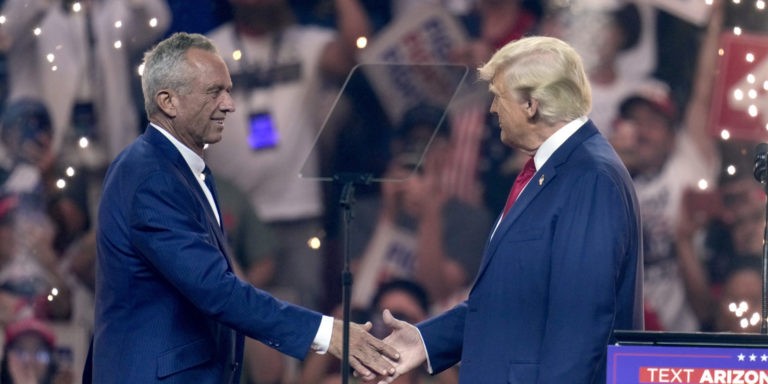
(Ken Silva, Headline USA) The New York Times published an insiders’ account on Monday of how Donald Trump and Robert F. Kennedy Jr. forged an alliance for the 2024 presidential election—revealing that the flashpoint occurred in the hours after the July 13 Trump assassination attempt.

The Kennedy and Trump teams had reportedly been flirting with the idea of working together for months before the shooting, but no solid plans ever formulated. But those plans quickly solidified on July 13, according to NYT.

After Mr. Trump was examined at a hospital in western Pennsylvania, they spoke by phone for nearly half an hour … Mr. Trump tried to coax Mr. Kennedy into his camp. ‘I would love you to do something,’ he said, according to a portion of the conversation that was later made public. ‘I think it’ll be so good for you and so big for you. And we’re going to win,’” NYT reported Monday.

The Trump-Kennedy alliance did risk collapsing after the two met on July 15 at the Republican National Convention in Milwaukee, due in large part to media leaks from Kennedy’s camp. Moreover, a Trump victory seemed certain for many conservatives at the time, giving the GOP fewer reasons to strike a bargain with former Democrats.

But after Joe Biden dropped out of the race and Kamala Harris surged in the polls, Trump’s team reportedly realized they needed to do something to regain the momentum.

“The next few days consolidated the alliance, although uncertainty lingered until the last moment. On Aug. 16, at his golf club in Bedminster, N.J., Mr. Trump sat down with members of the New Jersey Coalition for Vaccination Choice, a group that has fought vaccine mandates and whose support Mr. Trump was eager to court,” NYT reported Monday.

“The group was there to discuss child health issues but also talked up Mr. Kennedy as an ally, according to two of the people briefed on the meeting. Mr. Trump indicated that he planned to bring him into his camp … The next week, Mr. Kennedy’s running mate, Nicole Shanahan, told an interviewer that she and Mr. Kennedy were considering dropping out and supporting Mr. Trump, making public what had been privately in the works for weeks.”

Kennedy officially dropped his presidential bid on August 23 to endorse Trump.

Kennedy said in his endorsement speech that the Democratic party had changed significantly since he attended his first Democratic National Convention at the age of 6. He said it was no longer the party of his father and uncle. He blamed “shadowy DNC operatives” for fighting his campaign at every turn in legal battles challenging the signatures he turned in to get on the ballot in state after state. He also blamed media companies for failing to do their jobs.

A few days later, Trump made Kennedy an honorary co-chair of his transition team, giving RFK influence over personnel and policy for a second Trump term.

Ken Silva is a staff writer at Headline USA. Follow him at twitter.com/jd_cashless.