

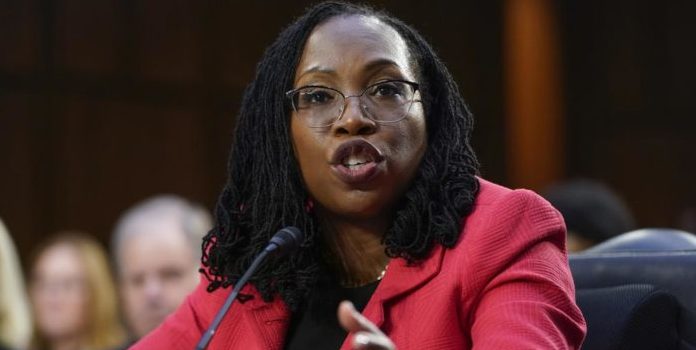
(Luis Cornelio, Headline USA) Supreme Court Justice Ketanji Brown Jackson has once again drawn ridicule across social media after one of her analogies defending birthright citizenship went viral on Wednesday.
During arguments about the constitutionality of birthright citizenship, Jackson appeared to suggest that committing crimes on foreign soil inherently means pledging allegiance to that country.
She appeared to be arguing that foreign nationals are subject to a country’s jurisdiction while present there. However, her remarks were muddled and quickly gained viral attention on X.
“I was thinking, I, a U.S. citizen, am visiting Japan. And what it means is that if I steal someone’s wallet in Japan, the Japanese authorities can arrest me and prosecute me,” Jackson began. “It’s allegiance, meaning can they control you as a matter of law.”
She continued, “I can rely on them if my wallet is stolen to, under Japanese law, go and prosecute that person who had stolen it. So there’s this relationship, even though I’m just a temporary traveler, I’m just on vacation in Japan, I’m still locally owing allegiance in that sense.”
Jackson then applied her analogy to foreign nationals in the U.S., adding, “Is that the right way to think about it? And if so, doesn’t that explain why both temporary residents and undocumented people would have that kind of allegiance just by virtue of being in the United States?”
KBJ: "If I steal a wallet in Japan, I am subject to Japanese laws…in a sense, it's allegiance."
pic.twitter.com/AaQGsgW2IT— Election Wizard (@ElectionWiz) April 1, 2026
Jackson’s remarks were not entirely clear, though they appeared to touch on the broader legal debate over what it means to be “subject to the jurisdiction” of the United States under the 14th Amendment.
The Trump administration has argued that courts have misinterpreted that clause for decades, applying it too broadly to grant automatic citizenship to nearly anyone born on U.S. soil.
Ratified in 1868 after the Civil War, the 14th Amendment extended the rights and liberties guaranteed under the Bill of Rights to formerly enslaved individuals in the U.S.
In 1898, the Court heard arguments in a case later interpreted to guarantee citizenship to individuals born in the U.S., unless they were children of diplomats.
Wednesday’s case, named Trump v. Barbara, followed an executive order signed by President Donald Trump on Jan. 20 aimed at ending automatic birthright citizenship for children of illegal aliens.
The ACLU sued, triggering the case. The final ruling is expected later this year.
