

(Mike Maharrey, Money Metals News Service) I have argued that the current economic environment has a lot of eerie parallels to 2007. We have extremely high asset valuations, the economy is loaded up with debt, and monetary policy has taken a similar trajectory, with easy money blowing up these bubbles. We even have characters like Larry Kudlow talking up the economy just like they did in 2007.
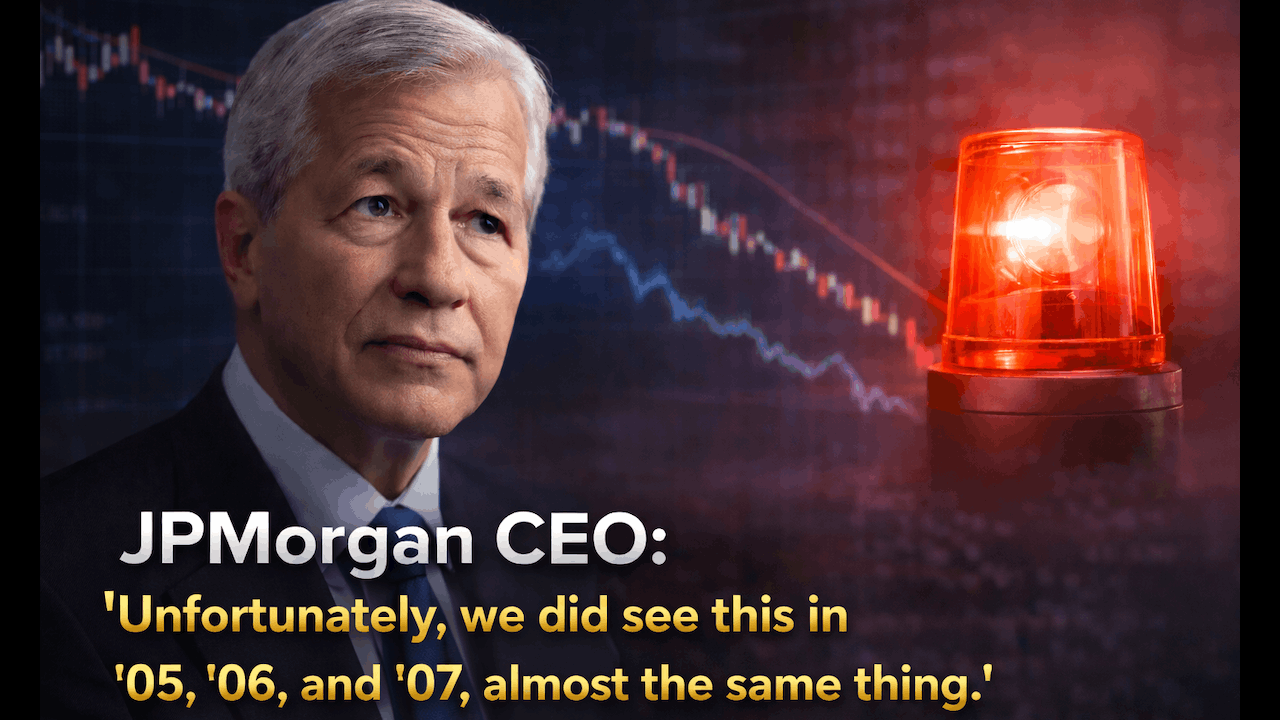
I’m not the only one who sees these concerning parallels. JPMorgan Chase CEO Jamie Dimon recently said elevated asset prices and an increasingly competitive banking environment, pushing more credit, remind him of the pre-2008 financial crisis years.
“My own view is people are getting a little comfortable that this is real, these high asset prices and high volumes, and that we won’t have any problems whatsoever.”
But he warned that the cycle will inevitably turn.
“There will be a cycle one day … I don’t know what confluence of events will cause that cycle. My anxiety is high over it. I’m not assuaged by the fact that asset prices are high. In fact, I think that adds to the risk.”
Dimon is increasingly concerned about rising levels of debt. Even as government, consumer, and corporate debt are at record levels, the banking industry is scrambling to make more loans, feeding the growing Debt Black Hole. He said that he sees many lenders loosening standards in pursuit of profit, like the run-up to the 2008 financial crisis.
“Unfortunately, we did see this in ’05, ’06, and ’07, almost the same thing. The rising tide lifting all boats, everyone was making a lot of money, people leveraging to the hilt. The sky was the limit.”
The sense that everything is great incentivizes more risk-taking.
“I see a couple of people doing some dumb things. They’re just doing dumb things to create NII (net interest income).”
Loose standards lead to bad loans. Bad loans create malinvestments. Malinvestments ultimately unwind, perpetuating a crisis. In 2006 and 2007, it was artificially low interest rates coupled with a government drive to increase homeownership that blew up a real estate bubble. Dimon said he wasn’t sure what would precipitate the next crash, but there is always something looming on the horizon.
“There’s always a surprise in a credit cycle. This time around it might be software because of AI.”
Dimon conceded that it’s easy to get caught up in market mania.
“You feel stupid when everyone’s coining money and everyone’s great … it does feel really good. And then when I think about all the factors taking place. I take a deep breath and say, `Watch out!'”
The Economy Never Reckoned with the 2008 Mistakes
On top of the similarities between 2007 and today, there are parallels to 2019 that should also raise eyebrows.
In the wake of the 2008 financial crisis, the Fed cut rates to zero and held them there for seven years. The central bank also bought more than $3.5 trillion in bonds via QE, bloating the balance sheet and injecting trillions of newly printed money into the economy. This fed the massive increase in asset valuations and debt that Dimon is worried about today.
The Fed didn’t lift a finger to normalize monetary policy until 2015, and it didn’t begin in earnest until two years later.
Even with only modest monetary tightening, the economy began to crack. The stock market tanked, and the economy got wobbly. It quickly became clear the central bank couldn’t normalize interest rate policy without crashing the economy, so it gave up. The Fed was forced to cut rates three times in 2019 and resume QE, just like today.
The pandemic bailed the Fed out in 2020, allowing the central bank to slash rates to zero and take QE to unprecedented levels. This kicked the can down the road, giving the easy money-addicted economy a surge of its preferred drug, and keeping the inevitable crash at bay.
Were it not for the massive monetary injection during COVID, the economy would have likely gone into a deep recession to cleanse the monetary excesses of the Great Recession. Instead, the pandemic allowed the central bank and the government to double down with stimulus, delaying the inevitable.
The reality is that the economy has to have its easy money drug. Without it, the addict goes into painful withdrawals.
The Fed (the pusher) has begun to dribble the monetary heroin into the addict’s veins. The problem is, over time, it takes more and more of the drug to maintain the high. Eventually, the druggie will OD.
No matter how this plays out, we’re looking at an increasingly inflationary environment. The money supply is already growing at the fastest rate since July 2022, in the early stages of the tightening cycle, and the pace of money creation will increase as the Fed continues QE (without calling it QE). We will also likely see additional rate cuts. That means you can look forward to the purchasing power of your dollar declining even more rapidly.
Of course, this will also add even more fuel to the fire Dimon is warning about.
Plan accordingly.
Mike Maharrey is a journalist and market analyst for Money Metals with over a decade of experience in precious metals. He holds a BS in accounting from the University of Kentucky and a BA in journalism from the University of South Florida.
. We will also likely see additional rate cuts. That means you can look forward to the purchasing power of your dollar declining even more rapidly.)