

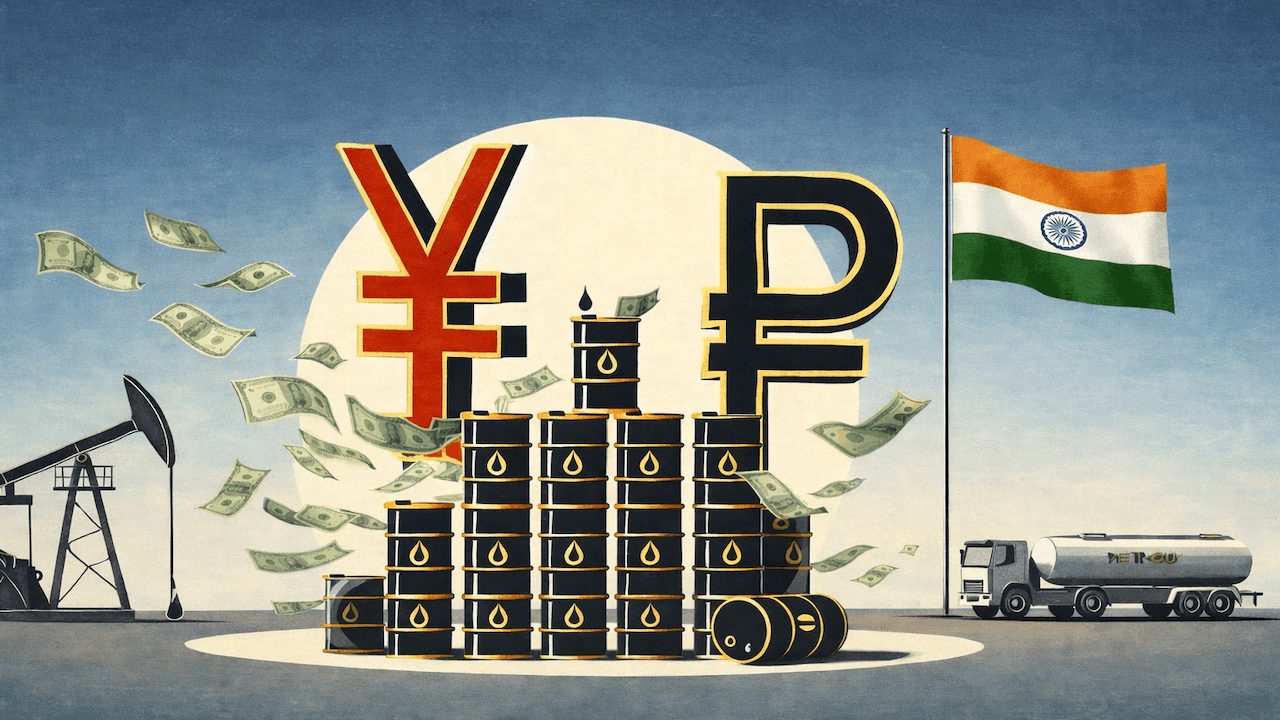
(Mike Maharrey, Money Metals News Service) India is increasingly bypassing the U.S. dollar in oil transactions.
The U.S. granted India a waiver to purchase Russian oil despite ongoing sanctions, as the Iran war squeezes global crude supplies. However, the waiver expires on April 11. According to a Bloomberg report, Russian refiners are seeking “more durable arrangements” and alternative payment arrangements.
Unnamed sources close to the matter told Bloomberg that oil transactions are increasingly being carried out using non-dollar currencies, circumventing the “petrodollar.” In practice, Indian customers deposit rupees into overseas bank accounts. The funds are then converted to yuan or UAE dirhams to complete the purchase. Sources say Indian banks with limited offshore presence are facilitating these trades.
Officials say the Singapore dollar and the Hong Kong dollar. The preferred currency depends on “individual banks’ comfort levels.”
India has reportedly purchased 60 million barrels of Russian oil since the U.S. issued its waiver.
This is another crack in the longstanding petrodollar system that has been under strain since the West aggressively sanctioned Russia in the wake of its invasion of Ukraine.
In a recent note, Deutsche Bank warned that the Iran war is further testing the dollar’s role in the global oil trade.
“The conflict could be the catalyst for erosion in petrodollar dominance and the beginnings of the petroyuan.”
The Deutsche Bank analyst said this could accelerate more general global de-dollarization, warning that the erosion of the petrodollar could have “significant downstream effects” on the dollar’s use in global trade and savings.
What Is the Petrodollar?
“Petrodollar” refers to the dollar’s role in crude oil transactions.
In the wake of the 1973 oil crisis, Saudi Arabia agreed to conduct all oil transactions in dollars and invest its oil surplus funds in U.S. Treasuries in exchange for U.S. military support.
The agreement was a boon for the dollar and was key in cementing the greenback as the world’s reserve currency.
Due to Saudi Arabia’s prominent role in the global oil trade, the agreement had a far-reaching effect. As a result, virtually all the world’s global oil transactions were priced in dollars. Since the dollar is the dominant currency in this system, the world uses dollars to purchase dollar-denominated assets and debt. This props up dollar dominance.
In effect, the petrodollar ensures a constant demand for dollars. Every country needs them to buy oil. This demand supports the U.S. government’s “borrow and spend” policies, along with its massive deficits. As long as the world needs dollars for oil, it guarantees demand for the greenback. That means the Federal Reserve can print more dollars and issue more Treasuries than it could have otherwise. As an article published by Nasdaq.com reported, the agreement created a “captive market” for U.S. government debt.
In 2024, nearly 80 percent of global oil sales were priced in dollars, but even then, countries were increasingly using other currencies. The Iran war may accelerate the process.
Ramifications of a Petrodollar Decline
Even modest de-dollarization could prove disastrous for the U.S. economy.
While the current de-dollarization trend doesn’t directly threaten the dollar’s role as the world reserve currency — yet — it could foreshadow bigger problems down the road, especially if it accelerates.
The dollar is already on shaky ground. Many countries are looking for ways to minimize dependence on the greenback due to growing concerns over the weaponization of the dollar, U.S. fiscal irresponsibility, and the rapidly increasing U.S. debt.
Make no mistake. This is a big problem for the U.S. because it depends on the global demand for dollars supported by its reserve status to underpin its massive government.
The only reason Uncle Sam can borrow, spend, and run massive budget deficits to the extent that it does is the dollar’s role as the world’s reserve currency. It creates a built-in global demand for dollars and dollar-denominated assets. This absorbs the Federal Reserve’s money creation and helps maintain dollar strength despite the Federal Reserve’s inflationary policies.
As one report put it more than a year ago, “If world players significantly reduce the use of U.S. dollars, the U.S.’s ability to issue dollar debt and earn dollars for exports will diminish, and the nation’s economy will shrink, according to international economists.”
In effect, if other nations no longer need dollars to conduct trade, the demand for dollars would plunge significantly. That would create a dollar glut and a rapid devaluation of the greenback. Interest rates on U.S. Treasury bonds would soar. This would be an untenable situation for a government servicing more than $39-plus trillion in debt. Rising interest rates have already driven interest payments sky-high. The U.S. government now spends more on servicing the debt than it does on national defense or Medicare.
A dollar glut would also impact the broader U.S. economy. It would increase inflationary pressure domestically as the value of the U.S. currency further depreciates. In the worst-case scenario, the dollar could collapse completely, leading to hyperinflation.
Mike Maharrey is a journalist and market analyst for Money Metals with over a decade of experience in precious metals. He holds a BS in accounting from the University of Kentucky and a BA in journalism from the University of South Florida.
