

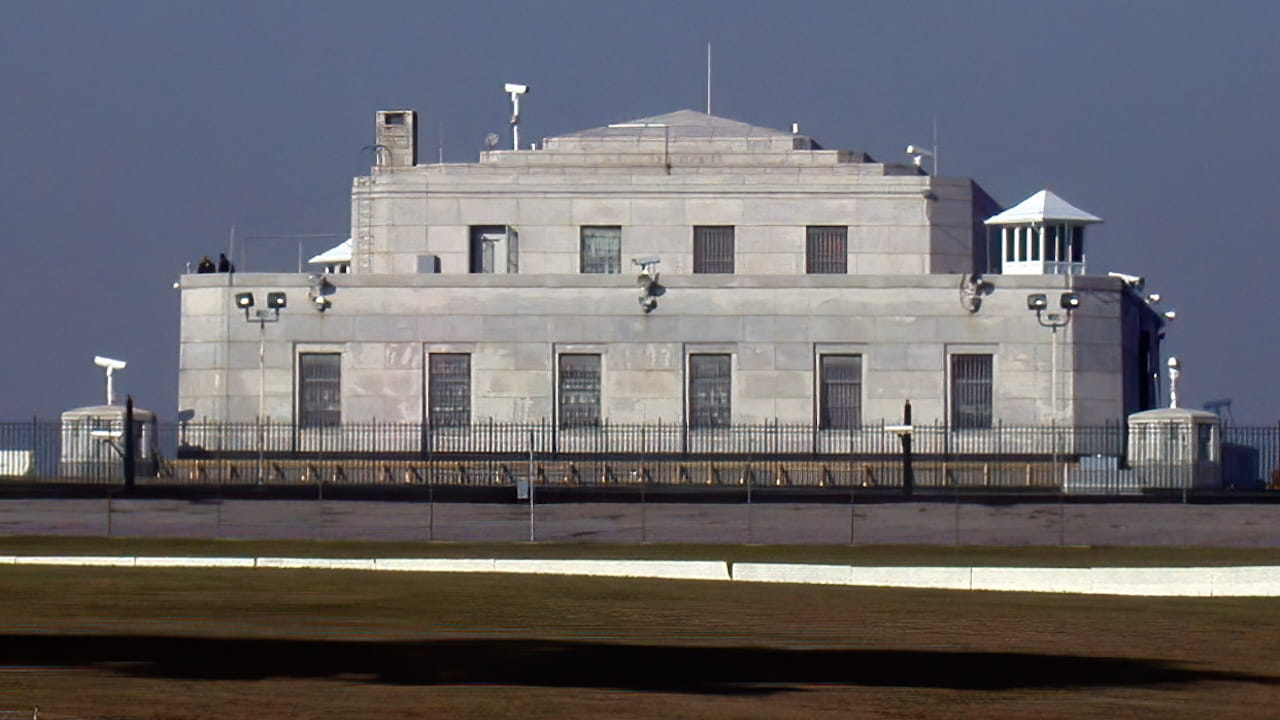
(Mike Maharrey, Money Metals News Service) The bulk of the U.S. gold reserves held in Fort Knox is made up of impure “non-standard” bars that don’t qualify for use in international settlements.
In practice, this means that most of America’s massive gold stockpile is illiquid and wouldn’t be readily accepted on the international market should the need arise.
“It’s a decrepit relic just like our monetary policy is. With respect to America’s gold stockpile, we hold ourselves to a lower standard than the rest of the world,” Money Metals CEO Stefan Gleason said.
The French central bank recently sold 129 tonnes of similar non-standard gold that was stored in New York and replaced it with higher-quality bars that will remain in France.
Notwithstanding the lack of any credible physical audits for decades, U.S. gold reserves are reported to be 8,133.5 metric tons (i.e., tonnes). That’s roughly 261.5 million troy ounces. About half of that (147.3 million ounces according to the U.S. Mint) is stored at Fort Knox. The rest is spread out between the Denver Mint, the West Point Bullion Depository, and the Federal Reserve vault in New York.
America’s gold is valued at $42.22 per ounce by statute. The price does not fluctuate with market movements.
According to the London Bullion Market Association (LBMA), gold bars must contain 350 to 430 fine troy ounces and have a minimum fineness of 995.0 parts per thousand to be acceptable for international settlements. In fact, the “good delivery” standards across the globe have been transitioning to 999+ fineness.
Based on documents released during a 2011 House Committee on Financial Services Hearing, however, we find only around 17 percent of the gold bars held by the U.S. government in Fort Knox meet any modern-day purity standards.
Here’s a breakdown of the purity of the gold bars held in Fort Knox:
- Fineness between 899 and 901 – 64 percent
- Fineness between 901.1 and 915.4 – 2 percent
- Fineness between 915.5 and .917 – 17 percent
- Fineness of .995 or higher – 17 percent
- The average fineness of U.S. gold reserves is 916.7 (or 91.67% pure gold)
Problematic Audits, Chain-of-Custody Discrepancies, Missing Records
Keep in mind, we’re operating on guesswork here because the U.S government’s gold holdings have not been audited since at least the 1970s.
In 1974, the government put together a publicity stunt in the name of an audit. The U.S. Treasury opened just one of its 15 Fort Knox vault compartments to politicians and reporters to view the gold and confirm its existence.
That’s been called an audit. However, none of the bars that were passed around were ever matched to a serial number, assayed or tested for purity, or even verified as part of the United States’ holdings. As Sound Money Defense League Director Matthew Cortez pointed out, “It seems the made-for-TV spectacle in 1974 was more of a pep rally than any credible proof of what the amount of U.S. gold purported to be in those vaults.”
Following the 1974 publicity stunt, the U.S. Treasury says it conducted a multi-year process of opening and inventorying vault compartments and affixing new tamper-evident seals to the doors of each compartment upon completion. However, these so-called audits failed to meet basic transparency or accounting standards.
Some reports have since gone missing, and there is no record of comprehensive assaying, weighing, or transactional history available to the public.
Furthermore, there is evidence that seals on vault compartments have been broken over the years, bars have been moved for unknown reasons, and seals have been re-affixed without fresh auditing. Subsequent annual reviews of the schedules of compartment seals serve only to whitewash the prior discrepancies.
In sum, the U.S. Treasury’s management of U.S. gold reserves is replete with audit “no-nos” that would never pass muster at a responsibly run private depository.
An “audit the gold” bill introduced by Sen. Mike Lee (R-Utah) last year would not only require a comprehensive audit of U.S. gold reserves, including, importantly, an accounting of any transactions involving said gold. It would also require the Treasury to refine all non-standard bars so that they meet modern requirements for international settlements — a process that could take several years.
Why So Much Non-Standard Gold?
How did the U.S. end up holding so many impaired gold bars that are illiquid on global markets?
It is the legacy of U.S. policy that abandoned the gold standard, leaving us with the fiat system we live with today.
Needing to expand the money supply to support his spending plans, President Franklin D. Roosevelt decided to expropriate the public’s gold and add it to the national reserves. On April 5, 1933, President Franklin D. Roosevelt signed Executive Order 6102, effectively making private gold ownership illegal.
FDR claimed the measure was to prevent “hoarding.” However, by creating an expansive definition of “hoarding,” the EO was designed to take virtually all gold coins and bars out of private hands and transfer them to the government.
Many people refer to Roosevelt’s scheme as “gold confiscation,” but that overstates what actually happened. The government didn’t go door-to-door taking people’s gold. However, bureaucrats still obtained huge amounts of gold, especially gold held by institutions, depositories, and banks.
Many Americans also turned in their gold voluntarily as an act of obedience. Some likely did so because they trusted the government, others out of a sense of patriotism, and some probably turned their gold in out of fear.
Everyone was paid $20.67 per ounce for their gold. But six months later, FDR formally devalued the dollar by some 40 percent when he declared gold worth $35 per ounce.
Much of the confiscated gold was in the form of coins that were generally 90 percent pure. At the time, private banks, along with the Federal Reserve, held a large number of coins. That was because Federal Reserve notes were redeemable for gold.
However, with private ownership of gold effectively banned, people would no longer be able to trade paper for metals, and there was no need to hold on to a bunch of coins. The government melted the coins down and formed them into bars, which now sit in Fort Knox vaults (as far as we know).
In a 1994 essay published by The Journal of Economic Education, William C. Wood called the Fort Knox depository “an artifact of the gold standard days.”
“The gold currently in Fort Knox came from the melting of Depression-era gold coins, from lend-lease arrangements in War II, and from government operations under the gold standard.”
Wood specifically noted, “The gold resulting from melting of coinage has considerably lower quality than the ‘fine’ or ‘good delivery’ gold commonly used in international trade. The majority of the gold in Fort Knox is the lower-quality coin gold.”
In some ways, it makes sense that U.S. gold reserves are impure and useless on the international market. It reflects the nature of the fiat system that replaced it.
Mises Institute Editor in Chief Ryan McMaken called the U.S. gold reserves “a legacy of theft and lies,” pointing out that the gold reserve was never intended to be a “static, untouchable hoard of the U.S. government.”
“It was supposed to be there for Americans and other users of dollars who traded in their dollars for gold. Gold was supposed to flow in and out. Then, the U.S. government slammed the doors of the federal gold vaults shut and declared ‘the gold is all ours forever.’ Like most everything else the U.S. government ‘owns,’ the gold in the U.S. gold reserves is there due to many years of lies, gaslighting, and deception. The gold is there because the U.S. regime defaulted on its debts and reneged on its promises to back dollars in gold.”
Mike Maharrey is a journalist and market analyst for Money Metals with over a decade of experience in precious metals. He holds a BS in accounting from the University of Kentucky and a BA in journalism from the University of South Florida.
.)