(Mike Maharrey, Money Metals News Service) Ask pretty much anybody, and they’ll tell you we have an inflation problem.
But what does that mean?
And how did it happen?
Most people have no clue.
The first problem is that policymakers and the media use a very imprecise definition of inflation. For most people, the word just means “rising prices.”
But that doesn’t really tell us anything, does it?
All kinds of things can cause rising prices. For instance, the ongoing Iran War oil shock is driving up prices throughout the economy. So, is inflation Iran’s fault?
Probably not. After all, we had inflation long before the Strait of Hormuz closed.
Perhaps it was Putin’s price hikes.
Or maybe not.
Greedy corporations could theoretically drive prices higher. That was a common narrative during the post-pandemic inflation spike. So, does that mean corporations are somehow less greedy during low-inflation periods?
Probably not.
So, maybe it has something to do with money printing?
Ah! Now we’re getting closer to the answer.
If we go back about 45 years, we discover that inflation wasn’t always defined simply as “rising prices.” Economists understood it as an increase in money and credit.
In other words, “inflation” was shorthand for “monetary inflation.”
Price inflation, measured by the CPI, is one symptom of monetary inflation.
The fact that we now use the same word for both monetary and price inflation creates a great deal of confusion. In his essay “Inflation in One Page,” Henry Hazlitt warned about this confusion, pointing out that it hides the culprit behind rising prices.
“Inflation is an increase in the quantity of money and credit. Its chief consequence is soaring prices.
“Therefore inflation—if we misuse the term to mean the rising prices themselves—is caused solely by printing more money. For this the government’s monetary policies are entirely responsible. (Emphasis added)”
Economist Ludwig von Mises made a similar point.
“People today use the term `inflation’ to refer to the phenomenon that is an inevitable consequence of inflation, that is the tendency of all prices and wage rates to rise.
“The result of this deplorable confusion is that there is no term left to signify the cause of this rise in prices and wages. There is no longer any word available to signify the phenomenon that has been, up to now, called inflation… As you cannot talk about something that has no name, you cannot fight it.”
Economist Milton Friedman declared that inflation is “always and everywhere a monetary phenomenon.” If he’s right, rising prices should follow an expansion of the money supply.
Turns out that they do.
As this chart shows, CPI spikes almost always follow sharp rises in the money supply with a one-to-two-year lag:

If you look closely at the chart, you might notice an anomaly. Money supply grew significantly during the Great Recession. However, there wasn’t a corresponding spike in price inflation, as measured by the CPI.
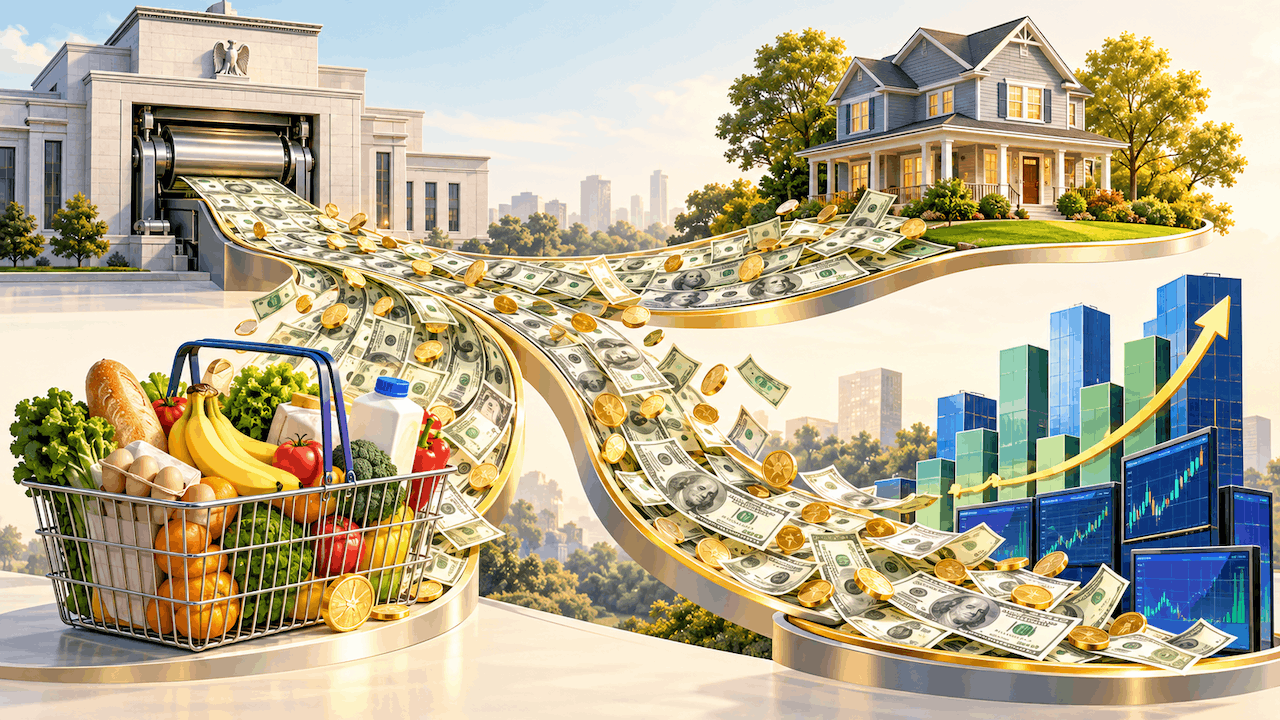
That’s because although rising consumer prices are one symptom of monetary inflation, they aren’t the only ones. Monetary inflation also manifests in asset price inflation.
A chart showing the trajectory of the S&P 500 and the growth of the M2 money supply reveals a surge in the stock market after both rounds of money creation during the Great Recession.

In other words, while consumer prices remained relatively steady, the monetary inflation showed up in stocks.
We see a similar phenomenon when we chart housing prices with money supply growth. Housing prices tend to go up within a year or two of a burst of monetary inflation.

If we chart money supply growth with the S&P 500, the CPI, and home prices, we find significant price increases follow every substantial increase in the money supply. Sometimes, CPI spikes higher. Sometimes, stocks surge. Sometimes, inflation shows up more clearly in real estate. But it always shows up somewhere (assuming the level of goods and services and the velocity of money remain relatively constant).

Where inflation manifests depends on the prevailing economic policies. During the Great Recession, banks were incentivized to hold newly created cash as reserves. As a result, inflation showed up more clearly in the financial system and less so in consumer prices. However, during the pandemic, government stimulus released a lot of newly created money into the economy, and inflation showed up in the CPI as well as asset prices. Money creation during the run-up to the 2008 financial crisis showed up in real estate thanks to government incentives at the time.
As I already said, many things can cause some prices to rise. Some things can cause many prices to rise. Only one thing causes a general rise in the price level — monetary inflation. But sometimes you have to look carefully to suss it out.
The bottom line is if you want to track inflation, you need to pay attention to the money supply. Inflationary price increases always follow monetary expansion. But they won’t always show up in the same way. You can have inflationary periods with relatively tame CPI, as we saw during the Great Recession.
NOTE: I have intentionally ignored the impact of the velocity of money and increases/decreases in the quantity of goods and services in the economy for this illustration. Those factors also influence how inflationary pressure manifests in the economy. However, it is safe to say that prices will be higher than they otherwise would have been with an increase in the supply of money and credit.
Mike Maharrey is a journalist and market analyst for Money Metals with over a decade of experience in precious metals. He holds a BS in accounting from the University of Kentucky and a BA in journalism from the University of South Florida.