


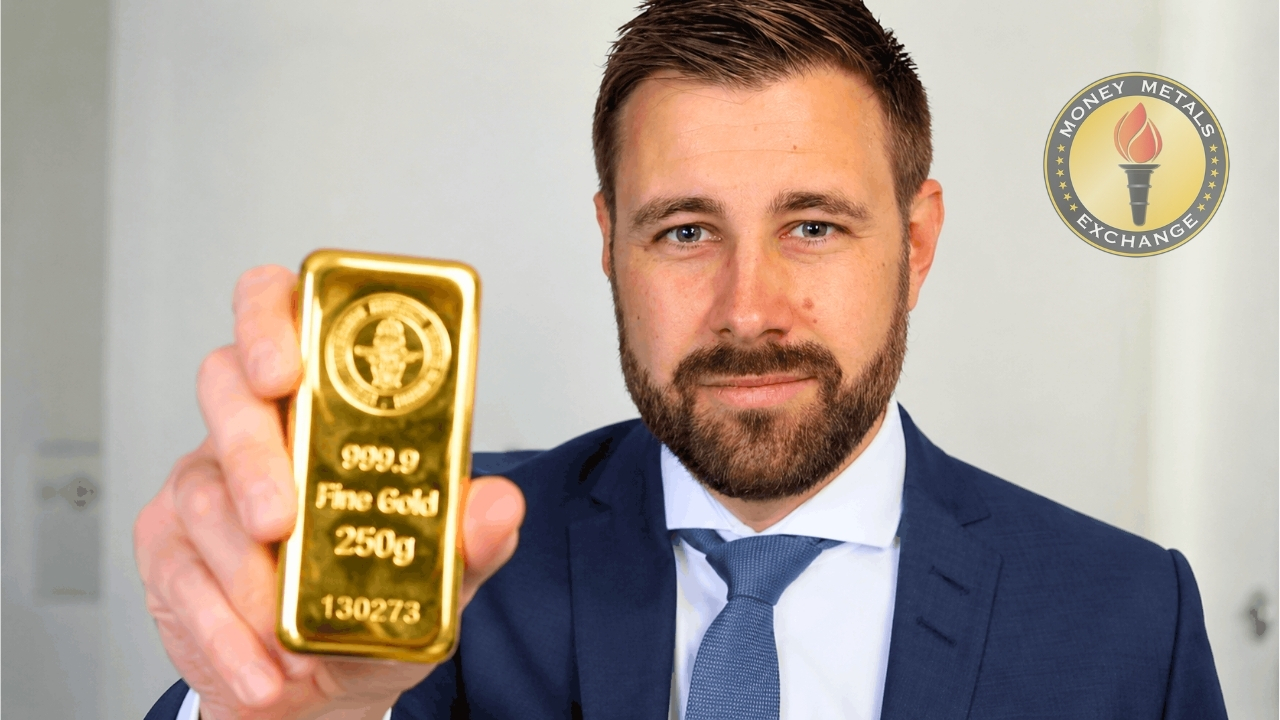
(Money Metals News Service) In a recent episode of the Money Metals Podcast, host Mike Maharrey sat down with Kai Hoffmann, founder and managing director of SOAR Financial, to discuss the recent turbulence in gold and silver markets, inflation concerns, central bank policy, and the outlook for mining stocks. Hoffmann, who has more than 15 years of experience in capital markets and the mining sector, acknowledged that recent price action in precious metals has puzzled even seasoned market observers.
According to Hoffmann, gold’s movements have become increasingly difficult to interpret. While geopolitical tensions and developments in the Middle East have clearly influenced market sentiment, he believes recent price swings have been driven more by headlines than by any fundamental change in the long-term investment case for gold. He noted that gold has reacted inconsistently to both peace talks and escalating tensions, making it difficult to draw straightforward conclusions from daily market moves.
Despite short-term volatility, Hoffmann emphasized that the core investment thesis for gold remains unchanged. He pointed to examples such as Turkey selling gold reserves to help stabilize its currency as evidence that gold continues to serve as both a safe-haven asset and a source of liquidity during periods of financial stress. He also highlighted ongoing purchases by central banks and major buyers such as Tether, suggesting institutional demand remains strong even as retail investors are shaken out of the market.
(Interview Starts Round 6:28 Mark)
America’s Debt Problem Is Being Ignored
One of the central themes of the discussion was the growing disconnect between market attention and America’s fiscal realities. Hoffmann argued that concerns over the U.S. national debt have largely disappeared from public debate despite the debt approaching $40 trillion. He estimated the total federal debt at roughly $39.3 trillion and rising rapidly.
While inflation and interest rates dominate financial headlines, Hoffmann believes the debt issue has simply been pushed aside. Efforts to control spending have largely failed, and he suggested that further monetary expansion remains likely. In his view, investors are overlooking not only rising government debt but also the expansion of the Federal Reserve’s balance sheet through ongoing quantitative easing measures.
The combination of expanding debt and monetary creation continues to support the long-term case for gold ownership. Yet Hoffmann noted that, unlike previous years, when debt ceiling debates regularly captured headlines, fiscal concerns have become secondary to geopolitical developments and military conflicts.
Why the Federal Reserve Faces an Impossible Balancing Act
The conversation also explored the difficult position facing central bankers. Hoffmann acknowledged that Federal Reserve officials often receive heavy criticism but argued that the reality of policymaking is more complicated than many investors appreciate.
He pointed out that many of the indicators the Fed relies upon—including inflation reports and employment data—are lagging indicators rather than leading indicators. This means policymakers are often reacting to economic developments after they have already begun rather than anticipating them in advance. Hoffmann specifically mentioned Kevin Warsh and expressed interest in whether future Fed leadership might adopt a more proactive approach.
Although inflation remains elevated, Hoffmann noted that current conditions are nowhere near the extremes experienced during the pandemic era. He referenced producer price inflation running near 6% annually while emphasizing that official inflation remains well below the approximately 9% levels seen during the COVID period. He also suggested that if geopolitical tensions ease and oil prices decline, inflation pressures could quickly moderate, potentially reviving the much-criticized concept of “transitory” inflation.
Contrary to many critics, Hoffmann believes the Federal Reserve has performed reasonably well over the past two to three years, given the information and tools available to policymakers. While not perfect, he argued that officials have largely succeeded in navigating an exceptionally uncertain environment.
Europe Is Not Facing an Energy Crisis—At Least Not Yet
With energy prices once again becoming a focus for investors, Maharrey asked Hoffmann about conditions in Europe. Hoffmann dismissed concerns about imminent jet fuel shortages, citing comments from Ryanair CEO Michael O’Leary, whose airline transports approximately 220 million passengers annually and ranks among the world’s largest carriers.
According to Hoffmann, major industry participants such as airlines and energy companies continue to report adequate fuel supplies. While headlines have raised concerns about shortages, he believes much of the discussion amounts to fear-driven speculation rather than evidence of an actual supply crisis.
Nevertheless, Hoffmann acknowledged that Europe remains structurally vulnerable due to its energy policies. He argued that the continent became overly dependent on Russian energy supplies and subsequently weakened its energy security through policy decisions that reduced domestic nuclear power capacity. While these long-term issues remain unresolved, he does not currently see evidence of an immediate fuel shortage.
Different Reasons, Same Love of Gold
The discussion turned to cultural attitudes toward precious metals, with Hoffmann highlighting notable differences between European and American investors.
In Germany, he explained, gold ownership is deeply influenced by historical memory. The hyperinflation of the 1920s remains embedded in the national consciousness, creating a strong preference for gold as a store of wealth and protection against currency debasement. Germans, he said, remember the stories of wheelbarrows full of nearly worthless currency and continue to view gold as a safeguard against similar outcomes.
American investors, by contrast, often approach gold from a more libertarian perspective. Hoffmann suggested that many U.S. buyers value gold because it offers independence from financial institutions and government control. The appeal lies not only in wealth preservation but also in the absence of counterparty risk and the ability to hold an asset outside the traditional financial system.
Although the motivations differ, Hoffmann believes investors on both sides of the Atlantic ultimately arrive at the same conclusion: gold provides security during uncertain times.
Mining Stocks Remain Strong Despite Gold’s Pullback
Drawing on his frequent attendance at mining conferences around the world, Hoffmann offered a bullish assessment of the mining sector.
He recently attended the Canaccord Conference and observed that while sentiment remains highly positive, the industry has not yet entered a phase of speculative euphoria. Capital continues flowing into junior mining companies, financing activity remains healthy, and investors are still willing to fund promising projects. However, he noted the absence of excessive optimism often associated with market tops.
One of the most interesting developments, according to Hoffmann, is that many mining stocks have recently refused to follow gold lower. While miners often lead recoveries in the precious metals market, they have not fully participated in recent downside moves. He views this divergence as a potentially constructive signal for the sector.
The economics of gold mining also remain exceptionally strong. Hoffmann estimated that first-quarter average gold prices were around $4,800 per ounce and expects second-quarter averages to remain near $4,500 per ounce. With many producers operating at all-in sustaining costs between roughly $1,800 and $2,000 per ounce, profit margins remain substantial even after recent price declines.
He suggested that margins of approximately $2,500 per ounce remain extraordinarily healthy and argued that investors may be overreacting to modest margin compression from record levels. Even if gold were to fall to $4,000 per ounce, he believes most producers would continue generating robust profits.
The Most Misunderstood Sector in Investing
Perhaps Hoffmann’s strongest argument centered on what he sees as a widespread misunderstanding of the gold mining industry among mainstream investors.
He cited a recent CNBC interview in which a fund manager claimed not to invest in non-cash-flowing companies when discussing Agnico Eagle, one of the world’s largest gold producers. Hoffmann expressed astonishment at the comment, noting that Agnico Eagle generates billions of dollars in free cash flow annually.
According to Hoffmann, many investors still fail to appreciate how financially healthy the mining sector has become. Major producers such as Barrick and Newmont are now sitting on net cash positions, paying higher dividends, repurchasing shares, and generating significant free cash flow. These are exactly the characteristics that traditionally attract institutional investors.
He believes pension funds and generalist investors are beginning to rediscover the sector, but widespread participation has not yet arrived. For that reason, Hoffmann sees the current environment as an opportunity for investors to gain exposure before a larger wave of capital enters the market.
Gold’s Enduring Value
As the interview concluded, Hoffmann returned to a theme that ran throughout the conversation: gold’s ability to prove its value repeatedly across different economic and geopolitical environments.
Whether discussing Turkey’s use of gold reserves to support its currency, Russia’s financial resilience, or the continued accumulation of bullion by central banks, Hoffmann argued that gold remains uniquely positioned as a trusted store of value. While market narratives may shift from inflation to war to interest rates, the underlying role of gold remains remarkably consistent.
For Hoffmann, the precious metals bull market is not being driven by short-term headlines alone. Rather, it is being supported by long-term structural forces, including rising government debt, ongoing monetary expansion, persistent geopolitical uncertainty, and growing recognition of gold’s role as a financial anchor in an increasingly unstable world.

 Kai Hoffmann tells Mike Maharrey why gold’s bull market remains intact despite volatility, citing rising U.S. debt, inflation risks, strong mining profits, central bank demand, and gold’s enduring role as a safe haven.)