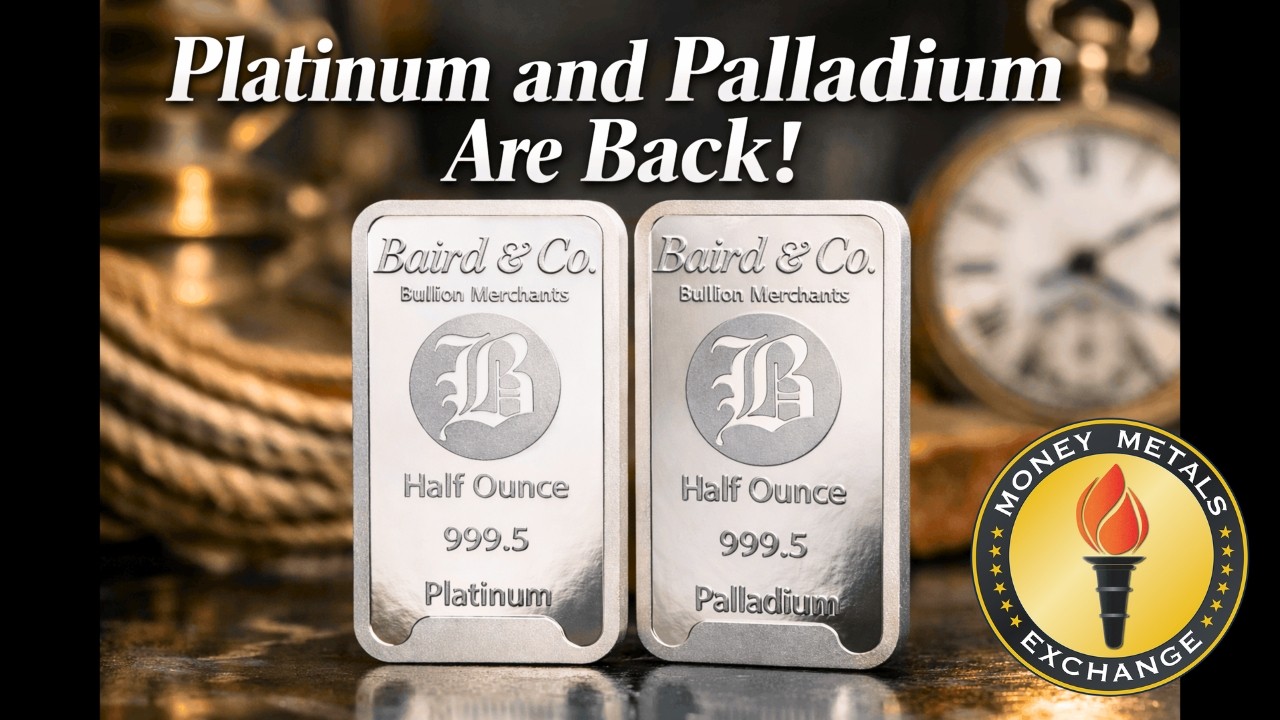
(Money Metals News Service) A recent episode of The Crux Investor podcast brought together two perspectives on platinum group metals. Nick Smart is CEO of ValOre Metals Corporation, and Stefan Gleason is President and CEO of Money Metals Exchange.
Gold and silver remain the cornerstone precious metals for most investors. Still, the discussion highlighted why platinum and palladium are re-entering the spotlight as supply tightens, industrial demand holds up, and investors look for diversification inside the broader hard asset complex.
Platinum’s Late 2025 Breakout Was Not a Fluke
Nick Smart described 2025 as a pivotal year for platinum, particularly in the last six months. That move followed multiple years of weak pricing that often sat below $1,000 per ounce.
His argument was direct. Years of underinvestment in mine supply met changing demand dynamics. Above-ground inventories began depleting, and the gap between supply and demand widened. When a market is that tight, prices tend to move quickly once the imbalance becomes apparent.
A Smaller Market Than Most Investors Realize
One of the most important points from the conversation is scale.
Smart put global primary platinum production at roughly 6 million ounces per year, with palladium in a similar range. He contrasted that with gold at roughly 120 to 130 million ounces annually, which underscores that platinum and palladium are far thinner markets than most investors expect.
In a market this small, it does not take a dramatic shift in demand to create meaningful price pressure.
Why Supply Is So Hard to Expand
Smart explained that platinum and palladium are not just rare. They are hard to find in concentrated, economically mineable deposits.
He noted that platinum and gold can have similar average distribution levels in the Earth’s crust, measured in parts per billion. However, platinum group elements require very specific geological conditions to form ore bodies rich enough to mine.
He also underscored that about 90 percent of global platinum group element reserves are in South Africa. That concentrates supply in a single region and makes diversification difficult.
From the mining side, he highlighted another constraint. Many deposits are deep underground and require heavy upfront infrastructure investment. Prices were depressed for years, so the industry did not invest enough to build the next wave of supply. Even now, new mines can take years to bring online.
Retail Demand Is Small, But It Can Still Matter
Stefan Gleason brought the retail bullion perspective.
He said that in Money Metals’ mix, platinum has typically been about 1 percent of sales, palladium less than 1 percent, and rhodium even smaller. Gold and silver dominate the investment conversation, and those markets are more liquid.
Even so, Gleason described why platinum is getting more attention. It has its own unique drivers, and in a tight market, marginal investment demand can have an outsized impact. Physical bullion buyers also tend to be long-term holders rather than short-term traders, especially given wider bid-ask spreads in platinum products.
Tight Markets Show Up First in the Market Plumbing
Gleason also discussed stresses that show up behind the scenes, especially in financing.
He referenced a shortage of platinum in London and said borrowing costs, often called lease rates, have surged to roughly 12 to 15 percent annualized. He also noted that there have been even higher spikes during periods of extreme tightness. Higher financing costs can ripple through refineries, industrial users, and producer hedging. That adds another layer of pressure beyond simple supply and demand.
He also described a geographic pull on available metal. Inventory moved into the United States amid tariff threats. At the same time, London looked tighter. China also expanded platinum hedging and investment participation, which created competing demand centers.
Above-Ground Inventory Is the Real Alarm Bell
Gleason said platinum has less than half a year of above-ground supply. He called that level unsustainable.
That matters because when inventory buffers get thin, even small disruptions can force prices to adjust quickly. Transportation delays, regional stockpiling, or a demand surprise can all create sudden stress.
The host offered a striking comparison to show the market’s size. He suggested that roughly $6 billion could buy up the available platinum supply. The point was not precision. The point was how small this market is relative to global capital flows.
Jewelry Demand Adds a Second Tailwind
A major theme that investors often overlook is jewelry substitution.
Gleason noted that gold is now roughly twice the price of platinum. He argued that this is encouraging more platinum jewelry demand, particularly in India and China.
Smart reinforced the point from the manufacturer’s perspective. When gold prices soar, producers face higher inventory costs and risk pricing out customers. Platinum can become a practical substitute, especially for white gold, while still carrying a luxury status.
What Could Derail the Bullish Case
The main downside risk discussed was a sharp economic slowdown.
Gleason said platinum is more economically sensitive than gold and silver. A deep recession could weigh on platinum demand, and palladium could be hit even harder. However, he also suggested that an inflationary slowdown could still be constructive for hard assets broadly.
Smart focused on what has changed structurally in auto demand. The shift to battery electric vehicles has not happened as aggressively as many forecasts assumed.
He said that in 2025, about 75 percent of new vehicles sold in the United States are still internal combustion engine vehicles. He identified hybrids as the fastest-growing global category. He also emphasized that hybrids can use more platinum and palladium than conventional engines, which supports industrial demand rather than weakening it.
Where Platinum and Palladium Fit in a Precious Metals Strategy
For most investors, gold and silver remain the foundation.
Still, this discussion highlighted why platinum and palladium can play a role. They bring a different set of drivers inside the precious metals universe, including industrial demand, constrained supply, and a market structure that can react sharply when inventories get thin.
For investors who already hold gold and silver, adding a modest allocation to platinum or palladium can diversify exposure across the precious metals complex. The supply picture described in this interview is one reason these metals are drawing attention again.
Buy Platinum, Palladium, Gold, and Silver from Money Metals
Money Metals Exchange offers a wide selection of physical precious metals for investors. That includes gold and silver bullion, plus platinum and palladium products.
If you want to build or diversify your holdings with physical metal, Money Metals makes it easy to buy securely and take delivery. You can also arrange professional storage through a trusted United States dealer that focuses on serving long-term precious metals investors.