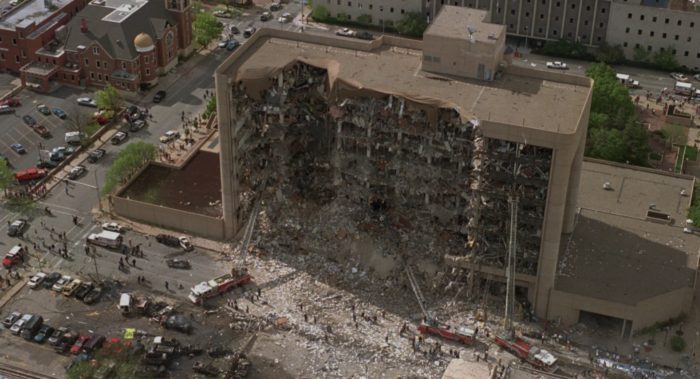
(Ken Silva, Headline USA) More than 31 years after the Oklahoma City bombing, state officials say an investigation into one of the case’s enduring mysteries is still technically open.
The mystery in question stems from a left leg that was found in the rubble of the Murrah federal building in the wake of the April 19, 1995, terror attack. That leg was eventually matched to OKC bombing victim Lakesha Levy. However, Levy had already been buried with another left leg in her coffin.
To this day, the leg initially matched to Levy remains unidentified. This has led researchers surmise that it may belong to an unknown victim, or perhaps an accomplice to OKC bombers Timothy McVeigh and Terry Nichols. Given the government’s apparent reluctance to identify the leg, some have speculated that the leg may have belonged to an FBI informant or undercover agent. McVeigh himself once told his attorneys the limb would “fuel conspiracy theories for years.”
For over two decades, investigators maintained that they were unable to extract DNA from the leg that was retrieved from Levy’s coffin because it has been embalmed. But in December 2015, Oklahoma Chief Toxicologist Dr. Byron Curtis told the Washington Times that the Office of the Chief Medical Examiner did, in fact, have DNA from the mystery leg.
“Dr. Curtis said, ‘DNA was extracted’ in 1997 and ‘we maintain samples of the leg,’” the Times reported in December 2015. “The DNA results are filed with the chief medical examiner, he said.”
🚨NEW: Officials say one of the OKC bombing's enduring mysteries is still an open investigation.
Attorneys Jesse Trentadue and Ben Wetmore filed a FOIA for records on the mysterious unidentified leg from the attack–only to be told that the case is still open.
STORY BELOW🧵 pic.twitter.com/jbbAwQ2GdU— Ken Silva (@JD_Cashless) June 26, 2026
Fast forward nearly another 11 years: Attorneys Jesse Trentadue and Ben Wetmore are still working to obtain information about the leg, referred to in OKC medical records as specimen “P-71.” Wetmore recently filed a request with the state for “records concerning the recovery, examination, storage, identification, DNA testing, chain of custody, disposition, and ultimate attribution of specimen P-71”—only to be told on Thursday that he can’t have the records because, among other reasons, the case is still open.
“Since ‘P-71’ has not been identified, it remains an open case and investigation,” Madalynn Martin, the counsel for Oklahoma’s Office of the Chief Medical Examiner, said in a letter Thursday, which Trentadue provided to this publication. “Further, Oklahoma provides that ‘the Chief Medical Examiner shall produce records, documents, evidence or other material of any nature only upon the order of a court.”
Trentadue told Headline USA that he intends to file a lawsuit over the matter.
The Utah attorney added that he believes the leg may have belonged to an accomplice who served in the military with McVeigh, who was executed for his part in the attack in June 2001. The FBI may have thought that at one point, too. An FBI memo provided by Trentadue says that agents found eight military deserters and roughly 60 other missing persons when investigating possible matches to the leg.
According to the book Oklahoma City: What the Investigation Missed, and Why it Matters, the FBI later surmised that the missing limb belonged to Cynthia Campbell Brown, a Secret Service agent killed in the bombing. However, the FBI didn’t want to test its theory because “doing so could raise the question of whose leg she was buried with—and perhaps set off an uncontrollable chain reaction of exhumations and mistaken body-part re-identifications,” the book said.
“If the extra leg did belong to a coconspirator, he was never investigated, much less identified,” the book added.
Ken Silva is the editor of Headline USA. Follow him at x.com/jd_cashless.