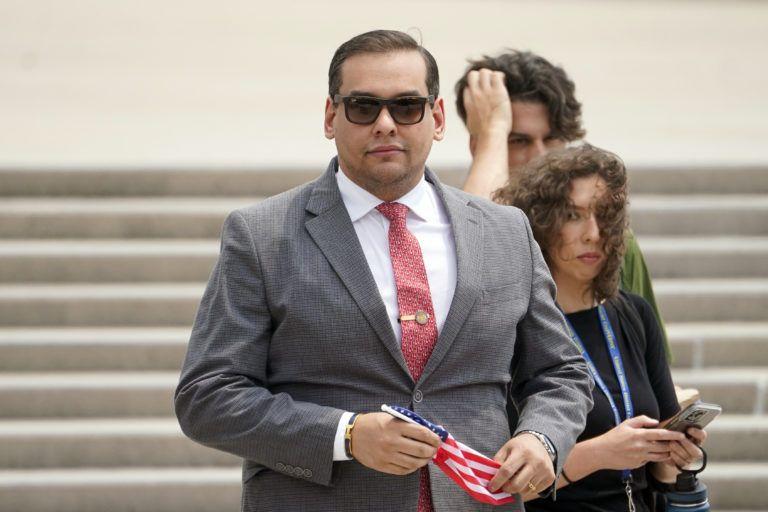
(Headline USA) Disgraced former Congressman George Santos agreed Friday to pay $35,000 to settle a federal investigation into his suspicious trades on the prediction marketplace Kalshi after he bet against his own plans to attend President Donald Trump’s State of the Union.
The onetime Republican lawmaker from New York said he settled with the federal Commodity Futures Trading Commission to “put this matter behind him,” noting that he did not admit to doing anything wrong.
“He chose a prompt, practical resolution, rather than protracted, costly litigation, and that choice should not be mistaken for admission of any wrongdoing, because it is not one,” Santos’ lawyer Joseph Murray said in a statement Santos shared on X.
The commission said Friday’s settlement represents the more than $17,000 Santos earned from the unlawful trading as well as a fine of $17,500. The agency also imposed a three-year trading ban on Santos.
Kalshi, which had reported Santos to regulators, said it will also pursue its own enforcement action and work to reimburse traders if monetary penalties are recovered.
Leading up to Trump’s February speech, Santos had talked frequently about his plans to be in the crowd. But minutes into the speech, he posted on X to say that he had been waylaid at the airport and couldn’t make it to Capitol Hill.
Watching SOTU from an airport tv was not part of the plan! FML 😡🤬
Social media users called him out, noting that Kalshi had put the odds of Santos attending the address at close to 75%.
Santos shrugged off the complaints at the time.
“I guess people lost money,” he said on his podcast in March. “Some people made unexpected money. That’s to show you how fragile these markets are.”
But the federal probe into the Kalshi trading prompted rival online prediction platform Polymarket to cut ties with Santos in June.
Santos’ lawyer, in his statement Friday, said his client had a “genuine intention” to attend the State of the Union, even booking a hotel and plane ticket before a winter storm scuttled the plans.
“Mr. Santos concealed neither his intention to attend, nor his change of plans to not attend the SOTU, from anyone,” Murray said. “There was absolutely no intent to deceive any person, nor intent to manipulate any market.”
Santos, who is set to appear on Fox’s reality contest “Special Forces: World’s Toughest Test” this fall, shot to political fame after winning a seat representing parts of the New York City borough of Queens and Long Island.
But his bogus life story of being a wealthy Wall Street player with a college degree and other accomplishments quickly unraveled.
Santos was eventually expelled from Congress and charged with federal wire fraud and identity theft charges as investigators probed how he funded his campaign. He pleaded guilty and served less than three months of a more than seven-year sentence before Trump granted him clemency last year.
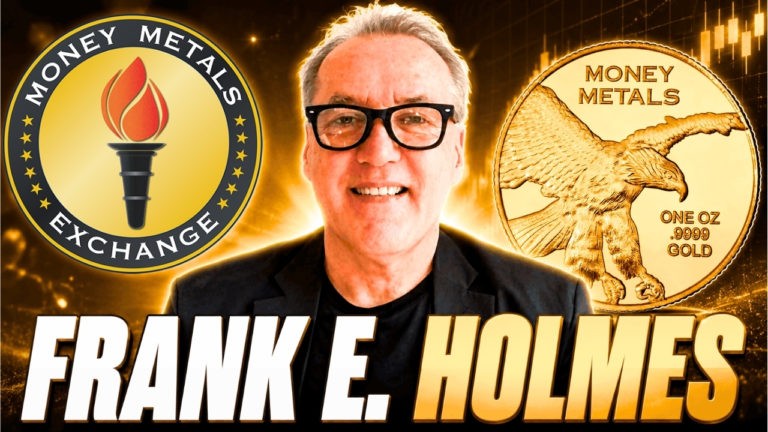
(Money Metals News Service) Despite months of sideways trading, Frank E. Holmes believes the gold bull market is alive and well. During a wide-ranging conversation with Money Metals’ Mike Maharrey, the executive chairman of HIVE Digital Technologies and CEO and Chief Investment Officer (CIO) of U.S. Global Investors argued that powerful global trends continue to support higher gold prices.
From Asian consumer demand and central bank buying to Japan’s interest rate shifts, artificial intelligence infrastructure, and rising government debt, Holmes outlined why he sees the current correction as a buying opportunity rather than the end of the bull market.
(Interview Starts Around 7:06 Mark)
The “Love Trade” Is Stronger Than the “Fear Trade”
Frank Holmes explained that gold demand is driven by two distinct forces: the “fear trade” and the “love trade.” Western investors tend to focus on fear-driven buying fueled by inflation, wars, monetary expansion, and financial instability. However, he argued that the larger and more durable driver comes from the love trade.
According to Holmes, roughly 60% of global gold demand comes from people purchasing gold as portable family wealth, particularly throughout Asia and the Middle East. Rising GDP per capita across countries such as China and India has dramatically increased gold ownership over the past two decades. In many emerging economies, physical gold functions as a form of financial insurance where traditional insurance markets are less developed.
Because of these cultural dynamics, Holmes believes every significant correction in gold is met with strong physical buying from Asian consumers, creating an important foundation underneath the market.
China, BRICS, and the Dollar’s Long-Term Challenge
Holmes also emphasized that global monetary shifts continue to favor gold.
He pointed to more than $350 trillion in global debt and ongoing adherence to Modern Monetary Theory (MMT)-style fiscal policies as long-term catalysts for precious metals. At the same time, he argued that China has steadily weakened the U.S. dollar’s international dominance through its Belt and Road Initiative and expanding influence among BRICS nations.
According to Holmes, approximately 75% of United Nations member countries now have financial ties to China through Belt and Road lending. That growing influence has encouraged more international trade to occur outside the traditional dollar system, reducing long-term demand for U.S. dollars while increasing interest in alternative reserve assets such as gold.
Japan May Be Driving More Than Investors Realize
One of Frank Holmes‘ biggest concerns centers on Japan’s changing interest rate environment.
For roughly 30 years, Japan maintained near-zero borrowing costs, allowing hedge funds, institutions, pension funds, and insurers to borrow cheaply in yen before investing in higher-yielding assets around the world. That so-called “carry trade” became a major source of global liquidity.
Now that Japan has begun raising interest rates following post-COVID inflation and supply chain disruptions, Holmes believes that money is beginning to flow back into Japan. As investors unwind those leveraged positions, markets ranging from technology stocks to gold experience selling pressure driven by margin calls rather than deteriorating fundamentals.
He noted that Japan holds one of the highest debt-to-GDP ratios among G7 nations, yet nearly half of that debt is owned domestically by the Bank of Japan. As Japanese capital returns home, Holmes expects the unwinding process to continue affecting markets worldwide.
AI Spending Suggests the Global Economy Remains Strong
Although technology stocks have experienced volatility, Holmes argued that the artificial intelligence boom is far from finished.
He highlighted Meta’s plans to build a $14 billion AI data center in El Paso, Texas, requiring approximately 50,000 tons of copper. Strong copper prices, he said, contradict the narrative that AI investment is collapsing.
Holmes also pointed to BlackRock’s willingness to invest roughly $10 billion into AI infrastructure, backed by sovereign wealth funds from countries including Norway, Saudi Arabia, and the United Arab Emirates. These enormous capital commitments suggest institutions continue viewing AI as a long-term supercycle rather than a speculative bubble.
To Holmes, copper’s continued strength reinforces that conclusion because rising industrial demand remains inconsistent with fears of an imminent AI collapse.
Quant Models Point to a Favorable Gold Setup
Rather than relying solely on macroeconomic forecasts, Holmes uses quantitative models to evaluate market conditions.
Frank Holmes explained that both gold and silver reached historically overbought levels earlier in the year, with silver moving approximately six standard deviations above its longer-term trend before futures exchanges increased margin requirements. Gold also experienced a significant correction as rising interest rates pressured prices.
After falling from roughly three standard deviations above trend to approximately 1.6 standard deviations below, Holmes said his models now indicate an approximately 85% probability that gold prices will be higher over the next 60 trading days.
He emphasized that this outlook comes from statistical market behavior rather than geopolitical predictions, arguing that markets naturally oscillate between periods of excessive optimism and excessive pessimism.
Mike Maharrey challenged Holmes on a common assumption: if interest rates remain elevated and bonds stay in a long-term bear market, shouldn’t that be bearish for gold?
Frank Holmes disagreed.
He argued that central bank gold buying—particularly among countries seeking to diversify away from the U.S. dollar—continues to provide substantial support. At the same time, governments facing mounting fiscal problems repeatedly resort to monetary expansion.
Holmes maintained that investors should hold at least 10% of their portfolios in gold and silver as financial insurance. While acknowledging that some vocal gold advocates own little or no physical metal themselves, he believes the underlying supply-and-demand fundamentals remain overwhelmingly favorable.
Will Central Banks Ever Stop Printing Money?
The discussion turned to speculation surrounding Kevin Warsh and whether future Federal Reserve leadership might maintain a tougher stance on inflation.
Holmes acknowledged that Warsh projects a more disciplined, fact-based communication style than previous Fed officials. However, he ultimately believes any major recession or financial crisis would lead policymakers back toward monetary stimulus.
He argued that the institutional culture within central banking overwhelmingly favors supporting economic growth through additional liquidity, making continued money creation more likely than prolonged monetary restraint.
That expectation reinforces Holmes’ long-term bullish outlook for gold, especially as governments continue expanding deficits.
Could Gold Eventually Reach $40,000?
Perhaps Holmes’ boldest projection involved the theoretical value of U.S. gold reserves.
Using a mark-to-market approach that compares America’s official gold holdings with total federal debt, Holmes suggested gold could approach $40,000 per ounce if policymakers sought to substantially improve the nation’s debt-to-gold ratio.
Smart Beta Investing and Reading the Global Economy
Holmes also discussed his Smart Beta 2.0 investment process, which emphasizes revenue growth, cash flow momentum, and portfolio construction rather than simple stock selection.
For gold mining investments, he favors royalty companies while evaluating quarterly production and revenue growth relative to movements in gold prices.
Outside precious metals, Holmes watches cargo shipping and airline traffic as real-time indicators of global economic activity. He noted that roughly 80% of commodities move by cargo ship, while airline travel has surged from approximately 85,000 daily TSA screenings during 2020 back to roughly 3 million travelers per day.
Despite negative headlines, Holmes believes these indicators demonstrate that the global economy remains resilient.
Military Spending, AI, and Staying Ahead of Monetary Expansion
Frank Holmes concluded by arguing that government spending is increasingly shifting toward defense technology, cybersecurity, and artificial intelligence rather than traditional social programs.
He estimated that approximately $2.5 trillion could flow into military modernization and AI-related investments over time. Combined with continued monetary expansion, he believes these trends will continue creating opportunities across sectors tied to technology, commodities, and precious metals.
Rather than complaining about money printing, Frank E. Holmes encouraged investors to position their portfolios ahead of it. In his view, owning assets that benefit from inflationary policies—including physical gold—remains the most practical long-term strategy.
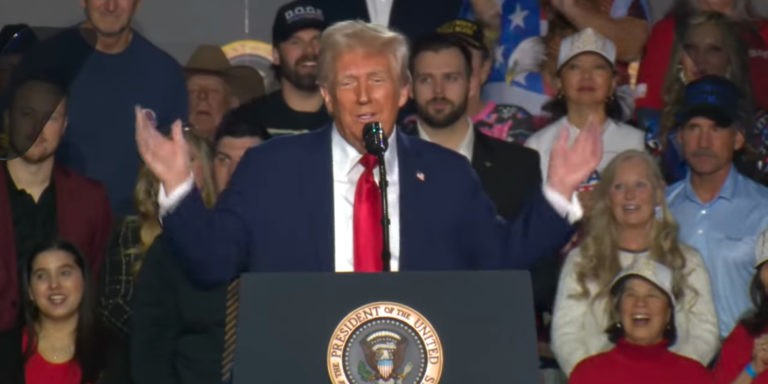
(Sarah Roderick-Fitch, The Center Square) During the 13th cabinet meeting of President Donald Trump’s second term, the president indicated he expects more back-and-forth strikes with Iran as he tells reporters he is “losing faith” in the Islamic Republic.
The president expressed frustration with the Iranian regime, adding that “they do lie” and “misrepresent,” noting Iran’s surprise missile attack on U.S. forces in Jordan. All five missiles were intercepted, prompting the U.S. to launch retaliatory strikes.
Despite the dust-up earlier in the week, the U.S. hasn’t launched strikes on the Islamic Republic since Wednesday evening.
The president added that he believes Iran will “get weaker,” but then “get a little stronger maybe now, but they’ll get weaker and then they peter out.”
He underscored a need for the U.S. to “keep” its “guard up” with the Islamic Republic even as talks are ongoing due to the regime going back on their word – making a possible nod to the memorandum of understanding signed on June 17, which fell apart within days of the agreement when Iran violated the agreement by refusing to open the Strait of Hormuz, including the targeting of commercial cargo ships.
The president and Secretary of the Treasury Scott Bessent have stressed the financial strain the U.S. continues to put on the Islamic Republic through sanctions and the ongoing complete naval blockade on Iranian ports, which the administration estimates is costing the regime between $400 million and $500 million in lost revenue.
During Bessent’s remarks in the cabinet meeting, he indicated that Iran is experiencing record-high inflation and can’t afford to pay its troops.
Last week, the U.S. House of Representatives narrowly passed a $1.15 trillion defense spending bill. The Pentagon claims the conflict with Iran has cost taxpayers $37.5 billion thus far.
However, multiple independent analyses suggest the true cost of the conflict has surpassed $100 billion. Moody’s Analytics estimated that the war has cost American consumers and taxpayers over $100 billion when factoring in surging energy prices and military outlays.
Separate assessments by independent groups, such as Brown University’s Costs of War project, also put total deployment, munitions and operational expenses in the $100 billion to $113 billion range.
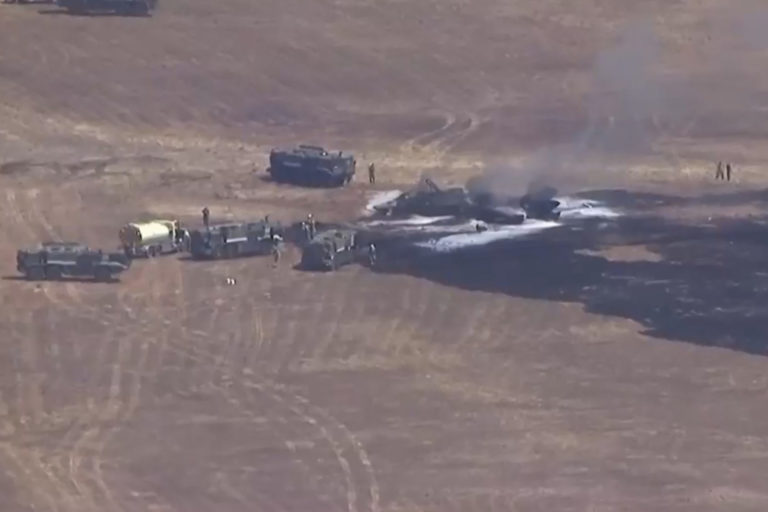
(Headline USA) The U.S. Marine Corps says the pilot of an F-35B stealth fighter is expected to live after ejecting from the jet before it crashed in California.
The jet went down Friday near the Miramar air base in San Diego. A Marines statement called it a “Class A mishap.” A single F-35B fighter jet costs about $109 million.
“The pilot ejected, was transported to a local medical facility in stable condition for evaluation and treatment of non-life-threatening injuries,” the Marine Corps said in an updated statement.
Aerial video from a news helicopter showed a plume of black smoke rising from the wreckage in a dirt field, with multiple military and firefighting vehicles and people standing nearby. What appeared to be white flame retardant covered the ground, and at least one person was spraying the wreckage with a fire hose.
Candace Hadley, a spokesperson for San Diego Fire, said firefighters were on scene to respond to a vegetation fire that sparked near the crash site. She referred additional questions to Miramar.
The F-35B is one of several versions of the advanced stealth fighter jet that is flown by the Marine Corps, Navy and Air Force. The “B” version has an engine that is designed for short takeoffs and is capable of vertical landings.
Marine Corps Air Station Miramar used to host the Navy fighter pilot training school depicted in the original “Top Gun” movie, and was known as “Fightertown USA” in its heyday. The school was relocated to Naval Air Station Fallon in Nevada in 1996 after the base was transferred to the Marine Corps.
(Headline USA) The families of four teenagers who died by suicide are suing Meta, TikTok, Snapchat and YouTube over what they describe as “years of escalating harms” from using their platforms that eventually resulted in their deaths.
The lawsuit, filed Thursday in the Superior Court of Delaware, is the latest in a flurry of suits filed against the social media giants that alleges their platforms are addictive and dangerous.
The complaint was filed on behalf of four families from Texas, North Carolina, Minnesota and Tennessee whose children died over a 14-month period starting in July 2024 through September 2025.
The Social Media Victims Law Center is bringing the suit on behalf of the families, and its founding attorney, Matthew Bergman, said it’s “particularly salient” that the children in this case died “long after” similar suits had been filed.
“These platforms continue to kill kids, despite the platitudes of their executives,” Bergman said in an interview. “This is a clear and present danger to the health and safety of children, not just in the United States but around the world.”
The four teens who died by suicide each experienced harms including social media addiction, severe sleep deprivation, depression, anxiety and suicidal ideation after years of using the social platforms, the complaint states. Livi Castro died at age 13, Riv Kelleher at 14, Nathaniel Chambers at age 17 and Dawson Holden at 18.
The complaint alleges the social media companies knew they were causing harm to young users.
A spokesperson for Google, which owns YouTube, said in a statement that “providing young people with a safer, healthier experience has always been core to our work. In collaboration with mental health and parenting experts, we’ve built services and policies to provide young people with age-appropriate experiences, and parents with robust controls. We send our deepest sympathies to the families and are reviewing the claims in this lawsuit.”
Representatives for Meta, TikTok and Snap did not immediately respond to requests for comment.
Sacha Haworth, executive director of The Tech Oversight Project, said in a statement that parents, activists and whistleblowers have come forward and met with lawmakers for years and “while Congress has dragged its feet, more children have died.”
Federal legislation of social media has moved at a glacial pace. The Senate passed the Kids Online Safety Act — which had the support of parents’ groups and children’s advocacy organizations — exactly two years before this lawsuit was filed. The House of Representatives never voted on that version of the legislation, and the House and Senate are currently disagreeing on key provisions they think should be included.
“Livi, Nathaniel, Dawson, and Riv’s stories are proof that Big Tech companies continue to lie about the safety of their products, choosing instead to pour hundreds of millions of dollars into false advertising, deceptive paid partnerships with trusted education programs and political lobbying,” Haworth’s statement continued.
Meta, YouTube, TikTok and Snap are facing numerous state and federal lawsuits over harms to minors. Meta is on trial in Tennessee this week for a lawsuit brought by the state attorney general claiming that the company deliberately designed its platforms, notably Instagram, to make them addictive to young people, and did not warn them of its dangers. And in August, Meta is heading to trial in federal court in Oakland,
California to face four of dozens of states that sued the company in 2023. That lawsuit says the company is contributing to the youth mental health crisis by designing addictive features and violated federal law by collecting data on kids under 13 without parental consent.
Not all lawsuits are successful, and many are settled out of court. Last week, a Florida teenager dropped his case against Meta that was set to go to trial in state court in Los Angeles, without receiving any payment from the company. Meta had argued that the teen only used his Instagram and Facebook for just minutes a day, on average, and created most accounts only after hiring a lawyer in his case.
Still, the mounting court cases can get expensive, even for a company like Meta Platforms. Earlier this week Meta said it had $2.4 billion in legal expenses in the second quarter, which contributed to a relatively unusual 14% profit decline.
(Headline USA) Seattle’s police chief resigned Thursday amid criticism that the city was slow to release key information about a fatal shootout at a food festival last weekend.
Mayor Katie Wilson’s announcement followed hours of speculation about whether Police Chief Shon Barnes would step down, as some of his supporters said he had rebuffed Wilson’s request to resign.
Wilson said she was appointing Deputy Chief Andre Sayles, a law enforcement veteran with more than two decades of experience, as interim chief.
Barnes told The Seattle Times earlier Thursday that whether he remained as chief was “up to the mayor.” He said he was off for the day and spending time with family.
In a written statement, the mayor said she was grateful for Barnes’ service. The statement included comments in which Barnes called it an honor to have served the city.
“I hope this transition gives the city and this department the opportunity to return full focus to what matters most, addressing youth gun violence and preventing more tragedies,” Barnes said.
Barnes was out of town at a law enforcement conference when gunfire erupted last weekend at the Bite of Seattle, an annual three-day festival that draws hundreds of food and retail vendors and performers. Three people, including one suspect, were killed, and four people were wounded. One of the injured was a 2-year-old boy.
Dozens of officers were at the event, and at least one saw a 15-year-old suspect firing into a crowd and quickly persuaded him to surrender, according to court documents. Police are still searching for at least one other person.
While Wilson credited the quick police response with potentially saving lives, she acknowledged that the city was slow to communicate in the aftermath.
After an initial social media post announcing the shooting, it took nearly five hours for police to provide any additional information to the public, including whether there was any ongoing threat. The city also failed to send out any notifications through its emergency alert system. In the meantime Wilson announced that two people had been taken into custody, a statement she later retracted.
Assistant Seattle Police Chief Tyrone Davis finally provided an update around 11 p.m. Sunday during a news conference that was also attended by the mayor, Gov. Bob Ferguson and U.S. Rep. Pramila Jayapal.
“What I did not fully understand in that moment was how little information had reached the public or the press since the incident began at 6 p.m.,” Wilson said in a video statement Thursday. “Had I known that, I would have pushed for an immediate briefing, rather than waiting for a press conference to be organized.”
Barnes was the second Black police chief in Seattle.
Several Black community organizations, including the Seattle NAACP and the Urban League of Metropolitan Seattle, rallied to try to save his job Thursday. In an open letter to the mayor’s office, they credited him with improving relations between the department and the community, helping reduce gun violence and strengthening the department’s operations.
“Chief Barnes should not be made a scapegoat for the complex challenges of public safety,” the letter said.
At least six City Council members issued statements supporting Barnes. A statement signed by four of them pointed out that the city has had four chiefs in less than three years.
“Our priority must be stability, not further disruption,” it said.
Barnes was appointed by Seattle’s previous mayor, Bruce Harrell, in December 2024 after serving as chief of the Madison, Wisconsin, police department.
When Wilson — a democratic socialist who once supported defunding police — won the mayor’s race last year, she kept Barnes on as chief. That was a signal to the city’s business establishment and community groups that she did not intend to take a radically different approach to public safety.
“Seattle had been on a positive course on public safety with police hiring trending up and crime trending down,” Jon Scholes, president of the Downtown Seattle Association, said in an emailed statement. “It’s imperative the next chief of police is able to maintain progress that’s been made and instill confidence in our community.”
Barnes faced some criticism for spending time in Chicago where his family lives. Sgt. Patrick Michaud, a department spokesperson, said Thursday that Barnes has made four trips to Chicago this year and spent in total about 18 days traveling there.
The resignation comes as Seattle heads into another big festival weekend. Seafair Weekend Festival 2026 — a boating event, air show and festival — starts Friday.
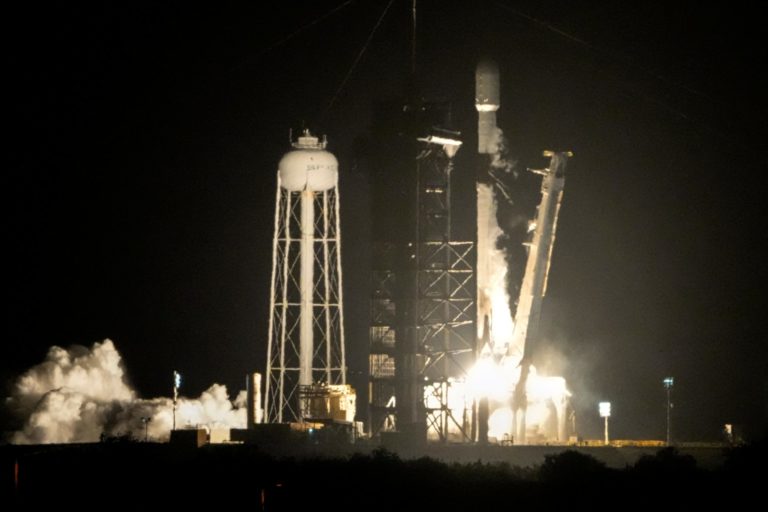
(Headline USA) A drifting SpaceX rocket is on a collision course with the moon after launching a pair of lunar landers more than a year ago.
The rocket’s upper stage will unintentionally slam into the moon on Wednesday, carving out a crater and sending up a plume of dust and rubble that scientists — and skygazers — are eager to observe.
Space tracking expert Bill Gray predicts an impact of 5,400 mph (8,700 kph) — seven times the speed of sound — near Einstein Crater on the moon’s sunlit western limb.
With the action unfolding in the wee hours, the eastern portions of the United States and Canada, and much of South America should have the best views.
While scientists are not too concerned about this particular piece of space junk, it highlights the growing threat as more and more items cram into orbit.
“Things are getting crowded up there,” said Gray, who plans to view the aftermath from New Brunswick, Canada.
It was never SpaceX’s intent to hit the moon. But space experts said the crash could have been avoided if the upper stage had been nudged into orbit around the sun.
It will be the second dead rocket known to crash into the moon accidentally. A Chinese rocket segment dug out a pair of craters on the lunar far side in 2022.
Lucky for astronomers, the upcoming smashup will occur on the moon’s near side, packing the equivalent energy of three tons of TNT.
The impact flash, lasting less than a second, will probably be too dim to see, according to experts. But the stream of ejected material could stretch for several miles (kilometers) into space and remain visible to telescopes for tens of minutes.
“The gravity on the moon is low and there is no wind to blow the dust away,” said Los Alamos National Laboratory’s Benjamin Fernando, who’s encouraging observations by professionals and amateurs alike.
“Part of the reason for our interest in this event is to figure out how much of a hazard debris impacts pose to future astronauts,” he added in an email.
Fernando anticipates an impact crater nearly 90 feet across and 16 feet deep (27 meters across and 5 meters deep), too small to see from Earth but visible to spacecraft.
NASA’s Lunar Reconnaissance Orbiter and South Korea’s Danuri lunar orbiter will gather before-and-after shots of the crash scene. Danuri will stray within a mile or two (a few kilometers) of the SpaceX rocket just two minutes before impact, according to Fernando and his team.
The abandoned rocket segment — measuring some 40 feet (12 meters) and weighing around 10,000 pounds (4,500 kilograms) — hoisted two private lunar landers on Jan. 15, 2025.
One of them — Firefly Aerospace’s Blue Ghost — became the first private spacecraft to pull off a fully successful lunar touchdown. The other, Japan-based ispace’s lander, wrecked.
With meteoroids and other natural objects offering little if any warning before walloping the moon, scientists said there’s much to learn by observing well-tracked strikes by human-made objects like the one coming up. NASA hurled rocket sections and lunar modules into the moon during the Apollo era for seismic measurements. Decades later, in 2009, NASA intentionally crashed its LCROSS spacecraft and upper stage in search of ice near the lunar south pole.
With the moon as the new travel hot spot, scientists said it’s crucial to improve debris monitoring and traffic control before packs of robots and astronauts arrive.
The United States and China are racing to land astronauts on the moon in the next few years. Elon Musk’s SpaceX and Jeff Bezos’ Blue Origin are vying to provide the lander for NASA’s yet-to-be-named moonwalkers of Artemis IV, who will succeed the 12 Apollo astronauts who strolled the lunar surface.
“This impact will not be a problem,” retired astrophysicist Jonathan McDowell said in an email. “But in a future where there are long-term bases on the moon, similar impacts would be an issue and we need not to leave rocket stages in chaotic orbits of this kind.”
(Ken Silva, Headline USA) A former legal assistant for the Brownsville, Texas, U.S. Attorney’s Office was indicted last month for releasing the identity of a Homeland Security Investigations agent who was working on a multi-agency immigration enforcement operation in Texas last year. The doxxing of the agent led to a Mexican national threatening the agent.
The indictment stems from June 2025, illegal immigration crackdown in Texas, which was livestreamed online. During the livestream, ex-DOJ legal assistant, Karen De Leon, allegedly revealed the identity of one of the agents involved in the operation.
“A male subject joined the chat and made an online death threat towards one of the federal agents involved in the operation,” a news release last year from Cameron County District Attorney’s Office reportedly stated. “A viewer of the live stream [De Leon] commented providing the identity of the federal agent to the person making the threat.”
HOLY CRAP! A DOJ EMPLOYEE HAS BEEN ARRESTED for doxxing an agent to a person on a live stream with his personal info in Texas.
There is a SICK AND TWISTED ROT within our DOJ that still exists.
It MUST be rooted out. Make an example of this lady!
De Leon admitted to doxxing the HSI agent during a voluntary interview at the Brownsville, Texas, AUSAO, according to a press release from the DOJ Inspector General’s Office. She was arrested last November and released on a $20,000 bond.
She was indicted on June 24 of this year. The DOJ Inspector General’s Office announced the indictment in a recent press release.
Ken Silva is the editor of Headline USA. Follow him at x.com/jd_cashless.
(Mike Maharrey, Money Metals News Service) If you want gold, you generally have to go to a place like Money Metals and buy it. Or, if you’re adventurous, you could dig it out of the ground. Of course, mining gold is hard, expensive, dirty work. It’s not for the faint of heart.
So, what if I were to tell you I know a place where gold is literally blowing out of the ground and raining from the sky?
There is such a place!
But before you start packing your bags, I should tell you that it’s in Antarctica.
The Ross Sea is more of a deep bay in Antarctica, about 840 miles from the South Pole. In the Ross Sea, you’ll find Ross Island. And on Ross Island stands Mt. Erebus.
Mt. Erebus is an active volcano. It’s not so much erupting as bubbling. Inside the volcano sits a permanent lake of blazing, molten rock. This hot lava emits a lot of gases. Mixed with the steam bubbling out of Mt. Erebus are microscopic particles of crystalline gold.
Mt. Erebus has been belching gold for decades. In 1991, researchers estimated that the volcano spews around 80 grams (A little over 2.5 troy ounces) of microscopic gold dust into the sky every single day. That comes to about 900 ounces of gold every year. At today’s gold price, we’re talking about some $3.6 million worth of gold.
Good luck collecting it, though.
As I mentioned, the gold is microscopic. As it blows into the atmosphere, wind currents carry the particles as far as 1,000 kilometers from the volcano before it falls to the ground like a soft rain.
It’s not unusual to find gold in volcanic emissions. For instance, scientists have detected gold around a volcano in Hawaii. However, Mt. Erebus is the only volcano known to spew high levels of crystalline gold into the air at this volume.
“A volcano is basically a hole in Earth’s crust, through which molten material from deep below the ground seethes upward.”
There are thousands of miles of nearly impenetrable rock between the core and the Earth’s surface, known as the mantle. It extends from about 22 miles below the Earth’s surface and crust to the core. The boundary between Earth’s center and the mantle lies about 1,800 miles deep.
The Earth’s molten outer core holds about 99.9 percent of the planet’s gold and other precious metals. Scientists estimate there is as much as 1.6 quadrillion tonnes of gold locked up in the Earth’s center. That’s enough gold to coat the entire surface of the Earth with a 20-inch-thick layer of the yellow metal.
Unfortunately, it is impossible to mine the core; however, Mother Nature sometimes pushes some of that gold to the surface.
As hot as lava is, it can’t vaporize the yellow metal. The boiling point of pure gold is far hotter than volcanic temperatures. That means gold coming out of the Earth is generally in a liquid state. Scientists think gold hitches a ride to the surface in volatile chlorine- or sulfur-bearing compounds that exist in hot volcanic gases.
The crystalline structure of the gold blowing out of Mt. Erebus is unique. According to Yahoo News, “Under an electron microscope, the particles appeared as intricate, faceted, almost perfectly geometric crystals rather than irregular specks, some measuring up to about 60 micrometers across.”
One theory is that under the environmental conditions around Mt. Erebus, gold crystallizes out of these chlorine and sulfur compounds as the gases cool. However, these compounds typically only contain small amounts of gold, and it is unclear how the large crystals can form.
Another theory is that the gold gradually deposits in a crust on the surface of the lava lake before being blown aloft by rising gases.
As Yahoo News put it, “Something about Mount Erebus – whether it’s the chemistry, the ambient temperature, the geology, or something else – appears to give it a unique ability to sprinkle the snow with gold dust like a mischievous pixie.”
I’d be OK with sending that mischievous pixie my way!
Mike Maharrey is a journalist and market analyst for Money Metals with over a decade of experience in precious metals. He holds a BS in accounting from the University of Kentucky and a BA in journalism from the University of South Florida.
According to billionaire hedge fund manager John Paulson, it’s still going on.
Gold peaked just over $5,500 an ounce in January, before sharply correcting. After a brief surge of safe-haven demand in the early days of the U.S.-Iran conflict, it has traded range-bound between $4,000 and $4,500 for the last few months.
Some analysts say the sell-off was the end of the gold bull market; however, in an interview on CNBC, Paulson said the bull run is just getting started because the world is losing faith in fiat currencies – especially the dollar.
“I do think we’re in the beginnings or the early stages of a long-term bull market for gold.”
Paulson famously won big in the early 2000s when he bet against subprime mortgages even as the mainstream insisted there was no problem in that sector. After the 2008 financial crisis, Paulson turned his attention to gold, arguing that unprecedented fiscal and monetary stimulus would ultimately weaken the dollar.
He was correct.
Based on the CPI, the dollar has lost about 35 percent of its value since 2008. And of course, the CPI understates the reality of inflation. In that same period, the price of gold has nearly quadrupled.
Why?
Paulson said the world is losing faith in fiat money.
“As people lose faith in paper currencies, gold as an alternative will continue to grow.”
He went on to explain that this growing preference for gold over dollars is reflected in both central bank and investor demand.
“Gold is becoming the most apt reserve currency in the world, replacing fiat currencies. The demand from central banks, for instance, has continued to grow, as has the private sector.”
Last year was the fourth-largest expansion of central bank gold reserves on record, at 863 tonnes. That was down 21 percent year-on-year, but still well above the 2010-2021 annual average of 473 tonnes.
The all-time high was set in 2022 (1,136 tonnes). It was the highest level of net purchases on record, dating back to 1950, including since the suspension of dollar convertibility into gold in 1971.
Paulson said that given this de-dollarization and the growing distrust of fiat currencies in general, the long-term trajectory for gold is up despite current headwinds.
“I think the trend of gold will continue to be on the upside.”
We can also see worries about fiat currencies reflected in an increasingly bearish bond market. Despite rate cuts in 2024 and the Fed’s more recent reluctance to hike despite persistent inflation, yields on the long end of the curve continue to creep higher. This signals investor reluctance to loan more money to fiscally irresponsible governments.
As Reuters recently reported, “Inflation, heavy government borrowing, policy uncertainty and bouts of stocks and bonds falling in tandem have weakened bonds’ role as a ballast, prompting some investors to look for more diversification.”
Paulson is not the only institutional investor bullish on gold. Last year, Morgan Stanley CIO Michael Wilson recommended an aggressive portfolio rebalancing, suggesting investors should cut their bond allocation to 20 percent and swap half of the bond portfolio to gold to serve as a “more resilient” inflation hedge.
“Gold is now the anti-fragile asset to own, rather than Treasuries. High-quality equities and gold are the best hedges.”
Mike Maharrey is a journalist and market analyst for Money Metals with over a decade of experience in precious metals. He holds a BS in accounting from the University of Kentucky and a BA in journalism from the University of South Florida.