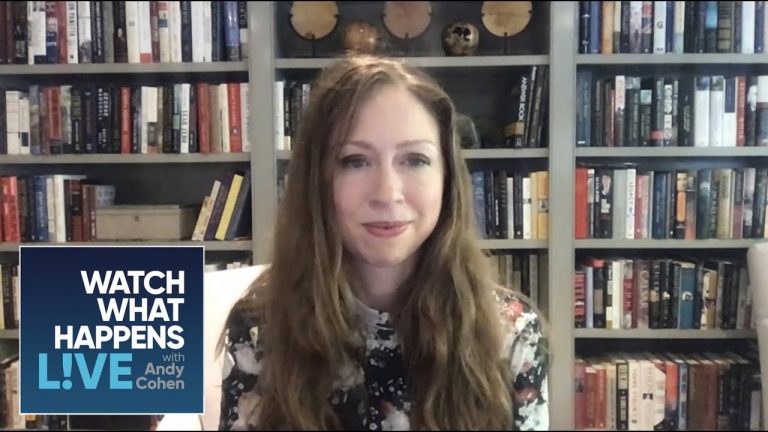
Chelsea Clinton: I Won’t Rekindle Friendship w/ ‘Complicit’ Ivanka Trump

Former First Daughter Chelsea Clinton said she has no interest in rekindling her friendship with GOP counterpart Ivanka Trump because she sees the White House adviser as “more than complicit” in her father’s “cruelty and incompetence.”

The 40-year-old daughter of former President Bill Clinton and 2016 presidential candidate Hillary Clinton used to be good friends with Ivanka Trump.

In 2015, they were seen embracing at the Glamour Women of the Year Awards. And in 2015, Clinton praised Ivanka Trump’s temperament and said it reminds her of her father’s spirit.

“She’s always aware of everyone around her and ensuring that everyone is enjoying the moment,” Clinton said at the time.

“It’s an awareness that in some ways reminds me of my dad, and his ability to increase the joy of the room,” she continued. “There’s nothing skin-deep about Ivanka.”

But Clinton said she hasn’t spoken to her since the 2016 election.

“I’ve not spoken to her since 2016, and I have no interest in being friends with someone who’s not only complicit, but actively taking part in this administration’s, like, everyday collision of cruelty and incompetence,” she told Bravo’s “Watch What Happens Live” last week.

“It’s just really hard when there’s someone who’s actively embracing their candidate, whether it’s their father or not, who’s trafficking in racism, and sexism, and anti-Semitism, and Islamophobia, and homophobia, and transphobia, and conspiracy theories, and lies and is so fundamentally corrupt,” Clinton continued.

Contrary to the unsubstantiated claims, Trump’s White House has been a vocal proponent of many of the minority groups mentioned and a particularly strong supporter of the Jewish state of Israel.

Trump has been among those sharply criticizing left-wing anti-Semites such as Rep. Ilhan Omar, D-Minn.

Ivanka’s husband, White House adviser Jared Kushner, is Jewish, as is Chelsea’s husband, Marc Mezvinsky.

Clinton added that she doesn’t think Ivanka Trump and her father, President Donald Trump, are “the same by any standard.”

However, Ivanka is still “more than complicit as anyone who’s worked for him for so long,” she added. “And I don’t want to be friends with someone like that.”

She continued to go after the president when asked what her take-away was from the first presidential debate between President Trump and Democratic presidential candidate Joe Biden.

“Donald Trump is still a racist, incompetent, cruel, miserable ghoul of a human being,” Clinton said.

UPDATE: Husband of Cal Cunningham’s Mistress Calls on Him to Drop Out of Senate Race

UPDATE 3:30 PM: From The News & Observer of Raleigh:

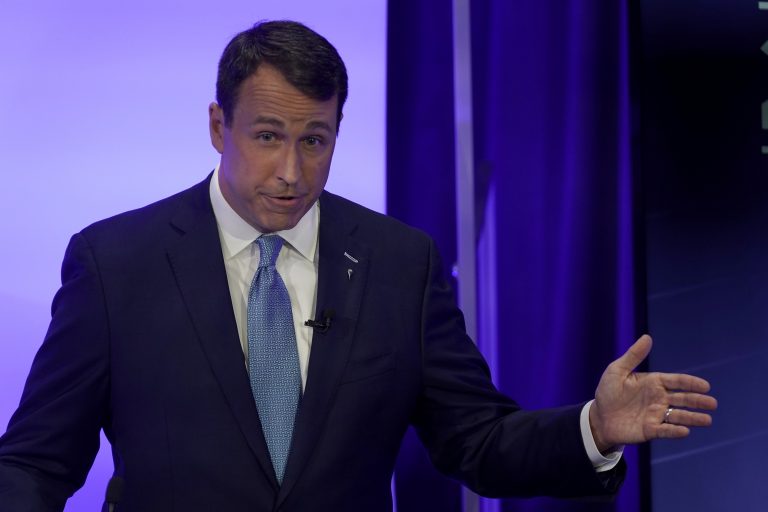
The husband of the woman who confirmed an extramarital affair with Democratic U.S. Senate candidate Cal Cunningham said he should drop out of the North Carolina race.

Jeremy Todd is an Army veteran who served 19-plus years and severely injured his spine during a paratrooper proficiency jump several years ago. His wife, Arlene Guzman Todd, has confirmed she had an intimate relationship with Cunningham after the candidate’s campaign confirmed the authenticity of suggestive text messages between the two.

“Mr. Cunningham chose to repeatedly engage in activities that would hurt his family and a fellow junior officer and veteran,” Jeremy Todd said in a statement Wednesday to The News & Observer.

“If elected, I can only imagine how misplaced his judgment would be for the people he’s charged to represent,” Todd said. “I firmly believe Mr. Cunningham should drop out of the Senate race and ask that his behavior and actions be reviewed under the Uniform Code of Military Justice.”

ORIGINAL ARTICLE: (Headline USA) A race in North Carolina critical to control of the U.S. Senate has been thrown into turmoil over allegations of personal misconduct by Democrat Cal Cunningham, a married man who had at least one extramarital relationship this summer with a consultant.

On Wednesday, the Army Reserve confirmed that it formally looking onto the Cunningham’s unseemly conduct as more text messages emerged, reported WRAL.

“The Army Reserve is investigating the matters involving Lt. Col. James Cunningham,” said Simon B. Flake, chief of media relations and public information for the Army Reserve Strategic Communications. “As such, we are unable to provide further details at this time.”

Previously undisclosed text messages (explicit) obtained by The Associated Press and additional interviews show that the relationship extended beyond suggestive texts, as was previously reported, to an intimate encounter as recent as July.

The revelations do not include information about an alleged second mistress that was found by conservative news Web site NationalFile.com, which also uncovered the first sexts between Cunningham and the consultant.

Republicans hold a 53-47 majority in the Senate, and the contest between Cunningham and Republican Sen. Thom Tillis has been among the most watched in the country, with polls showing a tight race and both parties investing heavily in the outcome.

Cunningham’s personal indiscretion offers a fresh test of whether voters will punish candidates for their private, consensual activity, and the answer they deliver could determine which party wields power in the Senate.

The chamber has been a bulwark for Republicans under President Donald Trump, with Democrats in control of the House.

An Army Reserve lieutenant colonel with a wholesome appeal, Cunningham was widely viewed as the kind of recruit Democrats needed to make inroads in conservative-leaning Southern states like North Carolina.

Yet the text messages and interviews offer a glimpse that is at odds with the image of a devoted family man. A week ago NationalFile.com published text messages between Cunningham and Arlene Guzman Todd, a public relations strategist from California, that suggested a personal relationship.

The newly obtained texts, which are between Guzman Todd and a friend, provide a more specific timeline about their recent relationship, as well as details that describe intimate encounters — not simply a digital exchange.

The text messages were not obtained from Guzman Todd. But the AP contacted her to confirm their authenticity. In a series of interviews late Monday as well as in the text messages, Guzman Todd described two in-person encounters with Cunningham. One was in March in Los Angeles that she said did not include intimate contact, and a second was in July in North Carolina, where she said they were intimate.

However, texts published on NationalFile.com show that Guzman Todd saying she had sex with Cunningham in his home “for a week.”

Guzman Todd characterized the experience in “another woman’s house” as “weird.”

In another exchange, Guzman Todd indicated that she was frustrated by the limited attention that he showed her.

“I’m just going to send to his opponent his naked photos,” Guzman Todd wrote. “That will teach him.”

“You don’t deserve me Cal,” she said in a separate text message to her friend. She added in another, “He knows (that I) can tank his campaign.”

In a statement, Guzman Todd apologized for the “pain and embarrassment, and disrespect I’ve caused to my immediate family, loved ones, and everyone affected by this situation.”

“A few months back, I displayed a lapse in judgment by engaging in a relationship with Cal Cunningham during a period of marital separation,” Guzman Todd said. “The relationship spanned several months and consisted primarily of a series of text exchanges and an in-person encounter” — without explaining how long she was at Cunningham’s North Carolina home.

Her text messages described the intimacy.

Cunningham’s campaign declined to comment on the newly disclosed texts or on Guzman’s statement.

The campaign instead pointed to a statement issued on Friday, shortly before they confirmed the authenticity of an initial round of texts that were made public between Cunningham and Guzman Todd.

“I have hurt my family, disappointed my friends, and am deeply sorry. The first step in repairing those relationships is taking complete responsibility, which I do. I ask that my family’s privacy be respected in this personal matter,” Cunningham, who has two teenage children and has been married for two decades, said at the time.

It’s unclear whether the revelation of affairs between consenting adults is something North Carolina voters will care about, particularly after the state swung in 2016 for Trump, who has been married three times and paid hush money to a porn star to keep silent about an alleged extramarital tryst.

Cunningham, 47, was a star recruit for Senate Minority Leader Chuck Schumer. He’s been a fundraising powerhouse, although that partially may be attributed to the competitive nature of the race and pursuit of the control of the Senate. He also checks important boxes: He’s a veteran, a father, an officer in the Army Reserve, a lawyer and a former state senator.

In recent years, he worked for the environmental services company WasteZero. And he’s had an aw-shucks style that matched effectively against Tillis and could be compelling to critical independent voters.

“He had this clean-cut image with a great story, a great background, an impeccable record of service,” said Brad Crone, a longtime state Democratic consultant. “He was straight out of central casting.”

Tillis has seized on the revelations, arguing that Cunningham “owes the people of North Carolina a full explanation” for his extramarital activity.

“On the debate stage last week Cal said it’s about integrity — and I agree,” Tillis said on “Fox & Friends.”

Both candidates are now on the sidelines. Tillis is isolating at his home, and his Charlotte campaign office is closed for the rest of the week. Cunningham pulled out of a previously planned online forum on Monday with the Libertarian candidate in the race. His campaign gave no reason for his decision.

Despite the developments, some state Democrats sought to keep supporting Cunningham for the seat, saying he’s still right on the issues important to the party faithful and the country.

“Cunningham had a critical lapse in judgement and morality. My prayers go out to his family as they work through healing,” tweeted North Carolina state Sen. Erica Smith, who lost to Cunningham in the March Democratic primary. “I ask our supporters to unite around our platform and stand with Cal for NC.”

But Chris Cooper, a political science professor at Western Carolina University, said how much the revelations will damage Cunningham’s campaign depends on whether additional details surfaced beyond the texts.

“It was a character-first campaign, and it was as much about who Cal Cunningham is than what Cal Cunningham stands for — and that’s a harder sell today than it was last week,” Cooper said Tuesday.

Adapted from reporting by Associated Press.

Grand Jury Indicts Mark and Patricia McCloskey

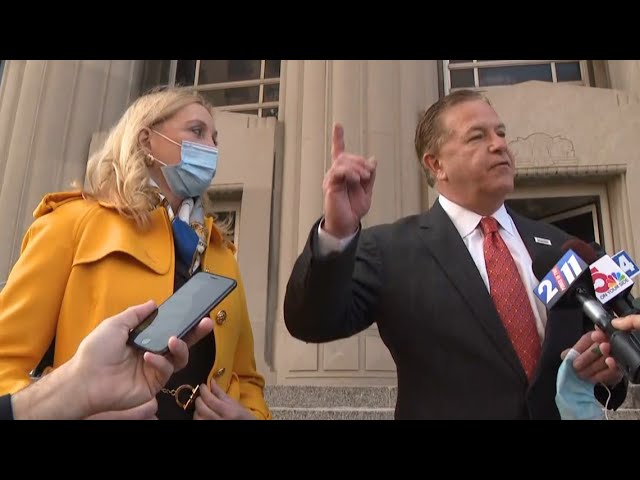
A grand jury indicted Mark and Patricia McCloskey, the St. Louis couple who went viral after confronting a mob of protesters trespassing on their property, on charges of exhibiting guns and tampering with evidence, according to KMOV-4.

The grand jury accused the couple of tampering with Patricia McCloskey’s gun, which was inoperable at the time it was handed over to investigators.

An investigation found that St. Louis City Attorney Kim Gardner was the one who tampered with the evidence, instructing the city’s crime lab to reassemble the gun into working order so that she could score a conviction against the McCloskeys. But this was not mentioned in the jury’s indictment.

The McCloskey’s attorney, Joel Schwartz, said that once all the evidence becomes available, Mark and Patricia McCloskey will be exonerated.

“Once all the facts are out, it will be clear the McCloskeys committed no crime whatsoever,” Schwartz said.

“Frankly because the grand jury is not an adversarial process and defense counsel are not allowed in there and I have no idea what was stated to the grand jury and what law was given to the grand jury,” he said.

Mark McCloskey blasted the indictment and said that it is evident the city is deliberately targeting him and his wife.

He cited recent charges brought against nine of the protesters who trespassed on his property. It was clear these protesters had broken the law, but local officials refused to prosecute them.

“Every single human being who as in front of my house was a criminal trespasser,” McCloskey said.

“They broke down our gate, they trespassed on our property. Not a single one of those people are now charged with anything,” he continued. “We’re charged with felonies that could cost us four years of our lives and our law licenses.”

Missouri Gov. Mike Parson and other prominent Republicans at the state and federal level have pledged to pardon the McCloskeys if they are convicted.

Trump Seeks to Salvage COVID Stimulus Despite Denouncing Pelosi’s Bad-Faith Bill

(Headline USA) President Donald Trump on Wednesday tried to salvage a few priority items lost in the rubble of COVID-19 relief talks that he himself blew up after pulling out of the bad-faith negotiations with Democrat leaders.

In a barrage of tweets, Trump pressed for passage of core components in the latest economic stimulus package after earlier saying he would end talks with House Speaker Nancy Pelosi for the time being.

Trump called on Congress to send him a “Stand Alone Bill for Stimulus Checks ($1,200)”—a reference to a preelection batch of direct payments to most Americans that had been a central piece of negotiations between Pelosi and the White House.

“I am ready to sign right now. Are you listening Nancy?” Trump said on Twitter Tuesday evening.

He also urged Congress to immediately approve $25 billion for airlines and $135 billion for the Paycheck Protection Program to help small businesses.

Pelosi has rejected such piecemeal entreaties all along, while the White House has refused to consider many of the partisan wish-list items included in House Democrats’ more than $2 trillion bill.

The California Democrat pushed for radical changes to the upcoming election, even as it is already in progress in many places.

The bill also included funding for insolvent Democrat-run cities that have refused to cut their own budgets while demanding federal funds to maintain wasteful spending programs and other fiscal abuse.

After the call to pull out of the talks until after the election caused stocks to drop on Tuesday, Trump’s tweets seemed to move the financial markets into positive territory.

However, questions linger as to whether either side will face any political fallout in the waning weeks before the Nov. 3 election.

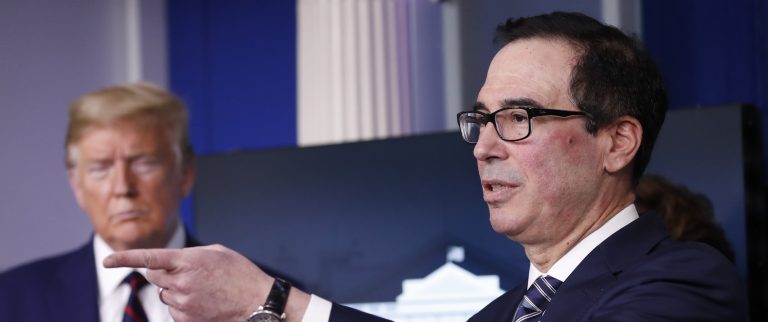
Trump’s decision to scuttle talks between Treasury Secretary Steven Mnuchin and Pelosi came after the president was briefed on the landscape for the negotiations—and on the blowback that any Pelosi–Mnuchin deal probably would have received from his GOP allies in Congress.

“It became very obvious over the last couple of days that a comprehensive bill was just going to get to a point where it didn’t have really much Republican support at all,” White House chief of staff Mark Meadows said Wednesday on Fox News.

“It was more of a Democrat-led bill, which would have been problematic, more so in the Senate than in the House,” he said.

Pelosi told reporters that “all the president wants is his name on a check” for direct aid payments.

Many Republican senators had signaled they would not be willing to go along with any measure that topped $1 trillion, and GOP aides had been privately dismissive of the prospects for a deal. Any Pelosi-sponsored agreement of close to $2 trillion raised the potential of a GOP revolt if such a plan came to a vote.

Pelosi and Mnuchin talked briefly on Wednesday morning about the chances for a stand-alone airline rescue, Pelosi spokesman Drew Hammill tweeted.

Pelosi directed Mnuchin to a measure she had attempted to pass on Friday on short notice under fast-track procedures, but only after Democrats made a number of changes Republicans did not like.

The talks have been troubled from their start in July and never appeared to close in on an agreement both sides could embrace.

Pelosi had been demanding a host of Democratic priorities on food aid, unemployment benefits, help for renters and homeowners, and aid to state and local governments.

Republicans charged she was dragging the talks to deny Trump a political victory before the Nov. 3 election.

Early rounds of virus aid passed by overwhelming margins as the economy went into lockdown in March. After that, Trump and many of his GOP allies focused on loosening social and economic restrictions as the key to recovery instead of more taxpayer-funded help.

Still, the decision to halt negotiations now could be politically perilous. While the stock market has clawed much of its way back after cratering in the early weeks of the crisis, unemployment stands at 7.9%, and the nearly 11 million jobs that remain lost since the start of the pandemic exceed the number that the nation shed during the entire 2008-09 Great Recession.

The economy has recovered more quickly than most economists had expected, largely because of the aid Congress approved in a $2 trillion package in March. The $1,200 stimulus checks, supplemental $600 unemployment benefits each week, and aid to small businesses boosted household incomes and enabled many low-income Americans to pay bills and rent and maintain their overall spending, according to data from Opportunity Insights.

But the recovery has slowed and certain sectors such as restaurants, hotels, theaters and airlines remain in bad shape, shedding jobs and risking permanent realignment. Without more stimulus, economists expect growth will slow significantly in the final three months of the year.

“You’re going to see quite a significant drag on growth,” said Gregory Daco, chief U.S. economist at Oxford Economics, a consulting firm. It “would really risk a double-dip recession.”

Adapted from reporting by the Associated Press

SCOTUS Clears Path for Maine’s Sketchy ‘Ranked Voting,’ Which Could Steal GOP Senate Seat

(Headline USA) The U.S. Supreme Court on Tuesday turned away a last-ditch effort by the Maine Republican Party to stop its controversial ranked-choice voting from being used for the first time in the state’s presidential contest.

The decision not to intervene could effectively throw the tightly contested Senate race in which Sen. Susan Collins is seeking re-election into the hands of whichever party puts forth the most candidates rather than winning the most votes.

Justice Stephen Breyer rejected the request for the high court to intervene after the GOP sought to delay ranked voting in this November’s presidential election until state voters had the final say through a “People’s Veto” referendum.

The Maine GOP’s appeal was filed after the first votes had been cast by overseas voters. Additional ballots were being cast this week as more voters returned absentee ballots, either in person or by mail.

The appeal to the U.S. Supreme Court came after the state Supreme Judicial Court twice rebuffed the Maine GOP.

It focused on whether the Maine GOP collected enough signatures to force a referendum on a law expanding ranked voting to the presidential contest. The appeal contended some of the rules governing the collecting of signatures were unconstitutional.

The GOP contended the Maine Constitution required ranked voting in the presidential race to be delayed if it could show a likelihood of success on a lawsuit seeking to reinstate the referendum.

The ranked voting system, approved by Maine voters in 2016, has become a partisan issue after Republican U.S. Rep. Bruce Poliquin was ousted in 2018 despite collecting the most first-place votes.

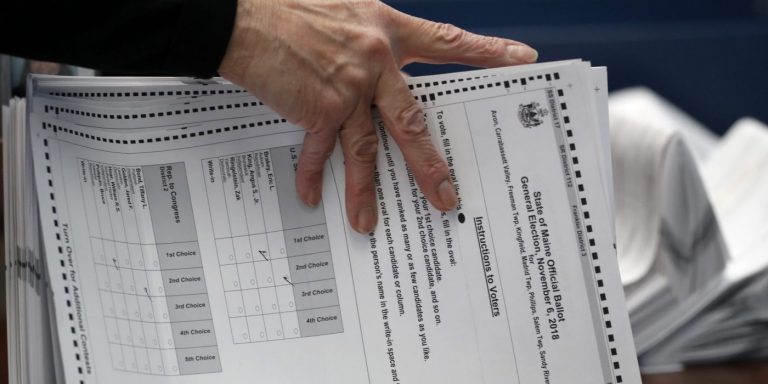
Under the convoluted system, voters are allowed to rank all candidates in order of preference on the ballot. A candidate who wins a majority of first-place votes is the winner. However, if there’s no majority winner, then there are additional tabulations in which last-place candidates are eliminated and votes are reallocated to achieve a majority winner.

That means that a party poised to lose may gain additional leverage by running a multitude of independent or third-party candidates who will knock the frontrunner down lower in the rankings.

The voting system is already used in U.S. House and U.S. Senate races in Maine. It isn’t used in state gubernatorial or legislative races because of concerns that it runs afoul of the Maine Constitution.

In the race to unseat the centrist GOP Sen. Collins, the ballot is expected to include at least four candidates, with an additional three waging write-in campaigns.

Only one of the third-party candidates, Max Linn, has ties to the Republican party.

Of the four others, two of them—Lisa Savage and Ian Kenton Engelman—have actively given money to leftist organizations and candidates, according to the Federal Election Commission.

Two others, Douglas Fogg and Tiffany Bond, have been more cautious about broadcasting their political leanings. However, their personal Facebook pages reveal that both appear to endorse radical concepts like critical race theory.

Bond is a member of the Maine Black Lives Matter group, while Fogg—a middle school social studies teacher—supported reading controversial works like Robin Diangelo’s White Fragility, Ibram X. Kendi’s Stamped from the Beginning and Jill Lepore’s These Truths, as well as Karl Marx’s Communist Manifesto.

Should backers of the radical write-in candidates so desire, they could now rank Collins’s Democrat opponent, Sara Gideon, second among their choices, put Collins at the bottom of the list and deliver the tossup seat to Democrats even if Collins receives the most votes, thereby narrowing Republicans’ 53-seat senate majority.

Adapted from reporting by the Associated Press

Congressional Committee that Likely Peeked at Trump Taxes Stays Silent over NYTimes Leak

(Headline USA) It’s one of the most obscure functions of Congress, little known or understood even by most lawmakers.

But it may have once put staffers in possession of one of the most enduring mysteries of the Donald Trump era: his tax data, which The New York Times revealed to the world.

The Times hit piece last month relied on data leaked from anonymous sources who, it claimed, had been legally authorized to access Trump’s financial documents.

Nonetheless, in transmitting the private details to the newspaper, the sources likely committed a felony—not to mention violating ethical norms—in what appeared to be a politically motivated attack coordinated in conjunction with the campaign of Trump’s rival, Democrat Joe Biden.

Not surprisingly, none of these well-connected sources had yet stepped forward to own the consequences.

Despite countless calls from his adversaries and lawsuits directed at forcing him to reveal his finances, Trump has long refused to release his tax returns.

He has cited an IRS audit that would allow his political opponents to pore over every detail and create potential tax liabilities where none previously existed.

That’s where Congress comes in. The audit of Trump’s taxes, the Times reported, has been held up for more than four years by staffers for the Joint Committee on Taxation, which has 30 days to review individual refunds and tax credits over $2 million.

When JCT staffers disagree with the IRS on a decision, the review is typically kept open until the matter is resolved.

The upshot is that information on Trump’s taxes, which Democrats are now suing to see, has almost certainly passed through the JCT’s hands, putting it tantalizingly close to lawmakers.

Key members of the tax-writing House Ways and Means Committee defended the JCT after the Times report and were emphatic that the panel does not have copies of tax forms pertaining to Trump.

“They are not sitting at JCT,” said House Ways and Means Committee Chairman Richard Neal, D-Mass. “I see no evidence that they’re sitting on those forms.”

But lawmakers did not say whether the JCT has reviewed any tax refund involving the president.

Neal and top House Republican tax expert Kevin Brady of Texas said the panel typically completes its reviews in a month or two, at most.

“The vast majority of JCT refund reviews are processed quickly and very rarely does JCT express concerns with the IRS audit findings,” said Brady, who has previously chaired the panel.

“Contrary to the Times’ reporting, I think the longest time JCT has ever had a case pending is one year. I think we should focus on the facts as much as possible.”

Lawmakers on Joint Tax are provided summary information on the categories of cases handled and how long it takes to process them, but the information is not made public. Even acknowledging that Trump’s taxes were before the panel is verboten.

“That gets too close to talking about potential tax return information, which is protected under the internal revenue code,” Joint Tax chief of staff Thomas Barthold said in declining to comment about the Times’ Trump story.

Representatives for the Trump Organization did not respond to messages seeking comment and confirmation that the Joint Tax Committee had reviewed Trump’s taxes.

How the process works: When an individual refund or credit over $2 million is approved, the IRS is statutorily required to notify Congress.

A designated team at the IRS prepares a report for the JCT on each individual case that contains taxpayer information, spreadsheets and technical data and analysis. Trump should have been sent a letter disclosing that his case was sent to the JCT for review.

Even when the JCT was sifting through Trump’s tax information, it should have remained beyond the grasp of the five Democrats and five Republicans on the committee.

The reviews are performed by the panel’s tax experts and attorneys, typically working in dedicated space in an IRS facility. Lawmakers don’t participate.

“It is held quite tightly in the hands of just a few lawyers in the staff who are dedicated to doing this work. And they know not to communicate any of it to outsiders,” said George Yin, an emeritus University of Virginia law professor who was JCT chief of staff from 2003 to 2005.

Former JCT staffers would not comment on whether they remembered the dispute with Trump, citing confidentiality rules.

Unauthorized release of tax return information can mean a felony conviction and a prison sentence of up to five years.

Kenneth Kies, a tax attorney who served as chief of staff on the committee from 1994 to 1998, said the committee typically handled a “couple hundred” cases year. And usually the JCT—which includes former IRS staffers—ratifies the IRS’s decision.

“A lot of them were fairly straightforward. Those were no drama,” Kies said. “Only occasionally we would get one where there was an interpretation of the law we didn’t agree with.”

While the Joint Committee rarely makes headlines, it plays a crucial role in policymaking, delivering cost estimates that can be make-or-break for proposed tax legislation.

It was instrumental during the creation of both the Obama administration health care law and the GOP tax overhaul in 2017.

The office is overseen by chief of staff Barthold, a Harvard Ph.D. economist who has worked on the panel for more than 30 years.

As the JCT’s top staffer since 2009, he is among the very few who might know whether Trump’s audit was reviewed. But he is legally barred from disclosing most information related to the committee’s audit work.

Left unresolved is a full accounting of Trump’s finances, which Democrats predict will illustrate numerous conflicts of interest between his businesses and his presidency.

Neal, the lead force behind a Democratic lawsuit to expose Trump’s taxes, said the Times’ reporting is proof that the documents should be given to Congress.

The existence of the audit also strengthens their legal case, he said, since the Democratic investigation is focused on that very issue.

“That’s what this case has been about—have the IRS tell us how auditing is done,” Neal said. “That’s always been our case.”

Adapted from reporting by the Associated Press

Latest Smoking-Gun Evidence Confirms that Corrupt Left Already Got Away w/ Russia Hoax

( J. Peder Zane, RealClear Investigations) Director of National Intelligence John Ratcliffe created a new category of news last week—the ho-hum smoking gun—when he released a letter regarding the Clinton campaign’s efforts to generate the Trump/Russia hoax during the 2016 election.

In three short paragraphs addressed to Sen. Lindsey Graham, R-SC, Ratcliffe revealed that U.S. intelligence officials had learned in late July 2016 that the Russians believed Clinton “had approved a campaign plan to stir up a scandal against U.S. Presidential candidate Donald Trump by tying him to Putin and the Russians’ hacking of the Democratic National Committee.”

On Tuesday, Ratcliffe went even further by releasing former CIA Director John Brennan’s handwritten notes describing his briefing about the Clinton issue with then-President Barack Obama—but still nary a ripple in the news cycle.

And Brennan didn’t just consider the information important enough to share with President Obama and other senior national security officials.

In addition, on Sept. 7, 2016, U.S. intelligence officials forwarded an investigative referral to then-FBI Director James Comey regarding “U.S. Presidential candidate Hillary Clinton’s approval of a plan concerning U.S. Presidential candidate Donald Trump and Russian hackers hampering U.S. elections as a means of distracting the public from her use of a private mail server.”

The information is ho-hum because it tells us what already we know.

By the spring of 2016 the Clinton campaign had hired the opposition research firm Fusion GPS and its agent, Christopher Steele, to dig up dirt on Trump’s alleged Russia connections.

Steele’s fishing expedition in Russian waters makes it reasonable to embrace the Ratcliffe letter’s main claim: that the Kremlin knew what the Clinton campaign was up to in July 2016—and so, too, did U.S. intelligence.

And yet, the letter is also a smoking gun because it shows how Obama administration officials willfully ignored all evidence to the contrary in their relentless pursuit of Trump.

Even though Brennan had information that Clinton was intent on blaming Trump for the hacking as a campaign ploy, he became one of the prime architects of the Trump/Russia conspiracy theory.

Same goes for Jim Comey. Stunningly, at his Senate hearing last week, Comey claimed he had no recollection of the U.S. intelligence referral that combined the bureau’s two most significant probes of 2016: Clinton’s emails and Trump’s supposed Russia connections.

Brennan’s and Comey’s malfeasance is especially troubling given that the information they ignored about Clinton was true while the disinformation they embraced about Trump turned out to be false.

At a minimum, they should have been on high alert about any Trump-related material coming from the Clinton campaign.

Brennan, instead, insisted that the Steele dossier be included in the Obama administration’s late 2016 Intelligence Community Assessment of Russian interference—and then lied about it.

For his part, Comey signed FISA court applications that used the Steele dossier to justify spying on Carter Page and, by extension, the Trump campaign.

The mainstream media was also a prime mover of the Russiagate hoax, and its coverage of the Ratcliffe letter reveals once more how it has used anonymous sources and misleading language to diminish facts that challenged that narrative.

Politico reported that the Senate Intelligence Committee “was made aware of that allegation early on in its investigation, and quickly dismissed it, the sources said.”

The New York Times went further, reporting that the Senate committee and Special Counsel Robert Mueller “had evaluated and rejected the information in the years since, according to three current and former officials familiar with those inquiries.”

Neither publication, however, showed any curiosity about how and why a report that made it to President Obama and was the subject of an intelligence referral to the FBI was rejected.

For that matter, the outlets didn’t seem to press their anonymous sources to explain how the Senate and Mueller’s office were even able to independently “evaluate” highly classified intelligence—which the intelligence community, according to Ratcliffe, has not dismissed.

Instead of exploring the issues raised, the publications and their anonymous sources are trying to shut down any inquiry through a deceptive leap of logic.

They are using one aspect of the intelligence that has not been verified—hat Clinton herself personally approved the anti-Trump effort—to invalidate the broader point that her campaign originated the Russiagate smear.

This is the same approach they have used regarding Hunter Biden’s efforts to cash in on his father’s name.

Obvious ethical questions about egregious conflicts of interest involving multiple members of the Biden family and their business associates are sidestepped by narrowly defining the issue as whether there’s direct evidence that Joe Biden changed policy to enrich his son.

This deception is especially brazen in the Clinton campaign’s case because its pivotal role in Russiagate is long established and beyond dispute.

As such, it seems part of a larger strategy to take every opportunity to fog the air and muddy the waters so the public doesn’t know what to think—a win for wrongdoers.

A final thought. Many of those horrified and disgusted by the Trump/Russia hoax have long been in “Iceman Cometh” mode, hoping tomorrow will deliver that last piece of evidence that convinces even Democrats to hold the wrongdoers accountable.

That day will never come. The Ratcliffe letter is the latest in a long line of smoking guns—including reports from the special counsel, the DoJ inspector general as well as dogged journalists—that have established beyond any doubt that the vast powers of our government were weaponized and politicized to destroy a candidate and then a president.

The crime is as clear as the fact that they got away with it.

J. Peder Zane is an editor for RealClear Investigations and a columnist for RealClear Politics. Reprinted with permission from original source.

The Left’s Plot to Hijack Elections Exposed in NC’s Recent Legal Shenanigans

( Kari Travis and Rick Henderson, Carolina Journal) A recent attempt to rewrite North Carolina elections law is just one piece of a larger plan to turn the state blue, a panel of experts say.

North Carolina is a battleground for a network of national organizations with liberal agendas, said Scott Walter, president of Capital Research Center, an investigative think tank in Washington D.C.

On Oct. 5, Walter joined a handful of other policy leaders—including John Locke Foundation CEO Amy Oliver Cooke and Senate leader Phil Berger, R-Rockingham—in an online discussion called “Flipping North Carolina Blue: Exposing the Left’s Plans To Seize Power.”

The left’s plan to push North Carolina away from conservatism involves voter activism, redistricting and lawsuits, Walter said Monday.

One example is a recent move in which the Democrat-controlled State Board of Elections attempted to change absentee ballot rules as part of a legal settlement.

The agreement in N.C. Alliance of Retired Americans vs. NCSBE is one of several lawsuits involving Democratic legal heavyweight Marc Elias and state officials or voters.

Elias, a partner at Perkins Coie, an international law firm based in Seattle, represented John Kerry in 2004 and Hillary Clinton in 2016.

He also represents the Democratic National Committee, the Democratic Senatorial Campaign Committee, the Democratic Congressional Campaign Committee, the Democratic Governors Association, and many Democratic members of Congress.

His dubious background includes being the lawyer who commissioned the notorious Steele dossier, but he also has a long history of interfering in elections and attempting to use the appearance of mysterious, uncounted ballots to reverse the results favoring Republican candidates.

He is singularly responsible for giving the US Senate Democrats the super-majority they needed in 2008 to pass Obamacare after securing an election reversal for election-night loser Al Franken in Minnesota.

He also can take credit for helping flip Virginia fully blue after stepping into tightly contested 2013 races involving Democrats Terry McAuliffe (a longtime Clinton surrogate) and Mark Herring.

And he helped pad the margin of victory for North Carolina’s Democrat Gov. Roy Cooper in 2016 after incumbent Republican Pat McCrory raised concerns over ballot harvesting.

marc elias
Marc Elias grills the son of former North Carolina congressional candidate Mark Harris during a hearing to force a do-over election following accusations of ballot harvesting. / IMAGE: CBS 17 via YouTube

Ironically, two years later, Elias led the accusations that similar instances of ballot-harvesting in a handful of counties had invalidated the results of a Republican-won congressional election.

Now, he’s filed or organized lawsuits for Democrats in 16 states through the group Democracy Docket.

And in most of them, he has pivoted back to supporting looser laws like ballot-harvesting that would help secure additional Democrat votes under the most suspicious of circumstances.

Yet, Democrats, like Cooper, who already gained power through such legal maneuverings are now in a position to lend the fraudulent schemes an air of legitimacy, even while circumventing state legislatures to railroad it through their corrupt judicial appointees.

“The left has an unlimited amount of money for litigation,” Walter said.

Republicans say the litigation is intended to undermine the integrity of the election, in which nearly 400,000 absentee ballots already have been cast. The Alliance is a group affiliated with the AFL-CIO labor union.

On Oct. 2, U.S. District Court Judge James Dever blocked the SBE’s attempts to remove witness signatures from absentee ballots. He said the legislature, rather than the elections board, has the constitutional authority to change elections law.

He also suggested changing the rules for fixing absentee ballots during an election may violate the 14th Amendment rights of voters who cast ballots early.

Dever then moved all lawsuits on the matter to the supervision of U.S. District Court Judge William Osteen Jr.

Osteen is overseeing a separate lawsuit from a left-wing activist group. He was slated to hear arguments on Wednesday.

The elections board may be feeling the heat from several sources. Carolina Journal has obtained a letter sent Oct. 1, from the top Republican on the U.S. House Committee on Administration to all state and county elections board officials.

In it, Rep. Rodney Davis, R-Ill., expressed doubt the state elections board “will conduct this election fairly and impartially.”

Davis mentioned the proposed settlement with Elias’s clients, calling Elias “one of the most partisan [Democratic] operatives in the election bar,” saying he isn’t “focused on good governance; rather, he traverses the country, picking up clients sympathetic to his main goal, which is to score victories for Democrats in court, even when those ideas have been defeated at the ballot box.”

The letter asked for assurances the elections board would follow the law.

In an email, board spokesman Patrick Gannon said the letter asked for a response by Oct. 12. The board indicated it would provide one by then.

The U.S. Supreme Court weighed in, indirectly.

On Monday, Oct. 6, the justices granted a temporary stay in a South Carolina lawsuit, filed by Democracy Docket clients, seeking to strip the witness signature requirement from S.C. absentee ballots. Without dissent, the justices said it was too close to the election to change the rules.

This is one argument Osteen will confront Wednesday, when he holds a hearing on the three lawsuits involving the elections board, seeking to loosen safeguards on absentee voting.

“This decision is going to be important for the absentee ballot cases before Judge Osteen for two reasons,” said Jon Guze, director of legal studies at the John Locke Foundation.

“The first reason is that it reinforces what the Supreme Court said in 2006, in Purcell v. Gonzalez, ‘Court orders affecting elections … can themselves result in voter confusion and consequent incentive to remain away from the polls,” he said.

Guze said the risk of confusion as a deterrent for voting would increase further as the election draws closer.

In North Carolina, early voting was already underway by the time the Cooper-dominated board made the 11th-hour changes. Subsequently, the board’s two Republican members resigned in protest, saying they had been misled.

Thus, Guze said, Osteen would be hard-pressed to allow the changes to stand.

“The second reason the decision is important in that it’s very much on point with the North Carolina cases,” he continued.

“In South Carolina, a court blocked the requirement that absentee ballots be signed by a witness, and among the changes to North Carolina’s absentee ballot rules that state Judge Bryan Collins recently approved was one that had the effect of removing the witness requirement in North Carolina,” Guze said. “It could hardly be clearer that the U.S. Supreme Court disapproves of courts making that kind of change while an election is underway.”

These cases illustrate further why courts are so critical, and why voters should pay attention, JLF’s Cooke said Monday.

“Marc Elias is a lawyer to the political stars of the socialist left,” she said. “He’s here to get Democrats elected.”

Reprinted with permission from the original source. Headline USA’s Ben Sellers contributed additional reporting to the piece.

NM Dem. Candidate: Gay Porn Roles in College ‘Helped Inspire’ His Work as Youth Arts Educator

(Headline USA) Roger Montoya, a Democratic candidate in an open New Mexico House race for the state legislature, has acknowledged his participation in two gay-oriented pornographic films in the 1980s as a college student.

The revelation about Montoya, 60, emerged as the longtime educator “for children of all ages” runs for office on a platform that emphasizes resolving issues of educational and economic inequality.

“I am not proud of that choice, as I was young and naive, but those experiences helped me understand the exploitation that young people face,” Montoya said in a lengthy statement posted on social media.

Reached by telephone, Montoya said he remains focused on the political race.

“Really for me at 60 years old this race is about the issues of the day,” he said. “I’m happy to talk about the inequalities in education, in water infrastructure access … to health care in the time of COVID.”

The state Republican Party on Monday called on Montoya to withdraw from the race against GOP candidate Justin Salazar–Torrez.

Montoya’s past work in pornography was first reported by conservative blog Piñon Post.

“While many students find college difficult financially, very few choose this route to solve their problems,” the party said in a statement. “This kind of risky and reckless behavior is unacceptable.”

High profile Democrats including U.S. Rep. Debra Haaland and state House speaker Brian Egolf rallied in support of Montoya.

Haaland accused the Republican Party of hypocrisy, highlighting President Donald Trump’s treatment of women and handling of the coronavirus pandemic.

Last year, CNN recognized Montoya as a community hero in a segment about his work as a co-founder of a local youth center that provides classes in art, music and dance.

Montoya also has organized an HIV support groupand was active in efforts to end the sponsorship of an annual tribute to a Spanish conquistador reviled by many local Native Americans.

In his written statement on social media, Montoya said his decision to participate in pornographic films took place at the age of 22 as he worked his way independently through college in Los Angeles.

“Among those choices were two adult films I acted in as an adult, with other adults, in a very different environment and time,” he wrote.

“Those experiences do not reflect who I am, and they are insignificant in the scope of my life’s work,” he insisted, “yet they helped inspire my dedication to my community and the work I do to make sure that youth have opportunities, support and confidence.”

State Republican Party Chairman Steve Pearce admonished Montoya’s past behavior.

“Starring in gay porno films, whether it takes place now or years ago, is unbecoming of any candidate or elected official,” Pearce said in a statement. “New Mexico holds dear to its strong, traditional values, and Mr. Montoya should leave the race immediately.”

Adapted from reporting by the Associated Press

Michigan Health Chief Scoffs at State Supreme Court Ruling, Cites ‘Broad’ Lockdown Authority

(Headline USA) Michigan‘s health chief said Tuesday he has “broad” legal authority to enforce draconian lockdown demands under the state’s emergency regulations, despite a recent court ruling that struck down the Nazi-era law cited by Gov. Gretchen Whitmer.

Robert Gordon, director of the state Department of Health and Human Services, issued additional orders reinstituting restrictions negated by a state Supreme Court ruling and requiring schools to notify the public of infections.

He also reinstated rules for nursing homes and other congregate-care settings.

Michigan was among four Democrat-led states that controversially forced nursing homes to comingle healthy and infected patients during the early days of the pandemic, although it since has dialed back the demand.

More than 7,100 residents of the state have died with confirmed or probable COVID-19 infections.

Gordon also told local health departments to inform K-12 schools within 24 hours of learning of a confirmed or probable case of COVID-19. A school must post it on its website within 24 hours of being notified.

The steps came a day after Gordon ordered the wearing of masks and limits on gathering sizes following the court decision that declared unconstitutional the law Whitmer had used to unilaterally extend an emergency order and underlying virus-related restrictions.

Many in the state chafed at her perceived power-grab, which favored Democrat pet causes like marijuana dispensaries and abortion clinics as “essential” services while prohibiting citizens from visiting their family members or traveling anywhere on nonessential business.

While the court determined that the 1945 law, which the governor had asserted to circumvent the GOP-led legislature, was obsolete, Gordon cited a 1978 law that empowers him to act.

That law stemmed from a 1919 law that was enacted after the Spanish flu pandemic.

“It’s a broad grant of authority,” he told The Associated Press by phone. “The actions we’re taking fall well within it.”

More legal challenges are now likely to force the two opposing sides back to the state Supreme Court.

A Republican legislative leader has come out against codifying mask and other rules into law, saying businesses, nonprofits and schools can make their own decisions nearly seven months into the outbreak.

Gordon said such restrictions cannot be voluntary. He said to expect additional orders soon.

“Orders matter. The law matters. They set common expectations, and they help everyone know what they need to do,” he said. “The science behind what we are doing is 100% clear. Masks reduce the spread of COVID. Social distancing reduces the spread of COVID.”

The state also was expected to keep in place workplace safety rules such as limiting restaurant capacity to 50%.

Patrick Wright directs the Mackinac Center Legal Foundation, which helped file the case that reached the state Supreme Court.

He said the governor will have the power to do “many of the things that she had done before. But it’s most likely that she will not be able to do everything.”

Whitmer, for instance, has called on legislators to return to session because an order that was nullified had extended state unemployment benefits from 20 weeks to 26 weeks.

People out of work during the pandemic also can receive an additional 13 weeks of payments from the federal government once they exhaust their state benefits and, if the unemployment rate remains high, up to 20 more weeks.

It is unclear if the Republican majority will agree to the 26 weeks. Senate Majority Leader Mike Shirkey said this week that an “arm wrestling contest” will take place on that issue, and lawmakers also will review other provisions in the governor’s unemployment order.

The Senate will meet Thursday to vote on “time-sensitive” bills that were not immediately specified, with the House planning to hold session Oct. 13. Before the ruling, the chambers had been unlikely to meet until after the November election.

“We will do everything we can to make sure the people of Michigan have peace of mind about the state’s response and about their future,” Shirkey and House Speaker Lee Chatfield said in a Tuesday statement.

Gordon, a Whitmer appointee, has drawn legal scrutiny in his own right during the pandemic after the state health department attempted to grant a no-bid contact-tracing contract to a highly partisan Democrat canvassing firm.

During hearings on the scandal, it came to light that the health officials had also consulted with a top Democrat operative—currently leading the Biden campaign’s efforts in the state—about prospective candidates.

Gordon shrugged off the criticism from concerned citizens and political opponents, insisting that regardless of whether people may support or oppose his orders, he is simply doing what he knows is best for them.

“For their sake, for their loved ones and for all of us, please wear a mask, socially distance, wash your hands,” he said. “The virus doesn’t care about the politics. The virus is on the move.”

Adapted from reporting by the Associated Press