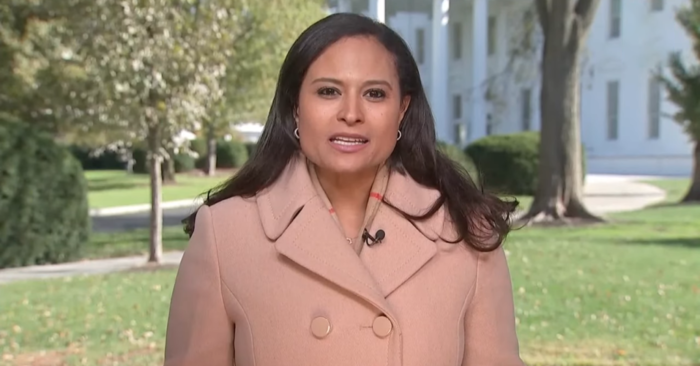
(Headline USA) A government ethics and watchdog group on Wednesday called upon the Commission on Presidential Debates to withdraw Kristen Welker, NBC’s White House Correspondent, from moderating Thursday’s debate between President Donald Trump and former Vice President Joe Biden.
In a letter, National Legal and Policy Center blasted the commission for choosing Welker despite her pro-Democrat bias and for fabricating a quote from President Trump.
NLPC cited news reports showing that Welker’s family have been strong Democrat financial supporters and photos of her with her father posing with the Obamas at a 2012 White House Christmas party.
NLPC also cited its August 11 letter to NBC brass calling for the suspension of Welker as a White House correspondent for making up a quote from President Trump in reacting to the shooting on the White House grounds in early August.
When asked by Welker if he was “rattled at all” by the incident, Trump calmly responded, ‘I don’t know, do I seem rattled?”
Shortly thereafter, Welker reported on NBC that in response to her question, “he said, ‘Of course.’”
“The American voter doesn’t need a biased moderator who acts as additional adversary to one of the candidates,” said NLPC Chairman Peter Flaherty.
“Sadly, none of the Commission’s criteria for selecting a moderator requires even a semblance of neutrality,” added Paul Kamenar, Counsel for NLPC who drafted the complaint.
Last weekend, President Trump tweeted that Welker has “always been terrible and unfair, just like most of the Fake News reporters.”
Trump has questioned why Welker had disabled her Twitter account after C-SPAN’s Steve Scully claimed — falsely, he later admitted — that he had been hacked. Scully was to have moderated an earlier debate that was canceled.
NBC said the halt to Welker’s Twitter account was temporary and done for security, not to hide anything she may have tweeted in the past.
Information from the Associated Press was used in this report.
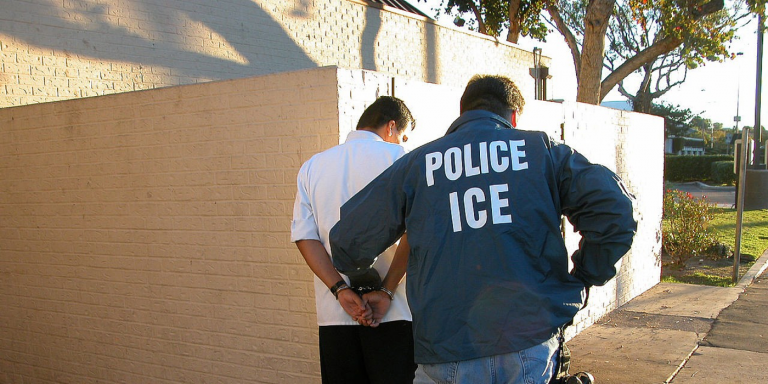
Federal immigration officers arrested 54 illegal aliens in the New York City Metropolitan Area and Nassau, Suffolk, Dutchess, Ulster and Westchester counties, removing rapists and gangsters from the streets who were sheltered by sanctuary city policies.
“ICE continues to protect communities by taking criminal aliens off the streets regardless of any locality’s cooperation policies – which is part of our congressionally mandated mission,” said ICE Senior Official Performing the Duties of the Director Tony H. Pham.
“Officers and agents of U.S. Immigration and Customs Enforcement are sworn federal law enforcement officers who enforce U.S. immigration laws created by Congress to keep this country safe,” he said.
Agents with Enforcement and Removal Operations, a division of ICE, conducted the sweep for criminal illegal aliens from Oct. 2 to Oct. 9.
Of the 54 illegals who were arrested, 52 have criminal histories in addition to illegally entering the United States.
Sanctuary jurisdictions previously released more than 30 criminal illegal aliens, despite ICE’s active immigration detainer requesting their transfer into federal custody.
New York arrested and charged these illegal aliens with crimes such as “assault, sexual assault against a child, lewd and lascivious acts upon a child, rape, criminal possession of a loaded firearm, criminal possession of stolen property, driving while intoxicated, robbery and grand larceny.”
Yet sanctuary city policies forced law enforcement agencies to put the criminal illegal aliens back onto the streets.
There were eight illegal aliens who had already been deported and another five with active deportation orders.
Two people are gang members and one is a fugitive from law in a foreign nation.
“Let us not gloss over the fact that the vast majority of the individuals arrested during this operation have criminal histories,” said Thomas R. Decker, ICE ERO New York field office director. “It’s frightening that New York City politicians created laws that force local law enforcement agencies to release dangerous criminals back into the community despite the seriousness of their crimes.”
Senate Democrats expressed outrage and alarm that the Justice Department sought to amend a policy about public investigations into election fraud, even as they have pushed to relax longstanding election-integrity laws in many battleground states.
“The Department has long recognized that public investigations of alleged election fraud can ‘interject[] the investigation itself as an issue’ in an ongoing election, creating ‘the obvious risk of chilling legitimate voting and campaign activities,’” wrote 13 Democrat senators on the Judiciary and Rules committees in a letter to Corey R. Amundson, chief of the DOJ’s Public Integrity Section criminal division.
The exception applies only if “the integrity of any component of the federal government is implicated by election offenses,” the Democrats noted.
But their concern comes as President Donald Trump has repeatedly sought to call attention to issues of ballot mishandling and abuse that are likely to result from increased mail-in voting.
“It is deeply troubling that the Department has chosen to weaken its non-interference policy weeks before Election Day and while millions of Americans have already voted, many of them by mail,” claimed the senators.
Left-wing operatives immediately began calling for an increase in remote and absentee ballots on the very day that Trump declared a national emergency in response to the coronavirus pandemic.
They have emphatically denied the existence of any evidence that might erode public confidence by casting aspersions on mail-in voting.
However, evidence has repeatedly shown that the system is ripe for abuse. Among the many concerns are:
the automatic mailing of ballots to ineligible and inactive voters
the abundance of duplicate ballots and carelessly discarded ballots
the Postal Service’s failure to deliver completed ballots, along with the endorsement of Democrat candidate Joe Biden by top postal-worker unions
third-party ballot-harvesting initiatives that make use of partisan (often left-wing) activists in soliciting and collecting ballots
the questionable tallying of ballots by potentially corrupt election officials and the loosening of deadlines for receiving them
Federal authorities already are known to have investigated a major ballot-stuffing ring in Pennsylvania, which may be one of the most crucial states in deciding the Nov. 3 election.
Meanwhile, Democrats’ attempts to make 11th-hour changes to voting laws have only sowed confusion and led to a deluge of last-minute lawsuits.
But the Left has continued to deflect from its suspicious operations by insisting that it is the authorities investigating such concerns who are, in fact, interfering with the election.
They have even trotted out a popular old standby, claiming—without clear evidence—that the Russians were behind efforts to discredit mail-in voting.
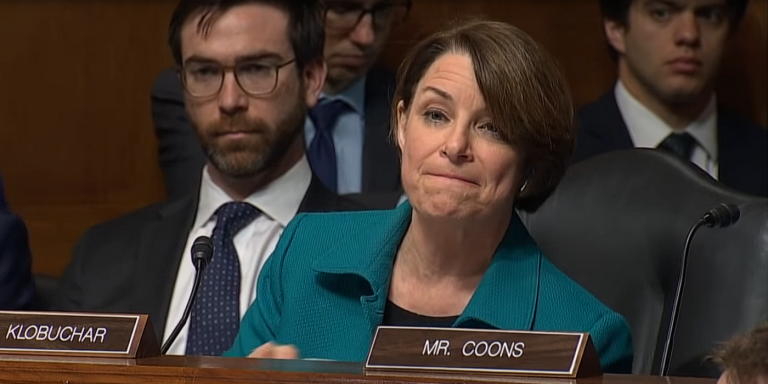
“This policy change coincides with repeated false claims by the President and Attorney General [William] Barr that voting by mail will lead to rampant fraud, while the Department of Homeland Security (DHS) is warning that Russia is amplifying these claims to undermine trust in the electoral process,” claimed Sen. Amy Klobuchar, D-Minn., ranking member of the Senate Rules Committee, in a press release.
Klobuchar’s home state was the subject of recent scrutiny after an exposé by conservative watchdog Project Veritas offered evidence of widespread, systemic ballot-harvesting abuses among Minneapolis’s Somali community.
Those abuses were overseen in large part by Rep. Ilhan Omar, who represents Minnesota’s 5th Congressional District encompassing its largest city.
Outrage over the almost exclusively blue-led state’s mishandling of race riots following the death of George Floyd has recently put the Gopher State in play for Trump, despite Hillary Clinton having edged him out in 2016.
It is one of several closely watched states in the upcoming election—many of them states where Trump narrowly prevailed four years ago—in which razor-thin margins could tilt the election either way.
Democrats long claimed that former FBI Director James Comey‘s interference in the 2016 election, along with alleged Russian disinformation efforts, helped lead Trump to victory.
However, both claims have since been debunked. In fact, both Comey and Russia were later revealed to be colluding with the Clinton campaign in order to undermine Trump by concocting false allegations that he was working with the Kremlin.
Comey’s decision to reopen a case into Clinton’s email scandal a few weeks before the election—due to his concern that it would eventually come to light and damage the FBI’s credibility—came only after the FBI had sat on the evidence for at least a month.
Yet, Klobuchar and other Democrats fretted that the DOJ’s potential probes into the delivery and counting of mail-in ballots could once again “jeopardize ‘the Department’s reputation for fairness, neutrality, and non-partisanship.'”
(Stefan Gleason, Money Metals News Service) The threat of economically crippling lockdowns, the promise of unending monetary stimulus, and the uncertainty of game-changing political outcomes – this is the “new normal” for investors.
The COVID pandemic won’t be eradicated anytime soon. And even when it finally is, the economic and social costs will continue to be borne for years to come.
In such an environment, all conventional asset classes carry heightened risk. Certain types of assets, though, may now be well positioned to shine.
With politicians and central bankers desperately trying to paper over real economic losses with artificial stimulus, the outlook for the value of the U.S. dollar looks bleak.
A record $3.1 trillion federal budget deficit combined with an explicit new inflation-raising campaign by the Federal Reserve puts holders of dollar-denominated paper assets in jeopardy.
Hard assets in general and precious metals in particular act as a natural countermeasure to currency depreciation.
Some commodities, such as crude oil, have suffered greatly in recent years amid the push for “green” alternatives to fossil fuels. Dramatic growth in electric vehicles and solar energy installations is likely to continue, regardless of the upcoming election outcome.
The upshot is that all viable alternatives to fossil fuels require massive amounts of metals – from copper to nickel to silver to rare earths.
“Silver is found in virtually every electronic device. If it has an on/off button, it’s likely that silver is inside,” according to the Silver Institute. “Silver’s excellent electrical conductivity makes it a natural choice for everything from printed circuit boards to switches and TV screens.”
As cars become more technologically advanced and more likely to be powered by batteries, they will require larger quantities of strategic metals including silver. The motor vehicle industry already consumes over 36 million ounces of silver per year – and that number will surely grow as global demand picks back up.
The trend toward more metals-intensive energy development could accelerate if Joe Biden wins the presidency and Democrats take over the Senate.
Biden now says he rejects the most extreme planks of AOC’s “Green New Deal” platform, including a ban on fracking. But he is still vowing to push through a multi-trillion-dollar green energy program of his own.
Regardless of the election outcome, most of America’s largest corporations will continue to pursue environmental, social, and governance (ESG) targets. In recent years, shareholder activists including government pension funds have successfully foisted their ESG demands upon corporate America.
It’s why today fast-food companies feel compelled to virtue signal their support for everything from reducing their carbon footprint to implementing critical race theory to celebrating transgenderism. What does any of this have to do with selling burgers?
It has to do with the fact that taking up politically fashionable causes is nearly a prerequisite for doing business as a publicly traded company. A low ESG score means being protested by activists and shunned by institutional investors.
A company can score ESG points by making commitments to “diversity” or capital investments in solar panels, for example. This means that demand for green technologies can far exceed the actual utility they deliver.
Demand for photovoltaic solar systems is expected to explode in the years ahead. This year solar-related stocks have been among the hottest performers in the market.
But as demand continues to grow, the solar industry could soon run into a serious supply problem in critical metals including silver.
Photovoltaics are one of the fastest growing sources of industrial demand for the white metal. Silver saw a 7% increase in such demand last year to over 85 million ounces.
Meanwhile, investment demand for silver bullion has been surging in recent months at the same time as mining supply is contracting due to adverse economic and political (lockdown) conditions.
Silver often trades in a volatile manner. That volatility could be amplified depending on how the election turns out and how much of a toll the virus takes in the coming weeks.
Regardless of whether the futures market reads a particular development as “good” or “bad” on any given day, three major long-term drivers of silver price appreciation appear unstoppable:
The Fed will continue to pursue inflationary stimulus regardless of the election outcome.
Insatiable demand for solar energy and various electronic applications will continue to use up more silver.
A mining supply deficit in silver will contribute to market tightness and possible bottlenecks that render refined silver products difficult to obtain by investors and industrial users alike.
At some point, higher silver prices will send market signals that alleviate the supply and demand crunch. But that point may be years away – and multiples of price appreciation ahead.
Stefan Gleason is President of Money Metals Exchange, a precious metals dealer recently named “Best in the USA” by an independent global ratings group. A graduate of the University of Florida, Gleason is a seasoned business leader, investor, political strategist, and grassroots activist. Gleason has frequently appeared on national television networks such as CNN, FoxNews, and CNBC and in hundreds of publications such as the Wall Street Journal, The Street, and Seeking Alpha.
(Clint Siegner, Money Metals News Service) America’s key institutions are broken. More people wake up daily to that reality. They are preparing for the moment this realization dawns on Americans at large, which explains why the markets for physical bullion are so active.
Markets certainly aren’t working. Perpetual central bank intervention, rampant Wall Street cheating, high frequency trading, index funds, and many other factors have divorced the price of securities from fundamental realities, such as high unemployment.
Washington, DC is dysfunctional and has been for decades. Regardless of anyone’s views on presidential politics, the political class has failed.
Government always gets bigger and more expensive and liberty is in steep decline (this year perhaps faster than ever). Corruption appears widespread within the Deep State, which serves its own interests rather than those of most Americans.
The Federal Reserve is a key tool for the Deep State. Its public mandate is to protect the value of the dollar but our money has lost at least 98% of its purchasing power over the last 100 years.
In recent times, the central bank’s actual mandate has become clear. The Fed exists to make sure Wall Street bankers are never held accountable for their sins and to make sure politicians have the funds for unlimited government.
The media, including big tech, is also subverted. One just has to look at which stories are reported and, perhaps more importantly, which stories aren’t.
More people than ever scoff at the notion that there is a free and honest press keeping Americans informed. Along with other media giants, Twitter’s effort to censor and cover up the Biden family’s questionable dealings with Burisma and with communist China is just the current example.
The Justice System has also failed. We know the FBI had emails, photos, and videos from Hunter Biden’s laptop nearly a year ago some of which appears to be directly relevant to the charges leveled at Trump during his impeachment. Someone apparently planned to bury the Hunter Biden evidence.
Jeffrey Epstein died while in federal custody awaiting justice, and prosecutions of his network of pedophiles could end with Ghislaine Maxwell.
From the Clintons to JPMorgan Chase, there is a long list of well-connected people and corporations who have been protected. The list of elites we don’t know about is probably longer.
The election system keeps letting Americans down. If the results of this year’s presidential election are contested, it could reveal a lot about how crooked and dysfunctional voting, and vote counting, has become.
Finally, it would not be fair unless a portion of the blame for the current state of our institutions is assigned to the American people at large. Voters stood idly by as government grew and our liberties eroded.
Markets, political leadership, media, the justice system, and the election system are broken. Citizens let it happen. This is reality and it is now beyond serious dispute. Many Americans are in denial or oblivious about these institutions completely failing and they expect someone will come along and fix them.
That may happen, but not without a reckoning first which destroys what public confidence remains.
The moment of reckoning may not be too far away. Most Americans do sense trouble, and it is getting tougher to ignore.
A contested presidential election, or the next big economic decline could be the tipping point. Who knows? The important thing is to prepare for turbulent times ahead…Original Source.
Clint Siegner is a Director at Money Metals Exchange, a precious metals dealer recently named “Best in the USA” by an independent global ratings group. A graduate of Linfield College in Oregon, Siegner puts his experience in business management along with his passion for personal liberty, limited government, and honest money into the development of Money Metals’ brand and reach. This includes writing extensively on the bullion markets and their intersection with policy and world affairs.
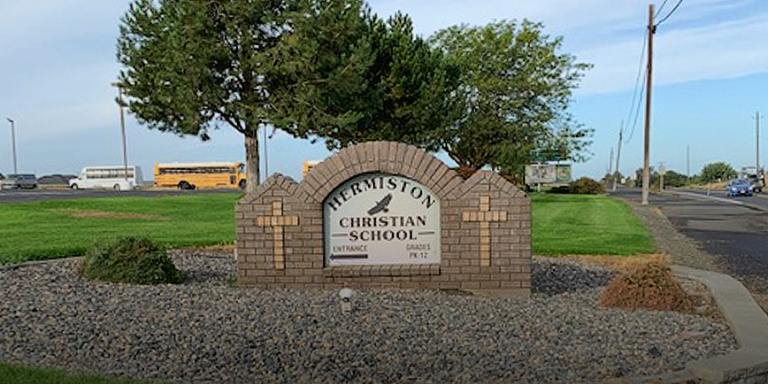
An Oregon school sued Gov. Kate Brown this week for preventing private schools from reopening despite allow public schools to resume in-person classes.
Hermiston Christian School was initially told that students would be allowed to return for in-person instruction this fall, so officials spent months putting together new safety guidelines to make sure the reopening process was conducted safely.
The Oregon Department of Education approved of Hermiston’s guidelines and noted that the “facility is very clean and organized,” and that the school’s staff “were very well prepared and are following the Health and Safety Guidelines.”
But on July 29, Brown suddenly reversed course and ordered private schools, such as Hermiston Christian, to remain closed.
At the same time, she gave public schools with 75 or fewer students the right to reopen. When confronted about this double standard, Brown argued she was trying to prevent a “mass exodus” from public schools.
“Gov. Brown’s personal preference for public over private education does not permit her to discriminate against faith-based schools,” said David Cortman, senior counsel for Alliance Defending Freedom, in a statement.
“Public health crises do not suspend the Constitution or permit elected leaders to favor secular public schools by granting them unique exceptions,” he said.
The state government is also threatening private schools that defy Brown’s order with 30 days jail time and $1,250 fines.
In its lawsuit, Hermiston argued that Brown’s order needlessly discriminates against private schools that are performing the same function as public ones.
“[Brown’s order] is unconstitutional and makes no sense,” the lawsuit reads. “The virus does not discriminate between public and religious schools; neither should the government.”
This is not the only lawsuit Brown faces. Last week, a group of Oregon Republicans similarly sued the governor over her coronavirus restrictions, arguing her executive orders usurped legislative authority and infringed upon Oregonians’ rights.
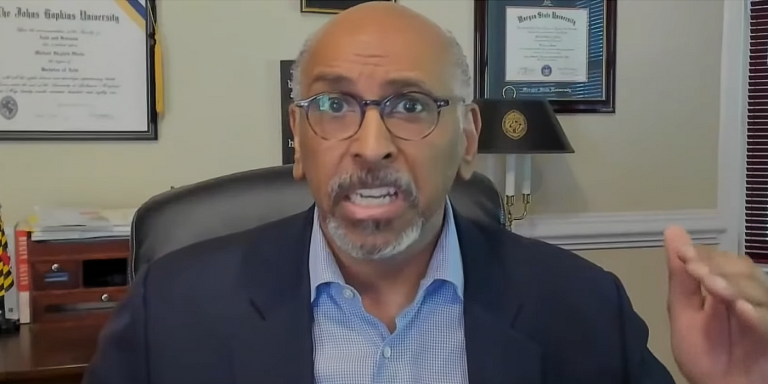
Former Republican National Committee Chair Michael Steele formally endorsed Democratic presidential candidate Joe Biden on Tuesday, a predictable move given his role in the NeverTrump group, the Lincoln Project.
Steele, who failed in his bid to become a senator and governor in his home state of Maryland, was elected RNC chair in January 2009, overlapping with the first three years of the Obama–Biden administration.
Although his tenure saw Republicans retake Congress in the 2010 midterm, Steele lost to the more conservative Reince Preibus at the RNC election the following year.
The blue-state centrist Steele broke rank with the growing Tea Party movement as it began to demand a stronger resistance to Obama’s partisan and highly polarizing style of governance.
However, Steele has been an outspoken critic of President Donald Trump’s since day one.
Trump’s is “not the kind of leadership that the country needs,” Steele said this week.
“Many of Donald Trump’s supporters bring legitimate concerns to the table,” he said.
“During my time leading the GOP, I endeavored to address these and other grievances through the lens of unity and growth,” he continued. “But Trump has energized the party through the exact opposite means—by focusing on stoking division and eroding our core principles,” Steele said in a statement issued by the Lincoln Project.
Biden “will pursue options that work towards healing the divide,” Steele claimed.
Steele joined the Lincoln Project, a group of NeverTrump grifters, in August, and recently appeared in an advertisement for the group.
In it, he admitted that he disagrees with Biden on “some policy points,” but will support him anyways “because we share an everlasting loyalty to what is ultimately best for our nation.”
This election, former RNC Chair and a lifelong Republican, @MichaelSteele, is voting to restore the soul of our nation.
Steele also said he supports the Lincoln Project’s efforts to oust Republican senators who have been supportive of Trump. That includes Sens. Susan Collins of Maine, Lindsey Graham of South Carolina, and Mitch McConnell of Kentucky, each of whom worked with Steele while he was RNC chairman.
Steele is the second former RNC chairman to endorse Biden. Former Montana Gov. Marc Racicot, who held the RNC chairmanship in the early years of former President George W. Bush’s presidency, endorsed Biden last month.
(Headline USA) President Donald Trump is hopping from one must-win stop on the electoral map to the next in the lead-up to a final presidential debate.
Democrat Joe Biden has taken the opposite approach, staying off the road and holing up for debate prep in advance of Thursday’s faceoff in Nashville, Tennessee — an abnormal campaign strategy. Trump stopped in Pennsylvania on Tuesday and was bound for North Carolina on Wednesday as he delivers what his campaign sees as his closing message.
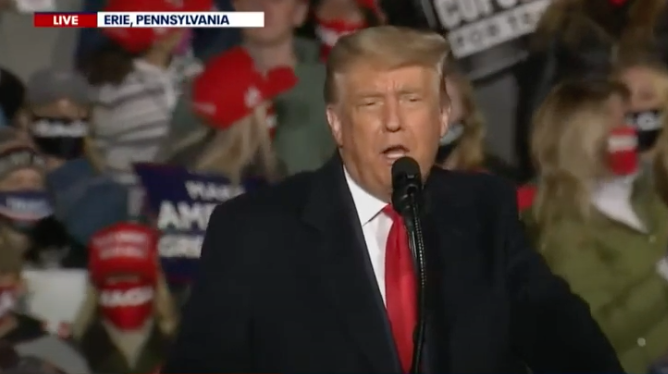
“This is an election between a Trump super recovery and a Biden depression,” the president said in Erie, Pennsylvania. “You will have a depression the likes of which you have never seen.” He added: “If you want depression, doom and despair, vote for Sleepy Joe. And boredom.”
Before leaving the White House for Pennsylvania on Tuesday, Trump taped part of an interview with CBS’ “60 Minutes” that apparently ended acrimoniously. On Twitter, the president declared his interview with Lesley Stahl to be “FAKE and BIASED,” and he threatened to release a White House edit of it before its Sunday airtime.
Trump’s trip to Pennsylvania on Tuesday was one of what is expected to be several visits to the state in the next two weeks.
“If we win Pennsylvania, we win the whole thing,” Trump said in Erie.
Erie County, which includes the aging industrial city in the state’s northwest corner, went for President Barack Obama by 5 percentage points in 2012 but broke for Trump by 2 in 2016. That swing, fueled by Trump’s success with white, working-class voters, was replicated in small cities and towns and rural areas and helped him overcome Hillary Clinton’s victories in the state’s big cities.
Trump, who spoke for less than an hour, showed the crowd a montage of various Biden and Kamala Harris comments (starting at about 6:30 on video above) in which they pledged to end fracking. The issue is critical in a state that is the second leading producer of natural gas in the country.
Biden, who taped his own interview with “60 Minutes” on Monday at a theater near his home, had no public events Tuesday or Wednesday and wasn’t scheduled to travel — except to the debate — on Thursday.
(Headline USA) The Trump administration announced Tuesday that asylum-seekers will lose their bids if they are convicted of driving under the influence or committing crimes to support gangs.
The rule, which takes effect Nov. 20, is the latest in a slew of measures to make asylum more difficult to obtain.
The immediate impact will be muted by a temporary pandemic-related ban on asylum introduced in March that calls for people who enter the country illegally to be immediately expelled on public health grounds.
While asylum has long been denied to people convicted of “particularly serious crimes,” the new rule adds a litany of crimes that would be disqualifying.
They include convictions for domestic violence — whether a felony or misdemeanor — assault or battery, re-entering the country illegally, identify theft, public benefits fraud, immigrant smuggling and driving under the influence.
The rules would also deny asylum to people convicted of crimes that an adjudicator “knows or has reason to believe” was committed to support a criminal street gang.
The rule to be published Wednesday in the Federal Register and signed by Attorney General William Barr rejects much of the criticism since it was first proposed in December, including that the authority to declare crimes gang-related was too broad and prone to error.
The administration deflected criticism that DUI wasn’t serious enough to merit automatic denial.
Advocacy groups criticized the move.
“The administration is showing needless cruelty by layering these new bars on an asylum system which already has been decimated since Trump entered office,” said Heidi Altman, the National Immigrant Justice Center’s policy director.
Asylum is for people fleeing persecution for their race, religion, nationality, political beliefs or membership in a social group.
It isn’t intended for people who migrate for economic reasons.
President Donald Trump has called asylum — which has been exploited with fraudulent claims by the thousands — “a scam,” and has introduced a string policies against it since the U.S. became the world’s top destination for asylum-seekers in 2017.
A rule proposed in June gives judges the power to reject claims without a hearing.
Several new factors weigh against asylum, including failure to pay taxes.
A rule in July lets authorities block asylum-seekers from countries with widespread communicable disease.
(Headline USA) With Amy Coney Barrett expected to join the Supreme Court as early as next week, the court’s action in a Pennsylvania voting case has heightened fears among Democrats about the court being asked to decide a post-election dispute and with it, the winner of the White House.
The justices split 4-4 Monday over a Republican plea to undo a state court order and force elections officials to ignore absentee ballots received after Election Day, Nov. 3.
The tie vote left the Pennsylvania court order in effect and allows mailed ballots to be counted if they are received by Nov. 6. Chief Justice John Roberts and his three liberal colleagues voted to leave the court order in place.
The four conservative members of the court who would have granted the GOP’s request are likely to be joined soon by Barrett. That’s a potential majority, even without Roberts, in any election-related dispute, whether from Pennsylvania or any other battleground state where mailed-in ballots or a recount fight could decide the winner.
“One more vote, provided by a hard-right, Trump-nominated justice, could be the difference between voting rights and voting suppression,” Senate Democratic leader Chuck Schumer of New York said Tuesday.
President Donald Trump already has signaled one reason for Barrett’s speedy nomination, just eight days after Justice Ruth Bader Ginsburg’s death, was to have her confirmed and installed on the court in time for any election lawsuit that might reach the justices.
The last time that happened was in 2000, when the court effectively decided the presidential election in favor of George W. Bush by a 5-4 vote.
If nothing else, the split vote Monday strongly suggested there is not likely to be the requisite five votes to upend a federal appeals court order that has blocked a six-day extension of the time to receive and count absentee ballots in Wisconsin. That case is pending at the Supreme Court.
The court’s conservatives, Roberts included, have regularly sided with state officials who object when a federal court relaxes election rules, even if the changes arise from the coronavirus pandemic.
At the same time, the Supreme Court generally won’t disturb state court rulings that are rooted in state law.
But civil rights lawyers and election law experts said the vote in the Pennsylvania case indicates at least four conservatives may be willing to look at state court election-related decisions in a way that calls to mind Bush v. Gore.
Pennsylvania Republicans relied in part on an opinion from Justice Clarence Thomas and two other conservative justices in Bush v. Gore to argue that the Supreme Court should get involved in the case because the state court had improperly taken powers given by the U.S. Constitution to state lawmakers when it comes to presidential elections. The court ruled for Bush on other grounds, that ballots were being handled differently across the state in violation of the Constitution’s guarantee of equal protection.
“Based on Judge Barrett’s record, there is every reason to believe that she would have been a fifth vote in favor of the Supreme Court overstepping its bounds and interfering with a non-federal issue that would have jeopardized voter access,” said Kristen Clarke, president and executive director of the Lawyers’ Committee for Civil Rights Under Law.
The group opposes Barrett’s confirmation.
The justices on Monday provided no written explanation of their votes, so it is impossible to say exactly why Justices Samuel Alito, Neil Gorsuch, Brett Kavanaugh and Thomas would have granted the Republican request or why the other half of the shorthanded court didn’t.
The Supreme Court has never cited Bush v. Gore in an opinion of the court, and in its unsigned majority opinion the court wrote, “Our consideration is limited to the present circumstances.”
But two lawyers who worked for Bush’s cause in 2000, Roberts and Kavanaugh, now sit on the court. And they soon could be joined by a third, Barrett.