Arizona Parents Arrested Trying to Get in Locked-Down School

0

(Headline USA) Police arrested three Arizona parents, shocking two of them with stun guns, as they tried to force their way into a school that police locked down Friday after an armed man was seen trying to get on campus, authorities said.

The parents were arrested as they tried to get to their children to protect them, authorities said. Officers in the Phoenix suburb of El Mirage used a Taser to stop two of them as they tried to help a man whose own handgun fell to the ground while he was being taken into custody, authorities said.

The scene at Thompson Ranch Elementary School developed nearly three months after hundreds of law enforcement officers in the small Texas city of Uvalde failed to act for more than an hour as a gunman killed two teachers and 19 students.

No shots were fired at Thompson Ranch, the school wasn’t breached and no one was hurt, other than a woman taken to a hospital with Taser injuries from officers who say they were trying to stop her from attacking them.

By the time the confrontations with the upset parents began, police had already confirmed that there was no longer a threat, removed a suspicious package and were planning to begin reuniting parents with the children, El Mirage police Lt. Jimmy Chavez said.

But the school was still on lockdown, meaning no one would be allowed on campus, according to the protocols police and the school district have set up. That’s when upset parents demanded to be allowed into the school so they could find their children and began confronting police, authorities said.

“Several parents continued with their agitation, made several statements that they were going to come on campus to help protect their kids,” Chavez said. “As a parent I understand that philosophy. However, there are procedures that law enforcement and the school were following.”

Chavez said a man began pushing to get past officers and as police were arresting him, a man and a woman who had also been confronting officers came to his aid. Officers used a Taser to subdue them and they too were arrested. As the first man was being taken into custody, a gun fell to the ground.

The armed parent will face a weapons charge — guns are not allowed on school grounds — and a disorderly conduct charge. The two parents who were stunned with the Taser will face unspecified charges. The woman was taken by ambulance to a hospital, Chavez said. None were immediately identified.

The incident began at about 10:30 a.m. Friday when school officials called police to report that a man, possibly armed with a gun, was trying to get into a locked school building. He could not get in and was chased off by staff before police from El Mirage and two other agencies arrived at the school, Chavez said.

Officers searching the school to ensure it was safe found a suspicious package and called a bomb squad, Chavez said, and moved some children to another part of the campus.

That’s when parents began arriving and the confrontations with officers began, with parents “forcefully pushing on the officers trying to get on to campus.”

“The parents need to understand that when the school is on lockdown and law enforcement is on scene, nobody is going to be allowed on campus,” Chavez said.

Chavez said the school lockdown procedures between the school district and law enforced “worked to a T.”

Police later located the man who had triggered the lockdown. He was being evaluated late Friday by mental health professionals and a police statement said charges were pending.,

Efforts to reach El Mirage Police Saturday to get additional information were not immediately successful.

Adapted from reporting by the Associated Press.
San Francisco Spends 4 years, $20K on a Trash Can

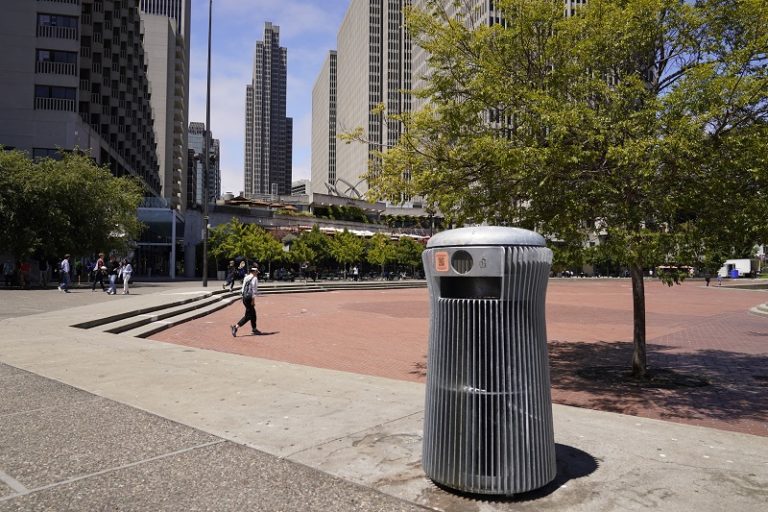
(Headline USA) What takes four years to make and costs more than $20,000? A trash can in San Francisco.

That costly, boxy bin is among six trash cans hitting San Francisco’s streets this summer in the city’s long saga in search of the perfect can. Overflowing trash cans are a common sight in the Northern California city, along with piles of used clothes, shoes, furniture, human waste, and other items strewn about on sometimes-impassable sidewalks.

City officials hired a Bay Area industrial firm to custom-design the pricey trash can along with two other prototypes that cost taxpayers $19,000 and $11,000 each. This summer, residents have the opportunity to evaluate them along with three off-the-shelf options added to the pilot program after officials faced criticism.

Last month, the city deployed 15 custom-made trash cans and 11 off-the-shelf trash cans — each of those costing from $630 to $2,800 — with QR codes affixed to them asking residents to fill out a survey. City officials said they intend to pay no more than $3,000 per can.

San Francisco began its search for the perfect trash can in 2018 when officials decided it was time to replace the more than 3,000 public bins that have been on the streets for almost 20 years.

Officials say the current bins have too big a hole that allows for easy rummaging. The bins also have hinges that need constant repair and locks that are easy to breach. Some people also topple them over, cover them in graffiti, or set them on fire.

The city is so serious about the endeavor it has created interactive maps so residents can track and test the different designs, which include the Soft Square, the priciest prototype at $20,900. The boxy stainless steel receptacle has openings for trash and for can and bottle recycling and includes a foot pedal. The Slim Silhouette, at $18,800 per prototype, is made of stainless steel bars that give would-be graffiti artists less space to tag.

If one of the custom-designed bins is chosen, the cost to mass produce it will be $2,000 to $3,000 per piece, said Beth Rubenstein, a spokeswoman for San Francisco’s Department of Public Works.

“We live in a beautiful city, and we want (the trash can) to be functional and cost-effective, but it needs to be beautiful,” she said.

But the good looks of the shiny new trash cans have not protected them from vandalism. Three weeks after being unveiled, several have already been tagged with orange and white graffiti. Others have attracted dumping, with people leaving dilapidated bathroom cabinets and plastic bags full of empty wine bottles next to them.

Trash on San Francisco city streets has been an issue for decades. In 2007, then-Mayor Gavin Newsom eliminated about 1,500 of the city’s 4,500 trash cans because he said they were not helping keep streets clean and were becoming magnets for more trash. Officials couldn’t say how many receptacles are currently on the curb, but the city plans to replace at least 3,000.

“A trash can is one of the most basic functions of city governance and if the city can’t do something as simple as this, how can they solve the bigger issues of homelessness and safety and poverty?” asked Matt Haney, a former supervisor who lives in the Tenderloin neighborhood and now represents the area in the California Assembly.

New trash cans will be the latest addition to the city’s arsenal against its dirty streets. In 2014, San Francisco launched its “Pit Stop” program in the Tenderloin neighborhood, the epicenter of drug dealing and homelessness in the city, setting up portable public toilets. In 2018, the city created a six-person “poop patrol” team amid demand to power wash sidewalks.

Haney said that as a supervisor he reluctantly agreed last year to approve the pilot program despite the high prices to avoid delays.

“I think most people, including me, would say just replace the damn cans with cans that we know work in other cities, just do it,” he said.

Haney said the “whole trash can saga has this stench of corruption,” referring to disgraced former Department of Public Works Director Mohammed Nuru, who pleaded guilty in January to federal wire fraud charges. Nuru awarded the contract to maintain San Francisco’s trash cans to a company owned by a relative of a developer who has pleaded guilty to conspiracy and is cooperating with federal authorities in the case against Nuru.

On top of the corruption, the city has long been the butt of jokes for how long it takes to complete public works projects of all kinds.

A bus rapid transit system along Van Ness Avenue, one of the city’s main arteries, finally opened this year after 27 years of construction. A new subway line connecting Chinatown with other areas of the city that started construction in 2010 is four years behind schedule. In 2017, the city completed the Transbay Transit Center only a year late, but the $2 billion terminal abruptly shut down six weeks later after crews discovered two cracked steel girders.

Ultimately, what trash can the city gets will depend on feedback from sanitation employees, and the surveys completed by the end of September, Rubenstein said. The new cans are not expected on the streets until the end of 2023.

Diane Torkelson, who often picks up trash in her Inner Richmond neighborhood with other volunteers, recently trekked 5 miles (8 kilometers) with a dozen other civic-minded San Franciscans to examine three of the cans.

The two prototypes were already full when the group arrived to check them out, she said.

“If the trash can is full, it’s of no use, no matter how well it was designed,” she said.

Adapted from reporting by the Associated Press

Ariz. Filling U.S.-Mexico Border Wall Gap This Weekend

0

(TThe Center Square) – Ariz. Gov. Doug Ducey issued an Executive Order on Friday this week directing the Ariz. Department of Emergency and Military Affairs to fill the gaps in the Yuma border wall starting immediately.

“Arizona has had enough. We can’t wait any longer. The Biden administration’s lack of urgency on border security is a dereliction of duty,” Ducey said in a press release.

“For the last two years, Arizona has made every attempt to work with Washington to address the crisis on our border.”

“Time and time again we’ve stepped in to clean up their mess. Arizonans can’t wait any longer for the federal government to deliver on their delayed promises,” he continued.

The Executive Order came days after the Biden administration abandoned the Remain in Mexico policy.

The governor’s office called the Biden administration’s decision “misguided.” It added that the White House has failed to secure the border, allowing transnational criminal organizations to bring more drugs over the southern border.

“Our border communities are being used as the entryway to the United States, overwhelming law enforcement, hospitals, nonprofits and residents. It’s our responsibility to protect our citizens and law enforcement from this unprecedented crisis,” Ducey said.

“With the resources and manpower in the right places, our Border Patrol and law enforcement will be better equipped to do their jobs well and prevent cartels from exploiting our communities. That’s exactly what our barrier mission will do.”

Ariz. will use 60 double-stacked shipping containers reinforced with concertina wire at the top to secure this vulnerable part of the border.

The double-stacked containers with wire will reach 22 feet high. The governor’s office says the state will use 800-pound, 9-by-40-feet containers. For reference, the Trump administration’s border walls were 30 feet tall.

Construction to fill this 1,000-foot gap began Friday morning. Emergency management contractor Ashbritt is building the barrier. A 25-man team will likely complete the project over the weekend.

The project will cost the state $6 million.

“National security starts with border security. Biden’s border crisis deteriorates daily while the White House is silent,” Jonathan Lines, Yuma County Supervisor, said in the press release.

“Border communities like Yuma bear the burden of a broken border while narcotics poison our youth, human smuggling rises and mass amounts of migrants wear on our nonprofits.”

“Beyond that, the seizure of counterfeit products at our ports of entry affects American businesses,” he continued.

“Governor Ducey has been a consummate partner, coordinating and leading state and local resources to do what the federal government won’t: secure the border.”

The Yuma Sector of the U.S.-Mexico border has been busy over the past year. It saw 235,230 migrant encounters from Oct. 2021 to June 2022, according to a press release from the governor’s office.

“The Yuma community does not have the infrastructure to handle thousands of people crossing the border in need of food, shelter and medical services,” Yuma Mayor Doug Nicholls said in the press release.

“The surge of migrants the federal government has allowed to trek over the border has the grave potential to greatly impact and strain our community.”

“Washington must send a clear message that this is not the way to immigrate to our country. Too many migrants make the treacherous journey that puts their lives in danger and exposes them to exploitation by cartels,” he continued.

“Yuma has experienced the worst of the border crisis. We’re grateful to Governor Ducey for ingraining himself in this issue and finding solutions.”

Drugs have also made their way across the border. So far this fiscal year, more than 2,400 pounds of fentanyl have been seized in Arizona’s sectors. Fentanyl overdoses are now the leading cause of death for people 19 and younger in Pima County, according to the governor’s office.

“The White House lacks a sense of urgency and detail while the border crisis gets worse every day. In Arizona, we put our money where our mouth is,” Tim Roemer, Arizona Department of Homeland Security Director and the state’s Chief Information Security Officer, said in the press release.

“The brave men and women of law enforcement need this support so they can conduct their important work catching the people who don’t want to get caught and stopping lethal drugs from coming over the border.”

“Governor Ducey once again showed he’ll take action to secure the border and give law enforcement every resource in the state’s power,” he concluded.

Va. to Soon Release Guidelines on ‘Sexually Explicit’ Material in Education Law

0

(Tyler Arnold, The Center Square) – Now that the public comment period has come to a close, the Va. Department of Education will soon finalize its guidance on a new law that allows parents to opt their children out of sexually explicit coursework.

Per the law, local school boards must adopt policies that inform parents of sexually explicit material in assigned coursework and allow parents to opt their children out of those assignments.

The teachers must pinpoint the sexually explicit part of the assignment when providing that information to parents.

If a parent opts his or her child out of an assignment, the teacher will need to provide an alternative assignment that does not contain anything sexually explicit.

The law does not give parents the ability to ban any material or any books in the schools, and it does not allow parents to force any changes to the curriculum on other students.

Sexually explicit material, as defined in the law, is a description or visual representation of a lewd exhibition of nudity, a depiction of sexual excitement or conduct, bestiality, sadomasochistic abuse, coprophilia, urophilia or fetishism.

When the legislation was being debated, some supporters cited literary material that depicted rape and oral sex being taught in classrooms, to which some parents expressed objections.

The Department of Education’s guidance will provide school boards with more specific guidance on how to apply that standard.

Under the draft guidance, which has yet to be finalized, the state would require school boards to adopt policies that give parents a 30-day notice before using any sexually explicit material.

It also would require them to consider the age of the student when determining what counts as sexually explicit.

For example, the draft guidelines would require teachers to notify parents of K-5 students of PG material, to notify parents of K-8 children of PG-13 or TV-14 material and notify parents of children in any grade of “R” and “MA” material.

However, the draft guidance also states parents must be notified of material that is legally defined as “sexual conduct” under the law.

“Sexual conduct” is defined as “actual or explicitly simulated acts of masturbation, homosexuality, sexual intercourse, or physical contact in an act of apparent sexual stimulation or gratification with a person’s clothed or unclothed genitals, pubic area, buttocks or if such be female, breast.”

Senate President Pro tempore L. Louise Lucas, D-Portsmouth, alleged this would prohibit any discussion of homosexuality.

“The Youngkin administration is now attempting to ban the mention of homosexuality in all Virginia schools – using an outdated and unconstitutional section of code to define ‘sexually explicit content’ to bypass the General Assembly,” the senator claimed.

The governor’s office has denied the guidelines function in that way.

After the guidelines are finalized, school boards will have until Jan. 1 of next year to adopt policies by the rules.

Pittsburgh, Philadelphia Still Have a Vaccine Mandate for City Workers

0

(Anthony Hennen, The Center Square) – Philadelphia and Pittsburgh, the largest cities in Pa. with COVID-19 vaccine mandates for city workers still in place, won’t see those disappear any time soon.

Worker vaccination rates are above 90%, respective city officials said in confirming the mandates will remain. Philadelphia’s compliance rate is “nearly 100%,” according to a city press release. In Pittsburgh, the rate was 95% as of last Dec.

“Mayor [Jim Kenney] has been clear from the beginning that the intent of the mandate was to ensure we are doing everything we can to protect our employees and the individuals they serve,” a Philadelphia city spokeswoman wrote in an email to The Center Square.

“To that end, since announcing the mandate we have seen significant increases in the number of employees who have started and completed their vaccination series. We have no plans to remove or adjust the mandate at this time.”

When asked whether the vaccine mandate would remain in place indefinitely or if Pittsburgh had specific metrics to end it, Maria Montano, press secretary for Mayor Ed Gainey, declined to comment.

The cities differ on exemptions, however. About 3,000 Philadelphia city employees have a vaccine exemption approved or pending. Yet Pittsburgh has only granted a few exemptions and is unlikely to expand that number.

“We recently decided to deny all religious exemptions that were requested,” Montano said.

The city remains under bargaining with some unionized workers, however, so the city’s policy isn’t yet finalized.

About 68 Philadelphia city workers will be fired for noncompliance with the mandate. In February, Pittsburgh fired four city workers, but an updated figure was not available.

Keeping the mandates are in contrast to recent changes in federal guidance, which is loosening. On Thursday, the CDC announced it was moving away from quarantine recommendations, even for unvaccinated Americans.

New York City, which has a strict vaccine mandate for the city and private workers, is also relaxing. Mayor Eric Adams has not enforced the mandate for private businesses and has no plans to do so, according to Bloomberg.

Of Pennsylvania’s 10 largest cities, Harrisburg also approved a vaccine mandate for city workers. However, that was repealed by executive order in January 2022 when Mayor Wanda Williams took office.

“The cooperation of city employees, especially those who interface with the public and other persons on a regular basis, have bolstered the city’s efforts in preventing infection and curbing the spread of the virus to the community at large,” Williams wrote in executive order No. 4.

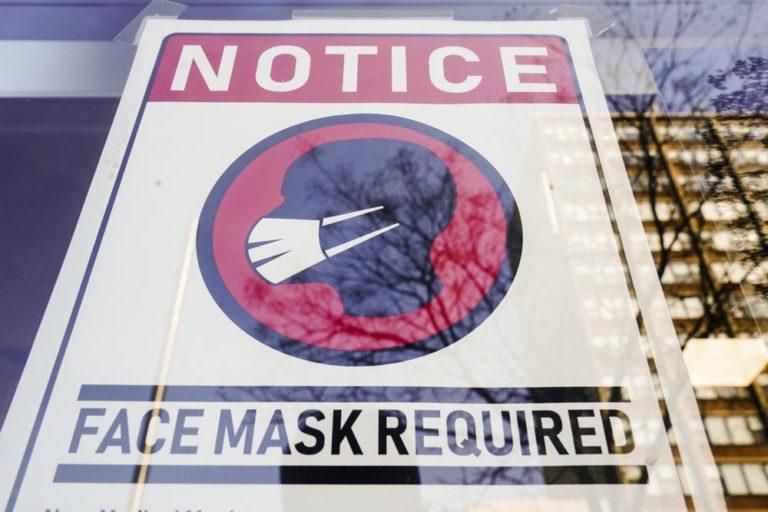
Attorneys General File Brief in Federal Travel Mask Mandate Case

0

(The Center Square) – Attorneys general from 23 states have filed an amicus brief in a federal appeals court urging judges to uphold a ruling from earlier this year that struck down the mask mandate for interstate travel.

Four months ago, Fla. U.S. District Judge Kathryn Kimball Mizelle sided with the Health Freedom Defense Fund and two Florida residents.

They claimed the restriction the Biden Administration announced on Jan. 29, 2021, as part of its COVID-19 guidelines exceeded federal authority.

Led by Fla. Attorney General Ashley Moody, the states’ attorneys generals say in their 37-page filing that the U.S. Centers for Disease Control and Prevention pursued “expansive” measures in its handling of the pandemic.

Officials from the states also remind the 11th Circuit Court of Appeals that federal judges set several other CDC guidelines aside.

The states “share an interest in protecting their sovereign authority to enact quarantine measures of their choosing to combat the spread of disease in the manner best adapted to their distinctive local conditions – authority historically reserved to the states, as CDC’s own regulations reflect even today,” the brief states.

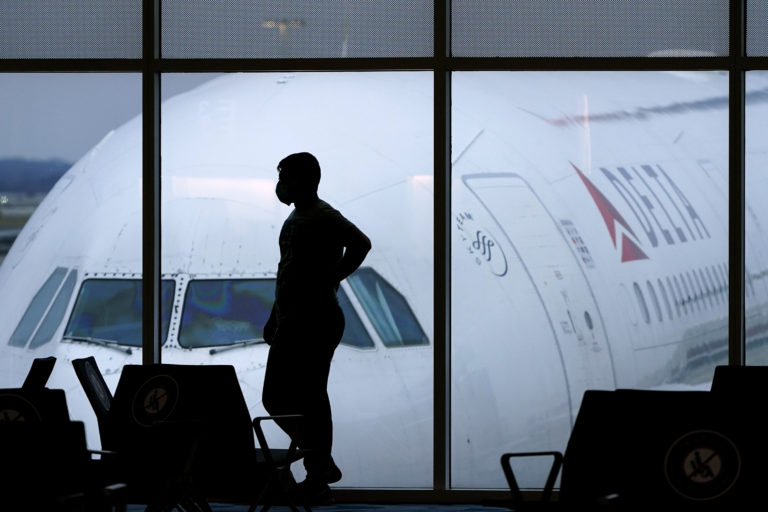
The CDC now recommends passengers in such places as airports and airplanes wear masks, but the mandate is no longer in effect. Still, the Biden Administration has asked the circuit court to intervene.

“It’s astonishing that Biden continues to fight to force mask passengers,” Moody said. “We are once again pushing back, in court, against his unlawful federal overreach.”

The states also claim the mask mandate is unlawful because it goes beyond the CDC’s ability to enforce sanitation measures.

They also claim the federal government failed to review what steps states were taking or determine if those measures were sufficient.

Besides Fla., other attorneys general from Ala., Alaska, Ariz., Ark., Ga., Idaho, Ind., Iowa, Kan., Ky., La., Miss., Mo., Mont., Neb., Ohio, Okla., S.C., Texas, Utah, Va. and W. Va. signed on to the brief.

“The district court’s ruling here correctly ended the Biden Administration’s mandate requiring all travelers to wear masks at airports, train stations and other transportation hubs,” said Ky. Attorney General Daniel Cameron.

“We joined this brief to support the court’s important ruling and ensure this mandate is not reinstated.”

Sheriff Accused of Pressuring Candidates to Drop Races

0

(Headline USA) A third candidate for public office has come forward to say a sheriff on Florida’s Space Coast offered help in getting a job in exchange for leaving a race and backing his favored candidate.

Kimberly Musselman, an assistant state attorney in Brevard County, told Florida Today she was asked by Brevard County Sheriff Wayne Ivey to bow out of her race for county judge and endorse a candidate backed by him.

In exchange, the sheriff said he could use his influence to help her become the district’s top prosecutor, she said.

After she refused, Ivey urged some of her biggest donors to drop their support, Musselman told Florida Today.

“My donors dried up real quick,” Musselman said.

In response to an inquiry Wednesday, Tod Goodyear, a spokesperson for the Brevard County Sheriff’s Office, said in an email, “We are not commenting at this time.”

Two other candidates for public office have made similar allegations to Florida Today.

Cocoa Beach police officer Chris Hattaway said the Republican sheriff asked him to step aside for former state Rep. Tom Goodson, another candidate in a county commission race.

Shawn Overdorf, a former school resource officer, told a similar story about his race for school board.

In exchange, both candidates were offered jobs in Goodson’s office if he won, Florida Today reported.

When contacted by Florida Today, Goodson denied involvement with any efforts to pressure candidates out of the election and said he had not spoken with Ivey about hiring anyone.

Ivey has gained national attention in recent years due to his weekly “ Wheel of Fugitive” videos which feature the sheriff spinning a wheel with photos of 10 of the county’s most wanted.

“Everybody watches it. Even the fugitives watch it” to see who becomes “fugitive of the week,” said Ivey, who was elected sheriff in 2012.

Adapted from reporting by the Associated Press

Dems Cheer Passing $740B Taxing Scheme for Green New Deal, Super-Sized IRS

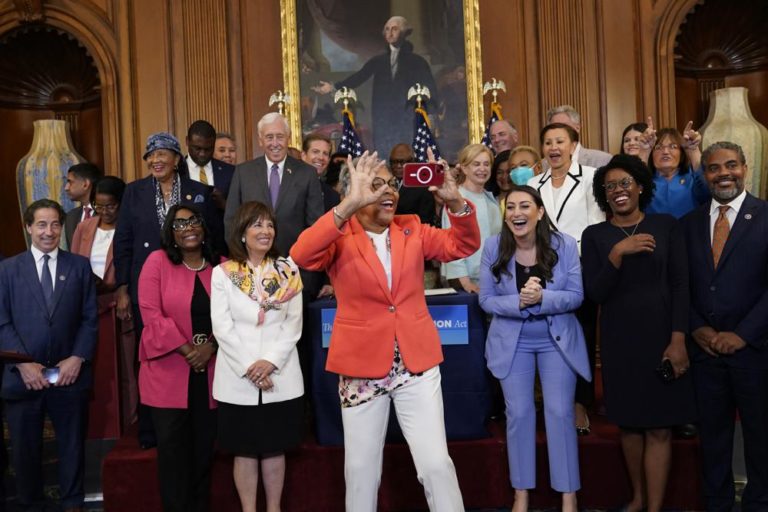
(Mark Pellin, Headline USA) After agreeing to scrap any funding for law enforcement and instead add squadrons of IRS agents for tax enforcement, House Democrats on Friday lustily cheered passage of their $740-billion Inflation Reduction Act that will do nothing to reduce inflation, while increasing taxes for nearly all Americans to pay for 87,000 new IRS agents, Obamacare subsidies and a radical Green New Deal.

“My colleagues now today are going to dump hundreds of billions of dollars into corporate America, screwing over the American people every single day with tax audits, increased energy prices and increased taxes,” Rep. Chip Roy, R-Texas, said from the House floor.

“Congratulations. Take that to the polls.”

President Joe Biden, last seen jetting off on Air Force One with his crack addict, law-dodging son for another vacation, praised the $740-billion boondoggle that he apparently thinks will rescue his floundering administration and salvage Democrat midterm hopes.

“Today, the American people won,” Biden boasted of the legislation that spends upwards of $80 billion to increase tax audits on the middle class and low-income earners, boosting revenue to fund pet projects and programs for partisan leftists and climate alarmists.

The bill also spends a titanic $370 billon for Green New Deal schemes that will “increase electricity prices, increase gas prices and tilt at windmills with unicorn energy policies,” Roy said.

With the bill safely passed in Congress, House Speaker Nancy Pelosi dropped any pretense that the taxing and spending would reduce inflation, noting that she was no longer calling it the Inflation Reduction Act, prompting a compliant fake news media to follow in lockstep.

Democrats also acknowledged that all income earners will be targeted for tax hikes, nixing an amendment by Sen. Mike Crapo, R-Idaho, that would have made “it clear that the $80 billion being given to the IRS — six times its current annual budget — could not be utilized to audit people making less than $400,000.”

“The most they would agree to was to say they did not ‘intend’ to audit them,” Crap noted.

MTG Files Articles to Impeach Garland

(Mark Pellin, Headline USA) Rep. Marjorie Taylor Greene, R-Ga., filed articles of impeachment on Friday against Attorney General Merrick Garland, following the FBI’s unprecedented militarized raid on former President Donald Trump’s Mar-a-Lago home and revelations that the authorizing search warrant read like a wildly-expansive fishing expedition.

“Merrick Garland has abused his position of power as the attorney general to politically persecute Joe Biden’s enemies,” Greene said from the Capitol before filing the impeachment resolution.

“The whole purpose of this is to prevent President Trump from ever being able to hold office.”

Charging that Garland “continues to materially endanger the justice system of the United States” by “utilizing the Federal Bureau of Investigation as a Federal police force to punish or intimidate anyone who questions or opposes the current regime,” Greene’s resolution brings two charges of impeachment against Garland.

The attorney general on Thursday announced that he personally signed off on the raid, approving the decision to seek a search warrant targeting Mar-a-Lago.

“We cannot tolerate this in America where our great institutions are welded in such a way to defeat people’s political enemies,” Greene said. “That’s not what this is for, and it should never exist.”

The first article of the impeachment filing stated that Garland’s “personal approval to seek a search warrant for the raid on the home of the 45th President of the United States, Donald J. Trump, constitutes a blatant attempt to persecute a political opponent.”

In doing so, Garland has “lost the trust of citizens of the United States to faithfully execute the laws of the United States without partisan bias.”

“Attorney General Garland, by such conduct, has demonstrated that he will remain a threat to the justice system of the United States of America if allowed to remain in office, and has acted in a manner grossly incompatible with democracy, self-governance, and the rule of law,” the resolution stated.

Citing Supreme Court precedent that found “the President, as Commander in Chief, has the power to control the classification and declassification of documents pertaining to national security,” the second article of impeachment stated that Garland “in persecuting former President Donald J. Trump over documents he legally declassified, has engaged in a pattern of conduct that is incompatible with his duties as a civil officer of the United States.”

Greene’s resolution is likely to be killed by the Democrat-controlled House and suffer the same fate in the Senate, at least for a few more months.

A move to impeach Garland, or at least investigate the long string of alleged FBI abuses that have occurred under his watch, is more likely if a red wave swamps the midterms.

“I’ve never been a fan of overusing impeachment, but I think there has to be an investigation,” Sen. Rand Paul, R-Ky., told Fox News in the aftermath of the Mar-a-Lago raid.

“And I wouldn’t be surprised if the investigation leads to abuse of power that this could even lead to an impeachment of the attorney general.”

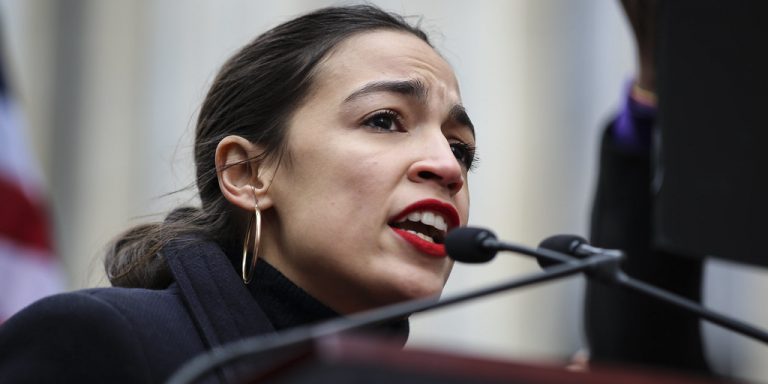
AOC’s Constituents Sour on Defunding the Police as Crime Soars

(Headline USA) Voters in Rep. Alexandria Ocasio-Cortez’s, D-N.Y., district have soured on the defund the police movement as crime in their neighborhoods soars. 

Ocasio-Cortez represents New York’s 14th congressional district, which is made up of more than 650,000 residents in the boroughs of the Bronx and Queens, reported Fox News. This area has experienced a steady rise in crime over the last two years. Thus far in 2022, crime is up by 44% compared to 2021, and up 57% compared to 2020, according to police statistics.

As a result, even liberal New Yorkers who support Ocasio-Cortez are questioning her support for defunding law enforcement.

“The more and more time goes on, and you see these crimes go up in the city, especially around this area, it’s gotten a lot worse,” one New Yorker told Fox News.

Another resident, Daniel, said, “I don’t think it’s a good idea to defund the police. I think we need more police in the area.”

In fact, a majority of New Yorkers (52%) said they believe the budget for the New York Police Department should be increased. Just 27% said it should remain the same, and 17% said they want the budget decreased.

“I wouldn’t say defund the police, but I would say force accountability,” local resident Zion said. “They do a good job. There are some who are great. But then there are others who are like they came from the pits of hell.”

Ocasio-Cortez has been a vocal advocate for defunding the police. In 2020, when former New York City Mayor Bill de Blasio proposed a $1 million budget cut to the NYPD, Ocasio-Cortez argued it wasn’t enough.

“These proposed ‘cuts’ to the NYPD budget are a disingenuous illusion,” she said in June 2020. “This is not a victory. The fight to defund policing continues.”