Boston Marathon to Allow ‘Non-Binary’ Runners

(Headline USA) The Boston Marathon announced this week that it will allow “non-binary” runners to compete in this year’s race.

Participants who register for the marathon are normally expected to select their sex, since male and female runners are judged by different qualifying times. But this year, runners will have the option to select the “non-binary” option if they don’t want to choose a gender, the organization said.

“Non-binary athletes who have completed a marathon as a non-binary participant during the current qualifying window (September 1, 2021 through September 16, 2022) may submit an entry application into the 2023 Boston Marathon between September 12-16, 2022,” the Boston Athletic Association said in a statement. 

“Entry into the event will be determined by an athlete’s submitted time and based on the Boston Marathon’s overall field size limit. The Boston Marathon registration application will feature the option to select non-binary in regards to gender,” it continued.

Notably, “non-binary” runners will not be subjected to specific qualifying times, and will instead be judged by the female qualifying times — which means a male runner who wants to avoid the stricter qualifying standards could just identify as “non-binary” to have a better chance at placing.

“With this being our first year, we do not yet have enough data to establish non-binary qualifying times. Therefore, we will use the [female] times listed here, as they are inclusive of the qualifying times for the two existing divisions,” organizers said.

“As we prepare for future races, participants can expect non-binary times to be updated accordingly. We view this first year as an opportunity to learn and grow together,” they added.

Last year, Philadelphia’s Distance Run became the first premier running event to offer an option for “non-binary” athletes. The Brooklyn Marathon and Half Marathon followed shortly thereafter. There were 82 runners in the Brooklyn races who identified as “non-binary,” many of whom ended as finishers.


Teen Ordered to Pay $150K Restitution after Defending Herself Against Sex Trafficker

(Chris Parker, Headline USA) In 2020, a 15-year-old-girl named Pieper Lewis was kidnapped and raped in Iowa by Zachary Brook, a 37-year-old human trafficker. She stabbed him and escaped in June of that year.

Now, at the age of 17 (still a minor), she is being ordered to pay Brooks’ family $150,000 in restitutions, reported Fox News.

Additionally, she has been ordered to serve five years of probation and 200 hours of community service. Polk County District Judge David Porter ordered the sentence while deferring the 10-year prison sentence she originally faced.

Porter believes he did the minor a service, stating a GPS tracking device will ensure she won’t fall “back into the lifestyle that you thus far left” after claiming that he was “presented with no other option.”

“My spirit has been burned, but still glows through the flames,” she read from a prepared statement. “Hear me roar, see me glow, and watch me grow.”

Prosecutors were bothered by her proclamation that she was a “survivor,” claiming she was responsible for depriving her attacker’s children of their child-molesting father.

“The next five years of your life will be full of rules you disagree with, I’m sure of it,” Porter said, later adding, “This is the second chance that you’ve asked for. You don’t get a third.”

A GoFundMe fundraiser organized by one of her Lewis’s school teachers has already raised more than enough money to cover her restitution amount.

Democrat officials have slowly begun using “criminal reform” policies that do more to punish victims than criminals, typically beginning with law-abiding gun owners. Biden Supreme Court nominee Judge Ketanji Brown Jackson also has a history of being lenient towards child sex offenders. Left-leaning representatives, pundits and journalists have been quick to defend her.

Iowa does not currently have a safe harbor law, so trafficking victims are more likely to be criminalized in that state for defending themselves.

Gay Backlash Against Trans Movement Gets Approval from Twitter

Editor’s note: Story contains obscenities.

(Joshua Paladino, Headline USA) Twitter gatekeepers let a “transphobic” hashtag, #LGBWithoutTheT, trend on the platform, as homosexuals and bisexuals vented their frustration at being associated with transgenderism.

The top tweet under the hashtag claims that lesbian, gay and bisexual people do not share goals with the transgender movement, American Thinker reported.

Other users said that transgender ideologues want to “sterilize children” and “invade sex specific places.”

One Twitter user posted a meme calling for a split between the LGB movement and the TIQA+ movement.

Last month, Twitter shut down the group Gays Against Groomers, citing transphobic and “hateful conduct.” The platform had pledged earlier, under left-wing-activist pressure, to censor the word “groomer,” which has become synonymous with pedophilia and public-school indoctrination.

But perhaps the blowback against child abuse and mutilation has reached the point that Twitter can no longer conceal it.

Jaimee Michell, who founded the Gays Against Groomers group, condemned teaching transgender ideology to children and sexually grooming them, PinkNews reported.

“In any moral society it [sexualising children] would be criminalised, what we see happening, and it should be criminalised… but that doesn’t seem to matter,” she said.

Polls show that almost no one except far-left Democrats supports transgenderism—especially the push to normalize cross-sex hormone shots and sex surgeries for teenagers and pre-pubescent children.

RINOs Secretly Attack MAGA Candidates with Untraceable Funds

(Ezekiel Loseke, Headline USA) RINOs are utilizing “pop-up super Political Action Committees” to help other RINOs defeat their MAGA opponents, while hiding the identity of their leftist funders.

Axios reported that pop-up super PACs are new organizations with vague and positive names that are new enough that the disclosure requirements do not require political donors to be named before voting for primaries ends.

“Republican operatives in Washington can try to tip the scales of key intra-party fights without leaving any fingerprints,” according to Axios.

These under-handed expenditures enable RINOs to “drop millions into a hard-fought race before voters have any idea where the money is coming from.” These pop-up super PACs have been used against several MAGA candidates.

Mitch McConnell has secretly spearheaded many attacks on MAGA candidates. White Mountain PAC, created late last month, “has already spent nearly $5 million” supporting RINO state senator Chuck Morse in opposition to MAGA Candidate Don Bolduc, reported Axios. It didn’t work; Bolduc won.

McConnell is connected to another organization that attacked MAGA Mizzou candidate Eric Greitens, but “it timed that spending to forestall donor disclosure until after the primary,” thus hiding the influence of the swamp, and its turtle, from the people of Missouri.

In New Hampshire, a group calling itself American Liberty Action PAC spent about $730,000 opposing the MAGA candidate Bob Burns, per Axios. Because of the timing of the expenditures, it won’t be known who was behind this avalanche of spending until the election is finished. The same anonymous group spent a fortune attacking MAGA candidates Anthony Sabatini of Florida and Carl Paladino of New York; Sabatini and Paladino both lost their primaries.

RINOs used similar tactics to try and save Liz Cheney from in her Wyoming primary.

Republican Strategist Doug Heye said of the deceptive tactics, “whatever you can do to do that [get your candidate elected], within the legal bounds, is what you’ll do.”

Railroad Strike May Be Final Straw for Vulnerable Dems’ Midterm Hopes

(Joshua Paladino, Headline USA) President Joe Biden could face an early October surprise as 60,000 unionized railroad workers, including engineers and conducts, plan to start striking on Sept. 16, American Greatness reported.

The planned strike would cost the American economy $2 billion per day, prevent agricultural products from reaching manufacturing plants, and cause food shortages at stores and restaurants.

And it would likely cost the Biden administration and the Democrats their precarious hold on the House and Senate.

The Biden administration has negotiated with the unionized workers for weeks to reach a deal and prevent a strike. Those efforts have mostly failed, though unions representing 45,000 other railroad employees have agreed to new contracts.

The 60,000-person strike would cripple America’s railroads, which transport 30% of the nation’s food and other products.

The planned strike in itself bodes poorly for Democrats, even without the devastating secondary consequences that it will cause—rising prices, delayed deliveries, and shortages—because it shows that Biden cannot control a key Democratic constituency: union workers.

And unlike with other recent economic crises, Democrats will not have a clear opportunity to deflect the blame. Politico reported that Biden “has been directly in touch with unions and railroad companies” to avoid the strike.

His Cabinet members—including Labor Secretary Marty Walsh, Transportation Secretary Pete Buttigieg and Agriculture Secretary Tom Vilsack—have talked with union leaders and the National Mediation Board in hopes of finding a settlement, too.

The Biden administration established a Presidential Emergency Board that negotiated for higher pay, back pay and cash bonuses. However, the unions who represent conductors and engineers want more, and they have the leverage to demand it as the entire economy sits on the brink of collapse.

The consequences have begun to set in.

Amtrak suspended three long-distance routes and part of another. Norfolk Southern has reduced freight transportation services.

One anonymous Politico source said a strike remains unlikely.

“My view is that a strike is unlikely, and that the likeliest scenarios are, one, that they reach an 11th hour or 11th hour and 59 minute deal,” said a person who claimed knowledge about the negotiations. “The second likeliest scenario is they extend the cooling off period so that they can have more time to cross all the t’s and dot all the i’s.”

SCOTUS Case May Spell End for Diversity, Equity & Inclusion Movement

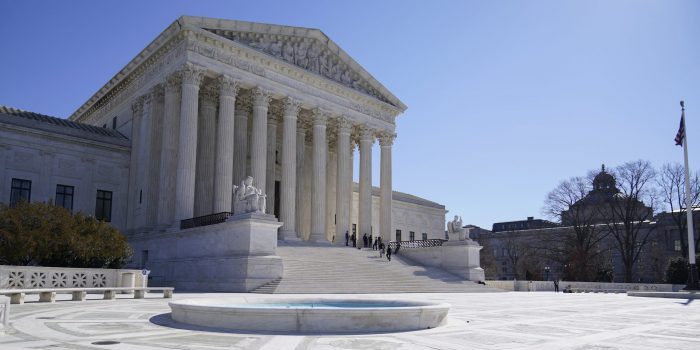
(Joshua Paladino, Headline USA) The Supreme Court will hear a case, Lowery v. Texas A&M University System, that will test whether affirmative action and anti-white discrimination violate the 14th Amendment’s Equal Protection Clause and Title IX of civil rights law.

Professor Richard Lowery, who teaches finances at the University of Texas at Austin, sued Texas A&M because it, “along with nearly every university in the United States, discriminates on account of race and sex when hiring its faculty,” Legal Insurrection reported.

Most American universities give preference to “female or non-Asian minorities at the expense of white and Asian men,” causing “universities to hire and promote inferior faculty candidates over individuals with better scholarship, better credentials, and better teaching ability.”

Representing him in the case are Gene P. Hamilton, vice-president and general counsel at the America First Legal Foundation, and Jonathan F. Mitchell, the former solicitor general of Texas.

Mitchell argued five cases before the Supreme Court and has been given credit for designing the Texas Heartbeat Act’s private enforcement mechanism, which allowed the nation’s strictest protections for the unborn to take effect under Roe v. Wade.

With the complaint, Lowery and his lawyers have launched a full-scale attack on the diversity, equity and inclusion regime—the reigning Left-wing religion.

“These discriminatory, illegal, and anti-meritocratic practices have been egged on by woke ideologues who populate the so-called diversity, equity, and inclusion offices at public and private universities throughout the United States,” the complaint stated.

Universities have avoided federal anti-discrimination law by claiming that race- and sex-based hiring practices contribute to the educational environment, even though they have objectively reduced higher education standards and outcomes.

“The existence of these offices is subverting meritocracy and encouraging wholesale violations of civil-rights laws throughout our nation’s university system,” the complaint stated.

3 Iranian Nationals Charged over Major U.S. Hacking Campaign

0

(Headline USA) The Justice Department said Wednesday that three Iranian citizens have been charged in the United States with ransomware attacks that targeted power companies, local governments and small businesses and nonprofits, including a domestic violence shelter.

The charges accuse the hacking suspects of targeting hundreds of entities in the U.S. and around the world, encrypting and stealing data from victim networks, and threatening to release it publicly or leave it encrypted unless exorbitant ransom payments were made.

In some cases, the victims made those payments, the department said.

The Biden administration has tried to go after hackers who have held U.S. targets essentially hostage, often sanctioned or sheltered by adversaries.

A Russia-based hacker group was accused of conducting a ransomware attack last year on Georgia-based Colonial Pipeline, which disrupted gas supplies along the East Coast.

These hackers are not believed to have been working on behalf of the Iranian government but instead for their own financial gain, and some of the victims were even in Iran, according to a senior Justice Department official who briefed reporters on the case on the condition of anonymity under ground rules set by the department.

The official said the activity, even if not directed by the Iranian government, exists because the regime permits hackers to largely operate with impunity.

In a related action Wednesday, the Treasury Department’s Office of Foreign Assets Control sanctioned 10 individuals and two entities affiliated with Iran’s Islamic Revolutionary Guard Corps—who, it says, have been involved in malicious cyber activities, including ransomware.

The announcements come amid an apparent stalemate in talks between the U.S. and Iran over the possible revival of a 2015 nuclear deal.

Israel and some U.S. lawmakers of both parties are pushing the Biden administration to get tougher on Iran, calling the negotiations on Iran’s nuclear program a failure.

The three accused hackers are thought to be in Iran and have not been arrested, but the Justice Department official said the pending charges make it “functionally impossible” for them to leave the country.

The case was filed in federal court in New Jersey, where a municipality and an accounting firm were among the victims.

The alleged hacking took place between October 2020 through last month, when the indictment was issued under seal.

The three defendants—identified as Mansour Ahmad, Ahmad Khatibi Aghda and Amir Hossein Nickaein Ravari—are accused of exploiting known or publicly disclosed vulnerabilities in software applications to break into the victims’ computer networks.

Prosecutors say the targets were seen by the defendants as victims of opportunities or entities that would likely be willing to pay money to get their data back.

The victims included a domestic violence shelter in Pennsylvania, which the indictment says was extorted out of $13,000 to recover its hacked data; electric utilities in Indiana and Mississippi; and a county government in Wyoming.

Adapted from reporting by the Associated Press

Jim Beam to Ramp Up Bourbon Production w/ New Biogas-Powered Distillery

(Headline USA) Jim Beam plans to ramp up bourbon production at its largest Kentucky distillery to meet growing global demand in a more than $400 million expansion to be powered by renewable energy.

The project will increase capacity by 50% at the Beam plant in Boston, Kentucky, while reducing greenhouse gas emissions by the same percentage, Beam Suntory said Wednesday.

The company behind the top-selling bourbon said it has reached production capacity at the Boston plant, about 36 miles south of Louisville, Kentucky. The expansion will be used to produce two mainstays—Jim Beam white- and black-label bourbons—and will mostly support expected sales growth overseas, especially in European and Asian markets, said Carlo Coppola, managing director of the Beam brands.

Jim Beam has registered mid-single-digit growth globally in the past two years, the company said.

Mixing renewable energy into crafting whiskey, Beam will use a process that produces renewable natural gas to power the plant, the company said.

Beam Suntory said it has entered into an agreement with 3 Rivers Energy Partners to build a facility across the street to convert waste from making bourbon into biogas, which will be treated to renewable natural gas standards and piped directly back to the distillery.

Once the project is completed, expected to be in 2024, the distillery will be 65% powered by renewable natural gas and 35% by fossil-based natural gas, the company said.

“This expansion will help ensure we meet future demand for our iconic bourbon in a sustainable way that supports the environment and the local community that has helped build and support Jim Beam,” said Beam Suntory President and CEO Albert Baladi.

Beam Suntory, whose products include Kentucky-crafted Maker’s Mark, said last year it wants to cut its companywide greenhouse gas emissions and water usage in half by 2030.

The company’s more ambitious goal is to remove more carbon than is emitted from its operations and among its supplier base by 2040.

The virtue-signaling spirits giant also is committed to planting 500,000 trees annually by 2030, with a goal of planting more trees than are use to make barrels to hold its aging whiskeys.

The new project will create 51 more jobs and includes additional storage warehouses.

Bourbon ages in new, charred oak barrels, where it acquires its color and flavor, while stored in warehouses. Most bourbons typically age four to eight years before reaching consumers.

Beam’s continued growth “reflects the strength of our state’s signature bourbon industry,” Kentucky Gov. Andy Beshear said.

Beam also is “fully leveraging” its capacity at its distillery in Clermont, Kentucky, where it produces Jim Beam, Basil Hayden, Knob Creek and Legent brands.

The two Beam distilleries are about 14 miles apart in central Kentucky. At another distillery that opened last year at Clermont, the company produces such small-batch brands as Booker’s, Baker’s and Little Book.

The company broadly outlined its Boston plant expansion earlier in the summer, but the announcement Wednesday provided details about production and the use of renewable energy.

Beam Suntory, a subsidiary of Suntory Holdings Limited of Japan, isn’t the first maker of bourbon to go green. Last year, spirits giant Diageo opened a carbon-neutral distillery of Bulleit bourbon powered by renewable energy in Lebanon, Kentucky.

Beam’s expansion at its Boston distillery comes amid continued rapid growth in the state’s $9 billion distilling industry.

Kentucky distillers are in the midst of a more than $5 billion capital investment campaign that includes expanding production facilities and warehousing to meet the global thirst for Kentucky bourbon, according to the Kentucky Distillers’ Association.

Kentucky is home to 95% of the world’s bourbon production, the association said.

Adapted from reporting by the Associated Press

Atlas Shrugged? Nat’l Science Foundation Bankrolls Powerful Laser in Michgan

(Headline USA) A newly constructed University of Michigan facility that will be home to the most powerful laser in the United States is hosting its first experiment this week as the nation seeks to become competitive again in the realm of high-power laser facilities.

The experiment will be conducted at ZEUS—short for Zettawatt-Equivalent Ultrashort pulse laser System—by researchers from the University of California, Irvine.

They traveled to Ann Arbor as part of their study of extremely intense interactions of light and matter, and how such interactions can be harnessed to shrink particle accelerators.

At the height of its power, ZEUS will be a 3-petawatt laser.

Three petawatts is “3 with 15 zeroes after it,” said Louise Willingale, an associate professor of electrical engineering and computer science at Michigan.

And “3 petawatts is 3,000 times more powerful than the U.S. power grid,” she said.

Michigan was awarded $18.5 million by the National Science Foundation to establish ZEUS as a federally funded international user facility.

Initially, the facility—housed in a building that is home to U-M’s Gérard Mourou Center for Ultrafast Optical Science—will host research teams conducting experiments that use a fraction of the laser’s full power potential. The system gradually will ramp up, and ZEUS is expected to begin its signature experiments in the fall of 2023.

The U.S. built the world’s first petawatt laser a quarter-century ago, but hasn’t kept pace with more ambitious systems in Europe and Asia. While ZEUS doesn’t feature the same raw power as its contemporaries overseas, its approach will simulate a laser that is roughly 1 million times more powerful than its 3 petawatts.

ZEUS primarily will study extreme plasmas, a state of matter in which the electrons have enough energy to escape atoms, creating a sea of charged particles. Nearly all of the seen universe is made of plasma. The sun is an example of a plasma.

Experiments are expected to contribute to the understanding of how the universe operates at the subatomic level and materials change on rapid timescales. Scientists also hope they lead to the development of smaller and more compact particle accelerators for medical imaging and treatment.

ZEUS will “have a huge range of applications across science, technology, engineering and medicine,” Willingale said.

Proposals to use ZEUS will be evaluated by an external panel comprised of scientists and engineers. Because of the NSF funding, there will be no cost to users whose experiment proposals are selected to conduct research, beyond providing their own travel costs to the facility.

The proposals will be selected on scientific merit and technical feasibility, Willingale said.

Franklin Dollar, an associate professor in Cal-Irvine’s Department of Physics & Astronomy, and four UCI graduate students arrived at Michigan last week to begin preparing for their experiment.

“One of the major challenges in our field is access to high quality, intense laser light,” Dollar said. “ZEUS will not only be the most powerful laser beam on the continent, but perhaps more importantly will provide multiple powerful beams.

“Rather than solely making highly energetic plasmas from a laser, there is a second beam which can interact with the plasma as well,” he said.

ZEUS is an upgrade over the University of Michigan’s 0.5-petawatt laser, known as HERCULES.

While Michigan researchers are thrilled with the birth of ZEUS, they are cognizant of how their naming conventions aren’t exactly in keeping with the chronology of Greek mythology.

“HERCULES was the predecessor to ZEUS,” Willingale said. “It’s slightly backward, because Hercules was the son of Zeus.

“So, we’re building the father after the son.”

Adapted from reporting by the Associated Press

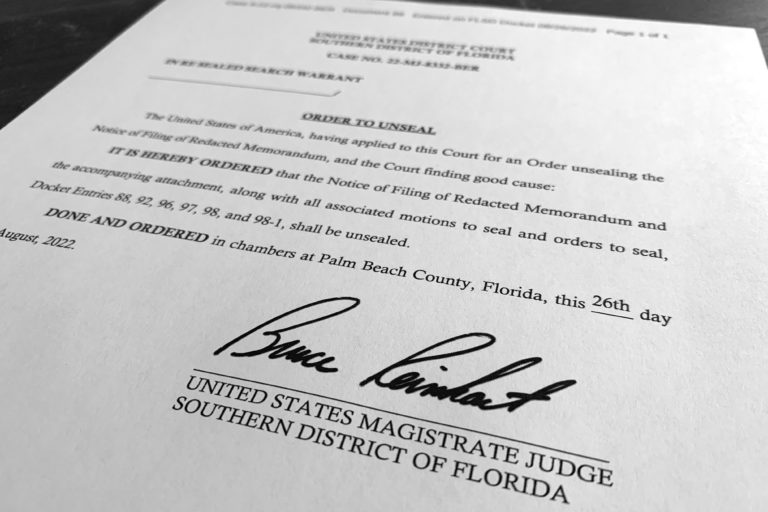
Judge Unseals Additional Portions of Mar-a-Lago Affidavit

(Headline USA) A federal judge Tuesday unsealed additional portions of an FBI affidavit laying out the basis for a search of former President Donald Trump’s Florida home.

The newly unredacted details, released by Judge Bruce Reinhart, appeared to show that, prior to the Aug. 8 raid, agents had obtained a hard drive after issuing a subpoena for surveillance footage recorded inside Mar-a-Lago.

A heavily redacted version of the affidavit was made public last month, but the Justice Department requested permission to show more of it after lawyers for Trump revealed the existence of a June grand jury subpoena that sought video footage from cameras in the vicinity of the Mar-a-Lago storage room.

“Because those aspects of the grand jury’s investigation have now been publicly revealed, there is no longer any reason to keep them sealed (i.e. redacted) in the filings in this matter,” department lawyers wrote.

The newly visible portions of the FBI agent’s affidavit show that the FBI on June 24 subpoenaed for the footage after a visit weeks earlier to Mar-a-Lago, in which agents observed 50 to 55 boxes of records in the storage room at the property.

The Trump Organization provided a hard drive on July 6 in response to the subpoena, the affidavit says.

The footage could be an important piece of the investigation, including as agents evaluate whether anyone has sought to obstruct the probe.

The Justice Department has said in a separate filing that it has “developed evidence that government records were likely concealed and removed from the Storage Room and that efforts were likely taken to obstruct the government’s investigation.”

The Justice Department has been investigating the holding of top-secret information and other classified documents at Mar-a-Lago after Trump left the White House. FBI agents during their Aug. 8 search of the home and club said they recovered more than 11,000 documents and 1,800 other items, including roughly 100 with classification markings.

Trump, however, has maintained that the records were all being held legally under the Presidential Records Act, which plainly states that the president, while in office, has the authority to declassify documents at his own discretion.

Trump announced in his final week as president that he was declassifying all documents related to the Russia-collusion hoax, in which the FBI itself has been implicated.

None of the charges cited in the probable cause section of the affidavit—including obstruction and violations of the Espionage Act—would require the Justice Department to prove that the documents in question were classified, leading some to suspect that the entire operation is a politically motivated legal trap under the direction of President Joe Biden.

Separately Tuesday, the Justice Department again urged U.S. District Aileen Cannon to lift her hold on core aspects of the investigation.

Cannon last week granted the Trump team’s request for an independent arbiter to review the seized documents and weed out from the investigation any records that may be covered by claims of executive or attorney–client privilege.

She also ordered the department to halt its review of the records pending any further court order or the completion of a review by the yet-to-be-named special master.

The department urged Cannon last week to put her order on hold and told the judge Tuesday that its investigation would be harmed by a continued delay of its ability to scrutinize the classified documents.

“The government and the public unquestionably have an interest in the timely enforcement of criminal laws, particularly those involving the protection of highly sensitive information, and especially where, as here, there may have been efforts to obstruct its investigation,” the lawyers wrote.

The Trump team on Monday urged the judge to leave her order in place, citing the potential for the highly public probe to damage him as the FBI and DOJ appear to be selectively leaking information to the media.

Democrats have long signaled their intention to use Trump as a political bludgeon in the upcoming midterms and beyond. Biden has recently referred to the opposition party’s Trump supporters as “semi-fascist” and has regularly insinutated that “ultra-MAGA” Republicans constituted a terrorist threat to American democracy.

Adapted from reporting by the Associated Press