(Mike Maharrey, Money Metals News Service) This is the perfect story that contrasts the value of real money – gold and silver – with the paper stuff your government tries to pass off as money.
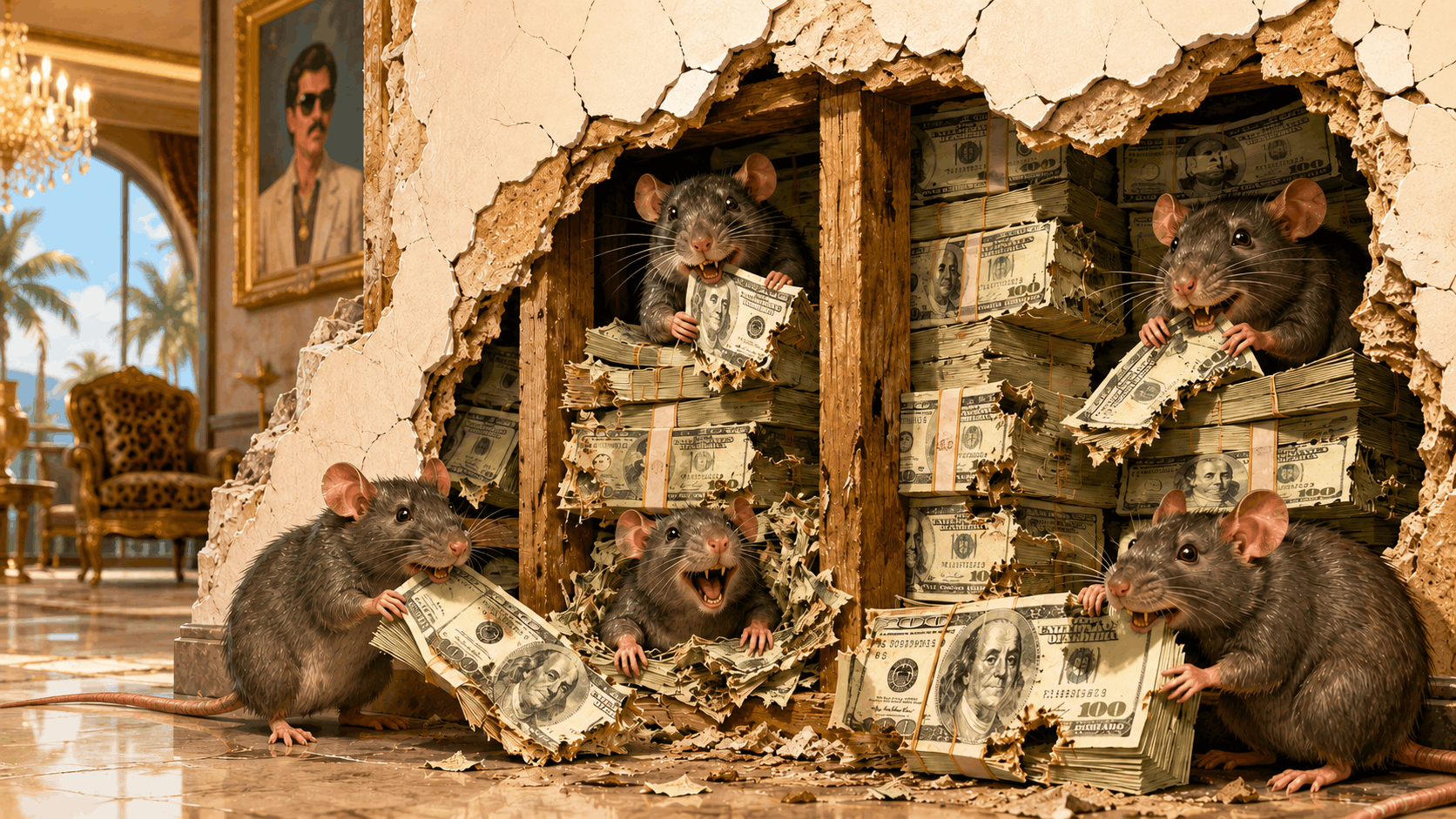
A Dutch homeowner digging in his backyard found more than 40 pounds of 1,000-year-old silver. Meanwhile, piles of cash stashed in fields and stuffed into walls a couple of decades ago got moldy and chewed up by rats.
Viking Silver
The silver horde discovered in Denmark consisted of around 700 objects from the Viking era, including bars, coins, and jewelry. The items are in remarkably good condition, considering they’ve been buried for around 1,000 years.

According to Live Science, all the silver bars, along with some of the bracelets and silver fragments, can be sorted into specific weight groups. This indicates that the collection represented an “important storage of wealth,” not just a random assortment of silver objects.
“The treasure so clearly shows how silver functioned as wealth and a means of payment in the Viking Age. It’s like finding a safe from the Viking Age,” North Jutland Museums cultural heritage manager Torben Sarauw said.
It’s notable that 1,000 years later, that wealth still exists and is worth every bit as much as it was back in its day.
In fact, based on the purity of comparable Viking-era Danish silver (around 94 percent), the 18.5-kilogram hoard contains roughly 559 troy ounces of pure silver. At the current spot price, the melt value is over $37,000.
So, here’s a question for you to ponder over a cup of coffee. What would happen to $37,000 in U.S. paper currency buried in the ground for 1,000 years? Would it still be worth $37,000?
We kind of know the answer to that question because people have tried it.
Turns out paper buried in the ground or stuffed in walls doesn’t hold up very well.
Billion-Dollar Rat Food
In the late 1980s and early ‘90s, Pablo Escobar was one of the richest men in the world. Forbes featured him on its list of international billionaires for seven straight years from 1987 to 1993.
Escobar made his billions the old-fashioned way.
Selling drugs.
In his day, Escobar’s Medellín cartel supplied around 80 percent of the world’s cocaine.
Roberto Escobar served as Pablo’s accountant. In his autobiography, he said the cartel brought in so much cash that it couldn’t launder the money fast enough. Cartel members resorted to stashing currency inside dilapidated warehouses, farm fields, and inside the walls of their homes.
Roberto said the cartel simply wrote off $2.1 billion per year in lost or destroyed cash.
“Pablo was earning so much that each year we would write off 10 percent of the money because the rats would eat it in storage or it would be damaged by water or lost.”
I’m just going to note here that rats don’t eat silver or gold.
Pablo’s nephew Nicholas Escobar confirmed the story, saying he found $18 million in cash stuffed inside the walls of an apartment once used by the cartel. Of course, many of the banknotes were damaged and unusable.
“The smell was astonishing. A smell 100 times worse than something that had died,” Nicholas said.
I’ll also note that silver and gold don’t stink when they’re left inside a wall.
Rats weren’t the only rodents eating away Pablo’s fortune. Politicians in Washington, D.C., were stealing his wealth through relentless currency debasement.
For the sake of argument, let’s say Pablo sealed $37,000 in cash in a wall back in 1990. If somebody stumbled upon that little horde today, it would only buy about $14,117 worth of stuff.
In other words, the purchasing power of that money plunged by nearly 62 percent in less than 40 years.
That is assuming the animal rats didn’t get to it first.
One of Aristotle’s four characteristics of good money is durability. In other words, money must stand the test of time. It can’t break down, rot, or corrode easily.
And it probably shouldn’t be edible by rats.
Paper fiat dollars fail this test miserably.
Viking silver, on the other hand…
Mike Maharrey is a journalist and market analyst for Money Metals with over a decade of experience in precious metals. He holds a BS in accounting from the University of Kentucky and a BA in journalism from the University of South Florida.