

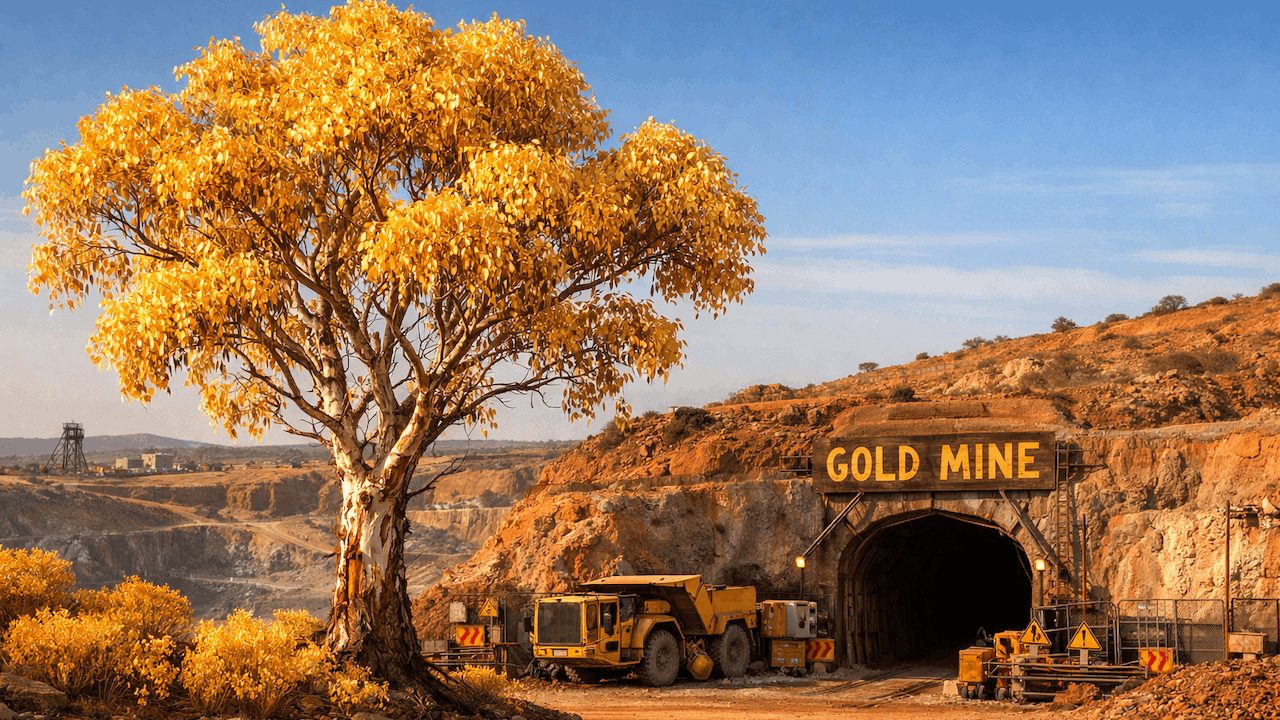
(Mike Maharrey, Money Metals News Service) Who says gold doesn’t grow on trees?
OK, so it doesn’t. But there have been cases of gold discovered inside trees.
In Australia, researchers have found minute traces of gold in the leaves of eucalyptus trees.
Now, I don’t recommend heading to Australia and collecting leaves. It’s not a viable get-rich-quick scheme. We’re talking about very small levels of gold nanoparticles at around 80 parts per billion.
Still, it’s a pretty cool story.
So, how did the gold get there?
Scientists believe trees growing above deep gold deposits tapped into the metal with their deep root systems. Eucalyptus roots have been known to reach as deep as 30 meters underground.
The process is called “biomineralization.” As an IFL Science article explained, “Microbes and oxidation help metal ions travel from the soil, up through stems, and into leaves.”
Melvyn Lintern was the lead author of the study. He said the eucalyptus tree essentially acts like a hydraulic pump.
“The plants, of course, are searching for water, not gold, but it just so happens that there’s gold dissolved in it.”
The fact that the gold ends up in the leaves may indicate the tree is trying to expel it (kind of like mainstream American investors). Scientists say the gold particles in the leaves were often found located near calcium oxalate crystals, theorized to be part of the removal pathway for toxic chemicals.
The scientists confirmed their finding through greenhouse experiments where eucalyptus saplings were grown in soil with similar levels of gold.
According to Smithsonian Magazine, “These separate streams of evidence, they say, show that the wild eucalyptus trees were indeed sucking up gold from deep underground.”
Subsequently, scientists in Finland have discovered gold nanoparticles embedded in the needles of Norway spruce trees.
While nobody is going to mine gold from tree leaves, understanding the biomineralization process may help mining companies discover new gold deposits.
Lintern told the Smithsonian:
“In an age when most of the readily accessible gold near the planet’s surface has been mined, it makes sense to harness the natural mineral exploration plants are already engaging in when they drive their roots deep into the ground. Doing so might even reduce the number of exploratory mines we’re forced to drill—and consequently, lead to less environmental destruction of these plants’ habitats as a result of mining.”
In fact, a 2019 mineral exploration company used tree leaves to locate a 6-meter vein containing 3.4 grams of gold per ton in Australia.
It’s pretty wild when you think about it. Nature has created a gold detection process unmatched by human technology! Just goes to show that sometimes, we would be well-served to pay closer attention to the world around us.
Mike Maharrey is a journalist and market analyst for Money Metals with over a decade of experience in precious metals. He holds a BS in accounting from the University of Kentucky and a BA in journalism from the University of South Florida.
