

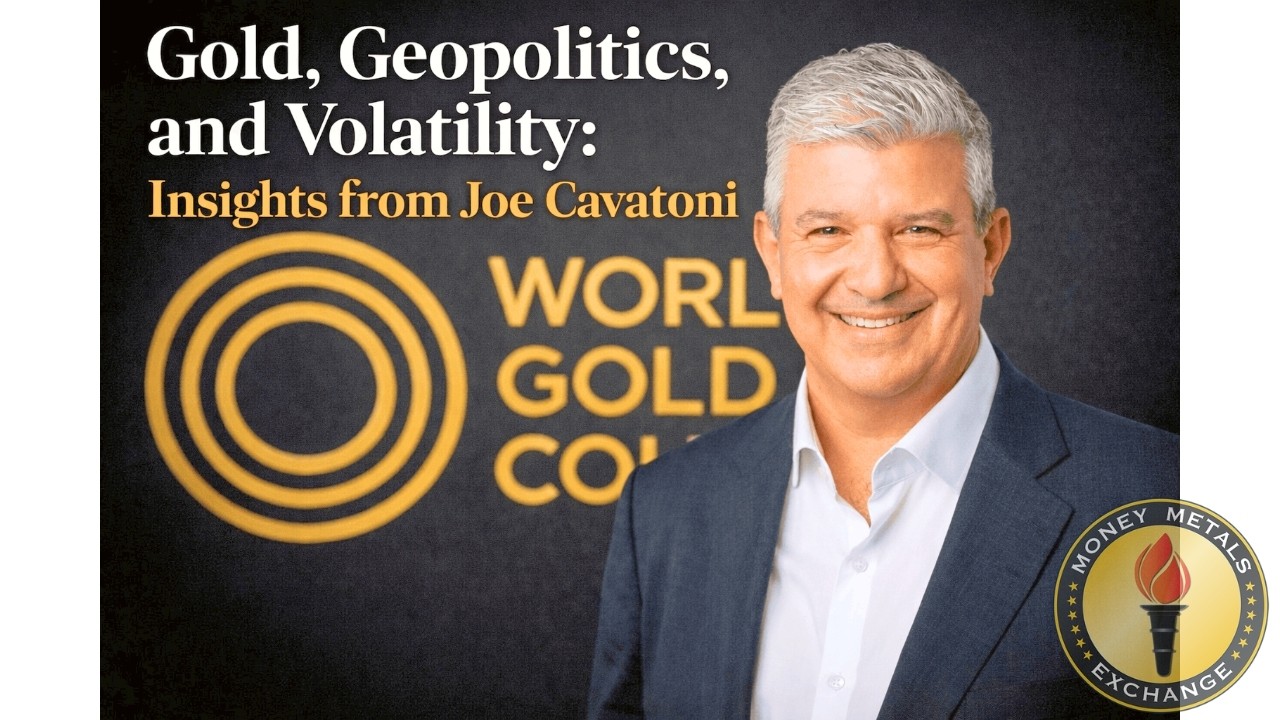
(Money Metals News Service) In a rapidly shifting geopolitical environment, gold continues to demonstrate both its resilience and its complexity as a financial asset.
In a recent episode of the Money Metals Podcast, host Mike Maharrey spoke with Joe Cavatoni, Market Strategist for North America at the World Gold Council, to unpack gold’s behavior amid the Iran–U.S.–Israel conflict and broader macroeconomic uncertainty.
Recorded against the backdrop of a potential ceasefire and volatile global headlines, the discussion explored gold’s recent price movements, investor behavior, and the evolving role of the metal in modern portfolios.
(Interview Starts Around 6:35 Mark)
Gold’s “Unexpected” Behavior Was Actually Expected
Despite widespread confusion among investors, Cavatoni emphasized that gold has behaved largely as expected during the conflict. While many questioned why gold appeared to “tank” during a geopolitical crisis, he explained that the real anomaly occurred earlier in the year.
Gold surged roughly 30% in January to near-record levels around $5,500, driven largely by momentum and speculative activity. This was followed by a logical correction of about 20%, setting the stage for subsequent volatility.
When the Iran conflict escalated, gold initially reacted as a classic safe-haven asset, spiking approximately 3–5% in a single day. However, as markets began assessing the broader implications, particularly the impact of oil shocks on global economies, gold retreated. Investors shifted into a “get-to-cash” mindset, selling assets, including gold, to meet liquidity needs and margin calls.
Cavatoni noted that gold’s decline to around $4,100–$4,200 reflected both earlier profit-taking and this liquidity-driven selling. As geopolitical tensions eased with ceasefire discussions, gold began climbing again, resuming its longer-term upward trajectory.
Safe Haven Doesn’t Mean “Never Sold”
A key takeaway from the discussion is that gold’s role as a safe haven includes being a source of liquidity. Investors often misunderstand this dynamic, expecting gold to rise continuously during crises.
Cavatoni explained that during periods of stress, investors frequently sell gold precisely because it is a reliable store of value. This behavior was evident not only among private investors but also at the institutional level.
Countries like Turkey reportedly liquidated portions of their gold reserves to manage economic shocks, while Poland explored using profits from its expanding gold holdings to support government spending. These actions highlight gold’s dual function as both a defensive asset and a financial resource in times of need.
The Era of “Regime Uncertainty” and Rising Volatility
The conversation also addressed what Maharrey described as “regime uncertainty,” referring to unpredictable policy shifts and geopolitical developments. Cavatoni agreed that unpredictability is now a defining feature of the market landscape.
He emphasized that investors should expect sustained volatility across all asset classes, including gold. Contrary to its historical reputation as a “boring” asset, gold now trades within wider price ranges and is increasingly central to both institutional and retail portfolios.
Despite short-term fluctuations, Cavatoni maintains a bullish long-term outlook. He suggested that gold could deliver annual gains in the range of 10% to 20%, with potential upside as high as 30% under current macroeconomic conditions. As of early April, gold was already up approximately 8–9% for the year.
ETF Flows Reveal Diverging Global Strategies
Gold-backed ETFs provided another lens into investor behavior. While North American funds experienced notable outflows following the January peak, Asian markets showed continued inflows through much of the first quarter.
Cavatoni attributed this divergence to differing investment approaches. In North America, ETFs such as GLD and IAU are often used as tactical trading instruments, leading to more pronounced inflows and outflows.
In contrast, Asian investors are increasingly adopting ETFs as long-term portfolio holdings, reflecting a structural shift away from physical gold and jewelry toward financial instruments.
He also noted that ETFs represent less than 10% of the overall gold investment market, underscoring their importance as a transparent but limited indicator of broader trends.
The Rising Influence of Eastern Markets
A major theme in the episode was the growing influence of Eastern investors on gold demand. Cavatoni highlighted a “decoupling” between gold prices and traditional drivers like U.S. interest rates and the dollar, largely due to increased demand from Asia.
He explained that cultural and economic factors shape this demand. In many Asian markets, gold is viewed as a generational store of wealth and a hedge against currency instability. This contrasts with the U.S., where investors often rely more heavily on financial instruments like Treasuries and equities.
At the same time, European investors have remained relatively quiet, though Cavatoni expects this to change as fiscal pressures, rising deficits, and currency concerns intensify across the region.
Modeling Markets in an Unpredictable World
From a professional standpoint, Cavatoni acknowledged that the current environment poses significant challenges for market modeling. Traditional frameworks struggle to fully capture the momentum-driven and globally interconnected nature of today’s gold market.
He stressed the importance of continuously recalibrating models and maintaining humility in analysis. Drawing on past crises such as the 1997 Asian financial crisis, he noted that excluding key historical events can lead to flawed assumptions and missed risks.
The World Gold Council, he said, is actively refining its approach to better account for political uncertainty and momentum-driven price movements.
Gold’s Expanding Role in a Complex Global Economy
Ultimately, the episode underscores that gold is no longer a passive asset sitting on the sidelines of the financial system. It is deeply integrated into global markets, influenced by everything from geopolitical conflicts and oil prices to logistics, central bank policies, and technological shifts.
Joe Cavatoni’s outlook remains clear. While short-term volatility is inevitable, the long-term fundamentals supporting gold remain strong. In an era defined by uncertainty, gold’s role as both a store of value and a source of liquidity ensures its continued relevance.
For investors, the message is straightforward. Understanding gold requires a global perspective, an appreciation for its multiple roles, and a willingness to look beyond short-term price movements.
 Gold’s volatile moves amid geopolitics reflect liquidity needs, global demand shifts, and long-term strength, highlighting its dual role as safe haven and financial resource.)