


(Mike Maharrey, Money Metals News Service) I may have stumbled upon the worst financial retirement plan ever conceived.
It’s actually worse than my savings plan as a young man — which was no plan at all.
About that. Here’s a confession.
I’m not a good saver.
Now, I’ve been working on that, and I’m definitely better than I was when I was younger. Back then, my retirement strategy was “hope and pray.”
I have a plan now, but that doesn’t make it easy. Like everyone, I’m feeling the inflation squeeze.
At least I’m not alone. Apparently, most Americans are struggling to save money. The personal savings rate dropped to 3.8 percent in September. With the exception of a post-pandemic dip in 2022, it’s the lowest level since 2008.

And when we do manage to throw a few pennies in the penny bank, inflation is stealing our savings. Even in the best of times, the government devalues your money at a 2 percent annual clip. That doesn’t sound like a lot, but it compounds. Every five years, your money loses a little over 10 percent of its purchasing power. And that’s the stated plan! The reality is even worse.
Back in the day, a family could put a few gold coins in a bag, and that money would buy roughly the same goods and services 20 years later. Today, you have to chase yield just to keep pace with inflation.
This incentivizes risk.
Sure, you could put your money in a savings account earning a small percentage of interest. But you’ll be lucky if you can maintain your purchasing power. Forget growing your wealth. To do that, you must move into riskier investments. And as inflation climbs, you have to take on more and more risk to generate adequate returns.
Of course, risk is risky.
And it’s gotten a little out of hand.
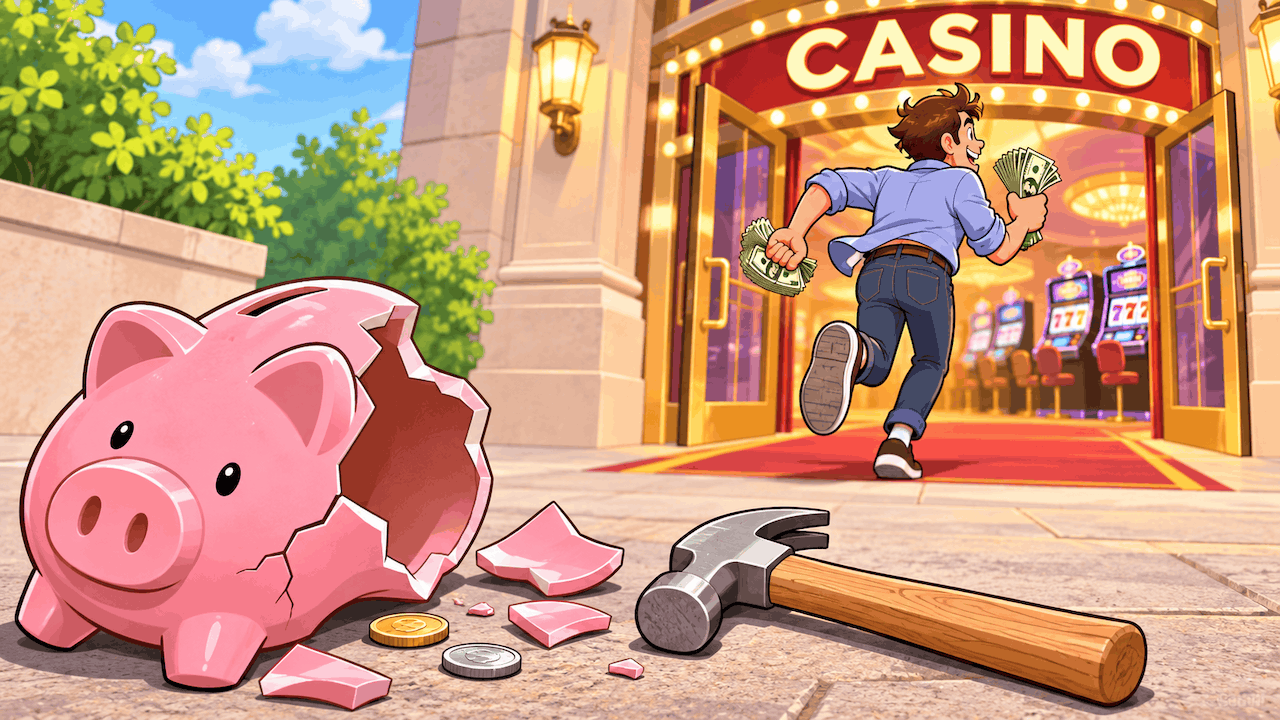
Young people now consider gambling a retirement strategy.
No, I don’t mean figuratively gambling in the stock market. I mean literally gambling – as in sports betting.
According to a recent survey of retail investors, 52 percent of Gen Z respondents said they took money set aside for investing and used it for sports betting instead.
And get this: a quarter of those Gen Z investors said they consider sports betting a part of their long-term financial strategy.
If you’re thinking, ‘That won’t end well,’ you’re right.
According to data from the Bank of America Institute, on average, bettors get back about 75 cents for every dollar they bet.
This shouldn’t come as a shock. Las Vegas is a thing because the house ultimately wins.
You can see gambling’s impact on savings rates. Household savings have dropped in states that have legalized sports betting.
Gamblers lose more than a bet. Let’s say I lose $50 betting on my beloved Tampa Bay Buccaneers. If I had invested that fifty bucks at age 25 and earned a 7 percent annual return, it would grow to about $750 by the time I was 65.
I get the gambling appeal. There’s always the possibility you’ll hit it big. But you probably won’t. Odds are, you won’t even break even. Vegas depends on it.
Regardless, saving is hard. But it’s possible. You just need to make a plan and execute it.
An investment planner recently told me a bad plan is better than no plan.
Well, I have a good plan.
Check out Money Metals’ monthly plan. You can take some of the money you’re dumping into your FanDuel account and buy gold and silver instead.
For as little as $100 per month, you can build your gold and silver portfolio over time. No. You won’t hit it big tomorrow. But you can rest easy knowing you’re saving in sound money the government won’t devalue by design.
Mike Maharrey is a journalist and market analyst for Money Metals with over a decade of experience in precious metals. He holds a BS in accounting from the University of Kentucky and a BA in journalism from the University of South Florida.