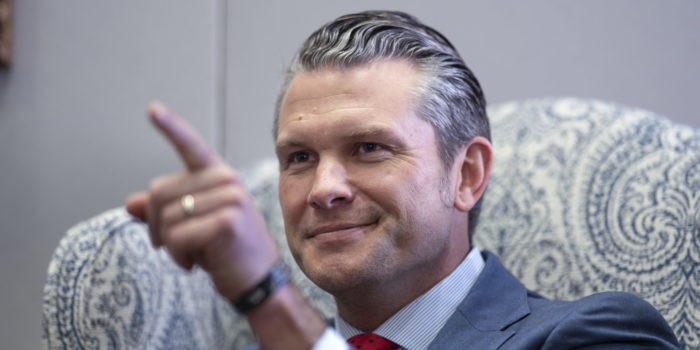
(Sarah Roderick-Fitch, The Center Square) U.S. bombers being moved back to the U.S. from the UK are the latest in American military assets being shifted in Europe, as Secretary of War Pete Hegseth told The Center Square that he expects more troops to be moved back to the Western Hemisphere from Europe.
The Pentagon confirmed all the bombers have been moved from the Royal Air Force Base in Fairford, UK, following an alleged foiled attack on the base last weekend.
The move comes hours after Hegseth told The Center Square the U.S. is expanding its “footprint in Central and South America with partners.”
The secretary added that as relationships with Central and South American countries progress, the U.S. wants “more burden sharing in Europe,” while focusing more on the U.S. and its own backyard.
“As we do that, a lot of those capabilities are going to move elsewhere, either back home to the big, beautiful base that we’re going to build…or to a different posture in the Western Hemisphere as we can get after these designated terrorist organizations. We are at war with the drug cartels, with DTOs,” Hegseth told The Center Square. The president’s been clear about that, so we’re going to posture and base as necessary to ensure that we have our foot on the pedal and are taking the fight to those ISIS and Al Qaeda in our hemisphere.”
The potential shift comes as the Trump administration has sought to dominate power in the Western Hemisphere, being called the Donroe Doctrine, a play on the Monroe Doctrine.
In the past year, there has been a major political shift in Central and South America, as nations have begun to move away from Marxist-aligned leadership and toward open-market candidates.
Last week, The Center Square asked President Donald Trump whether he had plans to build a military base in South America, including Venezuela, as there are currently no military bases in the region.
Trump appeared to leave the door open for the possibility of military bases in Venezuela or South America.
“We’re looking at doing a lot of things. We’re getting along very well, as you know. And Venezuela has been a great situation,” the president told The Center Square. “We’re taking a lot of oil, and we have a great relationship. And Venezuela’s making a lot of money, and so are we. We’re going to start filling up our national strategic reserves with the Venezuelan oil for very little money, and it’s going to be great.”
The potential shifts come as the U.S. reached an agreement to build two bases in Greenland.
The president’s influence in South America has been felt after a group of Trump-backed candidates on the continent won elections, further strengthening his standing in the region.
Following the siege and arrest of Venezuela’s former dictator, Nicolas Maduro, the U.S. has seized an opportunity to build relations and take charge of one of the world’s oil markets.
Up until the arrest of Maduro and his wife at the start of the year, Venezuela built relationships with China, Russia, and Iran, placing some of America’s greatest adversaries at its back door. In addition to keeping global adversaries in check, the Trump administration has been targeting narco terrorists around the Caribbean and South America for over a year.
In 2022, Venezuela hosted military drills with countries including Russia, China and Iran.
The Trump administration has already confirmed a drawdown of American troops in parts of Western Europe, specifically Germany, while floating the idea of moving additional troops out of Italy and Spain.
The Trump administration has pointed to its dissatisfaction with key NATO allies, either reluctant or refusing any support for the U.S. on its strikes against Iran.
The Pentagon is expected to finalize a six-month review of the U.S. military presence in Europe by the end of the year, seeking to shift more defense responsibility to NATO countries.
While Western Europe could continue to see troop drawdowns, Trump recently announced a more permanent base is in the works in Poland.