


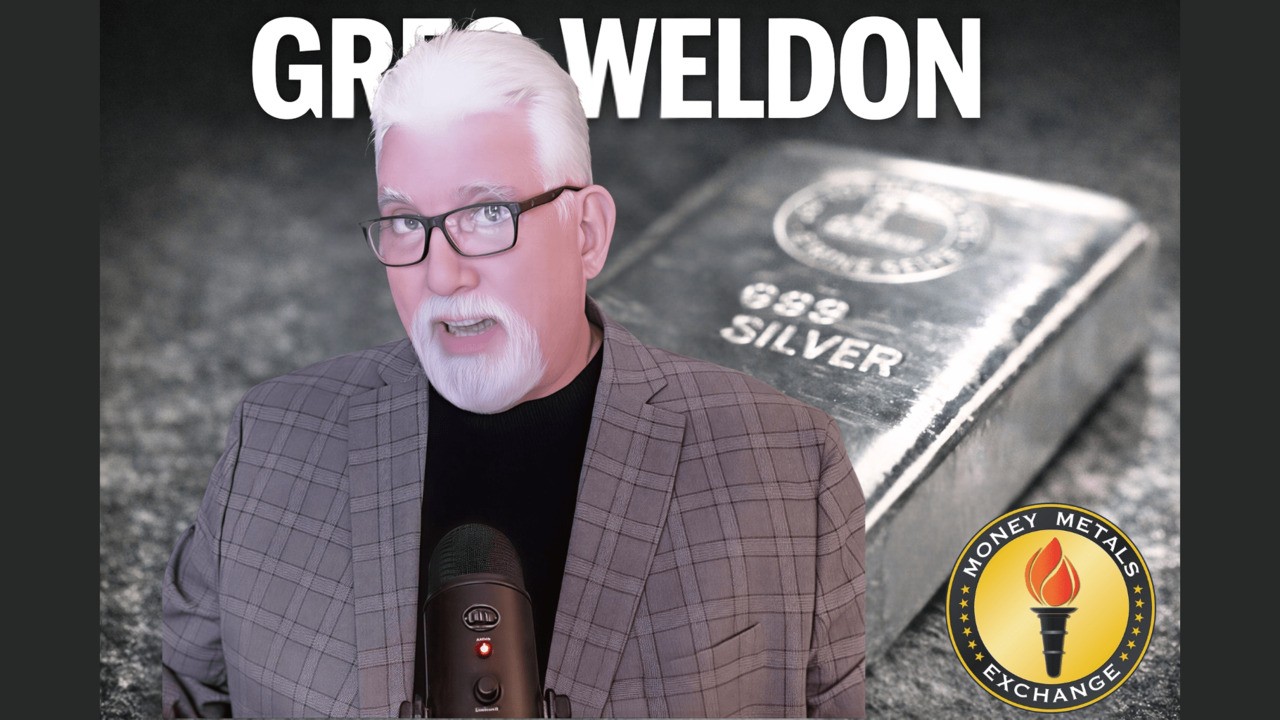
(Money Metals News Service) In a recent episode of the Money Metals podcast, host Mike Maharrey welcomes back Greg Weldon and notes Weldon’s long career that began in the 1980s on the trading floor in the gold and silver pits.
Maharrey says the last time Weldon appeared, in mid-October, gold had just pushed above $4,300 and silver was breaking $54. Now, he says, gold is about $150 higher and silver has surged close to $80.
Weldon says the speed of silver’s move does not surprise him. He points to a level he had emphasized earlier. Silver had repeatedly struggled around $36.50. In his view, once silver achieved a daily close above $36.50, the issue was no longer whether silver could reach $50, but how quickly it could get there.
He also references a call he made for clients on February 14, 2025. He titled it the “Silver Squeeze.” Weldon says people have talked about a squeeze for decades, but he has been “waiting 42 years” to see conditions align again, recalling the 1980s era after the Hunt Brothers episode. In his telling, what looks sudden to the mainstream is usually the visible phase of a longer shift that has been building beneath the surface.
(Interview Starts Around 8:07 Mark)
Is There a Real Shortage of Silver
Maharrey asks whether the squeeze narrative is mainly about metal being in the wrong place, with commentators focusing on flows between New York and London. He wants to know whether there is a true shortage of silver.
Weldon answers that, when he adds up the numbers, he believes it is a real shortage. He says he tracks warehouse inventories and supply-demand balance, and he argues there is not enough inventory to meet demand if delivery pressure rises.
He acknowledges the logistics story, including metal moving out of London into the U.S. earlier when tariff concerns created unusual premiums, and then shifting as the situation changed. He adds India to the picture, saying shipments into India have increased as the Indian rupee makes new all-time lows with striking regularity.
To illustrate potential upside pressure, Weldon offers a currency-based comparison. He says that if you translate the rupee’s move over the last five years into what it implies for U.S. dollar pricing, silver would be at $229.50. He stresses he does not treat that as a prediction. He prefers projected levels and argues that rigid forecasts often underestimate major regime moves.
Paper Claims, Delivery Risk, and the Chance of a Market Shock
Weldon argues that the system holds together until too many participants demand delivery rather than paper exposure. He says if investors sought delivery through ETFs or futures mechanisms, eligible inventories could be consumed rapidly.
He points to the LME nickel episode as a cautionary precedent. He describes a spike from $20,000 to $100,000 a ton, a 10-day market closure, and a reset around $27,000 with trades wiped out. He warns that if silver is treated as a strategic metal and export restrictions tighten, the market could become disorderly.
$50 Silver, $100 Silver, and the Bigger Driver Behind It
Maharrey raises the question that many investors argue about after every sharp pullback. He notes a recent correction from just above $80 down close to $70 and says pundits quickly claimed the bubble had popped and prices would return to $50 or even $30. He asks Weldon whether $50 or $100 is more likely this year.
Weldon says he can imagine both outcomes, depending on the path. He suggests $50 could come first, and then $100. He also says that if silver reaches $100, it may not return to $50.
He rejects the bubble framing and says the move is not mainly about hype. He argues the bigger turning point came after 2008, when money creation accelerated, and U.S. public debt exceeded GDP. In his view, silver is responding to a broader shift in monetary credibility and currency structure, along with a global drift away from the dollar.
The Debt Black Hole and Weldon’s Case for Ongoing Dollar Depreciation
Maharrey brings up Weldon’s “debt black hole” metaphor and says he has started using it publicly. Weldon expands the argument with figures. He cites $36 trillion in public debt and says total debt reaches $56 trillion when household leverage is included. He adds that $30 trillion of the public debt has been sold to the public.
Weldon argues the public is being repaid in a dollar that has depreciated 97% since 1985. He says the system will be forced into repeated depreciation because that becomes the easiest way to keep debt service manageable.
He also argues the U.S. lost the chance for an organic adjustment decades ago, referencing 1990 and 1991 as a moment when debt reduction and healthier growth could have been pursued. He says later shocks compounded the situation, including 2000, 2008, and the pandemic. In his framing, the U.S. has crossed the event horizon, meaning it cannot escape the pull of debt, and money creation becomes the default “propulsion.”
World War X and the Commodities Battle
Maharrey asks about China’s export restrictions on silver and what Beijing is trying to accomplish. Weldon calls it one weapon in a much wider struggle. He describes a global conflict he calls World War X, centered on resources, commodities, energy, and food, including rare earth elements and rare earth oxides.
Weldon says the U.S. is structurally vulnerable in rare earth supply chains. He claims the U.S. has one mine and lacks full domestic capacity for separation, concentration, refinement, and production. He says the U.S. is 97% reliant on China.
He brings Greenland into the discussion. He says Greenland holds 1.5 million tons of rare earths under the ice. He compares that to 2.3 million tons for the U.S., and 63.5 million tons for China and Russia combined.
He then shifts to the Arctic as an arena where competition could intensify. He notes Russia has built military bases, and the U.S. has installations in the region. He says China claims it is an Arctic nation. He references the Arctic Institute and says an agreement on cooperation ends in 2026, with growing concern that cooperation is turning into competition.
Platinum and Palladium as Trades, Not the Same Thesis as Gold and Silver
Maharrey asks about the sharp move in platinum and whether it is driven by the same macro setup as silver. Weldon says yes and no. He says platinum and palladium produced larger profits for his clients than gold and silver because the move was fast and the prices were low enough to create strong risk-reward leverage.
He points to supply-demand tightening, including a fourth straight year of annual supply deficit for platinum, meaning consumption exceeds production. He says shrinking inventories and improved performance in South African platinum stocks were key tells.
Weldon draws a distinction, though. He sees gold and silver as monetary metals, even as they have industrial and technological demand. He views platinum and palladium as more tied to industrial demand and treats them more as trading metals. He also suggests that palladium has lagged as technology shifts, including the rise of EVs.
The Fed’s December Pivot and a Return to Money Creation
Maharrey argues the Federal Reserve effectively restarted quantitative easing at the December meeting, even if it avoids the label. He says buying Treasuries with newly created money is QE in practice. He frames it as a symptom of the debt black hole because tight policy becomes difficult to sustain with massive debt loads.
Weldon agrees with the direction. He says he expected the Fed to be forced to accept higher inflation and that QE would return. He says he originally thought it would take 18 to 24 months, but it arrived sooner. He dismisses reserve-management explanations and says the policy reality is about keeping growth alive enough to service the debt.
Weldon’s Bootcamp and Why He Priced It at $29.95
Near the end, Maharrey asks Weldon to explain the trading bootcamp he created. Weldon says it started as a year-ahead outlook and became a reboot tied to the 20th anniversary of his original Trading Bootcamp.
He says it contains 12 lessons in 12 videos, about two and a half hours of instruction, plus more than 300 pages of charts. He says it covers macro monetary history, the debt black hole and global debt bubble, and ways to invest in metals through mining shares, ETFs, physical bars and coins, and futures. He emphasizes risk management, trading psychology, and the math required to avoid being “slaughtered” by leverage.
Weldon prices it at $29.95 and says he has sold similar products for $2,999 in the past. He directs listeners to WeldonOnline.com/BootCamp and shares his email, [email protected], along with his X handle @Weldonlive and his podcast, Money Markets and New Age Investing.

 Greg Weldon joins Mike Maharrey to explain silver’s surge, whether shortages are real, delivery risk in paper markets, China export limits, and why the “debt black hole” drives dollar depreciation.)