(Mike Maharrey, Money Metals News Service) Here’s a question for you.
If you were alive 2,000 years from now and dug up an old box of $100 bills, do you think you could spend it anywhere?
I’m going to guess no.
In the first place, it’s highly unlikely paper money would last 2,000 years underground. It would mold and deteriorate. If the box was compromised, animals and insects might even chew up the bills. Remember how rats ate money that drug lord Pablo Escobar’s people stashed in walls? That paper didn’t last a decade, much less 1,000 years.
Paper doesn’t stand the test of time – kind of like the value of any fiat currency.
And that leads to the second issue. I would be shocked if the U.S. existed in 2,000 years, at least not in the same way it does now. Without a backing government, U.S. fiat money would be worthless. It would be kind of like finding a box of old Confederate money that survived the Civil War. Sure, it would have some historical value. But you couldn’t take it to Walmart and buy a trinket.
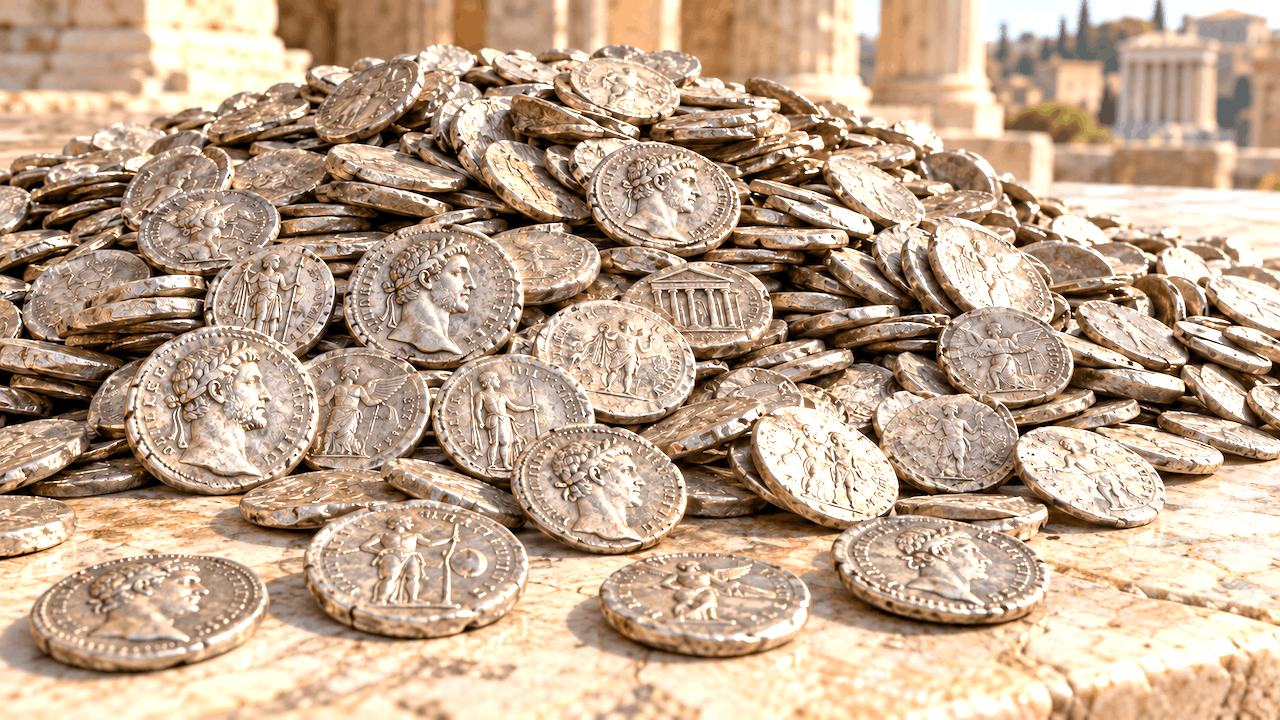
Contrast that with Roman denarii. If I dug up a box of those silver coins, they would be in virtually the same condition they were in when they were buried, with perhaps a bit of tarnish.
And I could immediately go and spend one of those silver coins. They might not take it at Walmart, but I guarantee I could quickly find someone who would accept the denarii.
Because silver has value, and virtually everybody in the world knows it.
That’s why I find these treasure discoveries so fascinating. It boggles my mind that 2,000-year-old money is as valuable as it was the day it was buried. Silver and gold stand the test of time.
I ran across an article this week about an amateur archeologist in Germany who found a trove of silver coins in a field.
Oliver Riedl found several Roman denarii and realized he was onto something big when his metal detector kept beeping. He called in help, and a group of experts unearthed 934 denarii.
That was quite a fortune in its day. Historians say a Roman soldier earned around 300 denarii per year, with about half withheld for food and equipment. So, the horde in Germany represented about 6 years of take-home pay.
Do you know what’s cool?
I can figure out the purchasing power of those coins today with a few simple calculations.
According to the AP report, the haul of coins weighed 6.8 pounds. That converts to about 99 troy ounces.
According to archeologists, the coins dated to the reign of Roman Emperor Hadrian. Roman coins minted in that era were about 80 percent silver. That means the stash of denarii contains a little over 79.2 ounces of silver.
This morning, silver was $65.47 per ounce, making the melt value of our denarii around $5,185.
In other words, I could theoretically buy over $5,000 worth of stuff just with the silver contained in those nearly 2,000-year-old coins.
Now, consider again what you might be able to buy with paper dollars in 2,000 years.
Let’s imagine you found $5,000 in cash 2,000 years from now. Somehow, the paper survived all those years, and the U.S. government was still around to back the money. I imagine that $5,000 would buy you about 0.0000000000001 cent worth of stuff, given the rate of monetary debasement. Heck, $5,000 buried 50 years ago would only purchase $859.75 today.
I think I’d rather have the Roman denarii.
One of Aristotle’s four characteristics of good money is durability. In other words, money must stand the test of time. It can’t break down, rot, or corrode easily.
Silver fits the bill.
Paper – not so much.
And you can’t print silver.
That means governments can’t devalue silver money by printing more. They have to dilute the metal’s purity. In fact, that’s exactly what Roman emperors did. In the Empire’s waning years, the denarii’s purity fell as low as 50 percent.
The moral of this story: get real money if you want to preserve your wealth over time. Gold and silver will not rust, corrode, mold, degrade, or be printed into worthlessness by the government!