


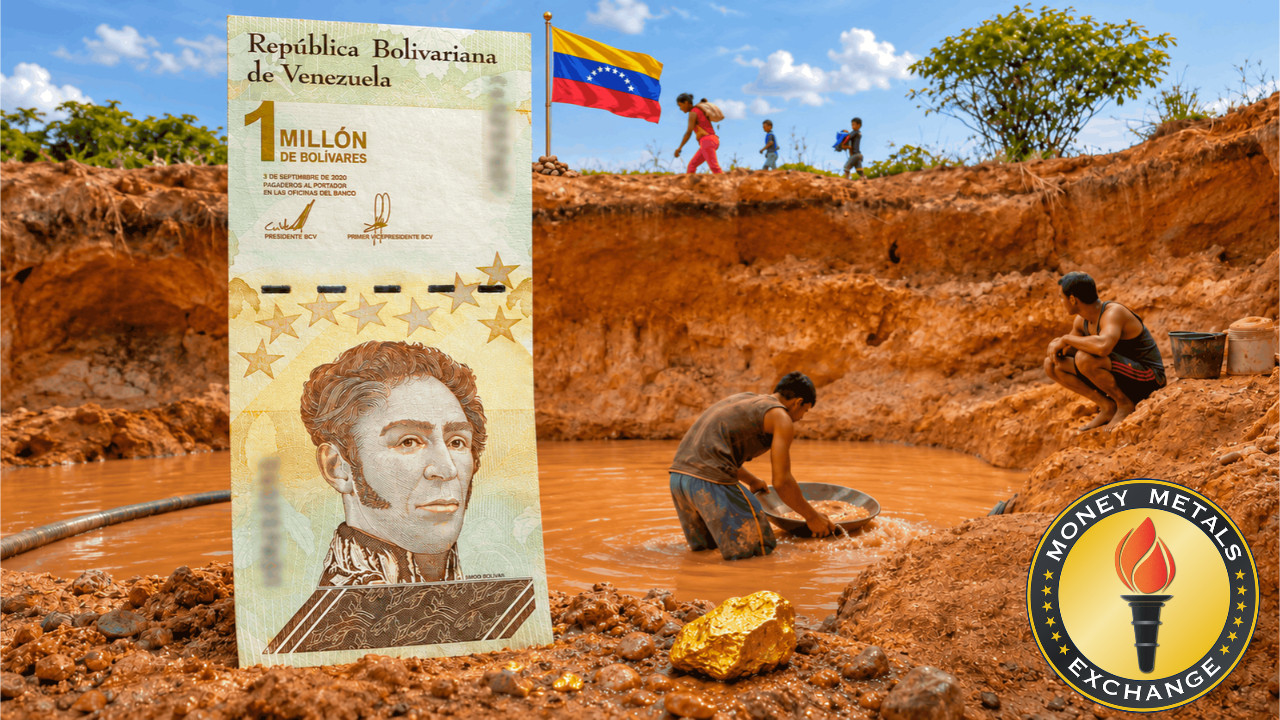
(Ááron Sepúlveda-Cué, Money Metals News Service) By February 2019, prices had risen in Venezuela at a rate of 345,000% in the last twelve months. People have no other option but to look for alternatives.
Usually, the US dollar is the first option during deep devaluation events for its international prominence. A process of monetization started for the US dollar and a demonetization of the Venezuelan bolívar.
The central government tried to stop it in vain. Government workers themselves were using dollars because the government currency they got paid in had near-zero demand, a situation known as hyperinflation.
While the dollar is seen as a good alternative, other currencies gained acceptance among Venezuelans too. In some areas of the Southeast, gold flakes, which had just been extracted from local mines, were being used as payment.
The metal was not just a savings asset anymore, but was generally accepted again, back to day-to-day prominence.
Something as predictable as the US dollar is accepted in many places worldwide. But in Venezuela, three other assets also became money besides the US dollar. One of those three was, and still is, gold.
The Case of the Two Other Fiat Currencies
In Venezuelan cities bordering Colombia, the Colombian peso quickly became not just a generally accepted medium of exchange in those towns, but even the unit of account (the numeraire used to set prices in every store).
Instead of the dollar becoming adopted as the primary new money, the Colombian peso gained faster acceptance in those border towns. Retailers, who facilitate a large number of transactions every day, started to accept the peso for payment for goods and services.
So, in a decentralized and spontaneous way, the Colombian peso became money in many border towns of Venezuela because of its proximity. To be clear, the dollar was and is generally accepted in those towns but used a lot less because those towns have other options available.
In the same way but positioned on the Brazilian border, the tourist town of Southern Venezuela, Santa Elena de Uairén, experienced the monetization process similar to the Colombian peso, but of the Brazilian real.
In an instant, shops in Santa Elena switched their prices from rolivares to reales. Again, like in the Venezuelan towns near the Colombian border, the US dollar was also accepted in Santa Elena, but not as the preeminent payment asset.
These border area examples highlight the insights found in Nobel Prize Economist F.A. Hayek’s book, Denationalisation of Money.
Hayek saw that in the border towns of Germany and Austria, shops and even banks accepted the currency of the neighboring country with tremendous ease. This is precisely why this essay was written: to illustrate real-life examples of monetizing assets not chosen by the central government.
Gold Comes into the Scene
It is easy to predict that under hyperinflation most border regions will adopt first the neighboring currency as their regional money because of the familiarity already installed of the foreign fiat currency.
But how about non-border regions? In Caracas, the national capital placed in the north of Venezuela, the only available option was the US dollar. Same pretty much everywhere else; except in the South. As you drive south towards Santa Elena and Brazil’s northern border (both mentioned above), just three hours before arriving in Santa Elena de Uairen, you can find a town that pays with gold.
Tumeremo, a mining town in Southeast Venezuela, fully monetized raw gold flakes. Some other towns in the region also organically reverted to a commodity-based monetary system using the gold flakes. El Callao and El Dorado are two of these towns.
These localized transitions from a failing fiat currency to commodity-money are very good illustrations of how decentralized markets spontaneously resolve monetary vacuums when formal institutions and trust disintegrate.
To ease day-to-day commerce, residents developed an efficient system to value and transact in shaved flakes of gold.
Whole gold nuggets are valued too highly, making them poor instruments for retail transactions. So miners and merchants used hand tools to chip fractional pieces out of larger metal rocks, creating units suitable for buying groceries, medicine, haircuts, or other needs. Ironically, the heavily depreciated bolivar fiat notes were repurposed as “origami” envelopes to safely transport these flakes in people’s pockets.
Retail sellers in Tumeremo and El Dorado shifted their prices from bolivares to fractions of gold and dollars. Shopkeepers would rely on weight scales to ensure accurate payment.
Later, merchants ended up developing the wisdom to assess purity by sight alone. Also, they developed a way to punish fraud and counterfeiters that would try to pay with fake gold, without any intervention from the central government of Venezuela.
Conclusion
345,000% annual inflation can make anyone move from fiat to gold.
The move from bolivares to gold flakes in Southeastern Venezuela is fascinating real-world evidence of how a monetary system develops from scratch. Even though using raw gold faces some challenges—such as the danger of armed gangs trying to control the mines, for one—it solves a major problem for ordinary people.
Without any controls from the central government, residents in El Callao, Tumeremo, El Dorado, and Santa Elena de Uairén created a working economy from scratch. Their story illustrates that when fiat money loses people’s trust, communities will naturally return to something solid and valuable to keep their daily lives moving forward.
Ááron Sepúlveda-Cué is an economist with a Master’s degree in Economics from Georgia Southern University. Born in Houston, Texas, and raised in Monterrey, Mexico, he has made Texas his permanent home since his early 20s. He is the Libertarian Christian Institute’s in-house economist. His areas of specialization are Monetary & Banking Theory and History, Austrian Economics, Liquidity Theory, International Trade, & Intellectual Property.