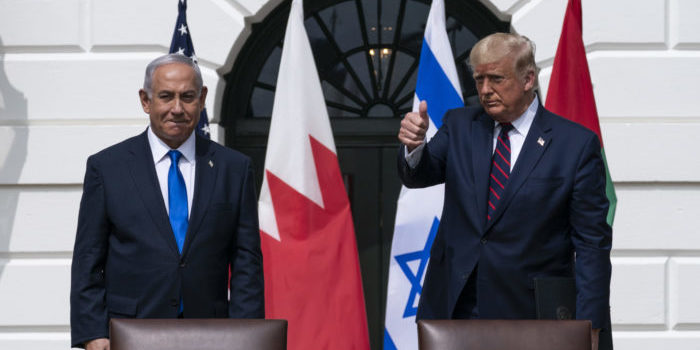
(José Niño, Headline USA) House leadership prevented members from casting votes on a provision that would forge an unprecedented merger between the American and Israeli defense industrial bases, Responsible Statecraft reported Monday.
The Rules Committee controlled which of over one thousand proposed NDAA amendments would advance to floor debate and voting. Following zero discussion Monday the committee killed a bipartisan amendment sponsored by Rep. Ro Khanna, (D-Calif.) and Thomas Massie, (R-Ky.), seeking to eliminate the “United States–Israel Defense Technology Cooperation Initiative” from the legislation. Monday night the committee published amendments deemed eligible for votes and theirs was absent.
The contested language establishes a dedicated executive agent within the Pentagon charged solely with deepening American and Israeli military technology fusion spanning nearly all defense functions from joint weapons manufacturing to “data fusion.” Israeli Prime Minister Benjamin Netanyahu characterized this evolution in bilateral ties as “my plan.”
Veteran national security professionals delivered blistering criticism and sounded alarms about threats to American interests. Joe Kent, who previously led the National Counterterrorism Center, stated that “The dangers of allowing any other nation to access our sensitive military technologies are obvious, including the fact that back doors and spyware can be installed that will most certainly be used by the Israelis to influence U.S. policy.”
Paul Pillar, a CIA veteran of more than a quarter century, expressed deep reservations about the provision alongside companion measures that would essentially mandate American intelligence sharing with Israel. “In intelligence, Israel is more of an adversary than an ally. Being an adversary in intelligence means indulging in the hostile act of espionage. Israel has a long record of conducting that type of hostile act against the United States,” Pillar observed in Responsible Statecraft.
Reinforcing Pillar’s concerns, Defense Intelligence Agency officials recently disclosed that Israeli espionage activities targeting the United States carry a “critical” designation, the most severe threat classification in the DIA framework.
The Rules Committee action guaranteed that voters would never learn how their elected officials stood on this pivotal question.
The Senate continues deliberating its parallel version and both NDAA drafts must ultimately be harmonized through a Conference Committee. Quincy Institute research fellow Steve Simon cautioned that “The measure risks tethering the US military to its Israeli counterpart technologically and making it difficult to uproot should conditions change.”
José Niño is the deputy editor of Headline USA. Follow him at x.com/JoseAlNino