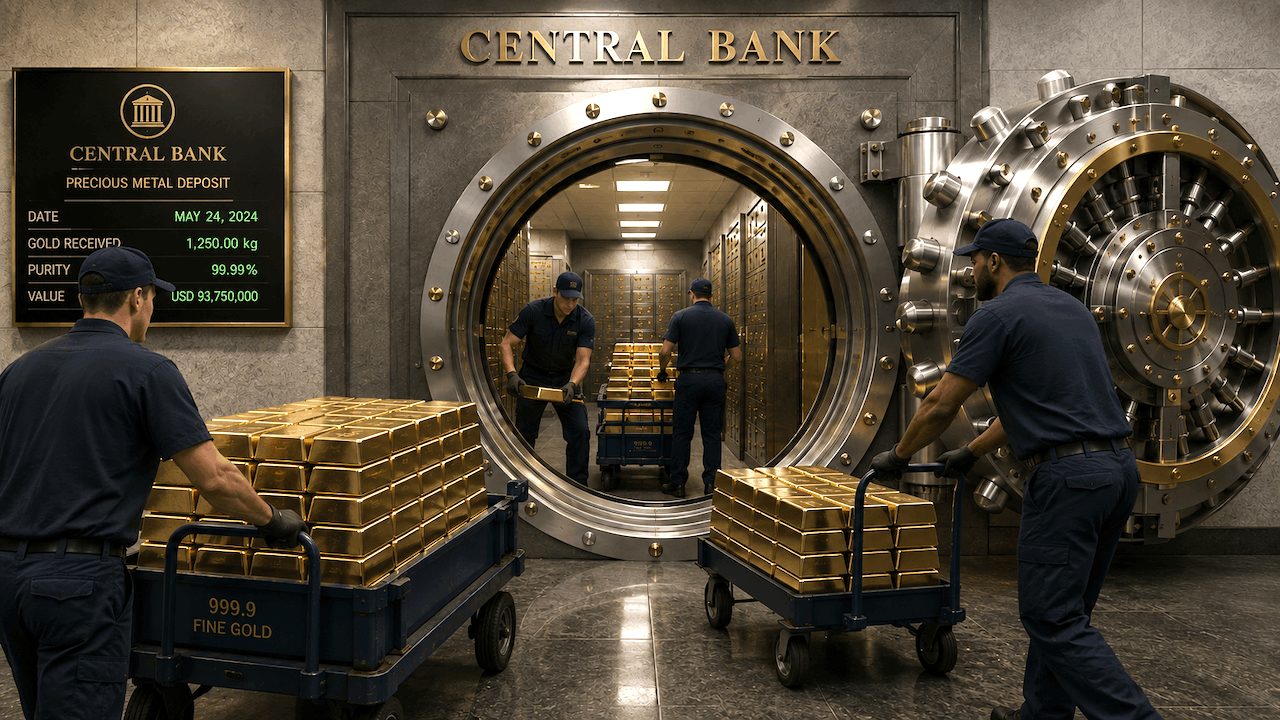
(Mike Maharrey, Money Metals News Service) Central bank gold buying was one of the pillars supporting the gold bull market last year, and it has continued to bolster the market even as it faced significant headwinds due to expectations of a higher interest rate environment.
But why are central banks piling into gold even as they minimize their exposure to the dollar?
There are four key reasons.
- Geopolitical risk
- The weaponization of the dollar.
- Worries about the U.S.’s deteriorating fiscal situation.
- Regime uncertainty
In an op-ed published by Reuters, financial journalist Jamie McGeever said that none of these events on their own would necessarily spark the current revival in gold.
“But throw them all together, and it’s a pretty compelling checklist. Especially for central banks, which had already started to ramp up their purchases in the second quarter after a lackluster first quarter.”
McGeever is referring to the resurgence of central bank gold buying in the second quarter of this year. Facing price pressure in Q1, central bank purchases slowed, but things started picking up in April. Central banks bought 289 tonnes of gold in the second quarter, nearly five times more than the Q1 total.
Following is an overview of these four factors and why they’re incentivizing gold accumulation and de-dollarization.
Geopolitical Risk
The war between the U.S. and Iran has had an oversized impact on the markets. After a brief safe-haven bid at the outset of hostilities, gold sold off and has traded sideways due to the oil price shock and worry that higher inflation will mean higher interest rates.
And the war is starting to look like a problem that won’t go away. McGeever called it “an unnerving geopolitical and policy backdrop that has reminded the world of gold’s underlying appeal.”
“Hopes of a peace ‘deal ’-however unsatisfactory that deal might be – are evaporating. U.S. President Donald Trump’s off-ramp ahead of November’s midterm elections is narrowing. Escalation or capitulation is not the only choice Trump faces, but it is a black-and-white scenario some analysts are now beginning to contemplate.”
As expectations for a Fed rate hike fade, gold’s safe-haven appeal is growing in this uncertain environment.
Dollar Weaponization
When the world sees the U.S. moving aggressively on the world stage, it increases worries about the weaponization of the dollar.
After Russia invaded Ukraine, the U.S. and its Western allies aggressively sanctioned Russia, effectively cutting the Russians off from the global financial system.
Other countries sat up and took notice.
While it may make sense from a Western foreign policy perspective, it has made many countries wary and sped up efforts to minimize dependence on the greenback. After all, if you have something that can be leveraged against you, it’s only natural to try to minimize your exposure to that thing. If the U.S. can pull the dollar rug out from under you, why not try to get that rug out of the room?
This is one of the primary dynamics driving central bank gold accumulation.
Notably, they are decreasing their exposure to dollars at the same time. Earlier this year, the European Central Bank confirmed gold has surpassed Treasuries as the top reserve asset.
U.S. Fiscal Malfeasance
The national debt is only a few billion dollars away from $40 trillion. Meanwhile, federal spending keeps speeding up. The U.S. ran the biggest monthly budget deficit in five years last month.
The world has financed America’s spending spree for decades, but it might be getting wary of loaning Uncle Sam money. Treasury yields have been pushing higher in what some analysts believe is the beginning of a secular bear market in bonds.
McGeever pointed out that yields on the benchmark 10-year Treasury note have climbed to their highest level in 18 months. Meanwhile, yields on 30-year bonds and 30-year inflation-protected bonds are at their highest since 2007 and 2008, respectively.
This indicates a sagging demand for U.S. debt.
Economist Phil Suttle explained the ramifications.
“The U.S. is now in a phase where its global seigniorage benefits of supplying the world’s reserve currency have now been exhausted; the next phase (which may already be underway) is what happens when the foreign official holders of your liabilities become more antsy about holding them.”
Regime Uncertainty
Markets are forward-looking. They don’t function very well when the future gets hazy.
For an economy to operate at peak efficiency, market participants need to be able to anticipate future developments. They need stability in policy and regulation.
We have none of that today.
The tariff situation is a prime example. Nobody knows what the tariff landscape will look like next month, much less a year from now. How does one plan for the unknown?
Meanwhile, many people on the international stage question Federal Reserve independence. They worry that pressure from the administration could drive monetary policy. It’s a legitimate concern because Fed independence is a myth.
While new Federal Reserve Chairman Kevin Warsh has talked a good game on tackling inflation, he hasn’t actually done anything. This is causing the markets to question his commitment to reining in inflation.
McGeever noted that it also appears Trump is in Warsh’s year.
“Media reports suggest Trump has repeatedly called Warsh since his appointment, and Trump has revived his attempts to fire Governor Lisa Cook. All this has unnerved the bond market.”
All these factors are driving central bank gold buying. BNY analysts say they should also incentivize renewed investor interest, especially with the price below all-time highs.
“Gold is not a pure Fed signal, but persistent official-sector demand and renewed investor interest are reinforcing the value of inflation, currency and geopolitical hedges.”
McGeever argued that this is a setup for a long-term gold bull run.
“As confidence in the world’s reserve assets frays, gold’s allure is unlikely to dim.”
Mike Maharrey is a journalist and market analyst for Money Metals with over a decade of experience in precious metals. He holds a BS in accounting from the University of Kentucky and a BA in journalism from the University of South Florida.