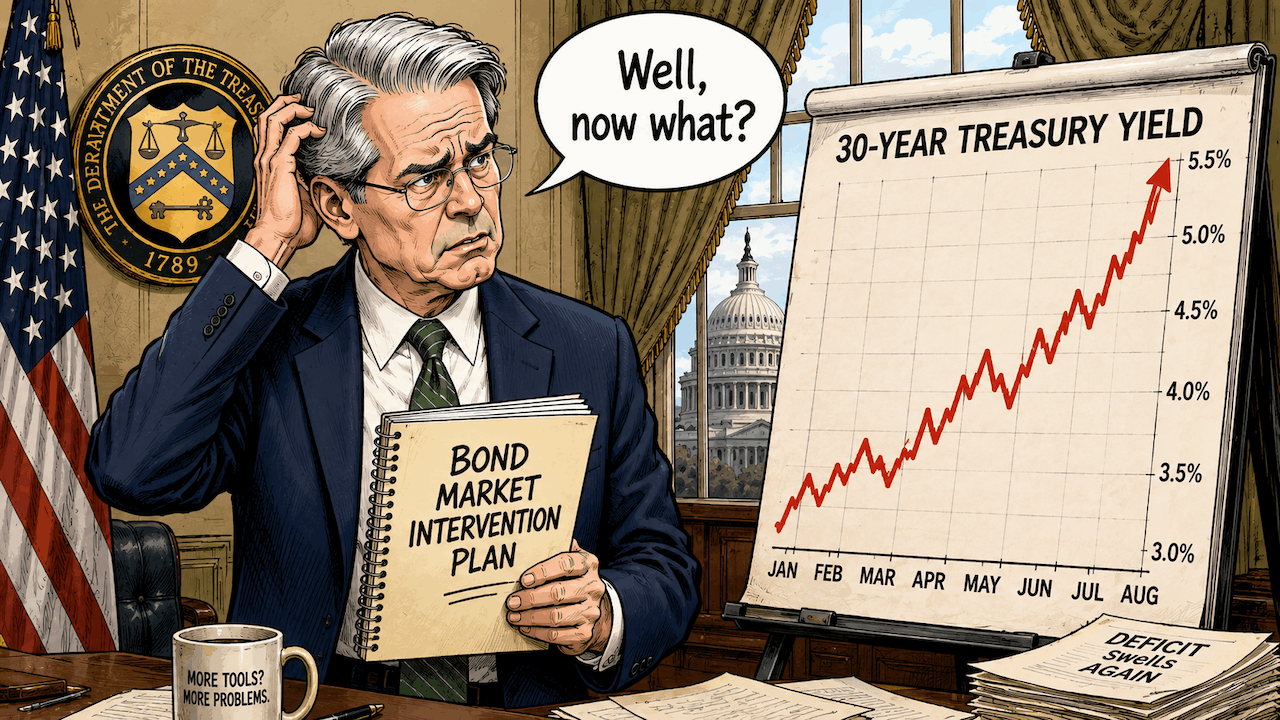
(Mike Maharrey, Money Metals News Service) Opps. That didn’t go as planned.
Treasury Secretary Scott Bessent wanted to drive down interest rates at the long end of the yield curve, so he intervened in the market.
It worked.
For about one day.
The 30-year Treasury yield closed at 5.31 percent on Tuesday (Aug. 18). Intraday, it hit 5.34 percent, the highest yield since 2007. By close on Wednesday, after the announcement, it dipped to 5.19 percent.
Two days later, it was back to 5.27 percent.
Instead of stabilizing the bond market and pushing long-term Treasury rates lower, the move appears to have juiced the debasement trade.
According to the announcement, the Treasury Department will increase buybacks of Treasury securities in the 10-20 and 20-30-year maturity sectors from a maximum of $2 billion to $4 billion per operation.
A Business Times report revealed the move’s fecklessness,
“U.S Treasury Secretary Scott Bessent’s bid to tame U.S. borrowing costs knocked down long-term yields for barely a day. The more lasting market signal: the dollar weakened while gold and Bitcoin rallied, reinforcing a debasement trade fueled by swelling U.S. deficits and concerns over the direction of U.S. economic policy.”
Keep in mind, the Treasury hasn’t started the bond buyback yet. According to the announcement, the expanded buyback operations will begin September 9 and run through November 4.
Nevertheless, the announcement didn’t have the impact Bessent hoped for. In fact, it appears to have exacerbated the situation and reignited the debasement trade – an investment strategy emphasizing holding tangible assets such as gold, silver, and other commodities to protect against the decline of fiat currencies caused by monetary debasement.
Treasuries have been selling off because many countries are increasingly wary of holding U.S. debt. With the national debt eclipsing $40 trillion last week, and with U.S. policymakers giving no hint that they intend to address the borrowing and spending, America’s fiscal situation doesn’t inspire confidence.
On top of the fiscal problems, the U.S. has weaponized the dollar as a foreign policy tool. This has made some countries even warrier about holding greenbacks.
The AI boom is exacerbating Uncle Sam’s funding problem. Financing for AI expansion has eaten into the broader bond market.
Bessent tried to frame the bond buyback as a “liquidity intervention” to maintain “market plumbing.” However, we don’t have a “plumbing” problem, and the Treasury Department intervention doesn’t solve the fundamental issue. That’s clear by the quick rebound in yields after the announcement.
Nomura macro strategist Charlie McElligott said the move showed the Treasury Department is reaching its pain threshold for higher yields, and he described the “gold-up, dollar-down move” as a “pressure-release valve” as the U.S. intervened to stabilize long-term rates.
Billionaire investor Ray Dalio was even more emphatic, urging investors to cut bond exposure and hold gold, along with some Bitcoin as protection against a potential U.S. “debt crisis.”
The market’s tepid reaction to Treasury’s announcement reveals an ugly reality. Try as he might, Bessent can’t control the market. The government can intervene and move the needle temporarily, but it can’t override the underlying market dynamics, as Manulife Investment Management senior portfolio manager Nathan Thooft told Business Times.
“The Treasury can influence liquidity and sentiment, but it can’t sustainably override growth, inflation, deficits and supply.”
The other problem is that the Treasury Department is limited in its ability to intervene. It can’t print money, so it must borrow to fund its buyback. In practice, it will have to issue more shorter-term bonds to raise cash so it can intervene on the long end of the curve. It’s a little like rearranging the chairs on the deck of the Titanic.
Enter the Federal Reserve.
Warsh & Company will face increasing pressure to intervene on behalf of the Treasury. Through quantitative easing operations (QE), the Fed can buy bonds using money created out of thin air. This decreases the total number of bonds on the market instead of simply shifting supply toward shorter-term notes.
In fact, the Fed is already running small-scale QE operations (although Fed people will never use the term) as evidenced by the expanding balance sheet.
However, that newly created money gets injected into the financial system. This is, by definition, inflation.
Historically, the Fed has held interest rates higher to battle inflation. In other words, the operation necessary to lower the federal government’s borrowing costs creates an effect that necessitates raising its borrowing costs.
This is why I point out over and over that the Fed is in a Catch-22.
The bottom line is the U.S. government is losing control of the bond market and yields. Investors are no longer just reacting because yields go up. They are reacting to the reasons behind yields going up. That means transparent U.S. intervention isn’t going to soothe the market.
This is a big problem for a country already shelling out over $1 trillion per year to service its debt.
Mike Maharrey is a journalist and market analyst for Money Metals with over a decade of experience in precious metals. He holds a BS in accounting from the University of Kentucky and a BA in journalism from the University of South Florida.