(Mike Maharrey, Money Metals News Service) On my desk sits a very small jar containing gold flakes. My grandparents panned the gold from an Alaskan river back in the 1950s.
There’s not much gold in the jar – far less than a gram. And to hear my grandmother tell it, they paid for that gold in blood.
Literally.
Apparently, mosquitoes in Alaska exact quite the fee for the privilege of panning for gold in the summertime.
My grandmother told that story over and over when I was a kid, and it made quite an impression on young me. I always thought hunting for gold sounded cold and miserable, and not very lucrative.
However, sometimes the blood, sweat, and tears pay off.
And sometimes it pays off big-time.
It certainly did for an Australian prospector with a metal detector.
He didn’t want to be named, so I’ll just call him “Dude.”
Dude said he’d been searching for several days on Mount Stuart station near Tibooburra, in the north-western corner of New South Wales, when his metal detector pinged.
He said the ping wasn’t very loud at first, but he realized he was onto something big as he started brushing away the dirt.
“It wasn’t a loud signal for the size of the piece that it is [but] once I got down to 100 [millimeters] or something like that, the machine was squealing. It might have been on the first or second scrape; I just seen this bright yellow dot in the center of the hole.”
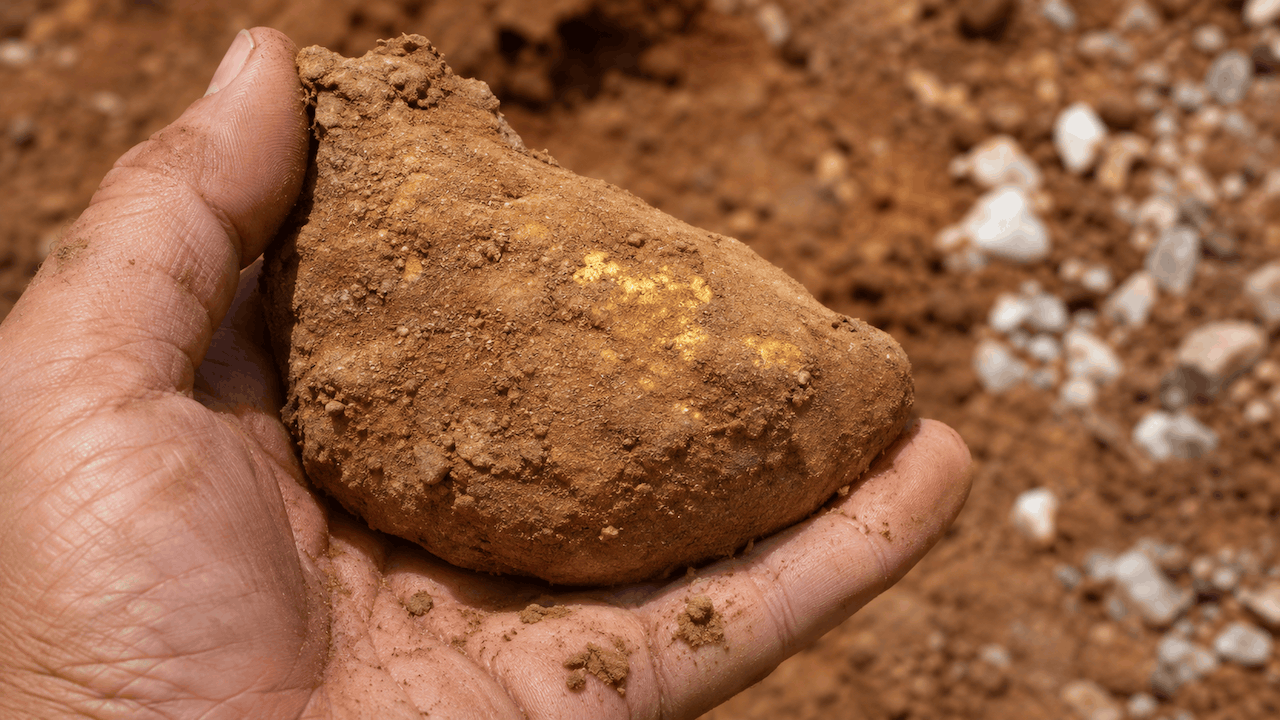
And then he pulled out a potato.
Except it wasn’t really a potato. It was a gold nugget.
The golden spud weighed in at 1,218 grams (about 38.6 troy ounces or 2.6 pounds). However, it was specked with quartz. Preliminary testing determined the nugget contained about 940 grams of pure gold. That’s worth about $121,000 at the current spot price.
Dude nicknamed the nugget the “Tibooburra Spud.” He hopes to sell it to a collector for as much as $200,000.
Dude told ABC Australia he’s been prospecting “for years” and that he’s used to “coming up empty.”
“You dig lots of rubbish … lots of lead bullets, old timer’s nails, horseshoes, everything.”
Now, that sounds like my grandmother’s version of prospecting!
And it makes sense, right?
Gold is rare. That’s one of the characteristics that makes it so valuable.
Mining experts say a 1-ounce nugget is harder to locate than a 5-carat diamond. As Earth.com explains it, “One reason for this scarcity is that gold deposits are scattered and often require extensive mining operations before any visible pieces are brought to the surface.”
So, it’s not like you can just walk along the side of the road and pick up gold nuggets – not even in Australia.
Although, on occasion…
In 1979, a couple using a metal detector located a massive gold nugget in western Australia’s Kalgoorlie Goldfields. Known today as the “Golden Beauty,” the nugget weighs in at nearly 10 pounds.
Can you imagine stumbling on such a find?
I can’t either. My imagination can’t get past my grandmother and grandfather swatting mosquitoes in the middle of a cold Alaskan river.
In 1869, two miners dug up the largest alluvial gold nugget ever found. The Welcome Stranger weighed in at 3,523.5 troy ounces (about 241 pounds). At today’s gold price, the nugget would be worth $14.4 million.
Unfortunately, the Welcome Stranger is no more.
The nugget was so big that a local blacksmith had to break it into three pieces on an anvil before they could weigh it. The pieces were later melted down and shipped to the Bank of England.
The duo received an estimated £9,381 for their find. That equals $12,614.91. That’s about $297,400.95 in today’s purchasing power.
No wonder people are willing to spend significant amounts of time and money (and sometimes blood) hunting for gold.
Dude had some advice for would-be gold hunters.
“Just keep walking, keep swinging, keep digging every target.”
You might just get rich.
But if that doesn’t work out for you, you can always get beautiful gold at MoneyMetals.com. You’ll do much less work. You can remain in the comfort of your home. And you’ll probably spend less money when it’s all said and done.
Mike Maharrey is a journalist and market analyst for Money Metals with over a decade of experience in precious metals. He holds a BS in accounting from the University of Kentucky and a BA in journalism from the University of South Florida.