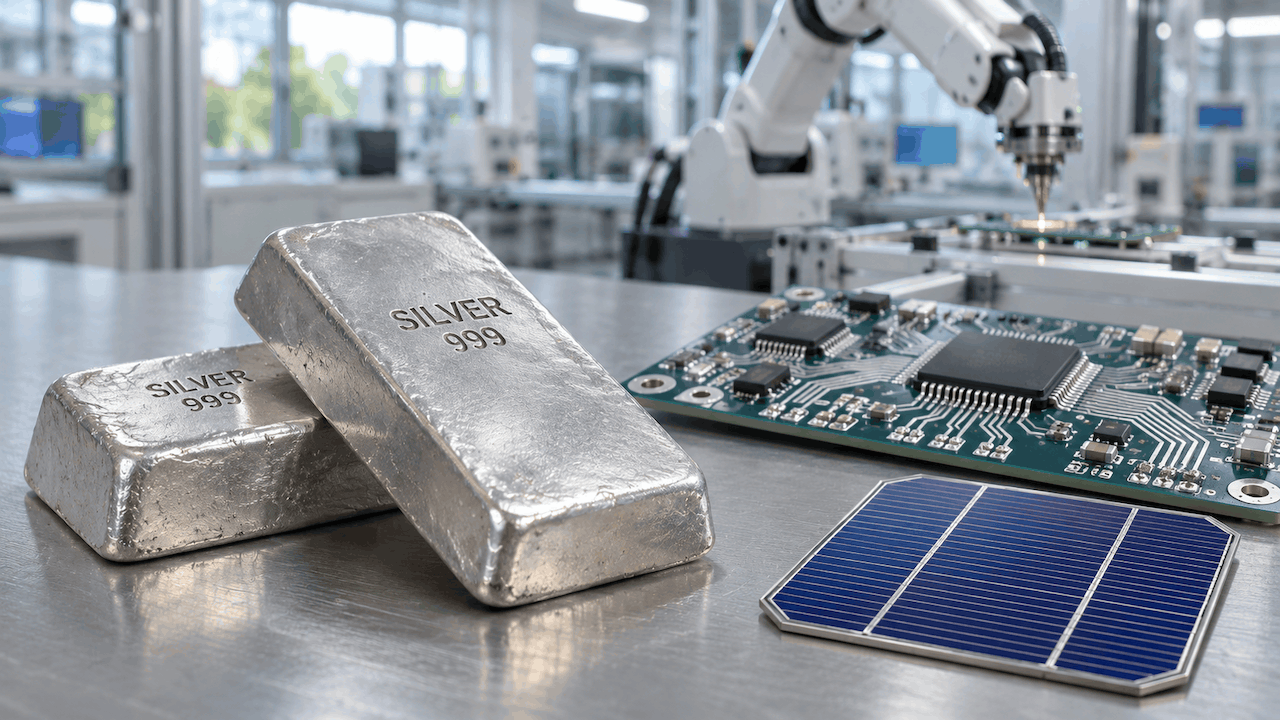
(Mike Maharrey, Money Metals News Service) At its core, silver is a monetary metal; however, it has extensive industrial applications. Technology and industrial applications account for about 60 percent of silver’s annual demand.
Silver has the highest electrical conductivity of any metal at room temperature. It also boasts the highest thermal conductivity of any metal and has antibacterial properties.
Scientists are constantly discovering new ways to utilize silver in technical and industrial applications. The Silver Institute featured several innovations in the latest edition of Silver News.
Cheaper Silver Nanoparticles
Silver nanoparticles are used in a wide range of applications, particularly in medicine and electronics. However, fabricating silver nanoparticles is costly, with commercial equipment costing thousands of dollars.
Mexican scientists may have solved that problem.
They produced silver nanoparticles using a $30 open-source microcontroller called Arduino. Computer enthusiasts use the controller to bridge the gap between software and physical hardware. Do-it-yourselfers often use Arduinos, along with a few other common components, to read inputs like motion or temperature and then turn on fans or lights in response. Arduinos also help build robotic devices.
The researchers isolated silver from silver nitrate and used Arduino-based circuitry to shape it into tiny particles that can be used in any nano-silver. These include microscopic antennas, light amplifiers, and chemical detectors. This method can produce silver nanoparticles at a much lower cost and could speed the development of silver-based products. The technique could also lower manufacturing barriers, allowing smaller, less-funded companies to deliver new products.
Silver and Medical Marijuana
Scientists in Iran have discovered a way to grow medical marijuana in traditional outdoor agricultural settings by using silver nanoparticles.
Medicinal cannabis is typically grown in expensive indoor facilities.
Scientists started with “callus cultures,” masses of undifferentiated plant cells that help the plant grow and repair. Unlike mature cannabis flowers, they don’t have certain structures like trichomes – tiny outgrowths on the surface of the plant – where cannabinoids are produced. When researchers exposed the cultures to silver nanoparticles, they found that it triggered cannabinoid production. They also found that increasing the number of silver particles boosted cannabinoid levels.
The exact mechanism remains unclear; however, scientists think the nanoparticles trigger young plants to produce THC and CBD. Both are important in medical treatments, especially CBD, which is used to treat seizures.
Silver Is Green
Many believe hydrogen is the fuel of the future. It burns cleanly and produces water vapor exhaust. However, it is expensive to produce.
A discovery by South Korean researchers may help change that.
A team at Seoul National University (SNU) said silver catalysts can help a solid oxide fuel cell generate electricity or split water to produce hydrogen.
This finding could lead to cleaner, more efficient electricity generation and boost hydrogen’s potential as an alternative fuel.
Scientists say they can manipulate the amount, size, and shape of silver nano-catalysts, and the particles act as a kind of ‘smart switch,’ telling the solid oxide cells whether to produce electricity or hydrogen.
Researchers say the discovery could benefit industry by maximizing energy device performance and reducing electricity generation costs for manufacturing and other processes. In addition, it could produce a ‘reversible’ cell offering a seamless change between producing hydrogen and electricity.
A Little Light on the Subject
Silver has been found to act as a nanoscale catalyst that reshapes silicon, making it shine when electricity is applied.
This method only requires a simple single-step etching, without the need for cleanrooms or special production protocols. In addition, because this technique uses standard silicon, it can be made at current chip-making facilities.
Researchers say consumers may benefit from the growing use of light pulses instead of electricity to carry information faster than current technology. This will also lead to longer battery life as light-carried information uses less electric power.
Better Nano-Silver for Better Solar Panels
The Central University of South Bihar (CUSB) has received a patent for a technology that produces tiny, hollow silver shells that can gather more sunlight for solar applications and may help reduce pollution.
Hollow nano-silver spheres typically require high-speed stirring to keep the material from collapsing during manufacture. This new method does not need stirring to keep its shape. This saves production costs.
It could also lead to more efficient solar panels.
The sun produces many different rays, some visible and many invisible. Engineers found they could “tune” a shell’s surface to absorb more of a specific infrared ray while allowing others to pass through. These “tuned” nano-shells can absorb and gather sunlight that would normally be wasted, while rejecting undesired rays.
Team leader Amiya Priyam said, “These tiny silver shells have special optical properties that allow them to absorb sunlight, particularly in the near-infrared range. This could make them useful in solar-energy applications and certain medical technologies.”
Mike Maharrey is a journalist and market analyst for Money Metals with over a decade of experience in precious metals. He holds a BS in accounting from the University of Kentucky and a BA in journalism from the University of South Florida.