


(Mike Maharrey, Money Metals News Service) Gold is acting weird.
It sold off steeply Friday, despite falling bond yields and a modestly weaker dollar.
Paradoxically, the mainstream continues to blame weakness in the gold market on inflation worries.
So, investors are dumping their inflation hedge.
As I said, gold is acting weird.
Or maybe it’s more accurate to say investors are acting weird.
But perhaps we can make sense of it.
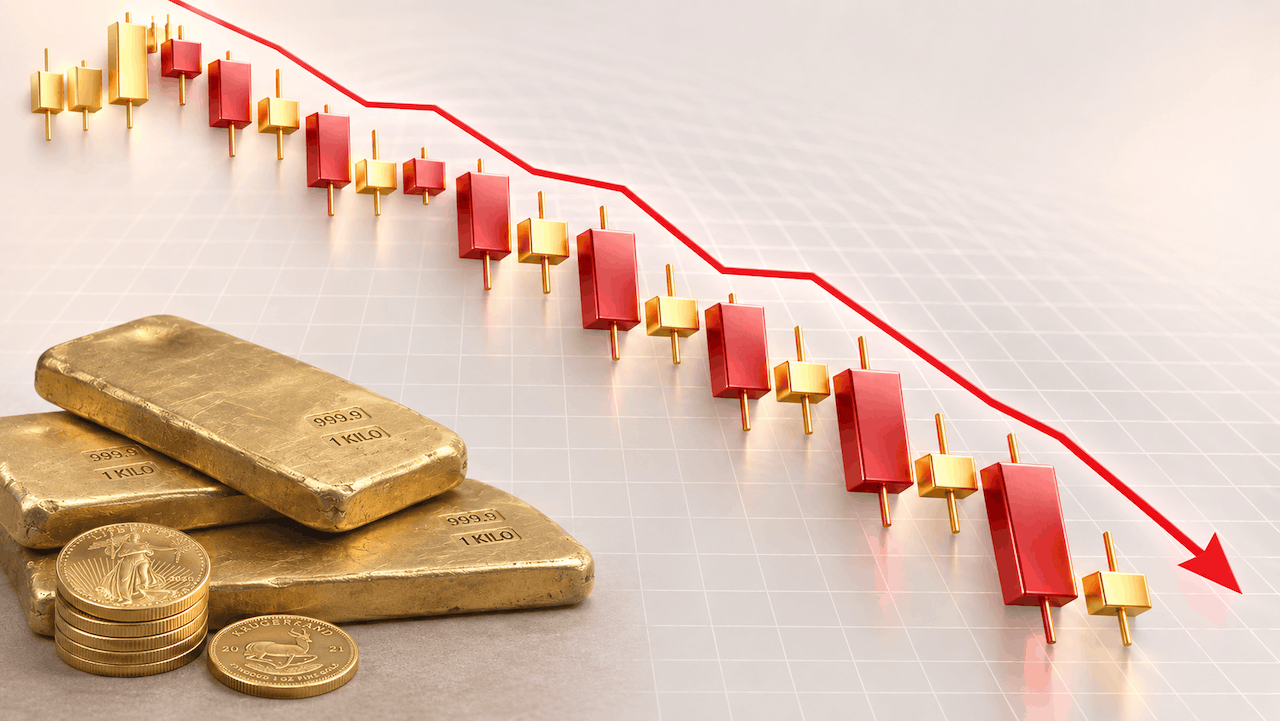
On Friday, spot gold tumbled 3.5 percent, crashing through $4,000 support, and falling as low as $3,880. It was the lowest gold price in 12 months.
What Sparked Friday’s Big Selloff?
Some of the usual suspects were in play. On Wednesday, the Federal Reserve wrapped up its meeting and delivered what was widely described as a “hawkish pause.” Bets that the central bank will hike in December increased to near certainty on the prediction markets.
This persistent anticipation of higher interest rates has created headwinds for gold and silver for months. Because precious metals are non-yielding assets, conventional wisdom holds that they don’t do as well in high-interest-rate environments.
Oil prices also spiked on Friday, adding fuel to the inflation fire. The oil shock stemming from the U.S. war with Iran has also been a constant headwind for gold.
However, the immediate catalyst for gold’s Friday selloff was most likely connected to the rout in tech stocks. The NASDAQ dipped 2.9 percent on Friday as poor earnings and growing concerns about excessive AI spending and debt sparked bearishness in the sector.
The tech selloff also dragged down the S&P 500, which fell by 1.8 percent.
Gold prices often fall in tandem with stocks during sharp corrections and in the early stages of a bear market, as investors liquidate winning gold positions to cover losses.
Here’s how an analyst explained it to Bloomberg after a big stock selloff in August 2024:
“Virtually every time there is marked equities weakness, investors who hold gold as a risk hedge will liquidate part of their holdings to raise liquidity against any potential margin calls. When the dust settles, they almost invariably buy it back.”
On Friday, a Commerzbank analyst told Reuters, “Friday’s sharp fall in technology stocks may have led to forced selling of safe-haven assets, such as gold, and margin calls.”
Margin calls are a big problem for investors during a sharp stock market downturn.
When an account falls below a certain threshold, brokers demand additional deposits of money or securities to bring the account balance up to a required minimum level.
Given gold’s liquidity, investors can quickly sell and raise cash to cover margin calls.
We saw this pattern during big stock market swoons. In 2020, gold dropped by 3 percent multiple times in the early days of the pandemic selloff. In October 2008, gold plunged by more than 7 percent in the early days of the financial crisis.
Liquidity selling is generally short-lived, and gold typically rebounds after as the crisis passes and investors rebuild their gold positions.
In fact, gold is up over $80 as I write this article Monday morning.
The Fed’s Path Isn’t As Cut and Dry as Advertised
Virtually everybody is convinced the Fed will keep interest rates higher for longer. This notion has persistently pulled gold down. However, the Fed’s trajectory isn’t as cut and dry as the mainstream imagines.
Nevertheless, inflation concerns will likely create headwinds for the gold and silver market until one of two things happens:
- The Iran war winds down and oil prices ease.
- The economy swerves into a ditch and forces the Federal Reserve to capitulate in its inflation fight.
Keep in mind, the central bank is between a rock and a hard place.
Yes, it needs to hike rates to control price inflation that has remained above the mythical 2 percent target for 67 consecutive months. It never hiked aggressively enough to rein in pandemic-era monetary inflation. In fact, it never normalized monetary policy after the Great Recession.
However, the central bank is operating in an economy dominated by a Debt Black Hole.
Debt-riddled economies don’t function well in a high-interest-rate environment.
This is the Catch-22 the central bank has faced for months, and there’s still no easy way out. It needs to cut rates to support the debt bubble. And it needs to raise rates to slay price inflation. It can’t do both.
If history is any indication, when push comes to shove, the Fed will ultimately choose more easy money despite elevated inflation to support the markets and the broader economy.
This is bullish for gold in the long term.
However, we can expect downward price pressure in the near term, especially as the price drops below technical support levels.
Mike Maharrey is a journalist and market analyst for Money Metals with over a decade of experience in precious metals. He holds a BS in accounting from the University of Kentucky and a BA in journalism from the University of South Florida.